
Segment Relationships in Circles
Segment relationships in circles are three product rules for the lengths of chords, secants and tangents. When two chords cross, the products of their parts are equal. For two secants from one point, outside part times whole is equal. For a tangent and a secant, the tangent squared equals outside part times whole.
Before this lesson: You should know Tangents to a Circle, Angle Relationships in Circles and Solving Quadratic Equations by Factoring.
The Three Segment Rules
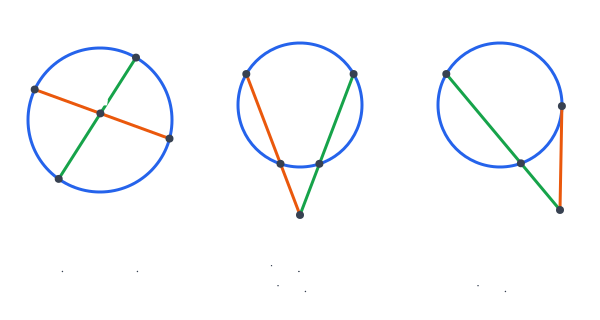
A secant segment runs from an outside point P through the circle to the far side. Its external segment is the part outside the circle, from P to the first point it touches. The whole secant is the external segment plus the part inside the circle (a chord).
| Situation | Rule | Memory phrase |
|---|---|---|
| Two chords cross inside the circle | a \cdot b = c \cdot d | part times part |
| Two secants from the same outside point | e_1 \cdot w_1 = e_2 \cdot w_2 | outside times whole |
| A tangent and a secant from the same outside point | t^2 = e \cdot w | tangent squared equals outside times whole |
In the table, e stands for an external segment, w for a whole secant and t for a tangent segment. These rules are also called the intersecting chords theorem, the secant-secant theorem and the secant-tangent theorem.
Why the Rules Work
Each rule comes from similar triangles. For two chords AB and CD crossing at E, draw chords AC and BD. Angles A and D are inscribed angles that intercept the same arc, so they are congruent (see inscribed angles). The vertical angles at E are also congruent. So the two triangles are similar by AA similarity, and their sides are proportional:
\frac{AE}{DE} = \frac{CE}{BE} \quad \text{so} \quad AE \cdot BE = CE \cdot DEThe secant rules use the same idea with triangles that share the angle at P.
How to Use the Segment Rules
- Decide where the segments meet: inside the circle or outside.
- Inside: multiply the two parts of each chord and set the products equal.
- Outside: for each segment, multiply the outside part by the whole. A tangent is its own outside part and whole, so use t^2.
- Write the whole secant as outside part plus inside part.
- Solve the equation. Ignore negative answers, since lengths are positive.
Worked Examples
Example 1: Two chords
Chords AB and CD cross at E. AE = 4, EB = 9, CE = 6 and ED = x. Find x.
- Write the chord rule: AE \cdot EB = CE \cdot ED
- Substitute: 4 \cdot 9 = 6x
- Multiply: 36 = 6x
- Divide both sides by 6: x = 6
Answer: x = 6
Example 2: Chords with a quadratic
Two chords cross. One chord has parts x and x + 5. The other has parts 6 and 4. Find x.
- Write the chord rule: x(x + 5) = 6 \cdot 4
- Multiply on the right: x(x + 5) = 24
- Use the distributive property: x^2 + 5x = 24
- Subtract 24 from both sides: x^2 + 5x - 24 = 0
- Factor (see factoring trinomials): (x + 8)(x - 3) = 0
- Set each factor equal to zero: x + 8 = 0 or x - 3 = 0
- Solve each equation: x = -8 or x = 3
- A length can’t be negative, so x = 3
- Check: 3 \cdot 8 = 24 and 6 \cdot 4 = 24
Answer: x = 3
Example 3: Two secants
Two secants come from point P. The first has an external segment of 5 and an internal part of 7. The second has an external segment of 6 and an internal part of x. Find x.
- Find the first whole secant: 5 + 7 = 12
- Write the second whole secant: 6 + x
- Write the secant rule: 5 \cdot 12 = 6(6 + x)
- Multiply on the left: 60 = 6(6 + x)
- Use the distributive property: 60 = 36 + 6x
- Subtract 36 from both sides: 24 = 6x
- Divide both sides by 6: x = 4
Answer: x = 4. Check: 6 \cdot 10 = 60.
Example 4: A tangent and a secant
From point P, a tangent segment has length x. A secant from P has an external segment of 4 and an internal part of 12. Find x.
- Find the whole secant: 4 + 12 = 16
- Write the tangent rule: x^2 = 4 \cdot 16
- Multiply: x^2 = 64
- Take the positive square root: x = 8
Answer: The tangent is 8 units long.
Example 5: Word problem with a broken plate
A piece of a round plate is found. A straight edge across it makes a chord 24 cm long. From the midpoint of that chord, the curved edge is 6 cm away, measured at a right angle to the chord. What was the radius of the plate?
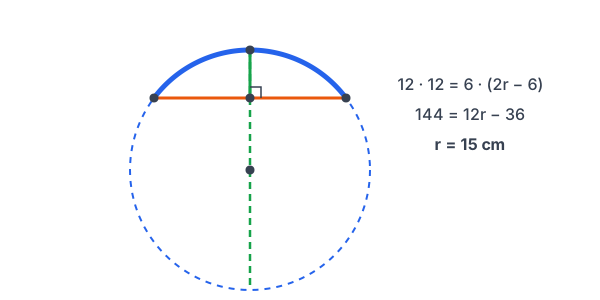
- The perpendicular from the midpoint of a chord passes through the center (see perpendicular and angle bisectors). So it lies on a diameter, which is a second chord.
- The diameter crosses the chord at M. The chord’s parts are 12 and 12. The diameter’s parts are 6 and 2r - 6.
- Write the chord rule: 12 \cdot 12 = 6(2r - 6)
- Multiply on the left: 144 = 6(2r - 6)
- Use the distributive property: 144 = 12r - 36
- Add 36 to both sides: 180 = 12r
- Divide both sides by 12: r = 15
Answer: The plate had a radius of 15 cm.
Common Mistakes
| Mistake | Example of the error | Fix |
|---|---|---|
| Using the inside part instead of the whole secant | 5 \cdot 7 = 6x | Multiply the outside part by the whole: 5 \cdot 12 = 6(6 + x). |
| Using outside times whole for chords | 4(4 + 9) = 6(6 + x) | For chords that cross inside, multiply the two parts: 4 \cdot 9 = 6x. |
| Forgetting to square the tangent | x = 4 \cdot 16 = 64 | The tangent rule is x^2 = 4 \cdot 16, so x = 8. |
| Keeping a negative answer | x = -8 | Lengths are positive. Keep x = 3. |
| Distributing to only one term | 6(6 + x) = 36 + x | Multiply both terms: 36 + 6x. |
Practice Problems
- Chords cross at E. One chord has parts 3 and 8. The other has parts 4 and x. Find x.
- Chords cross at E. One chord has parts 5 and x. The other has parts 10 and 6. Find x.
- Chords cross. One has parts x and x + 2. The other has parts 4 and 6. Find x.
- Two secants come from P. The first has an external segment of 4 and a whole length of 10. The second has an external segment of 5 and an internal part of x. Find x.
- Two secants come from P. The first has an external segment of 3 and an internal part of x. The second has an external segment of 4 and an internal part of 5. Find x.
- A tangent from P is 6 units long. A secant from P has an external segment of 3 and an internal part of x. Find x.
- A tangent from P is x units long. A secant from P has an external segment of 5 and an internal part of 15. Find x.
- A tangent from P is 12 units long. A secant from P has an external segment of x and an internal part of 18. Find x.
- A stone arch is part of a circle. It is 40 ft wide at the base and 10 ft tall in the middle. Find the radius of the circle.
- A circular pond has a diameter of 10 m. A lamp post stands 8 m from the nearest edge of the pond, on a line through the center. A path from the lamp post is tangent to the pond. How long is the path from the lamp post to the point of tangency?
Show answers
- Write the chord rule: 3 \cdot 8 = 4x
Multiply: 24 = 4x
Divide both sides by 4: x = 6 - Write the chord rule: 5x = 10 \cdot 6
Multiply: 5x = 60
Divide both sides by 5: x = 12 - Write the chord rule: x(x + 2) = 4 \cdot 6
Multiply on the right: x(x + 2) = 24
Distribute: x^2 + 2x = 24
Subtract 24 from both sides: x^2 + 2x - 24 = 0
Factor: (x + 6)(x - 4) = 0
Solve each factor: x = -6 or x = 4
A length is positive, so x = 4 - Write the secant rule: 4 \cdot 10 = 5(5 + x)
Multiply on the left: 40 = 5(5 + x)
Distribute: 40 = 25 + 5x
Subtract 25 from both sides: 15 = 5x
Divide both sides by 5: x = 3 - Find the second whole secant: 4 + 5 = 9
Write the secant rule: 3(3 + x) = 4 \cdot 9
Multiply on the right: 3(3 + x) = 36
Distribute: 9 + 3x = 36
Subtract 9 from both sides: 3x = 27
Divide both sides by 3: x = 9 - Write the tangent rule: 6^2 = 3(3 + x)
Square 6: 36 = 3(3 + x)
Distribute: 36 = 9 + 3x
Subtract 9 from both sides: 27 = 3x
Divide both sides by 3: x = 9 - Find the whole secant: 5 + 15 = 20
Write the tangent rule: x^2 = 5 \cdot 20
Multiply: x^2 = 100
Take the positive square root: x = 10 - Write the whole secant: x + 18
Write the tangent rule: 12^2 = x(x + 18)
Square 12: 144 = x(x + 18)
Distribute: 144 = x^2 + 18x
Subtract 144 from both sides: 0 = x^2 + 18x - 144
Factor: 0 = (x + 24)(x - 6)
Solve each factor: x = -24 or x = 6
A length is positive, so x = 6 - The center line of the arch is part of a diameter that crosses the base chord at its midpoint. The base parts are 20 and 20, and the diameter’s parts are 10 and 2r - 10.
Write the chord rule: 20 \cdot 20 = 10(2r - 10)
Multiply on the left: 400 = 10(2r - 10)
Distribute: 400 = 20r - 100
Add 100 to both sides: 500 = 20r
Divide both sides by 20: r = 25 ft - The line through the center is a secant. Its external segment is 8 and its internal part is the diameter, 10. Find the whole secant: 8 + 10 = 18
Write the tangent rule: t^2 = 8 \cdot 18
Multiply: t^2 = 144
Take the positive square root: t = 12 m
FAQ
What is the intersecting chords theorem?
When two chords cross inside a circle, the product of the two parts of one chord equals the product of the two parts of the other. For example, 4 \cdot 9 = 6 \cdot 6.
What is the secant-tangent theorem?
If a tangent and a secant come from the same outside point, the tangent squared equals the external segment times the whole secant.
What is the difference between the chord rule and the secant rule?
Chords that cross inside the circle use part times part. Segments that meet outside the circle use outside part times whole segment.
Why can a negative answer appear?
The equation is often a quadratic, which can have a negative solution. Lengths must be positive, so you keep only the positive answer.
Summary
- Chords crossing inside a circle: part times part equals part times part.
- Two secants from one outside point: outside times whole equals outside times whole.
- A tangent and a secant from one outside point: tangent squared equals outside times whole.
- The whole secant is the external segment plus the internal part.
- These rules come from similar triangles. Keep only positive lengths.
Previous lesson: Angle Relationships in Circles
Next lesson: Arc Length
Back to the Geometry Index