
Tangents to a Circle
A tangent to a circle is a line that touches the circle at exactly one point. Two theorems make tangents useful. A tangent is perpendicular to the radius at the point of tangency. And two tangent segments drawn from the same outside point are congruent.
Before this lesson: You should know the Parts of a Circle, the Pythagorean Theorem and the Converse of the Pythagorean Theorem.
What Is a Tangent?
A tangent is a line in the same plane as a circle that meets the circle at exactly one point. That point is the point of tangency. A tangent segment is the part of a tangent from an outside point to the point of tangency.
Picture a wheel resting on flat ground. The ground touches the wheel at one point and does not cut into it. The ground is tangent to the wheel.
The Tangent Theorems
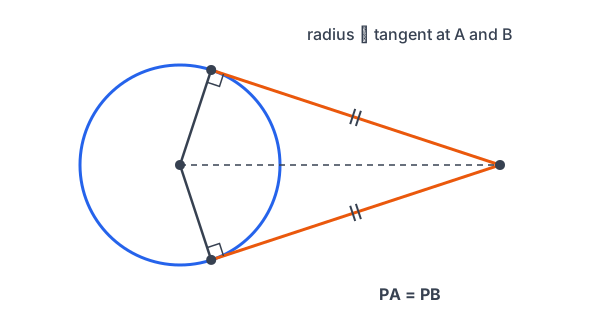
Tangent-radius theorem: A tangent is perpendicular to the radius drawn to the point of tangency.
\overline{OA} \perp \overleftrightarrow{PA}Converse: If a line is perpendicular to a radius at its endpoint on the circle, the line is tangent to the circle. You can test a line this way. If the radius, the line and a segment to the center form a right triangle, the line is tangent.
Two tangent theorem: If two tangent segments are drawn to a circle from the same outside point, they are congruent.
PA = PB
A memory picture for the second theorem is an ice cream cone. The two sides of the cone touch the scoop, and they are the same length.
Why the Theorems Are True
Why is the tangent perpendicular to the radius? The radius is the shortest segment from O to the tangent line. Every other point on the tangent is outside the circle, so it is farther from O. The shortest segment from a point to a line is the perpendicular one (see proofs with perpendicular lines).
Why are the two tangent segments congruent? Draw \overline{OP}. Triangles OAP and OBP are right triangles. Their hypotenuses are the same segment, OP. Their legs OA and OB are radii, so they are congruent. So the triangles are congruent by HL congruence, and PA = PB by CPCTC. You will finish this proof in practice problem 10.
How to Solve Tangent Problems
- Draw the radius to each point of tangency. Mark the right angle.
- Draw the segment from the center to the outside point. It is the hypotenuse.
- Use the Pythagorean theorem to find a missing length.
- If two tangent segments come from one point, set their lengths equal.
Worked Examples
Example 1: Is the line tangent?
Circle O has radius OA = 5. Point P is outside the circle, with PA = 12 and OP = 13. Is \overleftrightarrow{PA} tangent to the circle at A?
- The line is tangent only if \angle OAP is a right angle. Test with the converse of the Pythagorean theorem: is 5^2 + 12^2 = 13^2?
- Square the legs: 25 + 144
- Add: 169
- Square the longest side: 13^2 = 169
- Compare: 169 = 169, so the triangle is a right triangle with the right angle at A.
Answer: Yes. \overline{OA} \perp \overleftrightarrow{PA}, so the line is tangent at A.
Example 2: Find the length of a tangent segment
\overline{PA} is tangent to circle O at A. The radius is 8 and OP = 17. Find PA.
- The radius is perpendicular to the tangent, so triangle OAP is a right triangle with hypotenuse OP: 8^2 + PA^2 = 17^2
- Square the numbers: 64 + PA^2 = 289
- Subtract 64 from both sides: PA^2 = 225
- Take the positive square root: PA = 15
Answer: PA = 15
Example 3: Two tangent segments
\overline{PA} and \overline{PB} are tangent to a circle at A and B. PA = 3x + 4 and PB = 5x - 6. Find x and PA.
- Tangent segments from the same point are congruent: 3x + 4 = 5x - 6
- Subtract 3x from both sides (see equations with variables on both sides): 4 = 2x - 6
- Add 6 to both sides: 10 = 2x
- Divide both sides by 2: x = 5
- Substitute to find PA: 3(5) + 4
- Multiply, then add: 15 + 4 = 19
- Check PB: 5(5) - 6 = 25 - 6 = 19
Answer: x = 5 and PA = 19.
Example 4: Find the radius
\overline{PA} is tangent to circle O at A, and PA = 24. The shortest distance from P to the circle is 16, so OP = r + 16. Find the radius r.
- Write the Pythagorean theorem for right triangle OAP: r^2 + 24^2 = (r + 16)^2
- Square 24: r^2 + 576 = (r + 16)^2
- Square the binomial (see special products of binomials): r^2 + 576 = r^2 + 32r + 256
- Subtract r^2 from both sides: 576 = 32r + 256
- Subtract 256 from both sides: 320 = 32r
- Divide both sides by 32: r = 10
- Check: 10^2 + 24^2 = 100 + 576 = 676 = 26^2, and 10 + 16 = 26
Answer: The radius is 10.
Example 5: Word problem with a pond
A circular pond has a radius of 9 m. You stand 41 m from the center of the pond. Your line of sight just touches the edge of the pond at point T. How far is it from you to T?
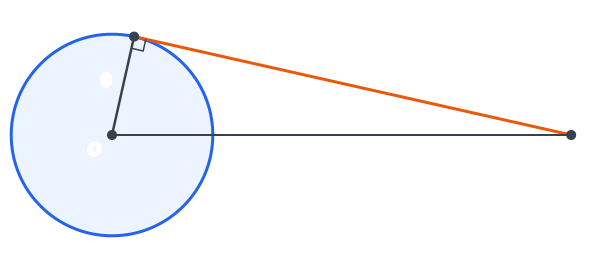
- The line of sight is a tangent, so it is perpendicular to radius OT. Write the Pythagorean theorem: 9^2 + PT^2 = 41^2
- Square the numbers: 81 + PT^2 = 1681
- Subtract 81 from both sides: PT^2 = 1600
- Take the positive square root: PT = 40
Answer: It is 40 m from you to the point T.
Common Mistakes
| Mistake | Example of the error | Fix |
|---|---|---|
| Using the tangent segment as the hypotenuse | 8^2 + 17^2 = PA^2 | The segment to the center is the hypotenuse: 8^2 + PA^2 = 17^2. |
| Forgetting the radius in OP | Using OP = 16 when the outside distance to the circle is 16 | OP goes all the way to the center: OP = r + 16. |
| Squaring a binomial term by term | (r + 16)^2 = r^2 + 256 | Include the middle term: r^2 + 32r + 256. |
| Assuming a line is tangent because it looks like it | Calling a line tangent without checking | Show the right angle with the converse of the Pythagorean theorem. |
| Setting tangent segments from different points equal | Setting PA equal to a tangent from another point Q | Only segments from the same outside point are congruent. |
Related Idea: Circles Inside Polygons
When a circle is tangent to every side of a polygon, the circle is inscribed in the polygon. The inscribed circle of a triangle is centered at the incenter (see circumcenter and incenter). Each vertex has two tangent segments, and they are equal. So if the three pairs are 4, 6 and 7, the triangle’s perimeter is 2(4 + 6 + 7) = 34.
With two tangents from P, the angle at P and the central angle AOB are supplementary. Quadrilateral OAPB has two right angles, and its angles add to 360° (see interior and exterior angles of polygons).
Practice Problems
- Circle O has radius 6. Point P has PA = 8 and OP = 10, where A is on the circle. Is \overleftrightarrow{PA} tangent at A?
- Circle O has radius 7. Point P has PA = 20 and OP = 21. Is \overleftrightarrow{PA} tangent at A?
- \overline{PA} is tangent to circle O at A. The radius is 12 and OP = 13. Find PA.
- \overline{PA} is tangent to circle O at A. The radius is 9 and OP = 15. Find PA.
- Two tangent segments from P are 2x + 9 and 4x - 5. Find x and the length of each segment.
- \overline{PA} is tangent to circle O at A, and PA = 12. The shortest distance from P to the circle is 8. Find the radius.
- A triangle is circumscribed about a circle. The tangent segments from the three vertices are 4, 6 and 7. Find the perimeter of the triangle.
- Two tangents from P touch circle O at A and B. If m\angle APB = 50^\circ, find m\angle AOB.
- A plane flies 6 mi above Earth. Earth’s radius is about 3,960 mi. About how far is it from the plane to the horizon? Round to the nearest tenth of a mile.
- Complete the proof. Given: \overline{PA} and \overline{PB} are tangent to circle O at A and B. Prove: \overline{PA} \cong \overline{PB}.
| Statement | Reason |
|---|---|
| 1. \overline{PA} and \overline{PB} are tangent to circle O at A and B | Given |
| 2. \overline{OA} \perp \overline{PA} and \overline{OB} \perp \overline{PB} | ? |
| 3. △OAP and △OBP are right triangles | ? |
| 4. \overline{OA} \cong \overline{OB} | ? |
| 5. \overline{OP} \cong \overline{OP} | ? |
| 6. \triangle OAP \cong \triangle OBP | ? |
| 7. \overline{PA} \cong \overline{PB} | ? |
Show answers
- Test the converse of the Pythagorean theorem: is 6^2 + 8^2 = 10^2?
Square the legs: 36 + 64
Add: 100
Square 10: 10^2 = 100
They are equal, so the angle at A is a right angle. Yes, the line is tangent. - Test: is 7^2 + 20^2 = 21^2?
Square the legs: 49 + 400
Add: 449
Square 21: 21^2 = 441
449 \ne 441, so the angle at A is not a right angle. No, the line is not tangent. - Write the Pythagorean theorem: 12^2 + PA^2 = 13^2
Square the numbers: 144 + PA^2 = 169
Subtract 144 from both sides: PA^2 = 25
Take the positive square root: PA = 5 - Write the Pythagorean theorem: 9^2 + PA^2 = 15^2
Square the numbers: 81 + PA^2 = 225
Subtract 81 from both sides: PA^2 = 144
Take the positive square root: PA = 12 - Set the segments equal: 2x + 9 = 4x - 5
Subtract 2x from both sides: 9 = 2x - 5
Add 5 to both sides: 14 = 2x
Divide both sides by 2: x = 7
Substitute: 2(7) + 9 = 14 + 9 = 23
Check: 4(7) - 5 = 28 - 5 = 23. Each segment is 23. - Write the Pythagorean theorem with OP = r + 8: r^2 + 12^2 = (r + 8)^2
Square 12: r^2 + 144 = (r + 8)^2
Square the binomial: r^2 + 144 = r^2 + 16r + 64
Subtract r^2 from both sides: 144 = 16r + 64
Subtract 64 from both sides: 80 = 16r
Divide both sides by 16: r = 5 - Each vertex has two equal tangent segments, so each length appears twice: P = 2(4 + 6 + 7)
Add inside the parentheses: P = 2(17)
Multiply: P = 34 - Angles OAP and OBP are right angles. The angles of quadrilateral OAPB add to 360°: m\angle AOB + 90^\circ + 90^\circ + 50^\circ = 360^\circ
Add the known angles: m\angle AOB + 230^\circ = 360^\circ
Subtract 230° from both sides: m\angle AOB = 130^\circ - The line of sight to the horizon is tangent to Earth. The distance from the plane to the center is 3960 + 6 = 3966 mi. Write the Pythagorean theorem: 3960^2 + d^2 = 3966^2
Subtract 3960^2 from both sides: d^2 = 3966^2 - 3960^2
Use a calculator: d^2 = 47{,}556
Take the positive square root: d \approx 218.1 mi - 2. A tangent is perpendicular to the radius at the point of tangency
3. Definition of a right triangle (perpendicular lines form right angles)
4. All radii of a circle are congruent
5. Reflexive property of congruence
6. HL congruence
7. CPCTC
FAQ
Is a tangent always perpendicular to the radius?
Yes, at the point of tangency. The radius drawn to the point where the tangent touches the circle meets the tangent at a 90° angle.
How many tangents can you draw to a circle from an outside point?
Exactly two. The two tangent segments from that point to the circle are the same length.
How do you prove a line is tangent to a circle?
Show that the line is perpendicular to a radius at the point where they meet. With side lengths, use the converse of the Pythagorean theorem to show the triangle has a right angle.
What is the difference between a tangent and a secant?
A tangent touches a circle at exactly one point. A secant crosses the circle at two points.
Summary
- A tangent touches a circle at exactly one point, the point of tangency.
- A tangent is perpendicular to the radius at the point of tangency, and the converse is also true.
- Two tangent segments from the same outside point are congruent.
- Draw the radius and the segment to the center to make a right triangle, then use the Pythagorean theorem.
Previous lesson: Parts of a Circle
Next lesson: Arcs and Central Angles
Back to the Geometry Index