
Arcs and Central Angles
A central angle is an angle whose vertex is the center of a circle. The arc inside a central angle has the same measure as the angle. Arcs and central angles let you measure parts of a circle in degrees, where the whole circle is 360°.
Before this lesson: You should know the Parts of a Circle, Measuring and Classifying Angles and the Segment Addition Postulate.
Central Angles and Arcs
An arc is a part of a circle between two points. A central angle has its vertex at the center, and its sides are radii. The arc between the two radii is the arc the angle intercepts.
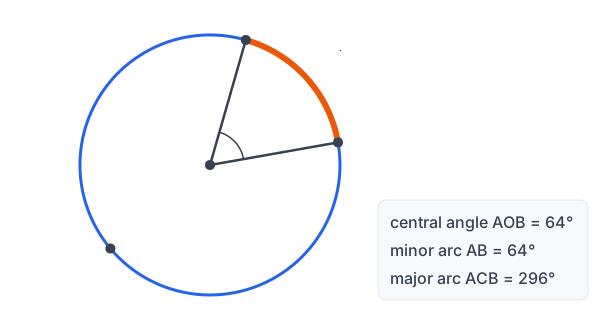
A full circle is 360°. Each central angle cuts the circle into two arcs.
| Type of arc | Measure | How to name it |
|---|---|---|
| Minor arc | Less than 180°, equal to its central angle | Two letters: \overset{\frown}{AB} |
| Major arc | More than 180°: 360° minus the minor arc | Three letters: \overset{\frown}{ACB} |
| Semicircle | Exactly 180°, cut off by a diameter | Three letters |
The middle letter in a three-letter name is any point on the arc. It tells you which way around the circle to go. Write the measure of an arc as m\overset{\frown}{AB}.
The Arc Rules
Central angle rule: The measure of a minor arc equals the measure of its central angle.
m\overset{\frown}{AB} = m\angle AOBMajor arc rule: A major arc and its minor arc add to 360°.
m\overset{\frown}{ACB} = 360^\circ - m\overset{\frown}{AB}Arc Addition Postulate: The measure of an arc made of two arcs that share only an endpoint is the sum of the two arcs. It works like the segment addition postulate.
m\overset{\frown}{ABC} = m\overset{\frown}{AB} + m\overset{\frown}{BC}Congruent arcs and chords: In the same circle, or in congruent circles, two arcs are congruent when their central angles are congruent. Congruent arcs also have congruent chords, and the reverse is true.
How to Find Arc Measures
- Find the central angle that intercepts the arc. A minor arc has the same measure.
- For a major arc, subtract the minor arc from 360°.
- For an arc made of smaller arcs, add them.
- If angles around the center are given as expressions, set their sum equal to 360° (whole circle) or 180° (semicircle), then solve.
Worked Examples
Example 1: Minor and major arcs
In circle O, m\angle AOB = 64^\circ. Find m\overset{\frown}{AB} and m\overset{\frown}{ACB}.
- A minor arc equals its central angle: m\overset{\frown}{AB} = 64^\circ
- Write the major arc rule: m\overset{\frown}{ACB} = 360^\circ - 64^\circ
- Subtract: m\overset{\frown}{ACB} = 296^\circ
Answer: m\overset{\frown}{AB} = 64^\circ and m\overset{\frown}{ACB} = 296^\circ
Example 2: Arc Addition Postulate
Points A, B and C are on circle O, with B between A and C. m\overset{\frown}{AB} = 70^\circ and m\overset{\frown}{BC} = 45^\circ. Find m\overset{\frown}{ABC}.
- Write the Arc Addition Postulate: m\overset{\frown}{ABC} = m\overset{\frown}{AB} + m\overset{\frown}{BC}
- Substitute: m\overset{\frown}{ABC} = 70^\circ + 45^\circ
- Add: m\overset{\frown}{ABC} = 115^\circ
Answer: m\overset{\frown}{ABC} = 115^\circ
Example 3: Central angles on a diameter
\overline{AD} is a diameter of circle O. Points B and C are on the same side of the diameter. m\angle AOB = 3x + 10, m\angle BOC = 5x and m\angle COD = 2x + 20. Find each angle.
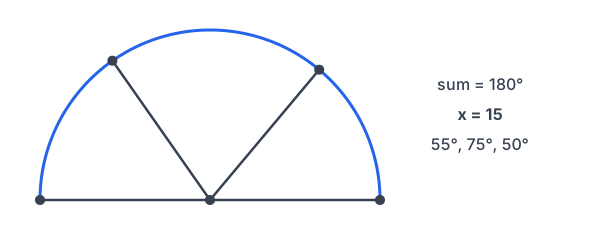
- The three angles make a straight angle at O, so they add to 180°: (3x + 10) + 5x + (2x + 20) = 180
- Combine like terms (see combining like terms): 10x + 30 = 180
- Subtract 30 from both sides: 10x = 150
- Divide both sides by 10: x = 15
- Find m\angle AOB: 3(15) + 10 = 45 + 10 = 55^\circ
- Find m\angle BOC: 5(15) = 75^\circ
- Find m\angle COD: 2(15) + 20 = 30 + 20 = 50^\circ
- Check: 55 + 75 + 50 = 180
Answer: The angles are 55°, 75° and 50°. So m\overset{\frown}{AB} = 55^\circ, m\overset{\frown}{BC} = 75^\circ and m\overset{\frown}{CD} = 50^\circ.
Example 4: Word problem with a pie chart
In a survey, 40% of students chose pizza as their favorite lunch. What central angle should the pizza slice of a pie chart have?
- The whole circle is 360°, and the slice is 40% of it: 0.40 \times 360^\circ
- Multiply: 144^\circ
Answer: The pizza slice has a central angle of 144°, so its arc is 144°. Every pie chart works this way (see percentages).
Example 5: Word problem with a clock
At 4:00, what is the measure of the smaller arc between the hour hand and the minute hand? What is the larger arc?
- The 12 numbers split the circle into 12 equal arcs: 360^\circ \div 12 = 30^\circ
- At 4:00, the hands are 4 numbers apart: 4 \times 30^\circ = 120^\circ
- Find the larger arc: 360^\circ - 120^\circ = 240^\circ
Answer: The smaller arc is 120° and the larger arc is 240°.
Common Mistakes
| Mistake | Example of the error | Fix |
|---|---|---|
| Naming a major arc with two letters | Writing \overset{\frown}{AB} for the 296° arc | Use three letters for a major arc: \overset{\frown}{ACB}. |
| Subtracting from 180° for a major arc | 180^\circ - 64^\circ = 116^\circ | A whole circle is 360°: 360^\circ - 64^\circ = 296^\circ. |
| Adding arcs that overlap | Adding \overset{\frown}{AC} and \overset{\frown}{BD} when they share a piece | Only add arcs that meet at a single endpoint. |
| Thinking equal degrees means equal length | Saying a 60° arc on a big circle is as long as a 60° arc on a small circle | Arc measure is in degrees. Length depends on the radius (see arc length). |
| Using 360° for angles on a diameter | Setting angles on one side of a diameter equal to 360° | Angles on one side of a diameter add to 180°. |
Practice Problems
- In circle O, m\angle AOB = 38^\circ. Find m\overset{\frown}{AB} and the major arc m\overset{\frown}{ACB}.
- A major arc measures 250°. Find its minor arc and the central angle of the minor arc.
- Arcs \overset{\frown}{AB} and \overset{\frown}{BC} share only point B. m\overset{\frown}{AB} = 85^\circ and m\overset{\frown}{BC} = 120^\circ. Find m\overset{\frown}{ABC}.
- \overline{AC} is a diameter, and B is on the circle. m\overset{\frown}{AB} = 2x + 8 and m\overset{\frown}{BC} = 4x - 2. Find x and each arc.
- Four central angles fill a circle: 4x, 5x, 6x and 9x. Find each angle.
- In circle O, chord AB is congruent to chord CD, and m\overset{\frown}{AB} = 78^\circ. Find m\overset{\frown}{CD}.
- A pie chart shows that 25% of a budget is rent and 15% is food. Find the central angle for each slice.
- At 2:00, what is the smaller arc between the clock hands?
- A wheel has 36 spokes spaced evenly around the hub. What is the central angle between two spokes that are next to each other?
- Circle P is small and circle Q is large. Each has a 40° arc. Are the arcs congruent? Explain.
Show answers
- A minor arc equals its central angle: m\overset{\frown}{AB} = 38^\circ
Write the major arc rule: m\overset{\frown}{ACB} = 360^\circ - 38^\circ
Subtract: m\overset{\frown}{ACB} = 322^\circ - Subtract from 360°: 360^\circ - 250^\circ = 110^\circ
The minor arc is 110°, and its central angle is also 110°. - Write the Arc Addition Postulate: m\overset{\frown}{ABC} = 85^\circ + 120^\circ
Add: m\overset{\frown}{ABC} = 205^\circ - A diameter cuts off a semicircle, so the arcs add to 180°: (2x + 8) + (4x - 2) = 180
Combine like terms: 6x + 6 = 180
Subtract 6 from both sides: 6x = 174
Divide both sides by 6: x = 29
Find m\overset{\frown}{AB}: 2(29) + 8 = 58 + 8 = 66^\circ
Find m\overset{\frown}{BC}: 4(29) - 2 = 116 - 2 = 114^\circ
Check: 66 + 114 = 180 - The angles fill the circle: 4x + 5x + 6x + 9x = 360
Combine like terms: 24x = 360
Divide both sides by 24: x = 15
Multiply to find each angle: 4(15) = 60^\circ, 5(15) = 75^\circ, 6(15) = 90^\circ, 9(15) = 135^\circ
Check: 60 + 75 + 90 + 135 = 360 - Congruent chords in the same circle have congruent arcs: m\overset{\frown}{CD} = 78^\circ
- Rent: 0.25 \times 360^\circ = 90^\circ
Food: 0.15 \times 360^\circ = 54^\circ - Each hour mark is 360^\circ \div 12 = 30^\circ
The hands are 2 marks apart: 2 \times 30^\circ = 60^\circ - Divide the circle into 36 equal angles: 360^\circ \div 36 = 10^\circ
- No. Both arcs measure 40°, but congruent arcs must be in the same circle or in congruent circles. The arc on the larger circle is longer.
FAQ
Is the arc measure equal to the central angle?
Yes. A minor arc has the same degree measure as the central angle that intercepts it. A major arc is 360° minus that angle.
What is the difference between a minor arc and a major arc?
A minor arc is less than 180° and is named with two letters. A major arc is more than 180° and is named with three letters.
What is the Arc Addition Postulate?
If two arcs share only an endpoint, the measure of the arc they form together is the sum of their measures. For example, 70° + 45° = 115°.
How many degrees are in a semicircle?
A semicircle is half of a circle, so it measures 180°. A diameter cuts a circle into two semicircles.
Summary
- A central angle has its vertex at the center of the circle.
- A minor arc equals its central angle. A major arc is 360° minus the minor arc. A semicircle is 180°.
- Name minor arcs with two letters and major arcs and semicircles with three letters.
- Arc Addition Postulate: add arcs that share only an endpoint.
- In the same or congruent circles, congruent central angles give congruent arcs and congruent chords.
Previous lesson: Tangents to a Circle
Next lesson: Inscribed Angles
Back to the Geometry Index