
Inscribed Angles
An inscribed angle is an angle whose vertex is on a circle and whose sides are chords. The Inscribed Angle Theorem says an inscribed angle is half of the arc it intercepts. So an inscribed angle is always half of the central angle that cuts off the same arc.
Before this lesson: You should know Arcs and Central Angles, the Triangle Angle Sum Theorem and Isosceles and Equilateral Triangles.
What Is an Inscribed Angle?
An inscribed angle has its vertex on the circle, and its sides are chords. The arc that lies inside the angle is its intercepted arc. Compare this with a central angle, which has its vertex at the center.
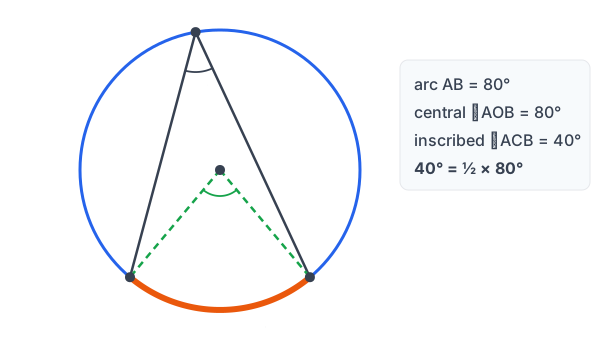
In the diagram, the central angle and the inscribed angle cut off the same arc. The central angle is 80°, but the inscribed angle is only 40°. The vertex is farther away, so the angle opens less.
The Inscribed Angle Theorem and Its Results
Inscribed Angle Theorem: The measure of an inscribed angle is half the measure of its intercepted arc.
m\angle ACB = \tfrac{1}{2}\, m\overset{\frown}{AB} \qquad m\overset{\frown}{AB} = 2\, m\angle ACBThree results follow from it.
- Same arc, same angle: Two inscribed angles that intercept the same arc are congruent.
- Angle in a semicircle: An inscribed angle that intercepts a semicircle is a right angle. So a triangle inscribed in a circle with one side as a diameter is a right triangle.
- Inscribed quadrilateral: If a quadrilateral is inscribed in a circle, its opposite angles are supplementary. They add to 180°.
Why the quadrilateral rule works: opposite angles intercept two arcs that together make the whole circle, 360°. Half of 360° is 180°.
How to Use Inscribed Angles
- Find the vertex. If it is on the circle and the sides are chords, the angle is inscribed.
- Find the intercepted arc, the arc inside the angle.
- To find the angle, take half the arc. To find the arc, double the angle.
- Look for a diameter (right angle) or an inscribed quadrilateral (opposite angles add to 180°).
- If the measures are expressions, write an equation and solve it.
Worked Examples
Example 1: Find the inscribed angle
An inscribed angle intercepts an arc of 110°. Find the angle.
- Write the theorem: m\angle = \tfrac{1}{2}(110^\circ)
- Multiply: m\angle = 55^\circ
Answer: 55°
Example 2: Find the intercepted arc
Inscribed angle PQR measures 38°. Find the arc it intercepts, m\overset{\frown}{PR}.
- The arc is twice the inscribed angle: m\overset{\frown}{PR} = 2(38^\circ)
- Multiply: m\overset{\frown}{PR} = 76^\circ
Answer: 76°
Example 3: A triangle in a semicircle
\overline{AB} is a diameter of circle O, and C is on the circle. m\angle A = 2x + 10 and m\angle B = 3x. Find x and both angles.
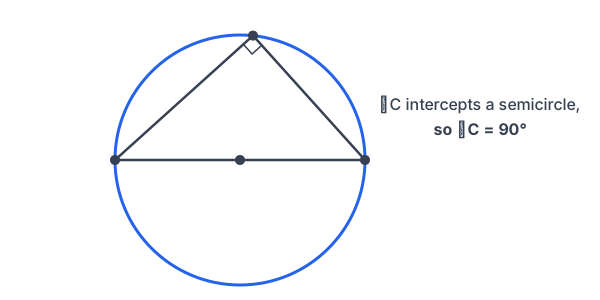
- Angle C intercepts a semicircle, so m\angle C = 90^\circ.
- The angles of a triangle add to 180°: (2x + 10) + 3x + 90 = 180
- Combine like terms: 5x + 100 = 180
- Subtract 100 from both sides: 5x = 80
- Divide both sides by 5: x = 16
- Find m\angle A: 2(16) + 10 = 32 + 10 = 42^\circ
- Find m\angle B: 3(16) = 48^\circ
- Check: 42 + 48 + 90 = 180
Answer: x = 16, m\angle A = 42^\circ and m\angle B = 48^\circ.
Example 4: An inscribed quadrilateral
Quadrilateral ABCD is inscribed in a circle. m\angle A = 3y + 5, m\angle C = 2y + 25 and m\angle B = 70^\circ. Find y, m\angle A, m\angle C and m\angle D.
- Angles A and C are opposite, so they are supplementary: (3y + 5) + (2y + 25) = 180
- Combine like terms (see combining like terms): 5y + 30 = 180
- Subtract 30 from both sides: 5y = 150
- Divide both sides by 5: y = 30
- Find m\angle A: 3(30) + 5 = 90 + 5 = 95^\circ
- Find m\angle C: 2(30) + 25 = 60 + 25 = 85^\circ
- Angles B and D are opposite: m\angle D = 180^\circ - 70^\circ
- Subtract: m\angle D = 110^\circ
Answer: y = 30, m\angle A = 95^\circ, m\angle C = 85^\circ and m\angle D = 110^\circ.
Example 5: Word problem with a circular arena
A stage sits on the edge of a circular arena. The two ends of the stage cut off an arc of 100° on the far side of the arena. Fans sit along the rest of the circle. At what angle does each fan see the stage?
- Each fan’s eyes are the vertex of an inscribed angle, and the stage’s ends are on the circle.
- Every one of these angles intercepts the same 100° arc: m\angle = \tfrac{1}{2}(100^\circ)
- Multiply: m\angle = 50^\circ
Answer: Every fan on the rest of the circle sees the stage at a 50° angle. Inscribed angles that intercept the same arc are congruent.
Common Mistakes
| Mistake | Example of the error | Fix |
|---|---|---|
| Using the whole arc as the angle | Arc 110°, so the inscribed angle is 110° | That is the central angle rule. An inscribed angle is half: 55°. |
| Halving when you should double | Angle 38°, so the arc is 19° | The arc is twice the angle: 76°. |
| Adding the wrong pair in a quadrilateral | Setting \angle A + \angle B = 180^\circ | Only opposite angles are supplementary: \angle A + \angle C = 180^\circ. |
| Missing the right angle | Not using 90° when one side is a diameter | An angle that intercepts a semicircle is 90°. |
| Picking the wrong arc | Using the arc outside the angle | The intercepted arc is the one inside the angle, between its sides. |
Why the Theorem Is True
Take the case where one side of the inscribed angle is a diameter. Let ∠ABC be inscribed, with \overline{BC} a diameter through center O. Draw radius \overline{OA}. Triangle OAB is isosceles, because OA and OB are radii. So its base angles are equal. The exterior angle ∠AOC equals the sum of those two base angles (see the triangle angle sum theorem). So ∠AOC is twice ∠ABC. Since ∠AOC equals the arc AC, ∠ABC is half the arc. Other cases split into two of these. Practice problem 10 walks through this proof.
Practice Problems
- An inscribed angle intercepts an arc of 84°. Find the angle.
- An inscribed angle measures 27°. Find its intercepted arc.
- Two inscribed angles intercept the same arc. One is 4x + 6 and the other is 6x - 10. Find x and the angle measure.
- \overline{AB} is a diameter, and C is on the circle. m\angle A = x + 15 and m\angle B = 2x. Find both angles.
- Quadrilateral ABCD is inscribed in a circle. m\angle A = 112^\circ, m\angle B = 5z - 5 and m\angle D = 3z + 25. Find m\angle C, z, m\angle B and m\angle D.
- In circle O, m\overset{\frown}{AB} = 130^\circ, and C is on the major arc. Find m\angle ACB and m\angle AOB.
- An inscribed angle intercepts a semicircle. What is its measure?
- Can a parallelogram that is not a rectangle be inscribed in a circle? Explain.
- Points A, B and C are on a circle. m\overset{\frown}{AB} = 100^\circ and m\overset{\frown}{BC} = 140^\circ, and the arcs do not overlap. Find m\overset{\frown}{CA} and the three angles of triangle ABC.
- Complete the proof. Given: ∠ABC is inscribed in circle O, and \overline{BC} is a diameter. Prove: m\angle ABC = \tfrac{1}{2}\, m\overset{\frown}{AC}.
| Statement | Reason |
|---|---|
| 1. Draw radius \overline{OA} | Two points determine a segment |
| 2. \overline{OA} \cong \overline{OB} | ? |
| 3. m\angle OAB = m\angle OBA | ? |
| 4. m\angle AOC = m\angle OAB + m\angle OBA | ? |
| 5. m\angle AOC = 2\, m\angle ABC | Substitution (∠OBA is ∠ABC) |
| 6. m\angle AOC = m\overset{\frown}{AC} | ? |
| 7. m\angle ABC = \tfrac{1}{2}\, m\overset{\frown}{AC} | ? |
Show answers
- Write the theorem: m\angle = \tfrac{1}{2}(84^\circ)
Multiply: m\angle = 42^\circ - Double the angle: 2(27^\circ)
Multiply: 54^\circ - Same arc, so the angles are congruent: 4x + 6 = 6x - 10
Subtract 4x from both sides: 6 = 2x - 10
Add 10 to both sides: 16 = 2x
Divide both sides by 2: x = 8
Substitute: 4(8) + 6 = 32 + 6 = 38^\circ
Check: 6(8) - 10 = 48 - 10 = 38^\circ - Angle C intercepts a semicircle, so it is 90°. The angles add to 180°: (x + 15) + 2x + 90 = 180
Combine like terms: 3x + 105 = 180
Subtract 105 from both sides: 3x = 75
Divide both sides by 3: x = 25
Find m\angle A: 25 + 15 = 40^\circ
Find m\angle B: 2(25) = 50^\circ - Opposite angles are supplementary: m\angle C = 180^\circ - 112^\circ = 68^\circ
B and D are opposite: (5z - 5) + (3z + 25) = 180
Combine like terms: 8z + 20 = 180
Subtract 20 from both sides: 8z = 160
Divide both sides by 8: z = 20
Find m\angle B: 5(20) - 5 = 100 - 5 = 95^\circ
Find m\angle D: 3(20) + 25 = 60 + 25 = 85^\circ - The inscribed angle is half the arc: m\angle ACB = \tfrac{1}{2}(130^\circ) = 65^\circ
The central angle equals the arc: m\angle AOB = 130^\circ - Half of a semicircle: \tfrac{1}{2}(180^\circ) = 90^\circ
- No. In a parallelogram, opposite angles are equal. In an inscribed quadrilateral, opposite angles add to 180°. Two equal angles that add to 180° are each 90°, so the parallelogram would have to be a rectangle.
- The three arcs fill the circle: m\overset{\frown}{CA} = 360^\circ - 100^\circ - 140^\circ
Subtract: m\overset{\frown}{CA} = 120^\circ
Angle C intercepts arc AB: \tfrac{1}{2}(100^\circ) = 50^\circ
Angle A intercepts arc BC: \tfrac{1}{2}(140^\circ) = 70^\circ
Angle B intercepts arc CA: \tfrac{1}{2}(120^\circ) = 60^\circ
Check: 50 + 70 + 60 = 180 - 2. All radii of a circle are congruent
3. Base angles of an isosceles triangle are congruent
4. Exterior angle theorem
6. A central angle equals its intercepted arc
7. Division property of equality (divide both sides of step 5 by 2, then substitute step 6)
FAQ
What is the inscribed angle theorem?
It says an inscribed angle is half of its intercepted arc. For example, an inscribed angle that cuts off a 110° arc measures 55°.
What is the difference between an inscribed angle and a central angle?
A central angle has its vertex at the center and equals its arc. An inscribed angle has its vertex on the circle and is half its arc.
Why is an angle inscribed in a semicircle a right angle?
A semicircle is 180°. An inscribed angle is half its arc, and half of 180° is 90°.
Are opposite angles of an inscribed quadrilateral supplementary?
Yes. Opposite angles intercept arcs that together make 360°, so the angles add to half of that, 180°.
Summary
- An inscribed angle has its vertex on the circle and chords as its sides.
- An inscribed angle is half its intercepted arc. The arc is twice the angle.
- Inscribed angles that intercept the same arc are congruent.
- An angle inscribed in a semicircle is a right angle.
- Opposite angles of an inscribed quadrilateral add to 180°.
Previous lesson: Arcs and Central Angles
Next lesson: Angle Relationships in Circles
Back to the Geometry Index