
Angle Relationships in Circles
Angle relationships in circles depend on where the vertex is. On the circle, the angle is half its arc. Inside the circle, it is half the sum of the two arcs. Outside the circle, it is half the difference of the far arc and the near arc.
Before this lesson: You should know Arcs and Central Angles, Inscribed Angles and Tangents to a Circle.
Three Places for the Vertex
Chords, secants and tangents can meet to form angles. To find such an angle, first ask where its vertex is. There are only three choices: on the circle, inside the circle or outside the circle.
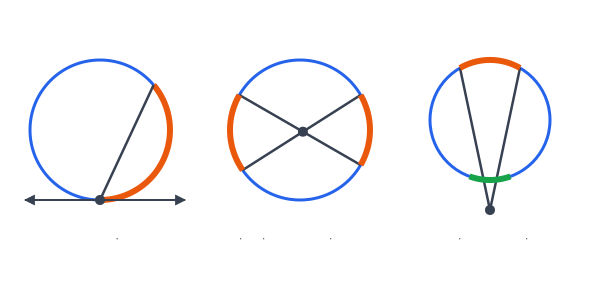
Each rule uses the arcs that lie between the sides of the angle. An angle with its vertex inside the circle has two arcs, one in front and one behind (its vertical angle’s arc). An angle with its vertex outside has a far arc and a near arc.
The Three Rules
| Where the vertex is | What forms the angle | Rule |
|---|---|---|
| On the circle | A tangent and a chord, or two chords (inscribed angle) | m\angle = \tfrac{1}{2}(\text{arc}) |
| Inside the circle | Two chords that cross | m\angle = \tfrac{1}{2}(\text{arc}_1 + \text{arc}_2) |
| Outside the circle | Two secants, a secant and a tangent, or two tangents | m\angle = \tfrac{1}{2}(\text{far arc} - \text{near arc}) |
The tangent and chord rule works like the inscribed angle rule from the last lesson. The inside rule averages the two arcs. The outside rule takes half the gap between them.
Two tangents: When both sides are tangents, the two arcs make the whole circle. If the near arc is x, the far arc is 360^\circ - x.
How to Find Angles in Circles
- Find the vertex: on, inside or outside the circle.
- Find the arcs that lie between the sides of the angle.
- Pick the rule: half the arc, half the sum or half the difference.
- Put in the arc measures and solve. To find an arc, work backward from the angle.
Worked Examples
Example 1: A tangent and a chord
A tangent and a chord meet at a point on the circle. The arc inside the angle measures 128°. Find the angle.
- The vertex is on the circle, so use half the arc: m\angle = \tfrac{1}{2}(128^\circ)
- Multiply: m\angle = 64^\circ
Answer: 64°
Example 2: Two chords inside the circle
Two chords cross inside a circle. The angle and its vertical angle intercept arcs of 64° and 100°. Find the angle.
- The vertex is inside, so use half the sum: m\angle = \tfrac{1}{2}(64^\circ + 100^\circ)
- Add inside the parentheses: m\angle = \tfrac{1}{2}(164^\circ)
- Multiply: m\angle = 82^\circ
Answer: 82°
Example 3: Two secants outside the circle
Two secants meet at a point outside a circle. The far arc is 130° and the near arc is 40°. Find the angle.
- The vertex is outside, so use half the difference: m\angle = \tfrac{1}{2}(130^\circ - 40^\circ)
- Subtract inside the parentheses: m\angle = \tfrac{1}{2}(90^\circ)
- Multiply: m\angle = 45^\circ
Answer: 45°
Example 4: Two tangents
Two tangents from point P touch a circle. The near arc between the points of tangency is 110°. Find the angle at P.
- The two arcs make the whole circle, so find the far arc: 360^\circ - 110^\circ = 250^\circ
- The vertex is outside, so use half the difference: m\angle P = \tfrac{1}{2}(250^\circ - 110^\circ)
- Subtract inside the parentheses: m\angle P = \tfrac{1}{2}(140^\circ)
- Multiply: m\angle P = 70^\circ
Answer: 70°. Notice that 70° and 110° add to 180°, which matches the two tangent rule from tangents to a circle.
Example 5: Word problem with a satellite
A satellite at point S sees Earth along two lines of sight that are tangent to Earth. The angle between the lines of sight is 30°. What arc of Earth (the near arc) can the satellite see?
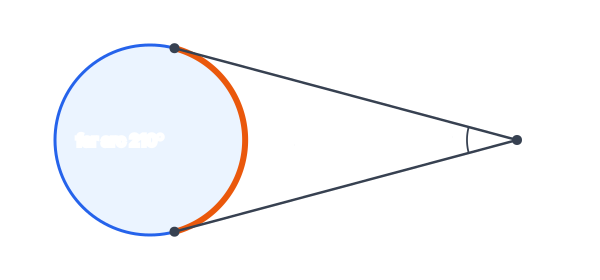
- Let the near arc be x. Then the far arc is 360 - x.
- Write the outside rule: 30 = \tfrac{1}{2}\big((360 - x) - x\big)
- Combine like terms inside: 30 = \tfrac{1}{2}(360 - 2x)
- Multiply both sides by 2: 60 = 360 - 2x
- Subtract 360 from both sides: -300 = -2x
- Divide both sides by −2: x = 150
- Find the far arc: 360 - 150 = 210
- Check: \tfrac{1}{2}(210 - 150) = \tfrac{1}{2}(60) = 30
Answer: The satellite sees a 150° arc of Earth.
Common Mistakes
| Mistake | Example of the error | Fix |
|---|---|---|
| Using the inside rule for an outside angle | \tfrac{1}{2}(130^\circ + 40^\circ) = 85^\circ | Outside the circle, subtract: \tfrac{1}{2}(130^\circ - 40^\circ) = 45^\circ. |
| Forgetting to halve | Inside angle = 64^\circ + 100^\circ = 164^\circ | Take half the sum: 82°. |
| Using only one arc for an inside angle | Angle = \tfrac{1}{2}(64^\circ) = 32^\circ | Use the arc in front and the arc behind (the vertical angle’s arc). |
| Subtracting in the wrong order | \tfrac{1}{2}(40^\circ - 130^\circ) = -45^\circ | Always far arc minus near arc. |
| Using the near arc for both arcs with two tangents | \tfrac{1}{2}(110^\circ - 110^\circ) = 0^\circ | The far arc is 360^\circ - 110^\circ = 250^\circ. |
Related Idea: Why the Inside Rule Works
Draw a chord that joins two of the endpoints so the inside angle becomes an exterior angle of a small triangle. The two remote angles of that triangle are inscribed angles, each half of one arc. The exterior angle equals their sum (the exterior angle theorem from the triangle angle sum theorem lesson), so it is half the sum of the arcs. The outside rule comes from the same idea, with a subtraction.
Practice Problems
- A tangent and a chord meet on a circle and intercept an arc of 96°. Find the angle.
- A tangent and a chord meet on a circle and form a 71° angle. Find the intercepted arc.
- Two chords cross inside a circle. An angle and its vertical angle intercept arcs of 52° and 118°. Find the angle.
- Two chords cross inside a circle and form a 60° angle. One of its intercepted arcs is 45°. Find the other arc.
- Two secants meet outside a circle. The far arc is 150° and the near arc is 36°. Find the angle.
- A secant and a tangent meet outside a circle. The far arc is 200° and the near arc is 70°. Find the angle.
- Two tangents from point P form a 48° angle. Find the near arc and the far arc.
- Two chords cross inside a circle and form a 70° angle. Its intercepted arcs are 3x and 5x + 20. Find x and both arcs.
- Two secants meet outside a circle and form a 40° angle. The far arc is 2y + 30 and the near arc is y. Find y and both arcs.
- A camera outside a circular fountain has two lines of sight that are tangent to the fountain. They form a 40° angle. What arc of the fountain’s edge faces the camera?
Show answers
- Half the arc: \tfrac{1}{2}(96^\circ)
Multiply: 48^\circ - The arc is twice the angle: 2(71^\circ)
Multiply: 142^\circ - Half the sum: \tfrac{1}{2}(52^\circ + 118^\circ)
Add: \tfrac{1}{2}(170^\circ)
Multiply: 85^\circ - Write the inside rule: 60 = \tfrac{1}{2}(45 + x)
Multiply both sides by 2: 120 = 45 + x
Subtract 45 from both sides: x = 75^\circ - Half the difference: \tfrac{1}{2}(150^\circ - 36^\circ)
Subtract: \tfrac{1}{2}(114^\circ)
Multiply: 57^\circ - Half the difference: \tfrac{1}{2}(200^\circ - 70^\circ)
Subtract: \tfrac{1}{2}(130^\circ)
Multiply: 65^\circ - Let the near arc be x, so the far arc is 360 - x. Write the outside rule: 48 = \tfrac{1}{2}\big((360 - x) - x\big)
Combine like terms inside: 48 = \tfrac{1}{2}(360 - 2x)
Multiply both sides by 2: 96 = 360 - 2x
Subtract 360 from both sides: -264 = -2x
Divide both sides by −2: x = 132
Find the far arc: 360 - 132 = 228. The arcs are 132° and 228°. - Write the inside rule: 70 = \tfrac{1}{2}(3x + 5x + 20)
Combine like terms: 70 = \tfrac{1}{2}(8x + 20)
Multiply both sides by 2: 140 = 8x + 20
Subtract 20 from both sides: 120 = 8x
Divide both sides by 8: x = 15
Find the arcs: 3(15) = 45^\circ and 5(15) + 20 = 75 + 20 = 95^\circ - Write the outside rule: 40 = \tfrac{1}{2}\big((2y + 30) - y\big)
Combine like terms inside: 40 = \tfrac{1}{2}(y + 30)
Multiply both sides by 2: 80 = y + 30
Subtract 30 from both sides: y = 50
Find the arcs: far 2(50) + 30 = 100 + 30 = 130^\circ, near 50^\circ - Let the near arc be x. Write the outside rule: 40 = \tfrac{1}{2}\big((360 - x) - x\big)
Combine like terms inside: 40 = \tfrac{1}{2}(360 - 2x)
Multiply both sides by 2: 80 = 360 - 2x
Subtract 360 from both sides: -280 = -2x
Divide both sides by −2: x = 140. The camera faces a 140° arc.
FAQ
How do you find an angle formed by two chords?
Add the two arcs intercepted by the angle and its vertical angle, then divide by 2. For arcs of 64° and 100°, the angle is 82°.
How do you find an angle formed by two secants?
Subtract the near arc from the far arc, then divide by 2. For arcs of 130° and 40°, the angle is 45°.
What is the angle between a tangent and a chord?
It is half the intercepted arc, just like an inscribed angle. A 128° arc gives a 64° angle.
Why is the outside angle smaller than the inside angle?
A vertex farther from the arcs makes a narrower angle. Subtracting the arcs instead of adding them shows this.
Summary
- First find the vertex: on, inside or outside the circle.
- On the circle (tangent and chord, or inscribed): half the arc.
- Inside the circle (two chords): half the sum of the two arcs.
- Outside the circle (secants and tangents): half of far arc minus near arc.
- With two tangents, the far arc is 360° minus the near arc.
Previous lesson: Inscribed Angles
Next lesson: Segment Relationships in Circles
Back to the Geometry Index