
Parts of a Circle
The parts of a circle are the center, radius, diameter, chord, secant and tangent. A radius goes from the center to the circle. A diameter is a chord through the center, so it is twice the radius. A secant crosses the circle twice, and a tangent touches it once.
Before this lesson: You should know Points, Lines and Planes, the Midpoint Formula and the Distance Formula.
What Is a Circle?
A circle is the set of all points in a plane that are the same distance from one point. That point is the center. You name a circle by its center. A circle with center O is called circle O, written \odot O.
The circle is only the curved edge. The center is not on the circle. Points closer to the center than the edge are in the interior. Points farther away are in the exterior.
The Parts of a Circle
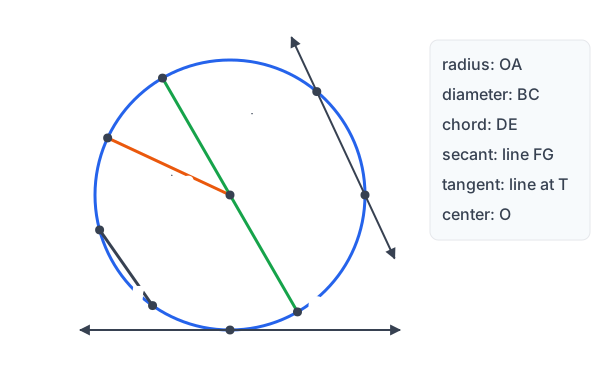
| Part | What it is | In the diagram |
|---|---|---|
| Radius | A segment from the center to a point on the circle | \overline{OA} |
| Chord | A segment whose endpoints are both on the circle | \overline{DE} |
| Diameter | A chord that passes through the center | \overline{BC} |
| Secant | A line that crosses the circle at two points | \overleftrightarrow{FG} |
| Tangent | A line that touches the circle at exactly one point | The line at T |
| Point of tangency | The point where a tangent touches the circle | T |
The word “radius” also means the length of a radius. The same goes for “diameter.” The plural of radius is radii.
Radius and Diameter
A diameter is made of two radii that point in opposite directions. So the diameter d is twice the radius r.
d = 2r \qquad r = \frac{d}{2}The diameter is the longest chord in a circle. All radii of the same circle are congruent. The distance around the circle is its circumference, C = \pi d (see circumference and area of circles).
Chord, Secant or Tangent?
These three are easy to mix up. Ask two questions. Is it a segment or a whole line? How many points does it share with the circle?
- A chord is a segment that stops at the circle at both ends.
- A secant is a line that goes through the circle. It meets the circle at two points. Every secant contains a chord.
- A tangent is a line that touches the circle at one point and stays outside it everywhere else.
Other Circle Words
- Congruent circles have the same radius.
- Concentric circles share the same center but have different radii, like the rings of a target.
- A semicircle is half of a circle, cut off by a diameter.
- An arc is part of a circle between two points. You will measure arcs in a later lesson in this unit.
Worked Examples
Example 1: Name the parts
Use the circle diagram above. Name the center, a radius, a diameter, a chord that is not a diameter, a secant and a tangent.
- The center is the point the same distance from every point on the circle: O
- A radius joins the center to the circle: \overline{OA}. Also \overline{OB} and \overline{OC} are radii.
- A diameter is a chord through the center: \overline{BC}
- A chord with both ends on the circle, not through the center: \overline{DE}
- A line that crosses the circle twice: \overleftrightarrow{FG} is a secant
- A line that touches the circle once: the line at T is a tangent, and T is the point of tangency
Example 2: Radius and diameter
(a) A circle has a diameter of 18 cm. Find the radius. (b) A circle has a radius of 7.5 in. Find the diameter.
- Part (a). Write the rule: r = \frac{d}{2}
- Substitute: r = \frac{18}{2}
- Divide: r = 9 cm
- Part (b). Write the rule: d = 2r
- Substitute: d = 2(7.5)
- Multiply: d = 15 in
Answer: (a) 9 cm (b) 15 in
Example 3: Use algebra with radius and diameter
In a circle, a radius is 3x + 2 and a diameter is 10x - 4. Find x, the radius and the diameter.
- A diameter is twice a radius: 2(3x + 2) = 10x - 4
- Use the distributive property: 6x + 4 = 10x - 4
- Subtract 6x from both sides (see equations with variables on both sides): 4 = 4x - 4
- Add 4 to both sides: 8 = 4x
- Divide both sides by 4: x = 2
- Find the radius: 3(2) + 2 = 6 + 2 = 8
- Find the diameter: 10(2) - 4 = 20 - 4 = 16
- Check: 16 = 2 \cdot 8
Answer: x = 2, the radius is 8 and the diameter is 16.
Example 4: A diameter on the coordinate plane
The endpoints of a diameter are (−3, 4) and (5, −2). Find the center and the radius of the circle.
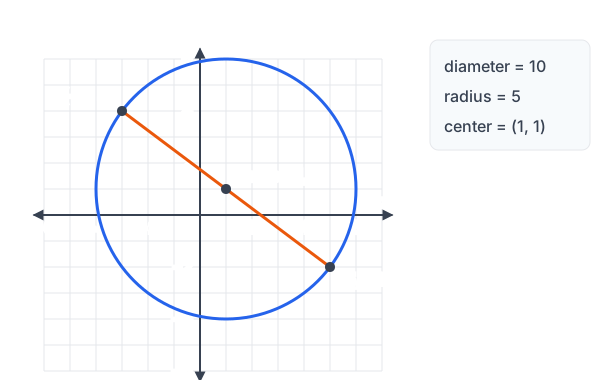
- The center is the midpoint of the diameter. Use the midpoint formula: \left(\frac{-3 + 5}{2}, \frac{4 + (-2)}{2}\right)
- Add: \left(\frac{2}{2}, \frac{2}{2}\right)
- Divide: (1, 1)
- Find the diameter with the distance formula: d = \sqrt{(5 - (-3))^2 + (-2 - 4)^2}
- Subtract inside the parentheses: d = \sqrt{8^2 + (-6)^2}
- Square: d = \sqrt{64 + 36}
- Add: d = \sqrt{100}
- Take the square root: d = 10
- Divide by 2 for the radius: r = \frac{10}{2} = 5
Answer: The center is (1, 1) and the radius is 5.
Example 5: Word problem with a bicycle wheel
Each spoke of a bicycle wheel runs from the center hub to the rim and is 31 cm long. A student says she measured a straight line across the wheel, from rim to rim, that was 70 cm long. Is that possible?
- Each spoke is a radius, so r = 31 cm.
- Find the diameter: d = 2(31)
- Multiply: d = 62 cm
- A segment from rim to rim is a chord. The longest chord is the diameter, 62 cm.
- Compare: 70 \gt 62
Answer: No. No chord of this wheel can be longer than 62 cm, so a 70 cm measurement must be a mistake.
Common Mistakes
| Mistake | Example of the error | Fix |
|---|---|---|
| Mixing up radius and diameter | Diameter 18, so radius 36 | The radius is half the diameter: r = \frac{18}{2} = 9. |
| Calling every chord a diameter | Saying \overline{DE} is a diameter | A diameter must pass through the center. |
| Calling a chord a secant | Saying segment DE is a secant | A secant is a whole line. A chord is a segment that stops at the circle. |
| Thinking the center is on the circle | Saying O is a point of circle O | The center is inside the circle, not on it. |
| Setting a radius equal to a diameter | 3x + 2 = 10x - 4 | Double the radius first: 2(3x + 2) = 10x - 4. |
Practice Problems
- A circle has a diameter of 26 m. Find the radius.
- A circle has a radius of 4.5 ft. Find the diameter.
- Is every diameter a chord? Is every chord a diameter? Explain.
- A line meets a circle at exactly one point. What is the line called? What is the point called?
- In a circle, a radius is 2x + 5 and a diameter is 7x - 5. Find x, the radius and the diameter.
- The endpoints of a diameter are (2, 7) and (8, −1). Find the center and the radius.
- A circle has center (−1, 2). One endpoint of a diameter is (3, 5). Find the other endpoint and the radius.
- Two concentric circles have radii 6 cm and 10 cm. How wide is the ring between them?
- A pizza has a diameter of 14 in. You cut a straight slice edge from the center to the crust. How long is that cut?
- True or false: (a) Every secant contains a chord. (b) A tangent can cross the circle at two points.
Show answers
- Write the rule: r = \frac{d}{2}
Substitute: r = \frac{26}{2}
Divide: r = 13 m - Write the rule: d = 2r
Substitute: d = 2(4.5)
Multiply: d = 9 ft - Every diameter is a chord, because both of its endpoints are on the circle. Not every chord is a diameter, because most chords do not pass through the center.
- The line is a tangent. The point is the point of tangency.
- A diameter is twice a radius: 2(2x + 5) = 7x - 5
Use the distributive property: 4x + 10 = 7x - 5
Subtract 4x from both sides: 10 = 3x - 5
Add 5 to both sides: 15 = 3x
Divide both sides by 3: x = 5
Find the radius: 2(5) + 5 = 10 + 5 = 15
Find the diameter: 7(5) - 5 = 35 - 5 = 30
Check: 30 = 2 \cdot 15 - Use the midpoint formula: \left(\frac{2 + 8}{2}, \frac{7 + (-1)}{2}\right)
Add: \left(\frac{10}{2}, \frac{6}{2}\right)
Divide: center (5, 3)
Use the distance formula for the diameter: d = \sqrt{(8 - 2)^2 + (-1 - 7)^2}
Subtract: d = \sqrt{6^2 + (-8)^2}
Square: d = \sqrt{36 + 64}
Add: d = \sqrt{100}
Take the square root: d = 10
Divide by 2: r = 5 - The center is the midpoint, so the center is halfway from (3, 5) to the other endpoint (x, y). Write the x-coordinate equation: \frac{3 + x}{2} = -1
Multiply both sides by 2: 3 + x = -2
Subtract 3 from both sides: x = -5
Write the y-coordinate equation: \frac{5 + y}{2} = 2
Multiply both sides by 2: 5 + y = 4
Subtract 5 from both sides: y = -1
The other endpoint is (-5, -1)
Use the distance formula from the center to (3, 5): r = \sqrt{(3 - (-1))^2 + (5 - 2)^2}
Subtract: r = \sqrt{4^2 + 3^2}
Square: r = \sqrt{16 + 9}
Add: r = \sqrt{25}
Take the square root: r = 5 - Concentric circles share a center, so subtract the radii: 10 - 6 = 4 cm
- A cut from the center to the crust is a radius: r = \frac{14}{2}
Divide: r = 7 in - (a) True. The two points where a secant crosses the circle are the endpoints of a chord. (b) False. A tangent touches the circle at exactly one point.
FAQ
What is the difference between a chord and a diameter?
Both are segments with endpoints on the circle. A diameter must pass through the center. A chord does not have to, so a diameter is a special chord, and the longest one.
What is the difference between a secant and a tangent?
A secant is a line that crosses a circle at two points. A tangent is a line that touches a circle at exactly one point.
Is the radius half the diameter?
Yes. A diameter is two radii joined at the center, so r = \frac{d}{2} and d = 2r.
What are the 7 parts of a circle?
Lists vary, but the usual seven are the center, radius, diameter, chord, secant, tangent and arc. Many books also name the circumference, the point of tangency and the sector.
Summary
- A circle is all points in a plane the same distance from the center.
- A radius goes from the center to the circle. A diameter is a chord through the center, and d = 2r.
- A chord is a segment with both endpoints on the circle.
- A secant is a line that crosses the circle twice. A tangent touches it once, at the point of tangency.
- The center of a circle is the midpoint of any diameter.
Previous lesson: Angles of Elevation and Depression
Next lesson: Tangents to a Circle
Back to the Geometry Index