
Angles of Elevation and Depression
An angle of elevation is the angle between a horizontal line and your line of sight when you look up at something. An angle of depression is the angle when you look down. Angles of elevation and depression turn height and distance questions into right triangles you can solve with trig.
Before this lesson: You should know Trigonometric Ratios, Solving Right Triangles and Parallel Lines and Transversals.
What Are Angles of Elevation and Depression?
Imagine standing on flat ground and looking at the top of a tower. Your line of sight is the straight path from your eye to the top. The horizontal is a level line, like the ground.
- The angle of elevation is measured up from the horizontal to the line of sight.
- The angle of depression is measured down from the horizontal to the line of sight.
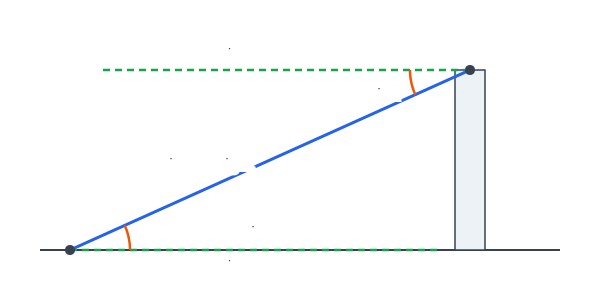
Both angles start at a horizontal line, never at a vertical one. A common trap is to measure the angle of depression from the side of the building. Always start at the level line.
Why Elevation Equals Depression
The horizontal line at A and the horizontal line at B are parallel. The line of sight crosses both of them, so it is a transversal. The angle of elevation and the angle of depression are alternate interior angles. Alternate interior angles formed by parallel lines are congruent (see parallel lines and transversals).
\text{angle of elevation from } A = \text{angle of depression from } BThis is useful. If a problem gives an angle of depression from a high point, you can put the same angle at the bottom of your triangle, where it is easier to use.
How to Solve Elevation and Depression Problems
- Draw a picture with the ground, the object and the horizontal line.
- Mark the angle from the horizontal. Move an angle of depression to the ground point if that helps.
- Find the right triangle. The height is usually opposite the angle, and the ground distance is adjacent.
- Choose sine, cosine or tangent with SOH CAH TOA, or use inverse trig to find an angle.
- Solve, then add any extra height, such as eye level.
Calculator note: Use degree mode. Round only the final answer.
Worked Examples
Example 1: Height of a tree from its shadow
A tree casts a shadow 30 ft long. The angle of elevation of the sun is 52°. How tall is the tree? Round to the nearest hundredth.
- The height is opposite the 52° angle and the shadow is adjacent, so use tangent: \tan 52^\circ = \frac{h}{30}
- Multiply both sides by 30: h = 30 \tan 52^\circ
- Use a calculator: h \approx 38.40
Answer: The tree is about 38.40 ft tall.
Example 2: Angle of depression from a lighthouse
A lighthouse is 45 m tall. From the top, the angle of depression to a boat is 14°. How far is the boat from the base of the lighthouse? Round to the nearest hundredth.
- The angle of depression equals the angle of elevation from the boat, so put 14° at the boat.
- From the boat, the height is opposite and the distance is adjacent, so use tangent: \tan 14^\circ = \frac{45}{d}
- Multiply both sides by d: d \tan 14^\circ = 45
- Divide both sides by \tan 14^\circ: d = \frac{45}{\tan 14^\circ}
- Use a calculator: d \approx 180.49
Answer: The boat is about 180.49 m from the base of the lighthouse.
Example 3: Find the angle of elevation
A kite is on a string 120 ft long. The kite is 80 ft higher than the hand holding the string. Assume the string is straight. Find the angle of elevation of the string. Round to the nearest tenth of a degree.
- The height is opposite the angle and the string is the hypotenuse, so use sine: \sin A = \frac{80}{120}
- Simplify the fraction: \sin A = \frac{2}{3}
- Use inverse sine (see solving right triangles): A = \sin^{-1}\left(\frac{2}{3}\right)
- Use a calculator: A \approx 41.8^\circ
Answer: The angle of elevation is about 41.8°.
Example 4: Add the eye height
A student stands 25 m from a flagpole. Her eyes are 1.6 m above the ground. The angle of elevation from her eyes to the top of the pole is 33°. How tall is the flagpole? Round to the nearest hundredth.
- The triangle starts at eye level. The part of the pole above eye level is opposite 33°, so use tangent: \tan 33^\circ = \frac{x}{25}
- Multiply both sides by 25: x = 25 \tan 33^\circ
- Use a calculator: x \approx 16.24
- Add the eye height to get the whole pole: h \approx 16.24 + 1.6
- Add: h \approx 17.84
Answer: The flagpole is about 17.84 m tall.
Example 5: Word problem with two boats
From the top of a cliff 60 m high, you see two boats in a straight line out to sea. The angle of depression to the nearer boat is 35°. The angle of depression to the farther boat is 20°. How far apart are the boats? Round to the nearest hundredth.
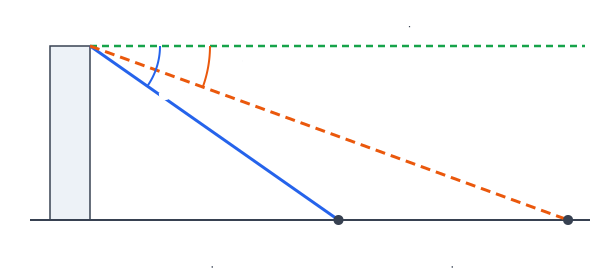
- For the nearer boat, put 35° at the boat and use tangent: \tan 35^\circ = \frac{60}{d_1}
- Multiply both sides by d_1: d_1 \tan 35^\circ = 60
- Divide both sides by \tan 35^\circ: d_1 = \frac{60}{\tan 35^\circ}
- Use a calculator: d_1 \approx 85.69
- For the farther boat, put 20° at the boat and use tangent: \tan 20^\circ = \frac{60}{d_2}
- Multiply both sides by d_2: d_2 \tan 20^\circ = 60
- Divide both sides by \tan 20^\circ: d_2 = \frac{60}{\tan 20^\circ}
- Use a calculator: d_2 \approx 164.85
- Subtract the distances: d_2 - d_1 \approx 164.85 - 85.69
- Subtract: d_2 - d_1 \approx 79.16
Answer: The boats are about 79.16 m apart. The smaller angle of depression belongs to the farther boat.
Common Mistakes
| Mistake | Example of the error | Fix |
|---|---|---|
| Measuring depression from the vertical | Using 76° instead of 14° for the lighthouse | Measure from the horizontal line, not from the building. |
| Putting the angle of depression at the top of the triangle’s vertical side | Using \tan 14^\circ = \frac{d}{45} | Move the angle to the ground point. Then the height is opposite: \tan 14^\circ = \frac{45}{d}. |
| Forgetting eye height | Saying the flagpole is 16.24 m | Add the height of the eyes: 16.24 + 1.6 = 17.84 m. |
| Matching the bigger angle to the farther object | Giving 35° to the far boat | Farther objects have smaller angles of depression and elevation. |
| Rounding before subtracting | Rounding each distance to the nearest ten first | Keep two or more decimal places until the last step. |
Related Idea: Grade and Slope
A road sign that says “8% grade” means the road rises 8 ft for every 100 ft of level distance. That ratio is the tangent of the road’s angle of elevation, and it is also the slope of the road. So the angle is \tan^{-1}(0.08) \approx 4.6^\circ.
Practice Problems
Round lengths to the nearest hundredth and angles to the nearest tenth of a degree.
- A building casts a shadow 18 m long when the angle of elevation of the sun is 61°. How tall is the building?
- From the top of a building 30 ft tall, the angle of depression to a parked car is 25°. How far is the car from the base of the building?
- A drone hovers 50 m above the ground. From a point on the ground, the angle of elevation to the drone is 40°. Find the ground distance to the point under the drone and the straight-line distance to the drone.
- A tree 40 ft tall casts a shadow 55 ft long. Find the angle of elevation of the sun.
- From a lookout 12 m above a lake, you see a canoe 70 m away, measured along the water. Find the angle of depression to the canoe.
- A kite string is 90 ft long and makes a 58° angle of elevation. How high is the kite above the hand holding the string?
- Your eyes are 1.5 m above the ground. You stand 40 m from a building, and the angle of elevation to its top is 28°. How tall is the building?
- Explain why the angle of elevation from a boat to the top of a cliff equals the angle of depression from the top of the cliff to the boat.
- From the top of a tower 80 m tall, the angles of depression to two cars on the same side of the tower are 30° and 50°. How far apart are the cars?
- A road climbs at a 7° angle of elevation. How much height do you gain after walking 500 m along the road?
Show answers
- The height is opposite and the shadow is adjacent, so use tangent: \tan 61^\circ = \frac{h}{18}
Multiply both sides by 18: h = 18 \tan 61^\circ
Use a calculator: h \approx 32.47 m - Put 25° at the car. The height is opposite and the distance is adjacent: \tan 25^\circ = \frac{30}{d}
Multiply both sides by d: d \tan 25^\circ = 30
Divide both sides by \tan 25^\circ: d = \frac{30}{\tan 25^\circ}
Use a calculator: d \approx 64.34 ft - The height is opposite 40° and the ground distance is adjacent: \tan 40^\circ = \frac{50}{g}
Multiply both sides by g: g \tan 40^\circ = 50
Divide both sides by \tan 40^\circ: g = \frac{50}{\tan 40^\circ}
Use a calculator: g \approx 59.59 m
The straight-line distance is the hypotenuse, so use sine: \sin 40^\circ = \frac{50}{s}
Multiply both sides by s: s \sin 40^\circ = 50
Divide both sides by \sin 40^\circ: s = \frac{50}{\sin 40^\circ}
Use a calculator: s \approx 77.79 m - The height is opposite and the shadow is adjacent: \tan A = \frac{40}{55}
Use inverse tangent: A = \tan^{-1}\left(\frac{40}{55}\right)
Use a calculator: A \approx 36.0^\circ - Put the angle at the canoe. The height is opposite and the water distance is adjacent: \tan A = \frac{12}{70}
Use inverse tangent: A = \tan^{-1}\left(\frac{12}{70}\right)
Use a calculator: A \approx 9.7^\circ - The height is opposite and the string is the hypotenuse: \sin 58^\circ = \frac{h}{90}
Multiply both sides by 90: h = 90 \sin 58^\circ
Use a calculator: h \approx 76.32 ft - The part above eye level is opposite 28°: \tan 28^\circ = \frac{x}{40}
Multiply both sides by 40: x = 40 \tan 28^\circ
Use a calculator: x \approx 21.27
Add the eye height: h \approx 21.27 + 1.5
Add: h \approx 22.77 m - The horizontal line at the boat and the horizontal line at the top of the cliff are parallel. The line of sight is a transversal. The two angles are alternate interior angles, and alternate interior angles formed by parallel lines are congruent.
- Near car (50°): \tan 50^\circ = \frac{80}{d_1}
Multiply both sides by d_1: d_1 \tan 50^\circ = 80
Divide both sides by \tan 50^\circ: d_1 = \frac{80}{\tan 50^\circ}
Use a calculator: d_1 \approx 67.128
Far car (30°): \tan 30^\circ = \frac{80}{d_2}
Multiply both sides by d_2: d_2 \tan 30^\circ = 80
Divide both sides by \tan 30^\circ: d_2 = \frac{80}{\tan 30^\circ}
Use a calculator: d_2 \approx 138.564
Subtract the distances: d_2 - d_1 \approx 138.564 - 67.128
Subtract: d_2 - d_1 \approx 71.436
Round: about 71.44 m - The road is the hypotenuse and the height gained is opposite 7°: \sin 7^\circ = \frac{h}{500}
Multiply both sides by 500: h = 500 \sin 7^\circ
Use a calculator: h \approx 60.93 m
FAQ
What is the difference between the angle of elevation and the angle of depression?
Both are measured from a horizontal line. The angle of elevation looks up from the horizontal. The angle of depression looks down from the horizontal.
Is the angle of elevation equal to the angle of depression?
Yes, when they use the same line of sight between two points. The two horizontal lines are parallel, so the angles are congruent alternate interior angles.
Which trig ratio do I use for elevation problems?
It depends on what you know. Height and ground distance use tangent. Height and a slanted length, like a ladder or a string, use sine. Ground distance and a slanted length use cosine.
How do you find the height of a building with an angle of elevation?
Measure your distance from the building and the angle of elevation to the top. Multiply the distance by the tangent of the angle, then add your eye height.
Summary
- The angle of elevation is measured up from the horizontal. The angle of depression is measured down from the horizontal.
- Along the same line of sight, the angle of elevation equals the angle of depression (alternate interior angles).
- Draw the right triangle, label opposite, adjacent and hypotenuse, and use SOH CAH TOA.
- Add eye height when the angle is measured from someone’s eyes.
- Farther objects have smaller angles.
Previous lesson: Solving Right Triangles
Next lesson: Parts of a Circle
Back to the Geometry Index