
Linear and Angular Speed
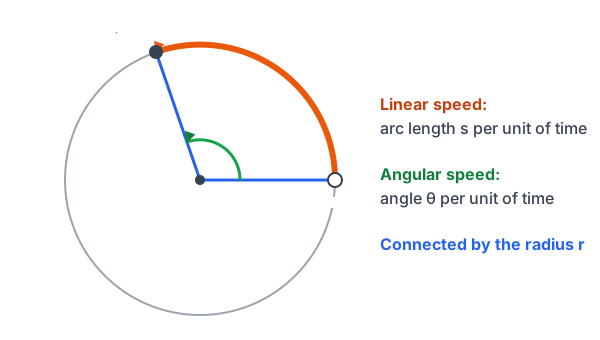
Linear speed is how fast a point moves along a circular path: v = \frac{s}{t}, the arc length per unit of time. Angular speed is how fast the angle changes: \omega = \frac{\theta}{t}, in radians per unit of time. The two are linked by v = r\omega, where r is the radius.
Before this lesson: You should know Radians, Arc Length and Unit Rates.
Two Ways to Measure Speed on a Circle
Picture two children on a merry-go-round, one near the center and one at the edge. Both go around once in the same time, so they turn through the same angle. They have the same angular speed.
The child at the edge travels a much bigger circle in that time, so she moves faster along her path. She has a greater linear speed. The farther a point is from the center, the faster it moves for the same turning rate.
Formulas for Linear and Angular Speed
| Quantity | Formula | Units |
|---|---|---|
| Linear speed | v = \frac{s}{t} | distance per time, like meters per second |
| Angular speed | \omega = \frac{\theta}{t} | radians per time, like radians per second |
| Connection | v = r\omega | \omega must be in radians per unit of time |
The Greek letter \omega is omega. The connection comes from arc length in radians, s = r\theta. Divide both sides by t to get \frac{s}{t} = r \cdot \frac{\theta}{t}, which is v = r\omega.
Speeds are often given in revolutions per minute (rpm). One revolution is 2\pi radians, so multiply rpm by 2\pi to get radians per minute.
Worked Examples
Example 1: Find an angular speed
A wheel turns through 12 radians in 3 seconds. Find its angular speed.
\omega = \frac{\theta}{t}Write the formula.
\omega = \frac{12}{3}Substitute.
\omega = 4
Divide.
Answer: 4 radians per second
Example 2: Convert revolutions per minute
A ceiling fan spins at 300 revolutions per minute. Find its angular speed in radians per minute.
\omega = 300 \cdot 2\pi
Each revolution is 2\pi radians, so multiply.
\omega = 600\pi
Multiply the numbers.
600\pi \approx 1884.96
Evaluate with a calculator.
Answer: 600\pi \approx 1884.96 radians per minute
Example 3: Linear speed from angular speed
A carousel horse is 4 meters from the center. The carousel turns at 0.5 radian per second. How fast is the horse moving?
v = r\omega
Write the connection.
v = 4 \cdot 0.5
Substitute.
v = 2
Multiply.
Answer: 2 meters per second. A horse 2 meters from the center would move only 1 meter per second.
Example 4: A bike wheel in miles per hour
A bike wheel has a diameter of 26 inches and turns at 180 revolutions per minute. How fast is the bike going, in miles per hour? (There are 63,360 inches in a mile.)
r = \frac{26}{2} = 13Find the radius in inches.
\omega = 180 \cdot 2\pi = 360\pi
Convert rpm to radians per minute.
v = 13 \cdot 360\pi
Use v = r\omega.
v = 4680\pi \approx 14{,}702.65Multiply. The speed is in inches per minute.
14{,}702.65 \cdot 60 = 882{,}159Convert minutes to hours by multiplying by 60 (see unit conversions) (inches per hour).
\frac{882{,}159}{63{,}360} \approx 13.92Convert inches to miles by dividing by 63,360.
Answer: about 13.92 miles per hour
Example 5: Word problem with Earth’s rotation
Earth’s radius is about 3960 miles, and it turns once every 24 hours. How fast is a person on the equator moving because of this rotation?
\omega = \frac{2\pi}{24}One turn is 2\pi radians, so find the angular speed.
\omega = \frac{\pi}{12}Simplify the fraction. The answer is in radians per hour.
v = 3960 \cdot \frac{\pi}{12}Use v = r\omega.
v = 330\pi
Divide 3960 by 12.
330\pi \approx 1036.73
Evaluate with a calculator.
Answer: about 1037 miles per hour, even though it feels like you are standing still.
Common Mistakes
| Mistake | Example of the error | Fix |
|---|---|---|
| Using degrees in v = rω | Using 360 degrees per minute for 1 rpm | Convert to radians: 1 rpm is 2\pi radians per minute. |
| Using the diameter as the radius | v = 26 \cdot 360\pi for a 26-inch wheel | The radius is half the diameter: 13 inches. |
| Forgetting the 2π for revolutions | Saying 300 rpm is 300 radians per minute | Multiply by 2\pi: 600\pi radians per minute. |
| Thinking all points move at the same linear speed | Saying the center and edge of a wheel move equally fast | They share the same angular speed, but linear speed grows with r. |
| Mixing time units | Using rad per minute with a time in seconds | Convert so all the units match before you multiply. |
Related Methods
Solve for angular speed
Divide both sides of v = r\omega by r to get \omega = \frac{v}{r}. If a point 4 feet from the center moves at 20 feet per second, \omega = \frac{20}{4} = 5 radians per second.
Use the circumference
For whole revolutions, you can also multiply the number of revolutions by the circumference, 2\pi r. At 180 rpm, the bike wheel in Example 4 travels 180 \cdot 26\pi = 4680\pi inches per minute, the same answer.
Linear and angular velocity
In physics, velocity also includes a direction. Angular velocity is positive for counterclockwise turning and negative for clockwise turning, like the angles in standard position.
Practice Problems
- A point travels 30 centimeters along a circle in 6 seconds. Find its linear speed.
- An angle of 5\pi radians is swept out in 10 seconds. Find the angular speed.
- A record turns at 45 revolutions per minute. Find its angular speed in radians per minute.
- A point is 8 centimeters from the center of a wheel turning at 3 radians per second. Find its linear speed.
- A point 4 feet from the center moves at 20 feet per second. Find the angular speed.
- A Ferris wheel with a radius of 25 meters makes one revolution every 2 minutes. Find the linear speed of a seat.
- The second hand of a clock is 6 centimeters long. Find the linear speed of its tip in centimeters per second.
- A car wheel with a radius of 0.3 meter spins at 50 radians per second. How fast is the car moving?
- A bike moves at 220 inches per second, and its wheels have a radius of 14 inches. Find the wheels’ angular speed in radians per second and in revolutions per minute.
- A lawn mower blade is 0.25 meter long from the center to the tip and spins at 3000 rpm. Find the linear speed of the tip in meters per second.
Show answers
1.
v = \frac{s}{t}Write the formula.
v = \frac{30}{6}Substitute.
v = 5
Divide.
Answer: 5 centimeters per second
2.
\omega = \frac{\theta}{t}Write the formula.
\omega = \frac{5\pi}{10}Substitute.
\omega = \frac{\pi}{2} \approx 1.57Simplify.
Answer: \frac{\pi}{2} radians per second
3.
\omega = 45 \cdot 2\pi
Multiply by 2\pi.
\omega = 90\pi \approx 282.74
Multiply.
Answer: 90\pi radians per minute
4.
v = r\omega
Write the connection.
v = 8 \cdot 3
Substitute.
v = 24
Multiply.
Answer: 24 centimeters per second
5.
\omega = \frac{v}{r}Solve for omega.
\omega = \frac{20}{4}Substitute.
\omega = 5
Divide.
Answer: 5 radians per second
6.
\omega = \frac{2\pi}{2} = \piFind the angular speed (radians per minute).
v = 25 \cdot \pi
Use v = r\omega.
25\pi \approx 78.54
Evaluate.
Answer: about 78.54 meters per minute
7.
\omega = \frac{2\pi}{60} = \frac{\pi}{30}The second hand makes one turn in 60 seconds (radian per second).
v = 6 \cdot \frac{\pi}{30}Use v = r\omega.
v = \frac{\pi}{5} \approx 0.63Simplify.
Answer: about 0.63 centimeter per second
8.
v = r\omega
Write the connection.
v = 0.3 \cdot 50
Substitute.
v = 15
Multiply.
Answer: 15 meters per second
9.
\omega = \frac{v}{r} = \frac{220}{14}Solve for omega.
\omega = \frac{110}{7} \approx 15.71Simplify. The answer is in radians per second.
\frac{110}{7} \cdot 60 = \frac{6600}{7} \approx 942.86Convert to radians per minute.
\frac{942.86}{2\pi} \approx 150.06Divide by 2\pi to get revolutions.
Answer: about 15.71 radians per second, or about 150 rpm
10.
\omega = 3000 \cdot 2\pi = 6000\pi
Convert rpm to radians per minute.
\omega = \frac{6000\pi}{60} = 100\piConvert to radians per second by dividing by 60.
v = 0.25 \cdot 100\pi = 25\pi
Use v = r\omega.
25\pi \approx 78.54
Evaluate.
Answer: about 78.54 meters per second
FAQ
What is the difference between linear speed and angular speed?
Linear speed is the distance a point travels along its circular path per unit of time. Angular speed is the angle it turns through per unit of time.
What is the formula that connects linear and angular speed?
It is v = r\omega, where r is the radius and \omega is the angular speed in radians per unit of time.
How do you convert rpm to radians per second?
Multiply by 2\pi to get radians per minute, then divide by 60. For example, 60 \text{ rpm} = \frac{60 \cdot 2\pi}{60} = 2\pi radians per second.
Why must angular speed be in radians?
The formula v = r\omega comes from s = r\theta, which only works with radians. With degrees, you would need an extra conversion factor.
Summary
- Linear speed: v = \frac{s}{t}, distance along the arc per unit of time.
- Angular speed: \omega = \frac{\theta}{t}, radians per unit of time.
- They are connected by v = r\omega.
- One revolution is 2\pi radians, so multiply rpm by 2\pi.
- Points farther from the center move faster for the same angular speed.
Previous lesson: Radians
Next lesson: Six Trigonometric Functions
Back to the Trigonometry Index