
Six Trigonometric Functions
The six trigonometric functions are sine, cosine and tangent and their reciprocals: cosecant, secant and cotangent. In a right triangle, each one is a ratio of two sides for an acute angle \theta. Cosecant flips sine, secant flips cosine, and cotangent flips tangent.
Before this lesson: You should know Trigonometric Ratios, the Pythagorean Theorem and Rationalizing the Denominator.
Three Ratios and Their Flips
In Geometry you used SOH CAH TOA for sine, cosine and tangent. Each one compares two sides of a right triangle, measured from an acute angle \theta. Turning each fraction upside down gives three more ratios. Together they make the six trig functions.
The names follow a pattern. Each “co” function pairs with one that has no “co”: sine with cosecant, cosine with secant, and tangent with cotangent.
Definitions of the Six Trig Functions
| Function | Ratio | Reciprocal of |
|---|---|---|
| Sine | \sin \theta = \frac{\text{opposite}}{\text{hypotenuse}} | cosecant |
| Cosine | \cos \theta = \frac{\text{adjacent}}{\text{hypotenuse}} | secant |
| Tangent | \tan \theta = \frac{\text{opposite}}{\text{adjacent}} | cotangent |
| Cosecant | \csc \theta = \frac{\text{hypotenuse}}{\text{opposite}} | sine |
| Secant | \sec \theta = \frac{\text{hypotenuse}}{\text{adjacent}} | cosine |
| Cotangent | \cot \theta = \frac{\text{adjacent}}{\text{opposite}} | tangent |
\csc \theta = \frac{1}{\sin \theta} \qquad \sec \theta = \frac{1}{\cos \theta} \qquad \cot \theta = \frac{1}{\tan \theta}- Label the sides from the angle \theta: opposite, adjacent and hypotenuse.
- If a side is missing, find it with the Pythagorean theorem.
- Write sine, cosine and tangent.
- Flip each one to get cosecant, secant and cotangent.
- Simplify each fraction and rationalize any square root in a denominator.
Worked Examples
Example 1: All six from a triangle
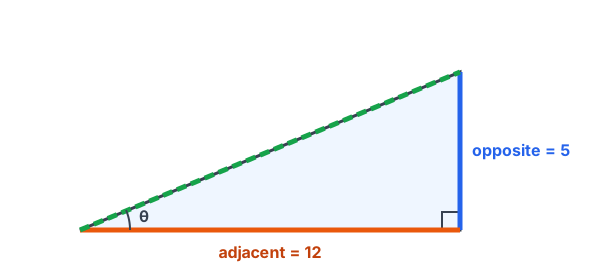
A right triangle has legs 5 and 12 and hypotenuse 13. The side opposite \theta is 5. Find all six trig functions of \theta.
Label the sides: opposite = 5, adjacent = 12, hypotenuse = 13
\sin \theta = \frac{5}{13}Write sine.
\cos \theta = \frac{12}{13}Write cosine.
\tan \theta = \frac{5}{12}Write tangent.
\csc \theta = \frac{13}{5}Flip sine.
\sec \theta = \frac{13}{12}Flip cosine.
\cot \theta = \frac{12}{5}Flip tangent.
Answer: \sin \theta = \frac{5}{13}, \cos \theta = \frac{12}{13}, \tan \theta = \frac{5}{12}, \csc \theta = \frac{13}{5}, \sec \theta = \frac{13}{12}, \cot \theta = \frac{12}{5}
Example 2: Find the missing side first
In a right triangle, the side opposite \theta is 8 and the side adjacent to \theta is 15. Find all six trig functions of \theta.
c^2 = 8^2 + 15^2
Use the Pythagorean theorem (see Pythagorean theorem)
c^2 = 64 + 225
Square each leg.
c^2 = 289
Add.
c = 17
Take the square root.
Write the three main ratios: \sin \theta = \frac{8}{17}, \cos \theta = \frac{15}{17}, \tan \theta = \frac{8}{15}
Flip them: \csc \theta = \frac{17}{8}, \sec \theta = \frac{17}{15}, \cot \theta = \frac{15}{8}
Answer: as listed in the last two steps.
Example 3: Start from one function
If \theta is acute and \sin \theta = \frac{3}{7}, find the other five trig functions.
Sine is opposite over hypotenuse, so draw a right triangle with opposite = 3 and hypotenuse = 7.
a^2 + 3^2 = 7^2
Set up the Pythagorean theorem for the adjacent side.
a^2 + 9 = 49
Square.
a^2 = 40
Subtract 9 from both sides.
a = \sqrt{40} = 2\sqrt{10}Take the square root and simplify (see simplifying square roots)
\cos \theta = \frac{2\sqrt{10}}{7}Write cosine.
\tan \theta = \frac{3}{2\sqrt{10}}Write tangent.
\frac{3}{2\sqrt{10}} \cdot \frac{\sqrt{10}}{\sqrt{10}} = \frac{3\sqrt{10}}{20}Rationalize the denominator (see rationalizing the denominator)
\csc \theta = \frac{7}{3}Flip sine.
\sec \theta = \frac{7}{2\sqrt{10}} = \frac{7\sqrt{10}}{20}Flip cosine and rationalize.
\cot \theta = \frac{2\sqrt{10}}{3}Flip tangent.
Answer: \cos \theta = \frac{2\sqrt{10}}{7}, \tan \theta = \frac{3\sqrt{10}}{20}, \csc \theta = \frac{7}{3}, \sec \theta = \frac{7\sqrt{10}}{20}, \cot \theta = \frac{2\sqrt{10}}{3}
Example 4: Reciprocal functions on a calculator
Find \sec 40^\circ and \cot 25^\circ to the nearest hundredth.
\sec 40^\circ = \frac{1}{\cos 40^\circ}Most calculators have no sec key, so use the reciprocal.
\cos 40^\circ \approx 0.76604
Evaluate cosine in degree mode.
\frac{1}{0.76604} \approx 1.3054Divide.
\cot 25^\circ = \frac{1}{\tan 25^\circ}Use the reciprocal for cotangent.
\tan 25^\circ \approx 0.46631
Evaluate tangent.
\frac{1}{0.46631} \approx 2.1445Divide.
Answer: \sec 40^\circ \approx 1.31 and \cot 25^\circ \approx 2.14. Calculator note: check that the calculator is in degree mode, then type 1 ÷ cos(40) and press ENTER. Do not use the cos⁻¹ key; that is the inverse function, not the reciprocal.
Example 5: Word problem with a ramp
A wheelchair ramp must rise 1 foot for every 12 feet of horizontal run. Let \theta be the angle between the ramp and the ground. Find \cot \theta and \csc \theta, and explain what \csc \theta tells a builder.
Label the sides: opposite = 1 (rise), adjacent = 12 (run)
c^2 = 1^2 + 12^2 = 1 + 144 = 145
Find the ramp length with the Pythagorean theorem.
c = \sqrt{145} \approx 12.04Take the square root.
\cot \theta = \frac{\text{adjacent}}{\text{opposite}} = \frac{12}{1} = 12Write cotangent.
\csc \theta = \frac{\text{hypotenuse}}{\text{opposite}} = \frac{\sqrt{145}}{1} \approx 12.04Write cosecant.
Answer: \cot \theta = 12 and \csc \theta = \sqrt{145} \approx 12.04. Cosecant is the length of ramp needed for each foot of rise, so a 2-foot rise needs about 24.08 feet of ramp.
Common Mistakes
| Mistake | Example of the error | Fix |
|---|---|---|
| Pairing the wrong reciprocals | \sec \theta = \frac{1}{\sin \theta} | Each “co” pairs with a non-“co”: secant goes with cosine, cosecant with sine. |
| Using the inverse key for a reciprocal | Finding \sec 40^\circ with cos⁻¹(40) | The reciprocal is \frac{1}{\cos 40^\circ}. cos⁻¹ finds an angle, not a ratio. |
| Labeling sides from the wrong angle | Calling 12 the opposite side for \theta in Example 1 | Opposite and adjacent depend on which acute angle you use. |
| Leaving a radical in the denominator | \tan \theta = \frac{3}{2\sqrt{10}} | Rationalize: \frac{3\sqrt{10}}{20}. |
| Calculator in radian mode | \cos 40 \approx -0.667 | Switch to degree mode: \cos 40^\circ \approx 0.766. |
Related Methods
Check with the ranges
For an acute angle, sine and cosine are always less than 1, because the hypotenuse is the longest side. So cosecant and secant are always greater than 1. If you get \sec \theta = 0.8, something went wrong.
Cofunctions of complementary angles
The two acute angles of a right triangle add to 90°. The side opposite one angle is adjacent to the other, so \sin \theta = \cos (90^\circ - \theta), \tan \theta = \cot (90^\circ - \theta) and \sec \theta = \csc (90^\circ - \theta).
Any angle, not just acute angles
Later in this course, the six functions are defined for any angle using a point on the terminal side, so they work for angles like 150° or −60° too.
Practice Problems
- A right triangle has opposite side 3, adjacent side 4 and hypotenuse 5 for angle \theta. Find all six trig functions.
- The side opposite \theta is 7 and the side adjacent to \theta is 24. Find \csc \theta, \sec \theta and \cot \theta.
- The hypotenuse is 10 and the side opposite \theta is 6. Find all six trig functions.
- If \theta is acute and \cos \theta = \frac{5}{13}, find the other five trig functions.
- If \theta is acute and \tan \theta = 2, find the other five trig functions.
- If \csc \theta = 2, find \sin \theta.
- Find \sec 70^\circ to the nearest hundredth.
- Find \cot 55^\circ to the nearest hundredth.
- Find \csc 12^\circ to the nearest hundredth.
- A kite is 30 meters above the ground and 40 meters away horizontally from the person holding the string. Let \theta be the angle between the string and the ground. Find \sec \theta and explain what it means.
Show answers
1.
Sine and cosine: \sin \theta = \frac{3}{5}, \cos \theta = \frac{4}{5}
\tan \theta = \frac{3}{4}Find the tangent: opposite over adjacent.
Flip each: \csc \theta = \frac{5}{3}, \sec \theta = \frac{5}{4}, \cot \theta = \frac{4}{3}
Answer: the six values above
2.
c^2 = 7^2 + 24^2 = 49 + 576 = 625
Find the hypotenuse.
c = 25
Take the square root.
\csc \theta = \frac{25}{7}Find the cosecant: hypotenuse over opposite.
\sec \theta = \frac{25}{24}Find the secant: hypotenuse over adjacent.
\cot \theta = \frac{24}{7}Find the cotangent: adjacent over opposite.
Answer: \frac{25}{7}, \frac{25}{24}, \frac{24}{7}
3.
a^2 + 6^2 = 10^2
Find the adjacent side.
a^2 + 36 = 100
Square.
a^2 = 64
Subtract 36.
a = 8
Take the square root. A side length is positive.
Main ratios: \sin \theta = \frac{6}{10} = \frac{3}{5}, \cos \theta = \frac{8}{10} = \frac{4}{5}, \tan \theta = \frac{6}{8} = \frac{3}{4}
Flip: \csc \theta = \frac{5}{3}, \sec \theta = \frac{5}{4}, \cot \theta = \frac{4}{3}
Answer: the six values above
4.
Draw a triangle with adjacent = 5 and hypotenuse = 13
b^2 + 5^2 = 13^2
Find the opposite side.
b^2 = 169 - 25 = 144
Subtract 25 from 169.
b = 12
Take the square root.
Main ratios: \sin \theta = \frac{12}{13}, \tan \theta = \frac{12}{5}
Flip: \csc \theta = \frac{13}{12}, \sec \theta = \frac{13}{5}, \cot \theta = \frac{5}{12}
Answer: the five values above
5.
Write tangent as a fraction: \tan \theta = \frac{2}{1}, so opposite = 2 and adjacent = 1
c^2 = 2^2 + 1^2 = 5
Find the hypotenuse.
c = \sqrt{5}Take the square root.
\sin \theta = \frac{2}{\sqrt{5}} = \frac{2\sqrt{5}}{5}Find the sine and rationalize.
\cos \theta = \frac{1}{\sqrt{5}} = \frac{\sqrt{5}}{5}Find the cosine and rationalize.
Flip: \csc \theta = \frac{\sqrt{5}}{2}, \sec \theta = \sqrt{5}, \cot \theta = \frac{1}{2}
Answer: the five values above
6.
\sin \theta = \frac{1}{\csc \theta}Use the reciprocal.
\sin \theta = \frac{1}{2}Substitute.
Answer: \frac{1}{2}
7.
\sec 70^\circ = \frac{1}{\cos 70^\circ}Use the reciprocal.
\cos 70^\circ \approx 0.34202
Evaluate.
\frac{1}{0.34202} \approx 2.9238Divide.
Answer: about 2.92
8.
\cot 55^\circ = \frac{1}{\tan 55^\circ}Use the reciprocal.
\tan 55^\circ \approx 1.42815
Evaluate.
\frac{1}{1.42815} \approx 0.7002Divide.
Answer: about 0.70
9.
\csc 12^\circ = \frac{1}{\sin 12^\circ}Use the reciprocal.
\sin 12^\circ \approx 0.20791
Evaluate.
\frac{1}{0.20791} \approx 4.8097Divide.
Answer: about 4.81
10.
c^2 = 30^2 + 40^2 = 900 + 1600 = 2500
Find the string length.
c = 50
Take the square root.
\sec \theta = \frac{50}{40} = \frac{5}{4}Secant is hypotenuse over adjacent.
Answer: \sec \theta = \frac{5}{4}, so the string is 1.25 meters long for every meter of horizontal distance
FAQ
What are the six trigonometric functions?
They are sine, cosine, tangent, cosecant, secant and cotangent. The last three are the reciprocals of the first three.
How do you remember which functions are reciprocals?
Each pair has exactly one “co”: sine and cosecant, cosine and secant, tangent and cotangent.
Is csc the same as sin⁻¹?
No. \csc \theta = \frac{1}{\sin \theta} is a ratio. The inverse sine, \sin^{-1} x, gives the angle whose sine is x.
How do you find secant on a calculator?
Find the cosine of the angle and divide 1 by it. For example, \sec 60^\circ = \frac{1}{\cos 60^\circ} = \frac{1}{0.5} = 2.
Summary
- Sine, cosine and tangent are opposite over hypotenuse, adjacent over hypotenuse and opposite over adjacent.
- Cosecant, secant and cotangent are their reciprocals.
- Each reciprocal pair has exactly one “co” in it.
- Find a missing side with the Pythagorean theorem, then write all six ratios.
- On a calculator, use 1 divided by sin, cos or tan.
Previous lesson: Linear and Angular Speed
Next lesson: Trig Values of Special Angles
Back to the Trigonometry Index