
Graphs of Secant, Cosecant and Cotangent
The graphs of secant, cosecant and cotangent come from flipping the graphs of cosine, sine and tangent. Wherever the original function is 0, the reciprocal has a vertical asymptote. Secant and cosecant are U-shaped curves with period 2\pi and never take values between −1 and 1. Cotangent has period \pi and falls from left to right.
Before this lesson: You should know Graph of Tangent, Amplitude and Period and Six Trigonometric Functions.
Graphing a Reciprocal
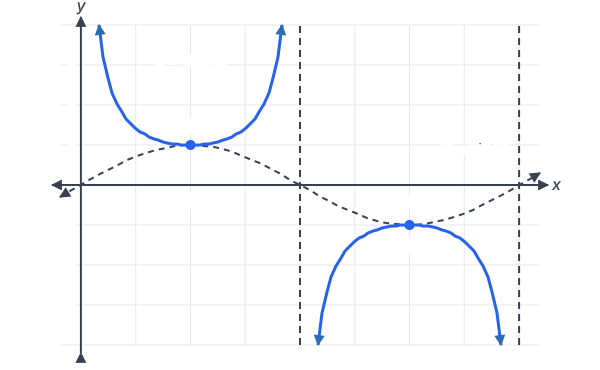
Since \csc x = \frac{1}{\sin x}, every height on the sine graph turns into its reciprocal. Where \sin x = 1, \csc x = 1 too. Where \sin x = \frac{1}{2}, \csc x = 2. As sine shrinks toward 0, its reciprocal grows huge, so cosecant shoots off toward an asymptote.
The easiest way to draw cosecant or secant is to sketch sine or cosine lightly first. Draw vertical asymptotes where that graph crosses the x-axis. Then draw U-shaped curves that touch each peak and each valley and bend away from the x-axis.
Key Features
| Feature | y = \csc x | y = \sec x | y = \cot x |
|---|---|---|---|
| Reciprocal of | \sin x | \cos x | \tan x |
| Period | 2\pi | 2\pi | \pi |
| Asymptotes | x = n\pi | x = \frac{\pi}{2} + n\pi | x = n\pi |
| Range | (-\infty, -1] \cup [1, \infty) | (-\infty, -1] \cup [1, \infty) | All real numbers |
| Turning points or zeros | (\frac{\pi}{2}, 1), (\frac{3\pi}{2}, -1) | (0, 1), (\pi, -1) | Zeros at x = \frac{\pi}{2} + n\pi |
Here n is any integer. For y = a \csc(bx) or y = a \sec(bx), the period is \frac{2\pi}{|b|} and the turning points move to heights \pm a. For y = a \cot(bx), the period is \frac{\pi}{|b|}.
Worked Examples
Example 1: Graph cosecant from sine
Describe one period of y = \csc x from 0 to 2\pi.
x = 0,\ \pi,\ 2\pi
Find where \sin x = 0. These are the asymptotes.
(\frac{\pi}{2}, 1)Sine has a peak here, so cosecant has a U opening up with its lowest point here.
(\frac{3\pi}{2}, -1)Sine has a valley here, so cosecant has a U opening down with its highest point here.
\csc \frac{\pi}{6} = \frac{1}{\sin \frac{\pi}{6}}Check a point. Cosecant is one over sine.
\frac{1}{\sin \frac{\pi}{6}} = \frac{1}{\frac{1}{2}}Use \sin \frac{\pi}{6} = \frac{1}{2}.
\frac{1}{\frac{1}{2}} = 2Divide.
Answer: two U-shaped branches between asymptotes at 0, \pi and 2\pi, turning at (\frac{\pi}{2}, 1) and (\frac{3\pi}{2}, -1).
Example 2: Graph secant from cosine
Find the asymptotes and turning points of y = \sec x from -\frac{\pi}{2} to \frac{3\pi}{2}.
x = -\frac{\pi}{2},\ \frac{\pi}{2},\ \frac{3\pi}{2}Find where \cos x = 0. These are the asymptotes.
(0, 1)
Cosine has a peak here, so secant turns here and opens up.
(\pi, -1)
Cosine has a valley here, so secant turns here and opens down.
\sec \frac{\pi}{3} = \frac{1}{\cos \frac{\pi}{3}}Check a point. Secant is one over cosine.
\frac{1}{\cos \frac{\pi}{3}} = \frac{1}{\frac{1}{2}}Use \cos \frac{\pi}{3} = \frac{1}{2}.
\frac{1}{\frac{1}{2}} = 2Divide.
Answer: asymptotes at x = -\frac{\pi}{2}, \frac{\pi}{2} and \frac{3\pi}{2}; turning points (0, 1) and (\pi, -1).
Example 3: Graph cotangent
Find the asymptotes, zero and key points of y = \cot x from 0 to \pi.
Cotangent is \frac{\cos x}{\sin x}, so its asymptotes are where \sin x = 0: x = 0 and x = \pi
x = \frac{\pi}{2}Its zero is where \cos x = 0.
\cot \frac{\pi}{4} = \frac{\frac{\sqrt{2}}{2}}{\frac{\sqrt{2}}{2}} = 1Find the quarter point: cotangent is cosine over sine.
\cot \frac{3\pi}{4} = \frac{-\frac{\sqrt{2}}{2}}{\frac{\sqrt{2}}{2}} = -1Find the three-quarter point the same way.
Answer: asymptotes x = 0 and x = \pi; points (\frac{\pi}{4}, 1), (\frac{\pi}{2}, 0), (\frac{3\pi}{4}, -1). The branch falls from left to right, the opposite of tangent.
Example 4: A vertical stretch
Find the range and turning points of y = 2 \sec x.
(0, 1),\ (\pi, -1)
Write the turning points of y = \sec x.
2 \cdot 1 = 2
Multiply each y-value by 2. Start with 1.
2 \cdot (-1) = -2
Multiply −1 by 2.
The branches never come closer to the x-axis than the turning points.
Answer: turning points (0, 2) and (\pi, -2); range (-\infty, -2] \cup [2, \infty). The asymptotes do not move.
Example 5: Word problem with a lighthouse beam
A lighthouse is 3 kilometers from a straight shore. Its beam makes an angle \theta with the line straight to the shore. The distance from the lighthouse to the lit spot on the shore is d = 3 \sec \theta kilometers. Find d when \theta = 0, \theta = \frac{\pi}{4} and \theta = \frac{\pi}{3}.
\sec 0 = \frac{1}{\cos 0} = 1At \theta = 0.
d = 3 \cdot 1 = 3
Multiply.
\sec \frac{\pi}{4} = \frac{1}{\frac{\sqrt{2}}{2}} = \frac{2}{\sqrt{2}} = \sqrt{2}At \theta = \frac{\pi}{4}.
d = 3\sqrt{2} \approx 4.24Multiply.
\sec \frac{\pi}{3} = \frac{1}{\frac{1}{2}} = 2At \theta = \frac{\pi}{3}.
d = 3 \cdot 2 = 6
Multiply.
Answer: 3 km, about 4.24 km and 6 km. As \theta nears \frac{\pi}{2}, the beam runs almost parallel to the shore, and d grows without limit: the asymptote of secant.
Common Mistakes
| Mistake | Example of the error | Fix |
|---|---|---|
| Putting asymptotes at the peaks | Asymptote of y = \csc x at x = \frac{\pi}{2} | Asymptotes are where the reciprocal is 0. Sine is 0 at n\pi, so that is where cosecant breaks. |
| Mixing up which function to flip | Drawing y = \sec x from the sine graph | Secant is \frac{1}{\cos x}. Each “co” pairs with a non-“co”. |
| Including values between −1 and 1 | Saying \csc x = 0.5 for some x | Since |\sin x| \le 1, |\csc x| \ge 1 always. |
| Using period 2π for cotangent | Period of y = \cot x is 2\pi | Cotangent repeats like tangent, every \pi. |
| Drawing cotangent rising | Copying the tangent shape for cotangent | Cotangent falls from left to right between its asymptotes. |
Related Methods
Use a table of reciprocals
Make a table of sine or cosine values at special angles, then flip each one. Values of 1 and −1 stay the same, \frac{1}{2} becomes 2, and 0 becomes an asymptote.
Cotangent from tangent
Since \cot x = \frac{1}{\tan x}, cotangent is 0 where tangent has an asymptote and has an asymptote where tangent is 0. Both graphs equal 1 at x = \frac{\pi}{4}.
Graphing calculators
Most calculators have no csc, sec or cot key. Enter them as reciprocals, such as y = \frac{1}{\sin x}, and use radian mode for these graphs.
Practice Problems
- Find \csc \frac{\pi}{6}.
- Find \sec \pi.
- Find \cot \frac{\pi}{4}.
- List the asymptotes of y = \csc x from 0 to 2\pi.
- List the asymptotes of y = \sec x from 0 to 2\pi.
- State the range of y = \sec x.
- Find the period of y = \cot 3x.
- Find the period of y = \csc 2x and its asymptotes from 0 to \pi.
- Find the turning points of y = 3 \csc x from 0 to 2\pi.
- A security camera is on top of a 10-meter pole and points down at an angle \theta from straight down. The length of its line of sight to the ground is L = 10 \sec \theta meters. Find L when \theta = \frac{\pi}{6}.
Show answers
1.
\csc \frac{\pi}{6} = \frac{1}{\sin \frac{\pi}{6}} = \frac{1}{\frac{1}{2}}Flip sine.
2
Divide.
Answer: 2
2.
\sec \pi = \frac{1}{\cos \pi} = \frac{1}{-1}Flip cosine.
Answer: −1
3.
\cot \frac{\pi}{4} = \frac{1}{\tan \frac{\pi}{4}} = \frac{1}{1}Flip tangent.
Answer: 1
4.
Sine is 0 at 0, \pi and 2\pi
Answer: x = 0, x = \pi, x = 2\pi
5.
Cosine is 0 at \frac{\pi}{2} and \frac{3\pi}{2}
Answer: x = \frac{\pi}{2}, x = \frac{3\pi}{2}
6.
Secant is never between −1 and 1
Answer: (-\infty, -1] \cup [1, \infty)
7.
\frac{\pi}{3}Use \frac{\pi}{|b|}.
Answer: \frac{\pi}{3}
8.
\frac{2\pi}{2} = \piFind the period: divide 2π by b.
2x = 0, \pi, 2\pi
Asymptotes where \sin 2x = 0.
x = 0, \frac{\pi}{2}, \piDivide by 2.
Answer: period \pi; asymptotes x = 0, \frac{\pi}{2}, \pi
9.
Turning points of y = \csc x: (\frac{\pi}{2}, 1) and (\frac{3\pi}{2}, -1)
Multiply the y-values by 3: 3 and -3
Answer: (\frac{\pi}{2}, 3) and (\frac{3\pi}{2}, -3)
10.
\sec \frac{\pi}{6} = \frac{1}{\cos \frac{\pi}{6}} = \frac{1}{\frac{\sqrt{3}}{2}} = \frac{2}{\sqrt{3}}Find the secant.
\frac{2}{\sqrt{3}} = \frac{2\sqrt{3}}{3}Rationalize (see rationalizing the denominator)
L = \frac{20\sqrt{3}}{3} \approx 11.55Multiply by 10.
Answer: about 11.55 meters
FAQ
How do you graph the cosecant function?
Sketch y = \sin x first. Draw vertical asymptotes where sine is 0, then draw U-shaped curves that touch each peak and valley of sine and bend away from the x-axis.
What is the range of secant and cosecant?
Both have range (-\infty, -1] \cup [1, \infty). They can never be between −1 and 1, because they are reciprocals of numbers between −1 and 1.
What is the period of cotangent?
The period of y = \cot x is \pi, the same as tangent. For y = \cot(bx), the period is \frac{\pi}{|b|}.
Where are the asymptotes of secant?
Secant has asymptotes wherever \cos x = 0, which is at x = \frac{\pi}{2} + n\pi.
Summary
- Secant, cosecant and cotangent are the reciprocals of cosine, sine and tangent.
- They have vertical asymptotes where the original function is 0.
- Secant and cosecant have period 2\pi and range (-\infty, -1] \cup [1, \infty).
- Their U-shaped branches touch the peaks and valleys of cosine and sine.
- Cotangent has period \pi, asymptotes at n\pi and falling branches.
Previous lesson: Graph of Tangent
Next lesson: Sinusoidal Models
Back to the Trigonometry Index