
Amplitude and Period
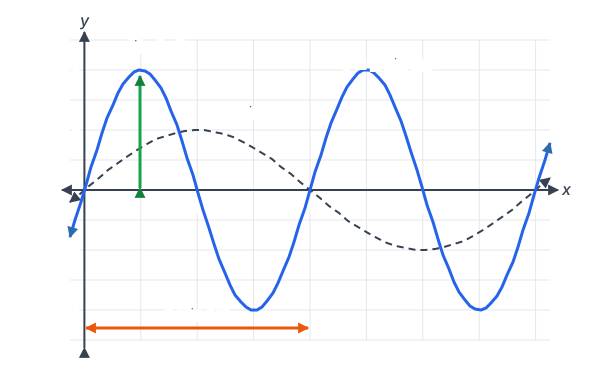
For y = a \sin(bx) or y = a \cos(bx), the amplitude and period describe the size and length of the wave. The amplitude is |a|, the distance from the middle of the wave to a peak. The period is \frac{2\pi}{|b|}, the horizontal length of one full cycle. A negative a flips the graph upside down.
Before this lesson: You should know Graphs of Sine and Cosine and Transformations of Functions.
Stretching the Sine Wave
The parent graph y = \sin x goes up to 1 and down to −1, and one cycle takes 2\pi. The number a in front stretches the wave up and down. For y = 3 \sin x, every height is tripled, so the wave goes from −3 to 3.
The number b next to x squeezes or stretches the wave sideways. For y = \sin 2x, the inside reaches 2\pi when x is only \pi, so the whole cycle fits in half the space. A bigger b means a shorter period and a faster wave.
Amplitude and Period Formulas
y = a \sin(bx) \quad \text{and} \quad y = a \cos(bx)| Feature | Formula | What it tells you |
|---|---|---|
| Amplitude | |a| | Half the distance from the minimum to the maximum |
| Period | \frac{2\pi}{|b|} | The length of one cycle |
| Maximum and minimum | |a| and -|a| | The highest and lowest values |
| Reflection | a \lt 0 | The graph is flipped over the x-axis |
- Find the amplitude |a| and the period \frac{2\pi}{|b|}.
- Divide the period by 4 to find the spacing between key points.
- Starting at x = 0, list five x-values that step by that spacing.
- Use the parent pattern for the y-values (sine: 0, 1, 0, −1, 0; cosine: 1, 0, −1, 0, 1) and multiply each by a.
- Plot the points and draw a smooth wave. Repeat the cycle as needed.
Worked Examples
Example 1: Change only the amplitude
Find the amplitude, period and key points of y = 3 \sin x.
Read the numbers: a = 3 and b = 1
|3| = 3
Find the amplitude: the absolute value of a.
\frac{2\pi}{1} = 2\piFind the period: divide 2π by b.
\frac{2\pi}{4} = \frac{\pi}{2}Spacing of key points.
0, 3, 0, -3, 0
Multiply the sine pattern by 3.
Answer: amplitude 3, period 2\pi, key points (0, 0), (\frac{\pi}{2}, 3), (\pi, 0), (\frac{3\pi}{2}, -3), (2\pi, 0)
Example 2: Change only the period
Find the amplitude, period and key points of y = \cos 2x.
Read the numbers: a = 1 and b = 2
|1| = 1
Find the amplitude: the absolute value of a.
\frac{2\pi}{2} = \piFind the period: divide 2π by b.
\frac{\pi}{4}Spacing of key points.
0, \frac{\pi}{4}, \frac{\pi}{2}, \frac{3\pi}{4}, \piList the x-values of the key points.
1, 0, -1, 0, 1
Use the cosine pattern.
Answer: amplitude 1, period \pi, key points (0, 1), (\frac{\pi}{4}, 0), (\frac{\pi}{2}, -1), (\frac{3\pi}{4}, 0), (\pi, 1)
Example 3: A reflection and a longer period
Find the amplitude, period and key points of y = -2 \sin \frac{x}{2}.
Read the numbers: a = -2 and b = \frac{1}{2}
|-2| = 2
Find the amplitude: the absolute value of a.
\frac{2\pi}{\frac{1}{2}} = 2\pi \cdot 2 = 4\piFind the period: divide 2π by b.
\frac{4\pi}{4} = \piSpacing of key points.
0, \pi, 2\pi, 3\pi, 4\pi
List the x-values of the key points.
0, -2, 0, 2, 0
Multiply the sine pattern by −2.
Answer: amplitude 2, period 4\pi. Because a is negative, the graph goes down first: (0, 0), (\pi, -2), (2\pi, 0), (3\pi, 2), (4\pi, 0).
Example 4: Write an equation from a description
A cosine graph has a maximum of 4 at x = 0, a minimum of −4, and a period of 6. Write its equation.
\frac{4 - (-4)}{2} = \frac{8}{2} = 4The amplitude is half the distance from the minimum to the maximum.
The graph starts at its maximum, so a = 4 (positive cosine).
\frac{2\pi}{b} = 6Set the period equal to 6.
2\pi = 6b
Multiply both sides by b.
b = \frac{2\pi}{6} = \frac{\pi}{3}Divide both sides by 6.
Answer: y = 4 \cos(\frac{\pi}{3} x)
Example 5: Word problem with a tuning fork
The tip of a tuning fork moves back and forth. Its position in millimeters after t seconds is y = 0.5 \sin(880\pi t). Find the amplitude, the period and the number of cycles per second.
Read the numbers: a = 0.5 and b = 880\pi
|0.5| = 0.5
Find the amplitude in millimeters.
\frac{2\pi}{880\pi}Find the period: divide 2π by b.
\frac{2}{880} = \frac{1}{440}Cancel \pi and simplify (second).
1 \div \frac{1}{440} = 440Cycles per second is 1 divided by the period.
Answer: The tip moves 0.5 mm each way, one cycle takes \frac{1}{440} second, and the fork vibrates 440 times per second. That number of cycles per second is the frequency, 440 hertz, the note A above middle C.
Common Mistakes
| Mistake | Example of the error | Fix |
|---|---|---|
| Using b as the period | Period of y = \sin 2x is 2 | Divide: \frac{2\pi}{2} = \pi. |
| Giving a negative amplitude | Amplitude of y = -2 \sin \frac{x}{2} is −2 | Amplitude is a distance: |-2| = 2. The negative sign means a reflection. |
| Dividing the wrong way | Period of y = \cos 2x is \frac{2}{2\pi} | The formula is \frac{2\pi}{|b|}, with 2\pi on top. |
| Spacing key points by the period | Using x-values 0, \pi, 2\pi for y = \cos 2x | Key points are a quarter period apart: \frac{\pi}{4}. |
| Thinking a bigger b makes a longer wave | Saying y = \sin 4x has a longer period than y = \sin x | A bigger b squeezes the wave: the period is \frac{\pi}{2}. |
Related Methods
Frequency
Frequency is the number of cycles in one unit of time, so it is 1 divided by the period: f = \frac{|b|}{2\pi}. In Example 5, f = \frac{880\pi}{2\pi} = 440.
Amplitude from a graph
If you know the highest and lowest values, the amplitude is \frac{\text{max} - \text{min}}{2}. This also works when the wave has been moved up or down, which you will see with vertical shifts.
Degrees instead of radians
In degrees, the period is \frac{360^\circ}{|b|}. For example, y = \sin 3x has a period of 120°.
Practice Problems
- Find the amplitude and period of y = 5 \cos x.
- Find the amplitude and period of y = \sin 4x.
- Find the amplitude of y = -3 \cos x, and describe the graph.
- Find the period of y = 2 \sin(\pi x).
- Find the amplitude and period of y = \frac{1}{2} \cos \frac{x}{3}.
- List the key points of y = 4 \sin 2x for one period.
- Write a sine function with amplitude 3 and period \pi.
- Write a cosine function with amplitude 2 and period 8.
- Find the maximum and minimum values of y = -6 \sin 3x.
- The height of an ocean wave, in meters, at a buoy is y = 1.2 \sin(\frac{\pi}{5} t), where t is in seconds. Find the amplitude and the period.
Show answers
1.
|5| = 5
Find the amplitude: the absolute value of a.
\frac{2\pi}{1} = 2\piFind the period: divide 2π by b.
Answer: amplitude 5, period 2\pi
2.
|1| = 1
Find the amplitude: the absolute value of a.
\frac{2\pi}{4} = \frac{\pi}{2}Find the period: divide 2π by b.
Answer: amplitude 1, period \frac{\pi}{2}
3.
|-3| = 3
Find the amplitude: the absolute value of a.
The negative sign reflects the graph, so it starts at its minimum, −3
Answer: amplitude 3; the cosine wave is flipped upside down
4.
\frac{2\pi}{\pi}Find the period: divide 2π by b.
2
Cancel \pi.
Answer: 2
5.
|\frac{1}{2}| = \frac{1}{2}Find the amplitude: the absolute value of a.
\frac{2\pi}{\frac{1}{3}} = 2\pi \cdot 3 = 6\piFind the period: divide 2π by b.
Answer: amplitude \frac{1}{2}, period 6\pi
6.
Period: \frac{2\pi}{2} = \pi; spacing: \frac{\pi}{4}
0, \frac{\pi}{4}, \frac{\pi}{2}, \frac{3\pi}{4}, \piList the x-values of the key points.
0, 4, 0, -4, 0
Multiply the sine pattern by 4.
Answer: (0, 0), (\frac{\pi}{4}, 4), (\frac{\pi}{2}, 0), (\frac{3\pi}{4}, -4), (\pi, 0)
7.
Amplitude 3 means a = 3
\frac{2\pi}{b} = \piSet the period.
b = \frac{2\pi}{\pi} = 2Solve.
Answer: y = 3 \sin 2x
8.
Amplitude 2 means a = 2
\frac{2\pi}{b} = 8Set the period.
b = \frac{2\pi}{8} = \frac{\pi}{4}Solve.
Answer: y = 2 \cos(\frac{\pi}{4} x)
9.
|-6| = 6
Find the amplitude: the absolute value of a.
The wave goes from -6 to 6
Answer: maximum 6, minimum −6
10.
|1.2| = 1.2
Find the amplitude in meters.
\frac{2\pi}{\frac{\pi}{5}} = 2\pi \cdot \frac{5}{\pi} = 10Find the period: divide 2π by b.
Answer: amplitude 1.2 meters, period 10 seconds
FAQ
How do you find the amplitude of a sine function?
For y = a \sin(bx), the amplitude is |a|, the absolute value of the number in front. It is how far the wave rises above or falls below its middle line.
How do you find the period of a trig function?
For sine and cosine, divide 2\pi by |b|, the number multiplying x. For y = \cos 3x, the period is \frac{2\pi}{3}.
Can amplitude be negative?
No. Amplitude is a distance, so it is always positive. A negative a reflects the graph over the x-axis but does not change its height.
What is the difference between period and frequency?
The period is the length of one cycle. The frequency is how many cycles happen in one unit, so it is 1 divided by the period.
Summary
- For y = a \sin(bx) and y = a \cos(bx), the amplitude is |a|.
- The period is \frac{2\pi}{|b|}; a bigger b gives a shorter period.
- A negative a flips the graph over the x-axis.
- Key points are a quarter period apart.
- Frequency is 1 divided by the period.
Previous lesson: Graphs of Sine and Cosine
Next lesson: Phase Shift
Back to the Trigonometry Index