
Trig Equations with Multiple Angles
Trig equations with multiple angles have the variable multiplied inside the function, like \sin 2x = \frac{\sqrt{3}}{2}. To solve one, let u = 2x, stretch the interval to match, and find every value of u. Then divide each one by 2. A multiple angle usually gives more solutions in [0, 2\pi).
Before this lesson: You should know Solving Trig Equations, The Unit Circle and Amplitude and Period.
Why a Multiple Angle Gives More Solutions
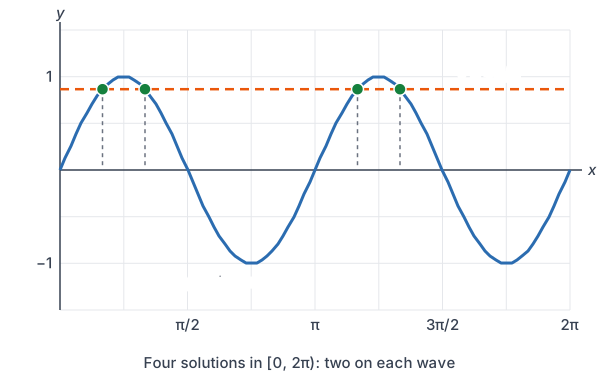
The graph of y = \sin 2x has period \pi, not 2\pi. So it fits two full waves into [0, 2\pi). Each wave can cross a horizontal line twice, so \sin 2x = \frac{\sqrt{3}}{2} has four solutions there.
The same idea works for any number k. The graph of \sin kx repeats k times in [0, 2\pi). So you can expect up to 2k solutions, two for each wave.
Steps for Trig Equations with Multiple Angles
To solve an equation like \sin kx = c on [0, 2\pi), follow these steps.
- Isolate the trig function.
- Let u = kx. Multiply the ends of the interval by k. If 0 \le x \lt 2\pi, then 0 \le u \lt 2k\pi.
- Solve for u in [0, 2\pi) with reference angles, just like in solving trig equations.
- Add 2\pi to each answer again and again, as long as it stays below 2k\pi. For tangent, add \pi instead.
- Divide every value of u by k to get x.
For the general solution, write u with + 2\pi n, then divide everything by k. For example, 2x = \frac{\pi}{3} + 2\pi n becomes x = \frac{\pi}{6} + \pi n.
Worked Examples
Example 1: Sine of 2x
Solve \sin 2x = \frac{\sqrt{3}}{2} on [0, 2\pi).
0 \le u \lt 4\pi
Let u = 2x. Multiply the interval by 2.
The reference angle is \frac{\pi}{3}, because \sin \frac{\pi}{3} = \frac{\sqrt{3}}{2}
Sine is positive in Quadrants I and II: u = \frac{\pi}{3} and u = \pi - \frac{\pi}{3} = \frac{2\pi}{3}
u = \frac{\pi}{3} + 2\pi = \frac{7\pi}{3}Add 2\pi to the first.
u = \frac{2\pi}{3} + 2\pi = \frac{8\pi}{3}Add 2\pi to the second.
Adding 2\pi again gives \frac{13\pi}{3}, which is more than 4\pi, so stop
x = \frac{\pi}{6}, \frac{\pi}{3}, \frac{7\pi}{6}, \frac{4\pi}{3}Divide each u by 2.
Answer: x = \frac{\pi}{6}, \frac{\pi}{3}, \frac{7\pi}{6}, \frac{4\pi}{3}. These are the four crossing points in the graph above.
Example 2: Cosine of 3x
Solve 2 \cos 3x + 1 = 0 on [0, 2\pi).
2 \cos 3x = -1
Subtract 1 from both sides.
\cos 3x = -\frac{1}{2}Divide both sides by 2.
0 \le u \lt 6\pi
Let u = 3x. Multiply the interval by 3.
The reference angle is \frac{\pi}{3}. Cosine is negative in Quadrants II and III: u = \pi - \frac{\pi}{3} = \frac{2\pi}{3} and u = \pi + \frac{\pi}{3} = \frac{4\pi}{3}
Add 2\pi to each: u = \frac{8\pi}{3} and u = \frac{10\pi}{3}
Add 2\pi again: u = \frac{14\pi}{3} and u = \frac{16\pi}{3}. Both are less than 6\pi = \frac{18\pi}{3}
x = \frac{2\pi}{9}, \frac{4\pi}{9}, \frac{8\pi}{9}, \frac{10\pi}{9}, \frac{14\pi}{9}, \frac{16\pi}{9}Divide each u by 3.
Answer: six solutions, x = \frac{2\pi}{9}, \frac{4\pi}{9}, \frac{8\pi}{9}, \frac{10\pi}{9}, \frac{14\pi}{9}, \frac{16\pi}{9}. Three waves give two crossings each.
Example 3: A half angle
Solve \tan \frac{x}{2} = 1 on [0, 2\pi), and give the general solution.
0 \le u \lt \pi
Let u = \frac{x}{2}. Multiply the interval by \frac{1}{2}.
The reference angle is \frac{\pi}{4}, because \tan \frac{\pi}{4} = 1
Tangent is positive in Quadrants I and III, but \pi + \frac{\pi}{4} = \frac{5\pi}{4} is not less than \pi. So the only value is u = \frac{\pi}{4}
x = \frac{\pi}{2}Multiply u by 2.
\frac{x}{2} = \frac{\pi}{4} + \pi nGeneral solution for u.
x = \frac{\pi}{2} + 2\pi nMultiply both sides by 2.
Answer: x = \frac{\pi}{2} on [0, 2\pi). A fraction inside makes the graph stretch out, so there are fewer solutions, not more.
Example 4: A multiple angle with a shift
Solve 2 \sin(2x - \frac{\pi}{3}) = 1 on [0, 2\pi).
\sin(2x - \frac{\pi}{3}) = \frac{1}{2}Divide both sides by 2.
0 \le 2x \lt 4\pi
Let u = 2x - \frac{\pi}{3}. Multiply the interval by 2.
-\frac{\pi}{3} \le u \lt \frac{11\pi}{3}Subtract \frac{\pi}{3} from each part.
Sine is \frac{1}{2} at u = \frac{\pi}{6} and u = \frac{5\pi}{6}
Add 2\pi to each: u = \frac{13\pi}{6} and u = \frac{17\pi}{6}. Both are less than \frac{11\pi}{3} = \frac{22\pi}{6}
Check below the interval: \frac{5\pi}{6} - 2\pi = -\frac{7\pi}{6}, which is less than -\frac{\pi}{3}, so it does not count
2x = \frac{3\pi}{6}, \frac{7\pi}{6}, \frac{15\pi}{6}, \frac{19\pi}{6}Add \frac{\pi}{3} = \frac{2\pi}{6} to each u (see adding and subtracting fractions)
2x = \frac{\pi}{2}, \frac{7\pi}{6}, \frac{5\pi}{2}, \frac{19\pi}{6}Simplify.
x = \frac{\pi}{4}, \frac{7\pi}{12}, \frac{5\pi}{4}, \frac{19\pi}{12}Divide each by 2.
Answer: x = \frac{\pi}{4}, \frac{7\pi}{12}, \frac{5\pi}{4}, \frac{19\pi}{12}. The shift moves the interval for u, which is covered in phase shift.
Example 5: Word problem with a spring
A weight bounces on a spring. Its position is y = 5 \cos(2\pi t) centimeters from rest, t seconds after release. During the first 2 seconds, 0 \le t \lt 2, when is the weight 2.5 cm above rest?
5 \cos(2\pi t) = 2.5
Set the position to 2.5.
\cos(2\pi t) = \frac{1}{2}Divide both sides by 5.
0 \le u \lt 4\pi
Let u = 2\pi t. Multiply the interval by 2\pi.
Cosine is positive in Quadrants I and IV: u = \frac{\pi}{3} and u = 2\pi - \frac{\pi}{3} = \frac{5\pi}{3}
Add 2\pi to each: u = \frac{7\pi}{3} and u = \frac{11\pi}{3}
t = \frac{1}{6}, \frac{5}{6}, \frac{7}{6}, \frac{11}{6}Divide each u by 2\pi.
t \approx 0.17, 0.83, 1.17, 1.83
Write as decimals.
Answer: at about 0.17, 0.83, 1.17 and 1.83 seconds. The spring bounces once per second, so it passes 2.5 cm twice each second. Models like this come from sinusoidal models.
Common Mistakes
| Mistake | Example of the error | Fix |
|---|---|---|
| Not stretching the interval | For \sin 2x = \frac{\sqrt{3}}{2}, giving only x = \frac{\pi}{6}, \frac{\pi}{3} | Use 0 \le 2x \lt 4\pi and add 2\pi to find all four. |
| Dividing too early | Writing \sin x = \frac{\sqrt{3}}{4} from \sin 2x = \frac{\sqrt{3}}{2} | The 2 is inside the function. Solve for 2x first. |
| Treating \sin 2x as 2 \sin x | Rewriting \sin 2x = 1 as 2 \sin x = 1 | They are different. Use u = 2x, or the double-angle formulas. |
| Dividing only the first part of the period | 2x = \frac{\pi}{3} + 2\pi n, so x = \frac{\pi}{6} + 2\pi n | Divide every term by 2: x = \frac{\pi}{6} + \pi n. |
| Keeping values out of range | For \tan \frac{x}{2} = 1, keeping u = \frac{5\pi}{4} | Here u must be less than \pi, so only u = \frac{\pi}{4} works. |
Related Methods
Find the general solution first
You can also solve for all u at once, then divide. For \sin 2x = \frac{\sqrt{3}}{2}, write 2x = \frac{\pi}{3} + 2\pi n or 2x = \frac{2\pi}{3} + 2\pi n. Divide by 2: x = \frac{\pi}{6} + \pi n or x = \frac{\pi}{3} + \pi n. Then plug in n = 0, 1, 2, \ldots and keep the values below 2\pi.
Count the waves first
The period of \sin kx or \cos kx is \frac{2\pi}{k}, so it makes k waves in [0, 2\pi). Most values give 2 solutions per wave. This tells you how many answers to look for before you start.
Check with a graph
Graph each side as its own function and count where they cross, as in the picture above. Use radian mode, and make sure the window shows all of [0, 2\pi).
Practice Problems
- Solve \sin 2x = 1 on [0, 2\pi).
- Solve \cos 2x = \frac{1}{2} on [0, 2\pi).
- Solve \tan 2x = 1 on [0, 2\pi).
- Solve 2 \sin 3x = \sqrt{2} on [0, 2\pi).
- Solve \sin \frac{x}{2} = \frac{1}{2} on [0, 2\pi).
- Solve \sin 4x = 0 on [0, 2\pi).
- Solve 2 \cos 2x + \sqrt{3} = 0 on [0, 2\pi).
- Write the general solution of \sin 3x = -1.
- Solve \cos(2x + \frac{\pi}{3}) = \frac{1}{2} on [0, 2\pi).
- A wave machine makes the water height h = 0.5 \sin(\pi t) + 2 meters, t seconds after it starts. During the first 4 seconds, 0 \le t \lt 4, when is the height 2.25 meters?
Show answers
1.
Let u = 2x, so 0 \le u \lt 4\pi
Sine is 1 at u = \frac{\pi}{2}
u = \frac{5\pi}{2}Add 2\pi.
x = \frac{\pi}{4}, \frac{5\pi}{4}Divide by 2.
Answer: x = \frac{\pi}{4}, \frac{5\pi}{4}
2.
Let u = 2x, so 0 \le u \lt 4\pi
Cosine is positive in Quadrants I and IV: u = \frac{\pi}{3} and u = 2\pi - \frac{\pi}{3} = \frac{5\pi}{3}
u = \frac{7\pi}{3}, \frac{11\pi}{3}Add 2\pi to each.
x = \frac{\pi}{6}, \frac{5\pi}{6}, \frac{7\pi}{6}, \frac{11\pi}{6}Divide by 2.
Answer: x = \frac{\pi}{6}, \frac{5\pi}{6}, \frac{7\pi}{6}, \frac{11\pi}{6}
3.
Let u = 2x, so 0 \le u \lt 4\pi
Tangent is 1 at u = \frac{\pi}{4}, and tangent repeats every \pi
u = \frac{5\pi}{4}, \frac{9\pi}{4}, \frac{13\pi}{4}Add \pi three times.
x = \frac{\pi}{8}, \frac{5\pi}{8}, \frac{9\pi}{8}, \frac{13\pi}{8}Divide by 2.
Answer: x = \frac{\pi}{8}, \frac{5\pi}{8}, \frac{9\pi}{8}, \frac{13\pi}{8}
4.
\sin 3x = \frac{\sqrt{2}}{2}Divide both sides by 2.
Let u = 3x, so 0 \le u \lt 6\pi
Sine is positive in Quadrants I and II: u = \frac{\pi}{4} and u = \pi - \frac{\pi}{4} = \frac{3\pi}{4}
u = \frac{9\pi}{4}, \frac{11\pi}{4}Add 2\pi.
u = \frac{17\pi}{4}, \frac{19\pi}{4}Add 2\pi again.
x = \frac{\pi}{12}, \frac{\pi}{4}, \frac{3\pi}{4}, \frac{11\pi}{12}, \frac{17\pi}{12}, \frac{19\pi}{12}Divide by 3.
Answer: the six values above
5.
Let u = \frac{x}{2}, so 0 \le u \lt \pi
Sine is positive in Quadrants I and II: u = \frac{\pi}{6} and u = \pi - \frac{\pi}{6} = \frac{5\pi}{6}
Both are less than \pi, and adding 2\pi goes past \pi
x = \frac{\pi}{3}, \frac{5\pi}{3}Multiply by 2.
Answer: x = \frac{\pi}{3}, \frac{5\pi}{3}
6.
Let u = 4x, so 0 \le u \lt 8\pi
u = 0, \pi, 2\pi, 3\pi, 4\pi, 5\pi, 6\pi, 7\pi
Sine is 0 at every multiple of \pi.
x = 0, \frac{\pi}{4}, \frac{\pi}{2}, \frac{3\pi}{4}, \pi, \frac{5\pi}{4}, \frac{3\pi}{2}, \frac{7\pi}{4}Divide by 4.
Answer: those 8 values
7.
2 \cos 2x = -\sqrt{3}Subtract \sqrt{3} from both sides.
\cos 2x = -\frac{\sqrt{3}}{2}Divide both sides by 2.
Let u = 2x, so 0 \le u \lt 4\pi
Cosine is negative in Quadrants II and III: u = \pi - \frac{\pi}{6} = \frac{5\pi}{6} and u = \pi + \frac{\pi}{6} = \frac{7\pi}{6}
u = \frac{17\pi}{6}, \frac{19\pi}{6}Add 2\pi.
x = \frac{5\pi}{12}, \frac{7\pi}{12}, \frac{17\pi}{12}, \frac{19\pi}{12}Divide by 2.
Answer: x = \frac{5\pi}{12}, \frac{7\pi}{12}, \frac{17\pi}{12}, \frac{19\pi}{12}
8.
3x = \frac{3\pi}{2} + 2\pi nSine is -1 only at \frac{3\pi}{2} in one turn.
x = \frac{\pi}{2} + \frac{2\pi n}{3}Divide every term by 3.
Answer: x = \frac{\pi}{2} + \frac{2\pi n}{3}, where n is any integer
9.
0 \le 2x \lt 4\pi
Let u = 2x + \frac{\pi}{3}. Multiply the interval by 2.
\frac{\pi}{3} \le u \lt \frac{13\pi}{3}Add \frac{\pi}{3}.
Cosine is \frac{1}{2} at u = \frac{\pi}{3}, \frac{5\pi}{3}, \frac{7\pi}{3}, \frac{11\pi}{3} (\frac{13\pi}{3} is not included)
2x = 0, \frac{4\pi}{3}, 2\pi, \frac{10\pi}{3}Subtract \frac{\pi}{3}.
x = 0, \frac{2\pi}{3}, \pi, \frac{5\pi}{3}Divide by 2.
Answer: x = 0, \frac{2\pi}{3}, \pi, \frac{5\pi}{3}
10.
0.5 \sin(\pi t) + 2 = 2.25
Set the height to 2.25.
0.5 \sin(\pi t) = 0.25
Subtract 2 from both sides.
\sin(\pi t) = \frac{1}{2}Divide both sides by 0.5.
Let u = \pi t, so 0 \le u \lt 4\pi
u = \frac{13\pi}{6}, \frac{17\pi}{6}u = \frac{\pi}{6}, \frac{5\pi}{6}, then add 2\pi.
t = \frac{1}{6}, \frac{5}{6}, \frac{13}{6}, \frac{17}{6}Divide by \pi.
Answer: at about 0.17, 0.83, 2.17 and 2.83 seconds
FAQ
How do you solve trig equations with multiple angles?
Replace the angle with u, multiply the interval by the same number, and find every value of u in that bigger interval. Then divide each value by the number to get x.
Why does sin 2x have more solutions than sin x?
The graph of \sin 2x repeats twice as fast. It makes two waves in [0, 2\pi) instead of one, so it usually crosses a horizontal line four times instead of two.
Is sin 2x the same as 2 sin x?
No. For example, at x = \frac{\pi}{2}, \sin 2x = \sin \pi = 0, but 2 \sin x = 2. The double-angle formula says \sin 2x = 2 \sin x \cos x.
How do you find the general solution with a multiple angle?
Write the general solution for the whole angle, then divide every term by the number in front of x. For 3x = \frac{\pi}{2} + 2\pi n, you get x = \frac{\pi}{6} + \frac{2\pi n}{3}.
Summary
- Let u = kx and multiply the interval by k.
- Find every u in the new interval by adding 2\pi (or \pi for tangent).
- Divide each value of u by k to get x.
- A whole number k gives more solutions. A fraction gives fewer.
- For the general solution, divide every term, including 2\pi n, by k.
Previous lesson: Solving Trig Equations
Next lesson: Solving Trig Equations with Identities
Back to the Trigonometry Index