
Double-Angle Formulas
The double-angle formulas rewrite trig functions of 2\theta in terms of \theta: \sin 2\theta = 2 \sin \theta \cos \theta, \cos 2\theta = \cos^2 \theta - \sin^2 \theta and \tan 2\theta = \frac{2 \tan \theta}{1 - \tan^2 \theta}. Cosine also has two other forms, 2\cos^2 \theta - 1 and 1 - 2\sin^2 \theta. These formulas all come from the sum formulas. They help you find exact values, simplify expressions and solve trig equations.
Before this lesson: You should know Sum and Difference Formulas and Fundamental Trig Identities.
Where the Formulas Come From
Doubling an angle does not double its sine. For example, \sin 60^\circ \approx 0.866, but 2 \sin 30^\circ = 1. To get the right formula, write 2\theta as \theta + \theta and use the sum formula:
\sin(\theta + \theta) = \sin \theta \cos \theta + \cos \theta \sin \theta = 2 \sin \theta \cos \theta
The same trick with the cosine sum formula gives \cos 2\theta = \cos^2 \theta - \sin^2 \theta. Replacing \sin^2 \theta or \cos^2 \theta with a Pythagorean identity gives the other two forms.
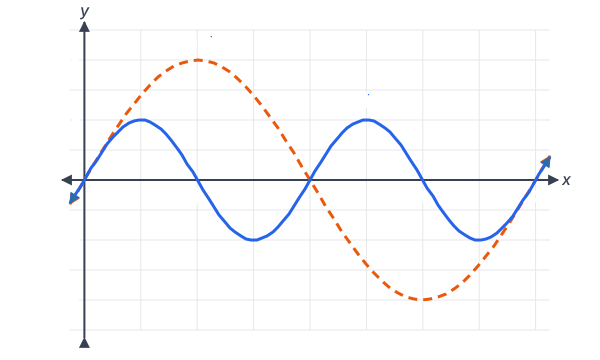
The Double-Angle Formulas
| Function | Formula |
|---|---|
| \sin 2\theta | 2 \sin \theta \cos \theta |
| \cos 2\theta | \cos^2 \theta - \sin^2 \theta |
| \cos 2\theta | 2\cos^2 \theta - 1 |
| \cos 2\theta | 1 - 2\sin^2 \theta |
| \tan 2\theta | \frac{2 \tan \theta}{1 - \tan^2 \theta} |
- Find \sin \theta, \cos \theta or \tan \theta, using the quadrant to choose signs.
- Choose the formula that uses the values you have. For cosine, pick the form with only sine or only cosine if that is all you know.
- Substitute and simplify.
- Check the sign: the quadrant of 2\theta decides the sign of the answer.
Worked Examples
Example 1: All three double-angle values
If \sin \theta = \frac{3}{5} and \theta is in Quadrant I, find \sin 2\theta, \cos 2\theta and \tan 2\theta.
\cos \theta = \sqrt{1 - \frac{9}{25}} = \frac{4}{5}Find cosine with the Pythagorean identity.
\sin 2\theta = 2 \cdot \frac{3}{5} \cdot \frac{4}{5} = \frac{24}{25}Use the sine formula.
\cos 2\theta = (\frac{4}{5})^2 - (\frac{3}{5})^2 = \frac{16}{25} - \frac{9}{25} = \frac{7}{25}Use the cosine formula.
\tan 2\theta = \frac{\sin 2\theta}{\cos 2\theta} = \frac{\frac{24}{25}}{\frac{7}{25}} = \frac{24}{7}Divide for tangent.
Answer: \sin 2\theta = \frac{24}{25}, \cos 2\theta = \frac{7}{25}, \tan 2\theta = \frac{24}{7}
Example 2: An angle in Quadrant II
If \cos \theta = -\frac{5}{13} and \theta is in Quadrant II, find \sin 2\theta and \cos 2\theta.
\sin \theta = \sqrt{1 - \frac{25}{169}} = \sqrt{\frac{144}{169}} = \frac{12}{13}Find sine, positive in Quadrant II.
\sin 2\theta = 2 \cdot \frac{12}{13} \cdot (-\frac{5}{13})Use the sine formula.
\sin 2\theta = -\frac{120}{169}Multiply.
\cos 2\theta = 2(-\frac{5}{13})^2 - 1Use the cosine-only form.
\cos 2\theta = 2 \cdot \frac{25}{169} - 1 = \frac{50}{169} - \frac{169}{169}Square.
\cos 2\theta = -\frac{119}{169}Subtract.
Answer: \sin 2\theta = -\frac{120}{169} and \cos 2\theta = -\frac{119}{169}. Both are negative, so 2\theta is in Quadrant III.
Example 3: Collapse an expression
Find the exact values of 2 \sin 15^\circ \cos 15^\circ and \cos^2 \frac{\pi}{8} - \sin^2 \frac{\pi}{8}.
2 \sin 15^\circ \cos 15^\circ = \sin 30^\circ
The first matches 2 \sin \theta \cos \theta with \theta = 15^\circ.
\sin 30^\circ = \frac{1}{2}Evaluate.
\cos^2 \frac{\pi}{8} - \sin^2 \frac{\pi}{8} = \cos \frac{\pi}{4}The second matches \cos^2 \theta - \sin^2 \theta with \theta = \frac{\pi}{8}.
\cos \frac{\pi}{4} = \frac{\sqrt{2}}{2}Evaluate.
Answer: \frac{1}{2} and \frac{\sqrt{2}}{2}
Example 4: Verify an identity
Verify (\sin \theta + \cos \theta)^2 = 1 + \sin 2\theta.
\sin^2 \theta + 2 \sin \theta \cos \theta + \cos^2 \theta
Start with the left side and expand.
(\sin^2 \theta + \cos^2 \theta) + 2 \sin \theta \cos \theta
Group the squares.
1 + 2 \sin \theta \cos \theta
Use the Pythagorean identity.
1 + \sin 2\theta
Use the double-angle formula.
Answer: verified, using the method from verifying trig identities.
Example 5: Word problem with a projectile
A ball is kicked at 20 m/s at an angle \theta above the ground. Ignoring air resistance, it lands R = \frac{v^2 \sin 2\theta}{g} meters away, where v is the speed and g = 9.8. Find the distance when \theta = 15^\circ and when \theta = 45^\circ.
\sin 2\theta = \sin 30^\circ = 0.5
For 15°, double the angle.
R = \frac{20^2 \cdot 0.5}{9.8} = \frac{400 \cdot 0.5}{9.8} = \frac{200}{9.8} \approx 20.41Substitute.
\sin 2\theta = \sin 90^\circ = 1
For 45°, double the angle.
R = \frac{400 \cdot 1}{9.8} \approx 40.82Substitute.
Answer: about 20.41 m at 15° and 40.82 m at 45°. Because \sin 2\theta is largest when 2\theta = 90^\circ, a 45° angle gives the longest kick.
Common Mistakes
| Mistake | Example of the error | Fix |
|---|---|---|
| Doubling the sine | \sin 2\theta = 2 \sin \theta | Use \sin 2\theta = 2 \sin \theta \cos \theta. |
| Mixing up the cosine forms | \cos 2\theta = 1 - 2\cos^2 \theta | The forms are 2\cos^2 \theta - 1 and 1 - 2\sin^2 \theta. |
| Wrong sign for a missing value | Using \sin \theta = -\frac{12}{13} in Quadrant II | Sine is positive in Quadrant II. |
| Tangent formula with a plus | \tan 2\theta = \frac{2 \tan \theta}{1 + \tan^2 \theta} | The denominator is 1 - \tan^2 \theta. |
| Halving the angle when collapsing | 2 \sin 15^\circ \cos 15^\circ = \sin 7.5^\circ | The formula doubles the angle: \sin 30^\circ. |
Related Methods
Power-reducing formulas
Solving \cos 2\theta = 2\cos^2 \theta - 1 for \cos^2 \theta gives \cos^2 \theta = \frac{1 + \cos 2\theta}{2}. Similarly, \sin^2 \theta = \frac{1 - \cos 2\theta}{2}. These lead to the half-angle formulas in the next lesson.
Triple angles
You can keep going: \sin 3\theta = \sin(2\theta + \theta). Using the sum formula and the double-angle formulas gives \sin 3\theta = 3 \sin \theta - 4 \sin^3 \theta.
Solving equations
Equations like \sin 2x = \cos x become easier after rewriting \sin 2x as 2 \sin x \cos x and factoring. You will do this in the trig equations unit.
Practice Problems
- If \sin \theta = \frac{4}{5} and \theta is in Quadrant I, find \sin 2\theta.
- Use the angle in problem 1 to find \cos 2\theta.
- If \tan \theta = \frac{1}{2}, find \tan 2\theta.
- If \cos \theta = \frac{12}{13} and \theta is in Quadrant IV, find \sin 2\theta.
- Find the exact value of 2 \sin 22.5^\circ \cos 22.5^\circ.
- Find the exact value of 1 - 2\sin^2 \frac{\pi}{12}.
- Find the exact value of 2\cos^2 75^\circ - 1.
- Simplify \frac{\sin 2\theta}{2 \sin \theta}.
- Verify \cos^4 \theta - \sin^4 \theta = \cos 2\theta.
- A ball is thrown at 30 m/s at a 30° angle. Use R = \frac{v^2 \sin 2\theta}{9.8} to find how far it travels, to the nearest hundredth.
Show answers
1.
\cos \theta = \sqrt{1 - \frac{16}{25}} = \frac{3}{5}Find cosine.
\sin 2\theta = 2 \cdot \frac{4}{5} \cdot \frac{3}{5}Substitute.
\frac{24}{25}Multiply.
Answer: \frac{24}{25}
2.
\cos 2\theta = (\frac{3}{5})^2 - (\frac{4}{5})^2Substitute.
\frac{9}{25} - \frac{16}{25}Square.
-\frac{7}{25}Subtract.
Answer: -\frac{7}{25}
3.
\tan 2\theta = \frac{2 \cdot \frac{1}{2}}{1 - (\frac{1}{2})^2}Substitute.
\frac{1}{1 - \frac{1}{4}} = \frac{1}{\frac{3}{4}}Simplify the top and bottom.
\frac{4}{3}Divide.
Answer: \frac{4}{3}
4.
\sin \theta = -\sqrt{1 - \frac{144}{169}} = -\frac{5}{13}Find sine, negative in Quadrant IV.
\sin 2\theta = 2 \cdot (-\frac{5}{13}) \cdot \frac{12}{13}Substitute.
-\frac{120}{169}Multiply.
Answer: -\frac{120}{169}
5.
\sin(2 \cdot 22.5^\circ) = \sin 45^\circ
It matches 2 \sin \theta \cos \theta.
\frac{\sqrt{2}}{2}Evaluate.
Answer: \frac{\sqrt{2}}{2}
6.
\cos(2 \cdot \frac{\pi}{12}) = \cos \frac{\pi}{6}It matches 1 - 2\sin^2 \theta.
\frac{\sqrt{3}}{2}Evaluate.
Answer: \frac{\sqrt{3}}{2}
7.
\cos(2 \cdot 75^\circ) = \cos 150^\circ
It matches 2\cos^2 \theta - 1.
-\frac{\sqrt{3}}{2}Use the reference angle 30° in Quadrant II.
Answer: -\frac{\sqrt{3}}{2}
8.
\frac{2 \sin \theta \cos \theta}{2 \sin \theta}Use the formula.
\cos \theta
Cancel 2 \sin \theta.
Answer: \cos \theta
9.
(\cos^2 \theta - \sin^2 \theta)(\cos^2 \theta + \sin^2 \theta)
Factor as a difference of squares.
(\cos^2 \theta - \sin^2 \theta) \cdot 1
Use the Pythagorean identity.
\cos 2\theta
Use the double-angle formula.
Answer: verified
10.
\sin 60^\circ \approx 0.86603
Double the angle.
R = \frac{900 \cdot 0.86603}{9.8}Substitute.
R \approx 79.53
Multiply and divide.
Answer: about 79.53 meters
FAQ
What is the double-angle formula for sine?
\sin 2\theta = 2 \sin \theta \cos \theta. It comes from the sum formula with both angles equal to \theta.
What are the three forms of cos 2θ?
\cos^2 \theta - \sin^2 \theta, 2\cos^2 \theta - 1 and 1 - 2\sin^2 \theta. They are equal because \sin^2 \theta + \cos^2 \theta = 1.
Is sin 2x the same as 2 sin x?
No. For x = 90^\circ, \sin 180^\circ = 0 but 2 \sin 90^\circ = 2. Doubling the angle is different from doubling the value.
Which cos 2θ formula should I use?
Use the form that matches what you know. If you only know \cos \theta, use 2\cos^2 \theta - 1; if you only know \sin \theta, use 1 - 2\sin^2 \theta.
Summary
- \sin 2\theta = 2 \sin \theta \cos \theta.
- \cos 2\theta = \cos^2 \theta - \sin^2 \theta = 2\cos^2 \theta - 1 = 1 - 2\sin^2 \theta.
- \tan 2\theta = \frac{2 \tan \theta}{1 - \tan^2 \theta}.
- All of them come from the sum formulas with A = B = \theta.
- \sin 2\theta is not 2 \sin \theta.
Previous lesson: Sum and Difference Formulas
Next lesson: Half-Angle Formulas
Back to the Trigonometry Index