
Reference Angles
A reference angle is the acute angle between an angle’s terminal side and the x-axis. Any trig value of an angle equals the trig value of its reference angle, with a plus or minus sign set by the quadrant. For example, 150° has a reference angle of 30°, so \sin 150^\circ = \sin 30^\circ = \frac{1}{2}.
Before this lesson: You should know Trig Functions of Any Angle, Trig Values of Special Angles and Coterminal Angles.
Why Reference Angles Work
Draw 150° in standard position. Its terminal side is 30° above the negative x-axis. Now draw 30°. Its terminal side is 30° above the positive x-axis. The two sides are mirror images across the y-axis.
A point on the 150° side, like (-\sqrt{3}, 1), matches a point on the 30° side, (\sqrt{3}, 1), except for the sign of x. So the trig values of 150° and 30° are the same size. Only the signs can differ, and the quadrant tells you the sign.
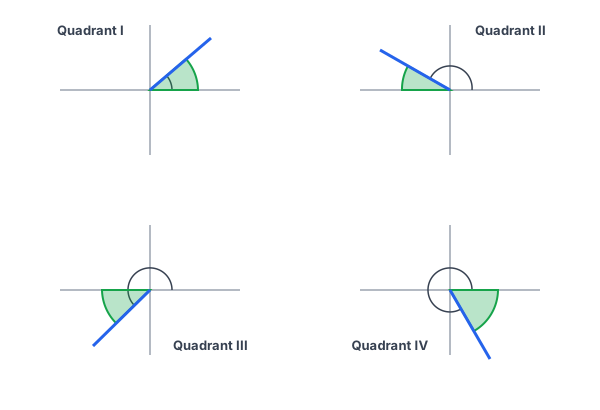
Reference Angle Formulas
| Quadrant of θ | Reference angle (degrees) | Reference angle (radians) |
|---|---|---|
| I | \theta | \theta |
| II | 180^\circ - \theta | \pi - \theta |
| III | \theta - 180^\circ | \theta - \pi |
| IV | 360^\circ - \theta | 2\pi - \theta |
- If the angle is not between 0° and 360°, find a coterminal angle that is.
- Find the quadrant of the terminal side.
- Use the formula for that quadrant to find the reference angle.
- Find the trig value of the reference angle.
- Attach the sign for the quadrant (All Students Take Calculus).
Worked Examples
Example 1: A Quadrant II angle
Find the reference angle of 150° and the exact value of \sin 150^\circ.
Find the quadrant: 90^\circ \lt 150^\circ \lt 180^\circ, so Quadrant II
180^\circ - 150^\circ = 30^\circ
Use the Quadrant II formula.
\sin 30^\circ = \frac{1}{2}Find the value for the reference angle.
\sin 150^\circ = \frac{1}{2}Sine is positive in Quadrant II.
Answer: reference angle 30°, and \sin 150^\circ = \frac{1}{2}
Example 2: A Quadrant III angle
Find the exact value of \cos 225^\circ.
Find the quadrant: 180^\circ \lt 225^\circ \lt 270^\circ, so Quadrant III
225^\circ - 180^\circ = 45^\circ
Use the Quadrant III formula.
\cos 45^\circ = \frac{\sqrt{2}}{2}Find the value for the reference angle.
\cos 225^\circ = -\frac{\sqrt{2}}{2}Cosine is negative in Quadrant III.
Answer: \cos 225^\circ = -\frac{\sqrt{2}}{2}
Example 3: An angle in radians
Find the exact value of \tan \frac{5\pi}{3}.
Find the quadrant: \frac{5\pi}{3} is between \frac{3\pi}{2} and 2\pi, so Quadrant IV
2\pi - \frac{5\pi}{3}Use the Quadrant IV formula.
\frac{6\pi}{3} - \frac{5\pi}{3} = \frac{\pi}{3}Rewrite 2\pi with denominator 3.
\tan \frac{\pi}{3} = \sqrt{3}Find the value for the reference angle.
\tan \frac{5\pi}{3} = -\sqrt{3}Tangent is negative in Quadrant IV.
Answer: \tan \frac{5\pi}{3} = -\sqrt{3}
Example 4: A negative angle
Find the exact value of \sin(-120^\circ).
-120^\circ + 360^\circ = 240^\circ
Find a coterminal angle (see coterminal angles)
Find the quadrant: 180^\circ \lt 240^\circ \lt 270^\circ, so Quadrant III
240^\circ - 180^\circ = 60^\circ
Use the Quadrant III formula.
\sin 60^\circ = \frac{\sqrt{3}}{2}Find the value for the reference angle.
\sin(-120^\circ) = -\frac{\sqrt{3}}{2}Sine is negative in Quadrant III.
Answer: \sin(-120^\circ) = -\frac{\sqrt{3}}{2}
Example 5: Word problem with a robot arm
A robot arm 2 meters long pivots at the origin. It turns 210° counterclockwise from the positive x-axis. Find the exact coordinates of the tip of the arm, (2 \cos 210^\circ, 2 \sin 210^\circ).
Find the quadrant: 180^\circ \lt 210^\circ \lt 270^\circ, so Quadrant III
210^\circ - 180^\circ = 30^\circ
Find the reference angle.
\cos 210^\circ = -\cos 30^\circ = -\frac{\sqrt{3}}{2}Cosine is negative in Quadrant III.
\sin 210^\circ = -\sin 30^\circ = -\frac{1}{2}Sine is negative in Quadrant III.
2 \cos 210^\circ = 2 \cdot (-\frac{\sqrt{3}}{2}) = -\sqrt{3}Find x.
2 \sin 210^\circ = 2 \cdot (-\frac{1}{2}) = -1Find y.
Answer: The tip is at (-\sqrt{3}, -1) \approx (-1.73, -1), below and to the left of the pivot.
Common Mistakes
| Mistake | Example of the error | Fix |
|---|---|---|
| Measuring to the y-axis | Reference angle of 150° is 60° (to the y-axis) | Always measure to the x-axis: 180^\circ - 150^\circ = 30^\circ. |
| Using the wrong quadrant formula | Reference angle of 225° is 180^\circ - 225^\circ = -45^\circ | In Quadrant III, use \theta - 180^\circ = 45^\circ. A reference angle is never negative. |
| Forgetting the sign | \cos 225^\circ = \frac{\sqrt{2}}{2} | Cosine is negative in Quadrant III: -\frac{\sqrt{2}}{2}. |
| Mixing degrees and radians | Reference angle of \frac{5\pi}{3} is 360^\circ - \frac{5\pi}{3} | Use 2\pi - \frac{5\pi}{3} = \frac{\pi}{3} in radians. |
| Skipping the coterminal step | Using 180^\circ - (-120^\circ) for −120° | First add 360° to get 240°, then use the Quadrant III formula. |
Related Methods
Picture the nearest x-axis
You don’t need the formulas if you sketch the angle. Ask how far the terminal side is from the closer side of the x-axis. For 300°, it is 60° short of 360°, so the reference angle is 60°.
Non-special angles
Reference angles work for any angle, not just special ones. For example, \cos 160^\circ = -\cos 20^\circ \approx -0.9397. A calculator gives this directly, but the reference angle explains the sign.
The unit circle
The next lesson puts all the special angles and their reference angles on one circle of radius 1, so you can read sine and cosine values at a glance.
Practice Problems
- Find the reference angle of 160°.
- Find the reference angle of 250°.
- Find the reference angle of 315°.
- Find the reference angle of \frac{7\pi}{6}.
- Find the reference angle of \frac{3\pi}{4}.
- Find the exact value of \sin 300^\circ.
- Find the exact value of \cos 135^\circ.
- Find the exact value of \tan 240^\circ.
- Find the exact value of \sin 495^\circ.
- The minute hand of a clock is 10 centimeters long. At one moment, it points at 330° in standard position, with its center at the origin. Find the exact coordinates of its tip, (10 \cos 330^\circ, 10 \sin 330^\circ).
Show answers
1.
180^\circ - 160^\circ = 20^\circ
Quadrant II: subtract the angle from 180°.
Answer: 20°
2.
250^\circ - 180^\circ = 70^\circ
Quadrant III: subtract 180° from the angle.
Answer: 70°
3.
360^\circ - 315^\circ = 45^\circ
Quadrant IV: subtract the angle from 360°.
Answer: 45°
4.
Quadrant III, since \pi \lt \frac{7\pi}{6} \lt \frac{3\pi}{2}
\frac{7\pi}{6} - \pi = \frac{7\pi}{6} - \frac{6\pi}{6} = \frac{\pi}{6}Subtract.
Answer: \frac{\pi}{6}
5.
Quadrant II, since \frac{\pi}{2} \lt \frac{3\pi}{4} \lt \pi
\pi - \frac{3\pi}{4} = \frac{4\pi}{4} - \frac{3\pi}{4} = \frac{\pi}{4}Subtract.
Answer: \frac{\pi}{4}
6.
Quadrant IV: reference angle 360^\circ - 300^\circ = 60^\circ
\sin 60^\circ = \frac{\sqrt{3}}{2}Find the value for the reference angle.
Sine is negative in Quadrant IV
Answer: \sin 300^\circ = -\frac{\sqrt{3}}{2}
7.
Quadrant II: reference angle 180^\circ - 135^\circ = 45^\circ
\cos 45^\circ = \frac{\sqrt{2}}{2}Find the value for the reference angle.
Cosine is negative in Quadrant II
Answer: \cos 135^\circ = -\frac{\sqrt{2}}{2}
8.
Quadrant III: reference angle 240^\circ - 180^\circ = 60^\circ
\tan 60^\circ = \sqrt{3}Find the value for the reference angle.
Tangent is positive in Quadrant III
Answer: \tan 240^\circ = \sqrt{3}
9.
495^\circ - 360^\circ = 135^\circ
Find a coterminal angle.
Quadrant II: reference angle 180^\circ - 135^\circ = 45^\circ
Value: \sin 45^\circ = \frac{\sqrt{2}}{2}, and sine is positive in Quadrant II
Answer: \sin 495^\circ = \frac{\sqrt{2}}{2}
10.
Quadrant IV: reference angle 360^\circ - 330^\circ = 30^\circ
\cos 330^\circ = \cos 30^\circ = \frac{\sqrt{3}}{2}Cosine is positive.
\sin 330^\circ = -\sin 30^\circ = -\frac{1}{2}Sine is negative.
10 \cdot \frac{\sqrt{3}}{2} = 5\sqrt{3}Find x.
10 \cdot (-\frac{1}{2}) = -5Find y.
Answer: (5\sqrt{3}, -5) \approx (8.66, -5)
FAQ
What is a reference angle?
It is the acute angle between the terminal side of an angle and the x-axis. It is always between 0° and 90°, or 0 and \frac{\pi}{2}.
How do you find a reference angle in radians?
Use \theta in Quadrant I, \pi - \theta in Quadrant II, \theta - \pi in Quadrant III and 2\pi - \theta in Quadrant IV.
Can a reference angle be negative?
No. A reference angle is a size, so it is always positive. For a negative angle, find a positive coterminal angle first.
Why do we use reference angles?
They let you find the trig value of any angle from the values of acute angles. You only need to memorize the special angles from 0° to 90° and the sign rules.
Summary
- The reference angle is the acute angle from the terminal side to the x-axis.
- Quadrant II: 180^\circ - \theta; Quadrant III: \theta - 180^\circ; Quadrant IV: 360^\circ - \theta.
- In radians, replace 180° with \pi and 360° with 2\pi.
- A trig value of \theta equals the value of its reference angle, with the sign for the quadrant.
- For angles outside 0° to 360°, find a coterminal angle first.
Previous lesson: Trig Functions of Any Angle
Next lesson: The Unit Circle
Back to the Trigonometry Index