
Trig Values of Special Angles
The trig values of special angles are the exact values of the six trig functions at 30°, 45° and 60°, or \frac{\pi}{6}, \frac{\pi}{4} and \frac{\pi}{3} in radians. They come from two special right triangles. For example, \sin 30^\circ = \frac{1}{2}, \cos 45^\circ = \frac{\sqrt{2}}{2} and \tan 60^\circ = \sqrt{3}.
Before this lesson: You should know Six Trigonometric Functions, Special Right Triangles and Radians.
Where the Exact Values Come From
A calculator gives \sin 30^\circ = 0.5 but \sin 60^\circ \approx 0.8660, a rounded decimal. Exact values keep the square roots, so they never lose accuracy. They come from the two triangles in special right triangles:
- 45°-45°-90° triangle: legs of 1 and 1, hypotenuse \sqrt{2}.
- 30°-60°-90° triangle: short leg 1 (across from 30°), long leg \sqrt{3} (across from 60°), hypotenuse 2.
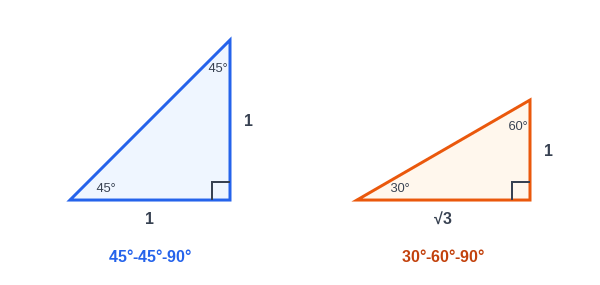
Table of Special Angle Values
| Angle | \sin | \cos | \tan | \csc | \sec | \cot |
|---|---|---|---|---|---|---|
| 30^\circ = \frac{\pi}{6} | \frac{1}{2} | \frac{\sqrt{3}}{2} | \frac{\sqrt{3}}{3} | 2 | \frac{2\sqrt{3}}{3} | \sqrt{3} |
| 45^\circ = \frac{\pi}{4} | \frac{\sqrt{2}}{2} | \frac{\sqrt{2}}{2} | 1 | \sqrt{2} | \sqrt{2} | 1 |
| 60^\circ = \frac{\pi}{3} | \frac{\sqrt{3}}{2} | \frac{1}{2} | \sqrt{3} | \frac{2\sqrt{3}}{3} | 2 | \frac{\sqrt{3}}{3} |
A memory pattern: the sines of 30°, 45° and 60° are \frac{\sqrt{1}}{2}, \frac{\sqrt{2}}{2} and \frac{\sqrt{3}}{2}. The cosines are the same list in reverse order, because 30° and 60° are complementary.
- Pick the triangle: 45°-45°-90° for 45°, or 30°-60°-90° for 30° and 60°.
- Label the sides opposite and adjacent to your angle.
- Write the ratio for the function you need.
- Rationalize any square root in the denominator.
Worked Examples
Example 1: Sine, cosine and tangent of 60°
Find the exact values of \sin 60^\circ, \cos 60^\circ and \tan 60^\circ.
Use the 30°-60°-90° triangle. From the 60° angle, opposite = \sqrt{3}, adjacent = 1, hypotenuse = 2.
\sin 60^\circ = \frac{\sqrt{3}}{2}Sine is opposite over hypotenuse.
\cos 60^\circ = \frac{1}{2}Cosine is adjacent over hypotenuse.
\tan 60^\circ = \frac{\sqrt{3}}{1} = \sqrt{3}Tangent is opposite over adjacent.
Answer: \sin 60^\circ = \frac{\sqrt{3}}{2}, \cos 60^\circ = \frac{1}{2}, \tan 60^\circ = \sqrt{3}
Example 2: All six functions of π/4
Find all six trig functions of \frac{\pi}{4}.
Convert to degrees: \frac{\pi}{4} = 45^\circ, so use the 45°-45°-90° triangle with opposite = 1, adjacent = 1, hypotenuse = \sqrt{2}.
\sin \frac{\pi}{4} = \frac{1}{\sqrt{2}}Write sine.
\frac{1}{\sqrt{2}} \cdot \frac{\sqrt{2}}{\sqrt{2}} = \frac{\sqrt{2}}{2}Rationalize.
\cos \frac{\pi}{4} = \frac{\sqrt{2}}{2}Cosine uses the same sides.
\tan \frac{\pi}{4} = \frac{1}{1} = 1Write tangent.
\csc \frac{\pi}{4} = \frac{\sqrt{2}}{1} = \sqrt{2}Flip sine.
\sec \frac{\pi}{4} = \sqrt{2}Flip cosine.
\cot \frac{\pi}{4} = 1Flip tangent.
Answer: \frac{\sqrt{2}}{2}, \frac{\sqrt{2}}{2}, 1, \sqrt{2}, \sqrt{2}, 1
Example 3: Evaluate an expression exactly
Find the exact value of 2 \sin 30^\circ + \tan^2 60^\circ.
2 \cdot \frac{1}{2} + (\sqrt{3})^2Substitute the special values.
2 \cdot \frac{1}{2} = 1Multiply.
(\sqrt{3})^2 = 3Square the root.
1 + 3 = 4
Add.
Answer: 4. The notation \tan^2 60^\circ means (\tan 60^\circ)^2.
Example 4: Reciprocal functions in radians
Find the exact values of \sec \frac{\pi}{6} and \cot \frac{\pi}{3}.
Convert: \frac{\pi}{6} = 30^\circ and \frac{\pi}{3} = 60^\circ
\sec 30^\circ = \frac{1}{\cos 30^\circ} = \frac{1}{\frac{\sqrt{3}}{2}}Use the reciprocal of cosine.
\frac{1}{\frac{\sqrt{3}}{2}} = \frac{2}{\sqrt{3}}Divide by multiplying by the reciprocal.
\frac{2}{\sqrt{3}} \cdot \frac{\sqrt{3}}{\sqrt{3}} = \frac{2\sqrt{3}}{3}Rationalize (see rationalizing the denominator)
\cot 60^\circ = \frac{1}{\sqrt{3}}Use adjacent over opposite for 60°.
\frac{1}{\sqrt{3}} \cdot \frac{\sqrt{3}}{\sqrt{3}} = \frac{\sqrt{3}}{3}Rationalize.
Answer: \sec \frac{\pi}{6} = \frac{2\sqrt{3}}{3} and \cot \frac{\pi}{3} = \frac{\sqrt{3}}{3}
Example 5: Word problem with a ladder
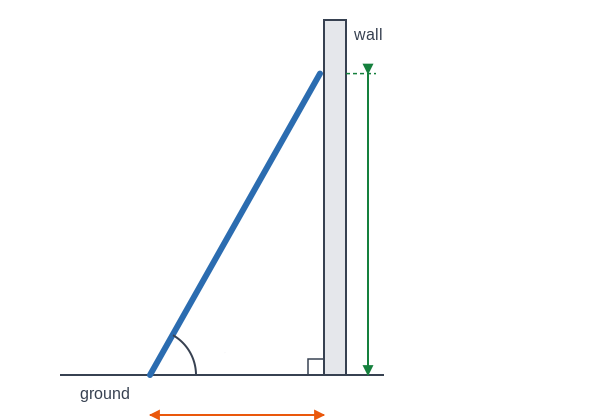
A 12-foot ladder leans against a wall and makes a 60° angle with the ground. How high up the wall does it reach, and how far is its base from the wall? Give exact answers, then decimals.
\sin 60^\circ = \frac{h}{12}The ladder is the hypotenuse. The height is opposite the 60° angle, so use sine.
h = 12 \sin 60^\circ
Multiply both sides by 12.
h = 12 \cdot \frac{\sqrt{3}}{2}Substitute the exact value.
h = 6\sqrt{3} \approx 10.39Simplify.
\cos 60^\circ = \frac{d}{12}The base distance is adjacent, so use cosine.
d = 12 \cdot \frac{1}{2} = 6Multiply both sides by 12 and substitute.
Answer: The ladder reaches 6\sqrt{3} \approx 10.39 feet up the wall, and its base is 6 feet from the wall.
Common Mistakes
| Mistake | Example of the error | Fix |
|---|---|---|
| Swapping sine and cosine of 30° and 60° | \sin 30^\circ = \frac{\sqrt{3}}{2} | The side across from 30° is the short leg, 1: \sin 30^\circ = \frac{1}{2}. |
| Putting the long leg across from 30° | Labeling the side opposite 30° as \sqrt{3} | The shortest side is always across from the smallest angle. |
| Leaving a root in the denominator | \tan 30^\circ = \frac{1}{\sqrt{3}} | Rationalize: \frac{\sqrt{3}}{3}. |
| Reading tan² as tan of 2θ | \tan^2 60^\circ = \tan 120^\circ | \tan^2 60^\circ means (\tan 60^\circ)^2 = 3. |
| Using a rounded decimal when an exact value is asked | \sin 60^\circ = 0.87 | Give \frac{\sqrt{3}}{2} unless the problem asks for a decimal. |
Related Methods
The hand trick for sine
Count up the square roots: \sin 0^\circ = \frac{\sqrt{0}}{2}, \sin 30^\circ = \frac{\sqrt{1}}{2}, \sin 45^\circ = \frac{\sqrt{2}}{2}, \sin 60^\circ = \frac{\sqrt{3}}{2}, \sin 90^\circ = \frac{\sqrt{4}}{2}. The cosines run the same list backward.
Finding the angle from a value
The table also works in reverse. If \theta is acute and \cos \theta = \frac{\sqrt{2}}{2}, then \theta = 45^\circ. This is the idea behind inverse trig functions later in the course.
Angles beyond the first quadrant
Special values also give exact values for angles like 150°, 225° and 300°. You will use reference angles and the unit circle to find those, with the signs set by the quadrant.
Practice Problems
- Find the exact value of \cos 30^\circ.
- Find the exact value of \tan 45^\circ.
- Find the exact value of \csc 60^\circ.
- Find the exact value of \sec 45^\circ.
- Find the exact value of \cot \frac{\pi}{6}.
- Find the exact value of \sin \frac{\pi}{4} \cos \frac{\pi}{4}.
- Find the exact value of \sin^2 60^\circ + \cos^2 60^\circ.
- Find the acute angle \theta, in degrees and radians, if \cos \theta = \frac{1}{2}.
- Find the acute angle \theta, in degrees and radians, if \tan \theta = \frac{\sqrt{3}}{3}.
- A kite string is 40 meters long and makes a 30° angle with the ground. How high is the kite?
Show answers
1.
From the 30° angle, adjacent = \sqrt{3} and hypotenuse = 2
Answer: \cos 30^\circ = \frac{\sqrt{3}}{2}
2.
\tan 45^\circ = \frac{1}{1}In the 45°-45°-90° triangle the legs are equal.
Answer: 1
3.
\csc 60^\circ = \frac{1}{\sin 60^\circ} = \frac{2}{\sqrt{3}}Flip sine.
\frac{2}{\sqrt{3}} \cdot \frac{\sqrt{3}}{\sqrt{3}} = \frac{2\sqrt{3}}{3}Rationalize.
Answer: \frac{2\sqrt{3}}{3}
4.
\sec 45^\circ = \frac{\sqrt{2}}{1}Flip cosine.
Answer: \sqrt{2}
5.
\frac{\pi}{6} = 30^\circConvert.
\cot 30^\circ = \frac{\sqrt{3}}{1}Adjacent over opposite.
Answer: \sqrt{3}
6.
\frac{\sqrt{2}}{2} \cdot \frac{\sqrt{2}}{2}Substitute.
\sqrt{2} \cdot \sqrt{2} = 2Multiply the tops (see multiplying radicals)
2 \cdot 2 = 4
Multiply the bottoms.
\frac{2}{4} = \frac{1}{2}Simplify.
Answer: \frac{1}{2}
7.
(\frac{\sqrt{3}}{2})^2 + (\frac{1}{2})^2Substitute.
\frac{3}{4} + \frac{1}{4}Square each.
\frac{4}{4} = 1Add.
Answer: 1
8.
In the table, cosine is \frac{1}{2} at 60°
60^\circ = \frac{\pi}{3}Convert.
Answer: \theta = 60^\circ = \frac{\pi}{3}
9.
In the table, tangent is \frac{\sqrt{3}}{3} at 30°
30^\circ = \frac{\pi}{6}Convert.
Answer: \theta = 30^\circ = \frac{\pi}{6}
10.
\sin 30^\circ = \frac{h}{40}The height is opposite the 30° angle.
h = 40 \sin 30^\circ
Multiply both sides by 40.
h = 40 \cdot \frac{1}{2} = 20Substitute.
Answer: 20 meters
Want more practice? The Trigonometry Unit 2 Practice Pack has 26 pages of problems on this and the other lessons in the unit. Every answer is worked step by step, and the steps link to the lessons that teach them. A cheat sheet is included.
FAQ
What are the special angles in trigonometry?
They are 30°, 45° and 60°, or \frac{\pi}{6}, \frac{\pi}{4} and \frac{\pi}{3}. Their trig values can be written exactly with square roots.
What is the exact value of sin 60°?
\sin 60^\circ = \frac{\sqrt{3}}{2}, which is about 0.866. It comes from the 30°-60°-90° triangle: the side across from 60° is \sqrt{3} and the hypotenuse is 2.
How do you remember the special angle values?
Remember the two triangles, or the pattern \frac{\sqrt{1}}{2}, \frac{\sqrt{2}}{2}, \frac{\sqrt{3}}{2} for the sines of 30°, 45° and 60°. The cosines are the same values in reverse.
Why is tan 45° equal to 1?
In a 45°-45°-90° triangle the two legs are equal. Tangent is opposite over adjacent, so it is a number divided by itself, which is 1.
Summary
- The special angles are 30°, 45° and 60° (\frac{\pi}{6}, \frac{\pi}{4}, \frac{\pi}{3}).
- Their values come from the 45°-45°-90° and 30°-60°-90° triangles.
- \sin 30^\circ = \cos 60^\circ = \frac{1}{2}, \sin 45^\circ = \cos 45^\circ = \frac{\sqrt{2}}{2}, \sin 60^\circ = \cos 30^\circ = \frac{\sqrt{3}}{2}.
- \tan 30^\circ = \frac{\sqrt{3}}{3}, \tan 45^\circ = 1, \tan 60^\circ = \sqrt{3}.
- Rationalize denominators in exact answers.
Previous lesson: Six Trigonometric Functions
Next lesson: Trig Functions of Any Angle
Back to the Trigonometry Index