
The Unit Circle
The unit circle is a circle with radius 1 centered at the origin. The terminal side of any angle \theta in standard position crosses it at the point (\cos \theta, \sin \theta). So the x-coordinate is the cosine, the y-coordinate is the sine, and \tan \theta = \frac{y}{x}. For example, the point for 30° is (\frac{\sqrt{3}}{2}, \frac{1}{2}).
Before this lesson: You should know Reference Angles, Trig Values of Special Angles and Trig Functions of Any Angle.
Why Radius 1 Makes Trig Simple
For a point (x, y) on the terminal side, you know \sin \theta = \frac{y}{r} and \cos \theta = \frac{x}{r}. On the unit circle, r = 1. Dividing by 1 changes nothing, so \cos \theta = x and \sin \theta = y. The coordinates of the point are the cosine and sine.
The circle also shows a key fact. Every point satisfies x^2 + y^2 = 1, which is the equation of a circle with radius 1. So \cos^2 \theta + \sin^2 \theta = 1 for every angle.
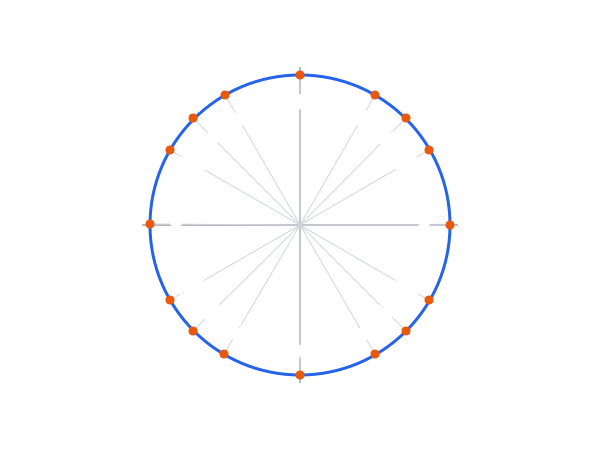
Unit Circle Values
The first-quadrant points come from the special angles. Every other point uses the same numbers with the signs for its quadrant.
| Degrees | Radians | Point (\cos \theta, \sin \theta) |
|---|---|---|
| 0° | 0 | (1, 0) |
| 30° | \frac{\pi}{6} | (\frac{\sqrt{3}}{2}, \frac{1}{2}) |
| 45° | \frac{\pi}{4} | (\frac{\sqrt{2}}{2}, \frac{\sqrt{2}}{2}) |
| 60° | \frac{\pi}{3} | (\frac{1}{2}, \frac{\sqrt{3}}{2}) |
| 90° | \frac{\pi}{2} | (0, 1) |
| 120° | \frac{2\pi}{3} | (-\frac{1}{2}, \frac{\sqrt{3}}{2}) |
| 135° | \frac{3\pi}{4} | (-\frac{\sqrt{2}}{2}, \frac{\sqrt{2}}{2}) |
| 150° | \frac{5\pi}{6} | (-\frac{\sqrt{3}}{2}, \frac{1}{2}) |
| 180° | \pi | (-1, 0) |
| 210° | \frac{7\pi}{6} | (-\frac{\sqrt{3}}{2}, -\frac{1}{2}) |
| 225° | \frac{5\pi}{4} | (-\frac{\sqrt{2}}{2}, -\frac{\sqrt{2}}{2}) |
| 240° | \frac{4\pi}{3} | (-\frac{1}{2}, -\frac{\sqrt{3}}{2}) |
| 270° | \frac{3\pi}{2} | (0, -1) |
| 300° | \frac{5\pi}{3} | (\frac{1}{2}, -\frac{\sqrt{3}}{2}) |
| 315° | \frac{7\pi}{4} | (\frac{\sqrt{2}}{2}, -\frac{\sqrt{2}}{2}) |
| 330° | \frac{11\pi}{6} | (\frac{\sqrt{3}}{2}, -\frac{1}{2}) |
- Find the reference angle of \theta.
- Write the first-quadrant point for the reference angle.
- Give each coordinate the sign for the quadrant: x is negative on the left, and y is negative below the x-axis.
- Read \cos \theta from x and \sin \theta from y. Find \tan \theta = \frac{y}{x} if you need it.
Worked Examples
Example 1: Read sine and cosine from the circle
Find \sin 120^\circ and \cos 120^\circ using the unit circle.
180^\circ - 120^\circ = 60^\circ
Find the reference angle.
(\frac{1}{2}, \frac{\sqrt{3}}{2})Write the point for 60°.
(-\frac{1}{2}, \frac{\sqrt{3}}{2})120° is in Quadrant II, so x is negative.
\sin 120^\circ = \frac{\sqrt{3}}{2}Read the y-coordinate.
\cos 120^\circ = -\frac{1}{2}Read the x-coordinate.
Answer: \sin 120^\circ = \frac{\sqrt{3}}{2} and \cos 120^\circ = -\frac{1}{2}
Example 2: An angle in radians
Find the point on the unit circle for \frac{7\pi}{4}, and give \sin \frac{7\pi}{4} and \cos \frac{7\pi}{4}.
2\pi - \frac{7\pi}{4} = \frac{8\pi}{4} - \frac{7\pi}{4} = \frac{\pi}{4}Find the reference angle.
(\frac{\sqrt{2}}{2}, \frac{\sqrt{2}}{2})Write the point for \frac{\pi}{4}.
(\frac{\sqrt{2}}{2}, -\frac{\sqrt{2}}{2})\frac{7\pi}{4} is in Quadrant IV, so y is negative.
Answer: \cos \frac{7\pi}{4} = \frac{\sqrt{2}}{2} and \sin \frac{7\pi}{4} = -\frac{\sqrt{2}}{2}
Example 3: Tangent from the circle
Find the exact value of \tan \frac{5\pi}{6}.
(-\frac{\sqrt{3}}{2}, \frac{1}{2})Read the point for \frac{5\pi}{6} (150°)
\tan \frac{5\pi}{6} = \frac{\frac{1}{2}}{-\frac{\sqrt{3}}{2}}Use \tan \theta = \frac{y}{x}.
\frac{1}{2} \cdot (-\frac{2}{\sqrt{3}}) = -\frac{1}{\sqrt{3}}Multiply by the reciprocal (see multiplying and dividing fractions)
-\frac{1}{\sqrt{3}} \cdot \frac{\sqrt{3}}{\sqrt{3}} = -\frac{\sqrt{3}}{3}Rationalize (see rationalizing the denominator)
Answer: \tan \frac{5\pi}{6} = -\frac{\sqrt{3}}{3}
Example 4: Find the angles with a given sine
Find every angle \theta with 0 \le \theta \lt 2\pi and \sin \theta = -\frac{1}{2}.
Sine is the y-coordinate, so look for points with y = -\frac{1}{2}.
The reference angle with sine \frac{1}{2} is \frac{\pi}{6}.
Sine is negative in Quadrants III and IV.
\pi + \frac{\pi}{6} = \frac{6\pi}{6} + \frac{\pi}{6} = \frac{7\pi}{6}Quadrant III angle.
2\pi - \frac{\pi}{6} = \frac{12\pi}{6} - \frac{\pi}{6} = \frac{11\pi}{6}Quadrant IV angle.
Answer: \theta = \frac{7\pi}{6} or \theta = \frac{11\pi}{6}
Example 5: Word problem with a Ferris wheel
A Ferris wheel has a radius of 20 meters, and its center is 25 meters above the ground. A rider starts level with the center on the right side and turns 150° counterclockwise. How high is the rider now? Use height = 25 + 20 \sin \theta.
\sin 150^\circ = \frac{1}{2}Read \sin 150^\circ from the unit circle.
20 \cdot \frac{1}{2} = 10Multiply by the radius.
25 + 10 = 35
Add the height of the center.
Answer: The rider is 35 meters above the ground. The rider is also 20 \cos 150^\circ = 20 \cdot (-\frac{\sqrt{3}}{2}) = -10\sqrt{3} \approx -17.32 meters from the center horizontally, so about 17.32 meters to the left.
Common Mistakes
| Mistake | Example of the error | Fix |
|---|---|---|
| Swapping sine and cosine | Reading \sin 60^\circ as the x-coordinate, \frac{1}{2} | The point is (\cos \theta, \sin \theta): x is cosine, y is sine. \sin 60^\circ = \frac{\sqrt{3}}{2}. |
| Wrong signs in a quadrant | Point for 210° is (\frac{\sqrt{3}}{2}, -\frac{1}{2}) | In Quadrant III, both coordinates are negative: (-\frac{\sqrt{3}}{2}, -\frac{1}{2}). |
| Mixing up 30° and 60° points | Point for 30° is (\frac{1}{2}, \frac{\sqrt{3}}{2}) | At 30° the point is closer to the x-axis, so x is larger: (\frac{\sqrt{3}}{2}, \frac{1}{2}). |
| Finding only one angle | \sin \theta = -\frac{1}{2} only at \frac{7\pi}{6} | Most values appear twice between 0 and 2\pi. Check both quadrants with the right sign. |
| Dividing in the wrong order for tangent | \tan \theta = \frac{x}{y} | Tangent is \frac{y}{x}, sine over cosine. |
Related Methods
The pattern in the first quadrant
Going from 0° to 90°, the x-values shrink: 1, \frac{\sqrt{3}}{2}, \frac{\sqrt{2}}{2}, \frac{1}{2}, 0. The y-values grow by the same list in reverse. Knowing this one list is enough to build the whole circle.
Symmetry
The circle is symmetric across both axes. The points for \theta, \pi - \theta, \pi + \theta and 2\pi - \theta have the same coordinates except for signs. This is the same idea as reference angles.
Toward trig graphs
As a point moves around the circle, its y-coordinate rises and falls between −1 and 1. Plotting that height against the angle gives the sine wave, which is the start of the next unit.
Practice Problems
- Give the point on the unit circle for 60°.
- Give the point on the unit circle for \frac{3\pi}{4}.
- Find \sin 240^\circ.
- Find \cos \frac{5\pi}{3}.
- Find \tan \frac{4\pi}{3}.
- Find \sin \pi and \cos \pi.
- Find \sec \frac{2\pi}{3}.
- Find every \theta with 0 \le \theta \lt 2\pi and \cos \theta = \frac{\sqrt{2}}{2}.
- Which angle between 0 and 2\pi has the point (-\frac{\sqrt{3}}{2}, -\frac{1}{2})?
- A bike wheel has a radius of 0.35 meter. A reflector starts at the 3 o’clock position and turns \frac{5\pi}{4} radians counterclockwise around the center. Find its position relative to the center, (0.35 \cos \frac{5\pi}{4}, 0.35 \sin \frac{5\pi}{4}), to the nearest hundredth.
Show answers
1.
60° is a special angle in Quadrant I
Answer: (\frac{1}{2}, \frac{\sqrt{3}}{2})
2.
\pi - \frac{3\pi}{4} = \frac{\pi}{4}Find the reference angle.
Quadrant II, so x is negative
Answer: (-\frac{\sqrt{2}}{2}, \frac{\sqrt{2}}{2})
3.
240^\circ - 180^\circ = 60^\circ
Find the reference angle.
Quadrant III, so y is negative
Answer: \sin 240^\circ = -\frac{\sqrt{3}}{2}
4.
2\pi - \frac{5\pi}{3} = \frac{\pi}{3}Find the reference angle.
Quadrant IV, so x is positive
Answer: \cos \frac{5\pi}{3} = \frac{1}{2}
5.
(-\frac{1}{2}, -\frac{\sqrt{3}}{2})Point for \frac{4\pi}{3}.
\frac{-\frac{\sqrt{3}}{2}}{-\frac{1}{2}} = \sqrt{3}Divide y by x.
Answer: \tan \frac{4\pi}{3} = \sqrt{3}
6.
The point for \pi (180°) is (-1, 0)
Answer: \sin \pi = 0 and \cos \pi = -1
7.
Point for \frac{2\pi}{3}: (-\frac{1}{2}, \frac{\sqrt{3}}{2}), so \cos \frac{2\pi}{3} = -\frac{1}{2}
\sec \frac{2\pi}{3} = \frac{1}{-\frac{1}{2}} = -2Flip cosine.
Answer: −2
8.
Cosine is the x-coordinate; x = \frac{\sqrt{2}}{2} at reference angle \frac{\pi}{4}
Cosine is positive in Quadrants I and IV
2\pi - \frac{\pi}{4} = \frac{7\pi}{4}Quadrant IV angle.
Answer: \frac{\pi}{4} and \frac{7\pi}{4}
9.
Both coordinates are negative, so the angle is in Quadrant III
The numbers match the point for \frac{\pi}{6}
\pi + \frac{\pi}{6} = \frac{7\pi}{6}Add to \pi.
Answer: \frac{7\pi}{6}
10.
(-\frac{\sqrt{2}}{2}, -\frac{\sqrt{2}}{2})Point for \frac{5\pi}{4}.
0.35 \cdot (-\frac{\sqrt{2}}{2}) \approx -0.247Multiply each by 0.35.
-0.247 \approx -0.25
Round.
Answer: about (-0.25, -0.25) meters from the center
FAQ
What is the unit circle?
It is a circle with radius 1 centered at the origin. For any angle \theta, the point where its terminal side meets the circle is (\cos \theta, \sin \theta).
How do you memorize the unit circle?
Learn the three first-quadrant points for 30°, 45° and 60°. Every other point uses the same numbers with the signs for its quadrant.
Is sine x or y on the unit circle?
Sine is the y-coordinate, and cosine is the x-coordinate. Alphabetical order helps: cosine before sine, x before y.
How do you find tangent on the unit circle?
Divide the y-coordinate by the x-coordinate: \tan \theta = \frac{\sin \theta}{\cos \theta}. It is undefined where x = 0, at \frac{\pi}{2} and \frac{3\pi}{2}.
Summary
- The unit circle has radius 1 and center (0, 0).
- The point for angle \theta is (\cos \theta, \sin \theta).
- \tan \theta = \frac{y}{x}, and \cos^2 \theta + \sin^2 \theta = 1.
- First-quadrant points come from 30°, 45° and 60°; other points use reference angles and signs.
- Most sine or cosine values appear at two angles between 0 and 2\pi.
Previous lesson: Reference Angles
Next lesson: Graphs of Sine and Cosine
Back to the Trigonometry Index