
Trig Functions of Any Angle
To find the trig functions of any angle, pick a point (x, y) on the angle’s terminal side and find its distance from the origin, r = \sqrt{x^2 + y^2}. Then \sin \theta = \frac{y}{r}, \cos \theta = \frac{x}{r} and \tan \theta = \frac{y}{x}. The signs of x and y give each value its sign in every quadrant.
Before this lesson: You should know Six Trigonometric Functions, Angles in Standard Position and the Distance Formula.
From Right Triangles to Any Angle
Right triangle ratios only work for acute angles. To handle an angle like 135° or −60°, put it in standard position and choose any point (x, y) on its terminal side, other than the origin.
Drop a line from the point straight to the x-axis. That makes a right triangle with legs |x| and |y| and hypotenuse r. Now the side lengths have signs: x is negative to the left of the y-axis, and y is negative below the x-axis. The distance r is always positive.
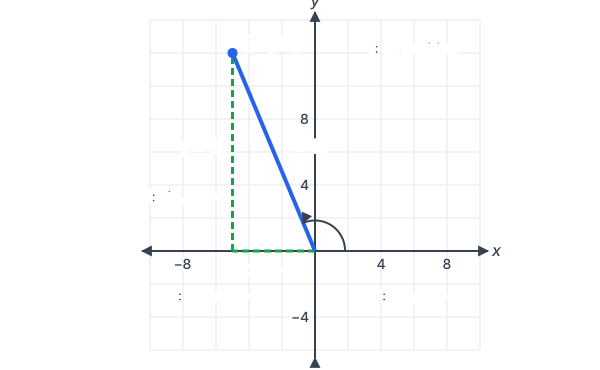
Definitions for Any Angle
r = \sqrt{x^2 + y^2}| Function | Definition | Function | Definition |
|---|---|---|---|
| \sin \theta | \frac{y}{r} | \csc \theta | \frac{r}{y}, y \ne 0 |
| \cos \theta | \frac{x}{r} | \sec \theta | \frac{r}{x}, x \ne 0 |
| \tan \theta | \frac{y}{x}, x \ne 0 | \cot \theta | \frac{x}{y}, y \ne 0 |
Signs by quadrant: since r is positive, the signs come from x and y. A common memory aid is “All Students Take Calculus.”
| Quadrant | Signs of x and y | Positive functions |
|---|---|---|
| I | x \gt 0, y \gt 0 | All six |
| II | x \lt 0, y \gt 0 | Sine and cosecant |
| III | x \lt 0, y \lt 0 | Tangent and cotangent |
| IV | x \gt 0, y \lt 0 | Cosine and secant |
Worked Examples
Example 1: A point in Quadrant I
The point (3, 4) is on the terminal side of \theta. Find all six trig functions.
r = \sqrt{3^2 + 4^2}Find r (see distance formula)
r = \sqrt{9 + 16} = \sqrt{25}Square and add.
r = 5
Take the square root.
Write the main three: \sin \theta = \frac{4}{5}, \cos \theta = \frac{3}{5}, \tan \theta = \frac{4}{3}
Flip them: \csc \theta = \frac{5}{4}, \sec \theta = \frac{5}{3}, \cot \theta = \frac{3}{4}
Answer: all six are positive, as expected in Quadrant I.
Example 2: A point in Quadrant II
The point (-5, 12) is on the terminal side of \theta. Find all six trig functions.
r = \sqrt{(-5)^2 + 12^2}Find r.
r = \sqrt{25 + 144} = \sqrt{169}Square and add.
r = 13
Take the square root.
\sin \theta = \frac{y}{r} = \frac{12}{13}Find the sine: y over r.
\cos \theta = \frac{x}{r} = \frac{-5}{13} = -\frac{5}{13}Find the cosine: x over r.
\tan \theta = \frac{y}{x} = \frac{12}{-5} = -\frac{12}{5}Find the tangent: y over x.
Flip them: \csc \theta = \frac{13}{12}, \sec \theta = -\frac{13}{5}, \cot \theta = -\frac{5}{12}
Answer: only sine and cosecant are positive, which fits Quadrant II.
Example 3: A point in Quadrant III
The point (-2, -3) is on the terminal side of \theta. Find all six trig functions.
r = \sqrt{(-2)^2 + (-3)^2} = \sqrt{4 + 9} = \sqrt{13}Find r.
\sin \theta = \frac{-3}{\sqrt{13}}Find the sine: y over r.
\frac{-3}{\sqrt{13}} \cdot \frac{\sqrt{13}}{\sqrt{13}} = -\frac{3\sqrt{13}}{13}Rationalize (see rationalizing the denominator)
\cos \theta = \frac{-2}{\sqrt{13}} = -\frac{2\sqrt{13}}{13}Cosine, rationalized the same way.
\tan \theta = \frac{-3}{-2} = \frac{3}{2}Find the tangent: y over x.
Flip sine and cosine: \csc \theta = -\frac{\sqrt{13}}{3}, \sec \theta = -\frac{\sqrt{13}}{2}
\cot \theta = \frac{2}{3}Flip tangent.
Answer: only tangent and cotangent are positive, which fits Quadrant III.
Example 4: Given one value and the quadrant
If \sin \theta = -\frac{3}{5} and \theta is in Quadrant IV, find the other five trig functions.
Sine is \frac{y}{r}, so let y = -3 and r = 5
x^2 + (-3)^2 = 5^2
Use x^2 + y^2 = r^2.
x^2 + 9 = 25
Square.
x^2 = 16
Subtract 9 from both sides.
Take the square root: x = 4 or x = -4
In Quadrant IV, x is positive, so x = 4
Write the others: \cos \theta = \frac{4}{5}, \tan \theta = -\frac{3}{4}, \csc \theta = -\frac{5}{3}, \sec \theta = \frac{5}{4}, \cot \theta = -\frac{4}{3}
Answer: as listed in the last step. Only cosine and secant are positive.
Example 5: Word problem with a drone
A drone starts at the origin and flies in a straight line to a point 30 meters west and 40 meters north. Let \theta be the angle of its path in standard position, with east as the positive x-axis. Find \sin \theta and \cos \theta. Then find where the drone would be after flying 100 meters along the same path.
West is the negative x-direction, so the point is (-30, 40)
r = \sqrt{(-30)^2 + 40^2} = \sqrt{900 + 1600} = \sqrt{2500} = 50Find r.
\sin \theta = \frac{40}{50} = \frac{4}{5}Find the sine: y over r.
\cos \theta = \frac{-30}{50} = -\frac{3}{5}Find the cosine: x over r.
x = 100 \cdot (-\frac{3}{5}) = -60After 100 meters, x = 100 \cos \theta.
y = 100 \cdot \frac{4}{5} = 80After 100 meters, y = 100 \sin \theta.
Answer: \sin \theta = \frac{4}{5} and \cos \theta = -\frac{3}{5}. After 100 meters the drone is at (-60, 80), 60 meters west and 80 meters north.
Common Mistakes
| Mistake | Example of the error | Fix |
|---|---|---|
| Making r negative | For (-5, 12), using r = -13 | r is a distance, so it is always positive: r = 13. |
| Dropping the signs of x and y | \cos \theta = \frac{5}{13} for the point (-5, 12) | Keep the sign: \cos \theta = \frac{x}{r} = -\frac{5}{13}. |
| Squaring a negative without parentheses | -5^2 = -25, so r = \sqrt{119} | Square the whole number: (-5)^2 = 25. |
| Picking the wrong sign for a missing coordinate | Using x = -4 in Quadrant IV | In Quadrant IV, x \gt 0 and y \lt 0. |
| Dividing by zero for a quadrantal angle | Saying \tan 90^\circ = 0 | At 90°, x = 0, so \tan 90^\circ = \frac{y}{0} is undefined. |
Related Methods
Quadrantal angles
For an angle on an axis, use a point one unit from the origin. For 180°, use (-1, 0) with r = 1: \sin 180^\circ = 0, \cos 180^\circ = -1, \tan 180^\circ = 0, and \csc 180^\circ and \cot 180^\circ are undefined.
Any point on the ray works
The points (3, 4) and (6, 8) are on the same terminal side. For (6, 8), r = 10 and \sin \theta = \frac{8}{10} = \frac{4}{5}, the same as before. The triangles are similar, so the ratios match.
Reference angles and the unit circle
The next lessons give a faster way for common angles: find the acute reference angle, use its special value, and attach the sign from the quadrant table above.
Practice Problems
- The point (8, 6) is on the terminal side of \theta. Find \sin \theta, \cos \theta and \tan \theta.
- The point (-7, 24) is on the terminal side of \theta. Find all six trig functions.
- The point (1, -1) is on the terminal side of \theta. Find \sin \theta, \cos \theta and \tan \theta.
- The point (-6, -8) is on the terminal side of \theta. Find \sin \theta, \cos \theta and \tan \theta.
- If \cos \theta = -\frac{8}{17} and \theta is in Quadrant III, find \sin \theta and \tan \theta.
- If \tan \theta = -2 and \theta is in Quadrant II, find \sin \theta and \cos \theta.
- Find \sin 270^\circ, \cos 270^\circ and \tan 270^\circ.
- In which quadrant is \theta if \sec \theta \gt 0 and \sin \theta \lt 0?
- Is \tan 200^\circ positive or negative?
- A boat is 12 kilometers east and 5 kilometers south of a lighthouse at the origin. Find the boat’s distance from the lighthouse and the sine and cosine of the angle \theta of its position in standard position.
Show answers
1.
r = \sqrt{8^2 + 6^2} = \sqrt{64 + 36} = \sqrt{100} = 10Find r.
Write the ratios: \sin \theta = \frac{6}{10} = \frac{3}{5}, \cos \theta = \frac{8}{10} = \frac{4}{5}, \tan \theta = \frac{6}{8} = \frac{3}{4}
Answer: \frac{3}{5}, \frac{4}{5}, \frac{3}{4}
2.
r = \sqrt{(-7)^2 + 24^2} = \sqrt{49 + 576} = \sqrt{625} = 25Find r.
Main three: \sin \theta = \frac{24}{25}, \cos \theta = -\frac{7}{25}, \tan \theta = -\frac{24}{7}
Flip: \csc \theta = \frac{25}{24}, \sec \theta = -\frac{25}{7}, \cot \theta = -\frac{7}{24}
Answer: the six values above
3.
r = \sqrt{1^2 + (-1)^2} = \sqrt{2}Find r.
\sin \theta = \frac{-1}{\sqrt{2}} = -\frac{\sqrt{2}}{2}Find the sine: y over r, then rationalize.
\cos \theta = \frac{1}{\sqrt{2}} = \frac{\sqrt{2}}{2}Find the cosine: x over r, then rationalize.
\tan \theta = \frac{-1}{1} = -1Find the tangent: y over x.
Answer: -\frac{\sqrt{2}}{2}, \frac{\sqrt{2}}{2}, −1
4.
r = \sqrt{(-6)^2 + (-8)^2} = \sqrt{36 + 64} = \sqrt{100} = 10Find r.
Write the ratios: \sin \theta = \frac{-8}{10} = -\frac{4}{5}, \cos \theta = \frac{-6}{10} = -\frac{3}{5}, \tan \theta = \frac{-8}{-6} = \frac{4}{3}
Answer: -\frac{4}{5}, -\frac{3}{5}, \frac{4}{3}
5.
Let x = -8 and r = 17
64 + y^2 = 289
Use x^2 + y^2 = r^2.
Subtract 64: y^2 = 225, so y = 15 or y = -15
In Quadrant III, y \lt 0, so y = -15
Write the ratios: \sin \theta = -\frac{15}{17}, \tan \theta = \frac{-15}{-8} = \frac{15}{8}
Answer: \sin \theta = -\frac{15}{17}, \tan \theta = \frac{15}{8}
6.
In Quadrant II, x \lt 0 and y \gt 0, so write \tan \theta = \frac{2}{-1}: x = -1, y = 2
r = \sqrt{(-1)^2 + 2^2} = \sqrt{5}Find r.
\sin \theta = \frac{2}{\sqrt{5}} = \frac{2\sqrt{5}}{5}Find the sine: y over r, then rationalize.
\cos \theta = \frac{-1}{\sqrt{5}} = -\frac{\sqrt{5}}{5}Find the cosine: x over r, then rationalize.
Answer: \frac{2\sqrt{5}}{5}, -\frac{\sqrt{5}}{5}
7.
Use the point (0, -1) with r = 1
\sin 270^\circ = \frac{-1}{1} = -1Find the sine: y over r.
\cos 270^\circ = \frac{0}{1} = 0Find the cosine: x over r.
Tangent: \frac{-1}{0} is undefined
Answer: −1, 0, undefined
8.
Secant is positive in Quadrants I and IV
Sine is negative in Quadrants III and IV
Answer: Quadrant IV
9.
200° is between 180° and 270°, so it is in Quadrant III
Tangent is positive in Quadrant III
Answer: positive
10.
South is the negative y-direction, so the boat is at (12, -5)
r = \sqrt{12^2 + (-5)^2} = \sqrt{144 + 25} = \sqrt{169} = 13Find r.
\sin \theta = -\frac{5}{13}Find the sine: y over r.
\cos \theta = \frac{12}{13}Find the cosine: x over r.
Answer: 13 kilometers; \sin \theta = -\frac{5}{13}, \cos \theta = \frac{12}{13}
FAQ
How do you find trig functions of any angle?
Choose a point (x, y) on the terminal side, find r = \sqrt{x^2 + y^2}, and use \sin \theta = \frac{y}{r}, \cos \theta = \frac{x}{r} and \tan \theta = \frac{y}{x}. Flip those for the other three.
What does All Students Take Calculus mean?
It names the positive functions in each quadrant, going counterclockwise from Quadrant I: All, Sine, Tangent, Cosine. Their reciprocals have the same signs.
Can r be negative?
No. r is the distance from the origin to the point, so it is always positive. The signs of the trig values come only from x and y.
Why is tangent undefined at 90°?
At 90°, the terminal side is the positive y-axis, where x = 0. Tangent is \frac{y}{x}, and you cannot divide by zero.
Summary
- Pick a point (x, y) on the terminal side and find r = \sqrt{x^2 + y^2}.
- \sin \theta = \frac{y}{r}, \cos \theta = \frac{x}{r}, \tan \theta = \frac{y}{x}, and flip them for csc, sec and cot.
- r is always positive; the signs come from x and y.
- All Students Take Calculus gives the positive functions in Quadrants I to IV.
- A function is undefined when its denominator is 0.
Previous lesson: Trig Values of Special Angles
Next lesson: Reference Angles
Back to the Trigonometry Index