
Verifying Trig Identities
Verifying trig identities means proving that two trig expressions are equal for every angle where both are defined. Start with the more complicated side and rewrite it, one step at a time, until it matches the other side. Useful moves are rewriting in sine and cosine, using Pythagorean identities, combining fractions and factoring.
Before this lesson: You should know Fundamental Trig Identities, Adding and Subtracting Rational Expressions and Special Products of Binomials.
A Proof, Not an Equation to Solve
To verify an identity, you do not solve for \theta, and you do not do the same thing to both sides. That would assume the identity is already true. Instead, you work on one side only and change it into the other side. Each step must use algebra or an identity you already know.
It helps to work like a mechanic who knows what the finished part should look like. Look at the target side. If it has only sine and cosine, rewrite your side in sine and cosine. If it has no fractions, look for a way to combine and cancel.
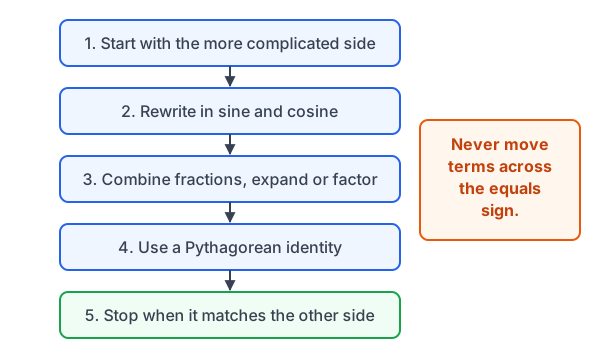
Strategies for Verifying Identities
- Start with the more complicated side.
- Rewrite tangent, cotangent, secant and cosecant in terms of sine and cosine.
- Combine fractions over a common denominator, or split a fraction into two.
- Expand products or factor expressions, such as a difference of squares.
- Replace patterns like 1 - \sin^2 \theta with \cos^2 \theta using a Pythagorean identity.
- If there is 1 - \cos \theta or 1 + \sin \theta in a denominator, try multiplying by its conjugate.
- Stop when your side looks exactly like the other side.
Worked Examples
Example 1: Rewrite in sine and cosine
Verify \tan \theta \cos \theta = \sin \theta.
\tan \theta \cos \theta
Start with the left side.
\frac{\sin \theta}{\cos \theta} \cdot \cos \thetaRewrite tangent with the quotient identity.
\sin \theta
Cancel the common factor \cos \theta.
This matches the right side.
Answer: verified, \tan \theta \cos \theta = \sin \theta
Example 2: Combine fractions
Verify \sec \theta - \cos \theta = \sin \theta \tan \theta.
\sec \theta - \cos \theta
Start with the left side.
\frac{1}{\cos \theta} - \cos \thetaRewrite secant.
\frac{1}{\cos \theta} - \frac{\cos^2 \theta}{\cos \theta}Write \cos \theta over the common denominator.
\frac{1 - \cos^2 \theta}{\cos \theta}Subtract the fractions.
\frac{\sin^2 \theta}{\cos \theta}Use the Pythagorean identity.
\sin \theta \cdot \frac{\sin \theta}{\cos \theta}Split off one sine.
\sin \theta \tan \theta
Use the quotient identity.
Answer: verified. The left side became the right side.
Example 3: Expand a product
Verify (1 + \sin \theta)(1 - \sin \theta) = \cos^2 \theta.
(1 + \sin \theta)(1 - \sin \theta)
Start with the left side.
1 - \sin^2 \theta
Multiply, using the difference of squares pattern (see special products of binomials)
\cos^2 \theta
Use the Pythagorean identity.
Answer: verified, (1 + \sin \theta)(1 - \sin \theta) = \cos^2 \theta
Example 4: Multiply by a conjugate
Verify \frac{\sin \theta}{1 - \cos \theta} = \frac{1 + \cos \theta}{\sin \theta}.
\frac{\sin \theta}{1 - \cos \theta}Start with the left side.
\frac{\sin \theta (1 + \cos \theta)}{(1 - \cos \theta)(1 + \cos \theta)}Multiply the top and bottom by the conjugate 1 + \cos \theta.
\frac{\sin \theta (1 + \cos \theta)}{1 - \cos^2 \theta}Multiply out the bottom.
\frac{\sin \theta (1 + \cos \theta)}{\sin^2 \theta}Use the Pythagorean identity.
\frac{1 + \cos \theta}{\sin \theta}Cancel one factor of \sin \theta.
Answer: verified. Multiplying by the conjugate is the same trick used in rationalizing the denominator.
Example 5: Two answers on a test
On a test, Ana simplified an expression to \csc \theta - \sin \theta, and Ben got \cot \theta \cos \theta. Show that both answers are correct by verifying \csc \theta - \sin \theta = \cot \theta \cos \theta.
\csc \theta - \sin \theta
Start with Ana’s side.
\frac{1}{\sin \theta} - \sin \thetaRewrite cosecant.
\frac{1}{\sin \theta} - \frac{\sin^2 \theta}{\sin \theta}Use a common denominator.
\frac{1 - \sin^2 \theta}{\sin \theta}Subtract.
\frac{\cos^2 \theta}{\sin \theta}Use the Pythagorean identity.
\frac{\cos \theta}{\sin \theta} \cdot \cos \thetaSplit the fraction.
\cot \theta \cos \theta
Use the quotient identity.
Answer: Ana’s expression becomes Ben’s, so both answers are correct.
Common Mistakes
| Mistake | Example of the error | Fix |
|---|---|---|
| Working on both sides at once | Multiplying both sides by \cos \theta to start | Change one side only, until it looks like the other side. |
| Canceling terms instead of factors | \frac{1 + \cos \theta}{\cos \theta} = 1 + 1 | Only common factors cancel. Split it: \frac{1}{\cos \theta} + 1 = \sec \theta + 1. |
| Squaring wrongly | (\sin \theta + \cos \theta)^2 = \sin^2 \theta + \cos^2 \theta | Include the middle term: \sin^2 \theta + 2\sin \theta \cos \theta + \cos^2 \theta. |
| Testing one angle and stopping | Checking only \theta = 0 | One angle can check your work, but a proof must hold for all angles. |
| Skipping steps | Jumping from \sec \theta - \cos \theta to \sin \theta \tan \theta | Write each step with the identity it uses. |
Related Methods
Work on both sides separately
Some teachers allow you to simplify each side on its own until both reach the same expression. This is fine as long as you never move a term from one side to the other.
Check with a graph
Graph both sides on Desmos or a calculator. If the graphs are exactly the same, the identity is probably true. If they differ anywhere, it is not an identity.
Factor like a polynomial
Treat \sin \theta and \cos \theta like variables. For example, \sin^4 \theta - \cos^4 \theta factors as a difference of squares: (\sin^2 \theta - \cos^2 \theta)(\sin^2 \theta + \cos^2 \theta).
Practice Problems
- Verify \sin \theta \cot \theta = \cos \theta.
- Verify \cos \theta \sec \theta = 1.
- Verify (1 - \cos \theta)(1 + \cos \theta) = \sin^2 \theta.
- Verify \sec^2 \theta - \tan^2 \theta = 1.
- Verify \tan \theta + \cot \theta = \sec \theta \csc \theta.
- Verify \csc^2 \theta (1 - \cos^2 \theta) = 1.
- Verify \frac{\cos \theta}{1 - \sin \theta} = \frac{1 + \sin \theta}{\cos \theta}.
- Verify (\sin \theta + \cos \theta)^2 = 1 + 2 \sin \theta \cos \theta.
- Verify \sin^4 \theta - \cos^4 \theta = \sin^2 \theta - \cos^2 \theta.
- A carpenter’s roof formula uses (\sec \theta - 1)(\sec \theta + 1). Show that it equals \tan^2 \theta.
Show answers
1.
\sin \theta \cdot \frac{\cos \theta}{\sin \theta}Rewrite cotangent.
\cos \theta
Cancel \sin \theta.
Answer: verified
2.
\cos \theta \cdot \frac{1}{\cos \theta}Rewrite secant.
1
Cancel.
Answer: verified
3.
1 - \cos^2 \theta
Multiply. This is a difference of squares.
\sin^2 \theta
Use the Pythagorean identity.
Answer: verified
4.
1 + \tan^2 \theta - \tan^2 \theta
Use \sec^2 \theta = 1 + \tan^2 \theta.
1
Combine like terms.
Answer: verified
5.
\frac{\sin \theta}{\cos \theta} + \frac{\cos \theta}{\sin \theta}Rewrite.
\frac{\sin^2 \theta + \cos^2 \theta}{\sin \theta \cos \theta}Use the common denominator \sin \theta \cos \theta.
\frac{1}{\sin \theta \cos \theta}Use the Pythagorean identity.
\frac{1}{\cos \theta} \cdot \frac{1}{\sin \theta} = \sec \theta \csc \thetaSplit.
Answer: verified
6.
\csc^2 \theta \cdot \sin^2 \theta
Use the Pythagorean identity.
\frac{1}{\sin^2 \theta} \cdot \sin^2 \thetaRewrite cosecant.
1
Cancel.
Answer: verified
7.
\frac{\cos \theta (1 + \sin \theta)}{1 - \sin^2 \theta}Multiply the top and bottom by 1 + \sin \theta.
\frac{\cos \theta (1 + \sin \theta)}{\cos^2 \theta}Use the Pythagorean identity.
\frac{1 + \sin \theta}{\cos \theta}Cancel one \cos \theta.
Answer: verified
8.
\sin^2 \theta + 2 \sin \theta \cos \theta + \cos^2 \theta
Expand the square.
(\sin^2 \theta + \cos^2 \theta) + 2 \sin \theta \cos \theta
Group the squares.
1 + 2 \sin \theta \cos \theta
Use the Pythagorean identity.
Answer: verified
9.
(\sin^2 \theta - \cos^2 \theta)(\sin^2 \theta + \cos^2 \theta)
Factor as a difference of squares.
(\sin^2 \theta - \cos^2 \theta) \cdot 1
Use the Pythagorean identity.
\sin^2 \theta - \cos^2 \theta
Simplify.
Answer: verified
10.
\sec^2 \theta - 1
Multiply. This is a difference of squares.
1 + \tan^2 \theta - 1
Use \sec^2 \theta = 1 + \tan^2 \theta.
\tan^2 \theta
Combine like terms.
Answer: verified
FAQ
How do you verify a trig identity?
Pick one side, usually the more complicated one. Rewrite it step by step, using algebra and known identities, until it matches the other side exactly.
Can you work on both sides of an identity?
You can simplify each side separately to the same expression, but you cannot add, multiply or move terms across the equals sign. That would assume what you are trying to prove.
What is the first step when verifying identities?
A good first step is to rewrite everything in terms of sine and cosine. It often shows which Pythagorean identity or common denominator to use.
How do you know if an equation is not an identity?
Test an angle. If the two sides give different values for even one angle where both are defined, the equation is not an identity.
Summary
- Verify an identity by transforming one side into the other.
- Start with the more complicated side.
- Rewrite in sine and cosine, combine fractions, expand or factor.
- Use Pythagorean identities to replace patterns like 1 - \sin^2 \theta.
- Multiply by a conjugate when 1 \pm \sin \theta or 1 \pm \cos \theta is in a denominator.
Previous lesson: Fundamental Trig Identities
Next lesson: Sum and Difference Formulas
Back to the Trigonometry Index