
Sum and Difference Formulas
The sum and difference formulas give the sine, cosine or tangent of A + B or A - B from the values for A and B. For example, \sin(A + B) = \sin A \cos B + \cos A \sin B. They let you find exact values like \sin 75^\circ by writing 75° as 45^\circ + 30^\circ. The cosine and tangent formulas work the same way.
Before this lesson: You should know Verifying Trig Identities, Trig Values of Special Angles and Multiplying Radicals.
Why sin(A + B) Is Not sin A + sin B
It is tempting to split \sin(45^\circ + 30^\circ) into \sin 45^\circ + \sin 30^\circ. Check with numbers: \sin 75^\circ \approx 0.966, but \sin 45^\circ + \sin 30^\circ \approx 0.707 + 0.5 = 1.207, which is more than 1. Sine does not distribute over addition.
The correct formulas mix sines and cosines of both angles. They can be proved with the distance formula on the unit circle. You do not need the proof to use them, but you do need to memorize the patterns.
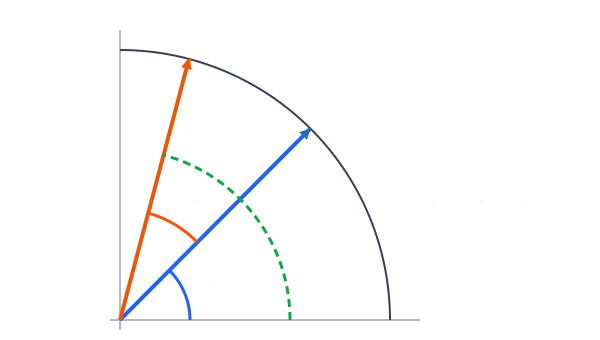
The Sum and Difference Formulas
| Function | Sum | Difference |
|---|---|---|
| Sine | \sin(A + B) = \sin A \cos B + \cos A \sin B | \sin(A - B) = \sin A \cos B - \cos A \sin B |
| Cosine | \cos(A + B) = \cos A \cos B - \sin A \sin B | \cos(A - B) = \cos A \cos B + \sin A \sin B |
| Tangent | \tan(A + B) = \frac{\tan A + \tan B}{1 - \tan A \tan B} | \tan(A - B) = \frac{\tan A - \tan B}{1 + \tan A \tan B} |
Memory tips: sine keeps the sign and mixes the functions (sin cos, cos sin). Cosine flips the sign and keeps the functions together (cos cos, sin sin).
- Write the angle as a sum or difference of special angles, like 45^\circ + 30^\circ or \frac{\pi}{3} - \frac{\pi}{4}.
- Choose the matching formula.
- Substitute the exact values of the special angles.
- Multiply the radicals and combine the fractions.
Worked Examples
Example 1: Exact value of sin 75°
Find the exact value of \sin 75^\circ.
75^\circ = 45^\circ + 30^\circ
Write 75° as a sum.
\sin(45^\circ + 30^\circ) = \sin 45^\circ \cos 30^\circ + \cos 45^\circ \sin 30^\circ
Use the sum formula.
\frac{\sqrt{2}}{2} \cdot \frac{\sqrt{3}}{2} + \frac{\sqrt{2}}{2} \cdot \frac{1}{2}Substitute.
\frac{\sqrt{6}}{4} + \frac{\sqrt{2}}{4}Multiply each product (see multiplying radicals)
\frac{\sqrt{6} + \sqrt{2}}{4}Add the fractions.
Answer: \sin 75^\circ = \frac{\sqrt{6} + \sqrt{2}}{4} \approx 0.966
Example 2: A difference formula for cosine
Find the exact value of \cos 15^\circ.
15^\circ = 45^\circ - 30^\circ
Write 15° as a difference.
\cos(45^\circ - 30^\circ) = \cos 45^\circ \cos 30^\circ + \sin 45^\circ \sin 30^\circ
Use the difference formula.
\frac{\sqrt{2}}{2} \cdot \frac{\sqrt{3}}{2} + \frac{\sqrt{2}}{2} \cdot \frac{1}{2}Substitute.
\frac{\sqrt{6}}{4} + \frac{\sqrt{2}}{4}Multiply.
\frac{\sqrt{6} + \sqrt{2}}{4}Add.
Answer: \cos 15^\circ = \frac{\sqrt{6} + \sqrt{2}}{4}. It equals \sin 75^\circ, because 15° and 75° are complementary.
Example 3: Tangent in radians
Find the exact value of \tan \frac{\pi}{12}.
\frac{\pi}{12} = \frac{\pi}{3} - \frac{\pi}{4}Write the angle as a difference.
\tan(\frac{\pi}{3} - \frac{\pi}{4}) = \frac{\tan \frac{\pi}{3} - \tan \frac{\pi}{4}}{1 + \tan \frac{\pi}{3} \tan \frac{\pi}{4}}Use the difference formula.
\frac{\sqrt{3} - 1}{1 + \sqrt{3}}Substitute \tan \frac{\pi}{3} = \sqrt{3} and \tan \frac{\pi}{4} = 1.
\frac{(\sqrt{3} - 1)(1 - \sqrt{3})}{(1 + \sqrt{3})(1 - \sqrt{3})}Multiply the top and bottom by the conjugate 1 - \sqrt{3} (see rationalizing the denominator)
(1 + \sqrt{3})(1 - \sqrt{3}) = 1 - 3 = -2Multiply out the bottom.
(\sqrt{3} - 1)(1 - \sqrt{3}) = \sqrt{3} - 3 - 1 + \sqrt{3} = 2\sqrt{3} - 4Multiply out the top.
\frac{2\sqrt{3} - 4}{-2} = -\sqrt{3} + 2Divide.
Answer: \tan \frac{\pi}{12} = 2 - \sqrt{3} \approx 0.268
Example 4: Use given values
Angles A and B are in Quadrant I, with \sin A = \frac{3}{5} and \cos B = \frac{5}{13}. Find \sin(A + B).
\cos A = \sqrt{1 - \frac{9}{25}} = \sqrt{\frac{16}{25}} = \frac{4}{5}Find \cos A with the Pythagorean identity.
\sin B = \sqrt{1 - \frac{25}{169}} = \sqrt{\frac{144}{169}} = \frac{12}{13}Find \sin B.
\sin(A + B) = \sin A \cos B + \cos A \sin B
Use the sum formula.
\frac{3}{5} \cdot \frac{5}{13} + \frac{4}{5} \cdot \frac{12}{13}Substitute.
\frac{15}{65} + \frac{48}{65}Multiply.
\frac{63}{65}Add.
Answer: \sin(A + B) = \frac{63}{65}
Example 5: Word problem with a window
You stand 10 meters from a building. The angle of elevation to the bottom of a window is 45°, and the angle to the top of the window is 75°. Find the exact height of the top of the window above your eye level, 10 \tan 75^\circ, and the height of the window itself.
\tan 75^\circ = \tan(45^\circ + 30^\circ)
Write 75° as a sum.
\frac{\tan 45^\circ + \tan 30^\circ}{1 - \tan 45^\circ \tan 30^\circ} = \frac{1 + \frac{\sqrt{3}}{3}}{1 - \frac{\sqrt{3}}{3}}Use the sum formula.
\frac{3 + \sqrt{3}}{3 - \sqrt{3}}Multiply the top and bottom by 3.
\frac{(3 + \sqrt{3})^2}{9 - 3} = \frac{12 + 6\sqrt{3}}{6}Multiply the top and bottom by 3 + \sqrt{3}.
\tan 75^\circ = 2 + \sqrt{3}Simplify.
10(2 + \sqrt{3}) = 20 + 10\sqrt{3} \approx 37.32Height of the top.
10 \tan 45^\circ = 10
Height of the bottom.
20 + 10\sqrt{3} - 10 = 10 + 10\sqrt{3} \approx 27.32Subtract.
Answer: The top of the window is 20 + 10\sqrt{3} \approx 37.32 m above eye level, and the window is 10 + 10\sqrt{3} \approx 27.32 m tall. These are angles of elevation from Geometry.
Common Mistakes
| Mistake | Example of the error | Fix |
|---|---|---|
| Distributing sine over a sum | \sin(45^\circ + 30^\circ) = \sin 45^\circ + \sin 30^\circ | Use \sin A \cos B + \cos A \sin B. |
| Wrong sign in the cosine formula | \cos(A + B) = \cos A \cos B + \sin A \sin B | Cosine flips the sign: \cos(A + B) = \cos A \cos B - \sin A \sin B. |
| Mixing up the products for cosine | \cos(A - B) = \cos A \sin B + \sin A \cos B | Cosine keeps like functions together: \cos A \cos B + \sin A \sin B. |
| Forgetting the quadrant | Using \cos A = \frac{4}{5} when A is in Quadrant II | In Quadrant II, \cos A = -\frac{4}{5}. Check the sign of every value. |
| Not simplifying the radicals | Leaving \frac{\sqrt{2} \cdot \sqrt{3}}{4} | Multiply: \frac{\sqrt{6}}{4}. |
Related Methods
Run the formula backward
An expression that matches a formula can be collapsed. For example, \sin 50^\circ \cos 10^\circ + \cos 50^\circ \sin 10^\circ = \sin(50^\circ + 10^\circ) = \sin 60^\circ = \frac{\sqrt{3}}{2}.
Prove cofunction identities
Use the difference formula with A = 90^\circ: \cos(90^\circ - \theta) = \cos 90^\circ \cos \theta + \sin 90^\circ \sin \theta = 0 + \sin \theta = \sin \theta.
Double angles
Setting B = A in the sum formulas gives the double-angle formulas, such as \sin 2A = 2 \sin A \cos A. That is the next lesson.
Practice Problems
- Find the exact value of \sin 105^\circ.
- Find the exact value of \cos 75^\circ.
- Find the exact value of \sin 15^\circ.
- Find the exact value of \cos \frac{7\pi}{12}.
- Find the exact value of \tan 75^\circ.
- Angles A and B are in Quadrant I, with \sin A = \frac{4}{5} and \cos B = \frac{12}{13}. Find \sin(A - B).
- Use the angles in problem 6 to find \cos(A + B).
- Find the exact value of \sin 50^\circ \cos 10^\circ + \cos 50^\circ \sin 10^\circ.
- Find the exact value of \cos 80^\circ \cos 20^\circ + \sin 80^\circ \sin 20^\circ.
- Verify \sin(\theta + \frac{\pi}{2}) = \cos \theta.
Show answers
1.
Write 105^\circ = 60^\circ + 45^\circ
\sin 60^\circ \cos 45^\circ + \cos 60^\circ \sin 45^\circ
Use the sum formula.
\frac{\sqrt{3}}{2} \cdot \frac{\sqrt{2}}{2} + \frac{1}{2} \cdot \frac{\sqrt{2}}{2}Substitute.
\frac{\sqrt{6}}{4} + \frac{\sqrt{2}}{4}Multiply.
Answer: \frac{\sqrt{6} + \sqrt{2}}{4}
2.
Write 75^\circ = 45^\circ + 30^\circ
\cos 45^\circ \cos 30^\circ - \sin 45^\circ \sin 30^\circ
Use the sum formula.
\frac{\sqrt{2}}{2} \cdot \frac{\sqrt{3}}{2} - \frac{\sqrt{2}}{2} \cdot \frac{1}{2}Substitute.
\frac{\sqrt{6}}{4} - \frac{\sqrt{2}}{4}Multiply.
Answer: \frac{\sqrt{6} - \sqrt{2}}{4}
3.
Write 15^\circ = 45^\circ - 30^\circ
\sin 45^\circ \cos 30^\circ - \cos 45^\circ \sin 30^\circ
Use the difference formula.
\frac{\sqrt{2}}{2} \cdot \frac{\sqrt{3}}{2} - \frac{\sqrt{2}}{2} \cdot \frac{1}{2}Substitute.
\frac{\sqrt{6}}{4} - \frac{\sqrt{2}}{4}Multiply.
Answer: \frac{\sqrt{6} - \sqrt{2}}{4}
4.
Write \frac{7\pi}{12} = \frac{\pi}{3} + \frac{\pi}{4}
\cos \frac{\pi}{3} \cos \frac{\pi}{4} - \sin \frac{\pi}{3} \sin \frac{\pi}{4}Use the sum formula.
\frac{1}{2} \cdot \frac{\sqrt{2}}{2} - \frac{\sqrt{3}}{2} \cdot \frac{\sqrt{2}}{2}Substitute.
\frac{\sqrt{2}}{4} - \frac{\sqrt{6}}{4}Multiply.
Answer: \frac{\sqrt{2} - \sqrt{6}}{4}
5.
\frac{1 + \frac{\sqrt{3}}{3}}{1 - \frac{\sqrt{3}}{3}}Write 75^\circ = 45^\circ + 30^\circ and use the sum formula.
\frac{3 + \sqrt{3}}{3 - \sqrt{3}}Multiply the top and bottom by 3.
\frac{(3 + \sqrt{3})^2}{9 - 3} = \frac{12 + 6\sqrt{3}}{6}Rationalize.
Answer: 2 + \sqrt{3}
6.
Find the other values: \cos A = \frac{3}{5} and \sin B = \frac{5}{13}
\sin A \cos B - \cos A \sin B
Use the difference formula.
\frac{4}{5} \cdot \frac{12}{13} - \frac{3}{5} \cdot \frac{5}{13}Substitute.
\frac{48}{65} - \frac{15}{65}Multiply.
Answer: \frac{33}{65}
7.
\cos A \cos B - \sin A \sin B
Use the sum formula.
\frac{3}{5} \cdot \frac{12}{13} - \frac{4}{5} \cdot \frac{5}{13}Substitute.
\frac{36}{65} - \frac{20}{65}Multiply.
Answer: \frac{16}{65}
8.
\sin(50^\circ + 10^\circ)
It matches the sine sum formula.
\sin 60^\circ
Add the angles.
Answer: \frac{\sqrt{3}}{2}
9.
\cos(80^\circ - 20^\circ)
It matches the cosine difference formula.
\cos 60^\circ
Subtract the angles.
Answer: \frac{1}{2}
10.
\sin \theta \cos \frac{\pi}{2} + \cos \theta \sin \frac{\pi}{2}Use the sum formula.
\sin \theta \cdot 0 + \cos \theta \cdot 1
Substitute \cos \frac{\pi}{2} = 0 and \sin \frac{\pi}{2} = 1.
\cos \theta
Simplify.
Answer: verified
FAQ
What is the sum formula for sine?
\sin(A + B) = \sin A \cos B + \cos A \sin B. For the difference, change the plus to a minus: \sin(A - B) = \sin A \cos B - \cos A \sin B.
What is the sum formula for cosine?
\cos(A + B) = \cos A \cos B - \sin A \sin B. Notice that the sign flips: a sum inside gives a minus sign.
How do you find sin 15° exactly?
Write 15° as 45^\circ - 30^\circ and use the difference formula. The result is \frac{\sqrt{6} - \sqrt{2}}{4} \approx 0.259.
Does sin(A + B) equal sin A + sin B?
No. For example, \sin(30^\circ + 60^\circ) = \sin 90^\circ = 1, but \sin 30^\circ + \sin 60^\circ \approx 1.366.
Summary
- \sin(A \pm B) = \sin A \cos B \pm \cos A \sin B.
- \cos(A \pm B) = \cos A \cos B \mp \sin A \sin B (the sign flips).
- \tan(A \pm B) = \frac{\tan A \pm \tan B}{1 \mp \tan A \tan B}.
- Write an angle like 75° or \frac{\pi}{12} as a sum or difference of special angles.
- Check the quadrant signs when you find missing values.
Previous lesson: Verifying Trig Identities
Next lesson: Double-Angle Formulas
Back to the Trigonometry Index