
Half-Angle Formulas
The half-angle formulas find the sine, cosine or tangent of \frac{\theta}{2} from \cos \theta: \sin \frac{\theta}{2} = \pm\sqrt{\frac{1 - \cos \theta}{2}} and \cos \frac{\theta}{2} = \pm\sqrt{\frac{1 + \cos \theta}{2}}. The quadrant of \frac{\theta}{2} decides the sign. They give exact values for angles like 15° and 22.5°, and they come from the double-angle formulas for cosine.
Before this lesson: You should know Double-Angle Formulas, Reference Angles and Simplifying Square Roots.
Halving an Angle
You know exact values for 30°, 45° and 60°. Halving those angles gives 15°, 22.5° and 30°. The half-angle formulas turn a known cosine into the sine or cosine of half the angle.
They come from the double-angle formula \cos 2x = 1 - 2\sin^2 x. Solve it for \sin^2 x to get \sin^2 x = \frac{1 - \cos 2x}{2}, then replace x with \frac{\theta}{2} and take the square root. The square root is why there is a \pm sign.
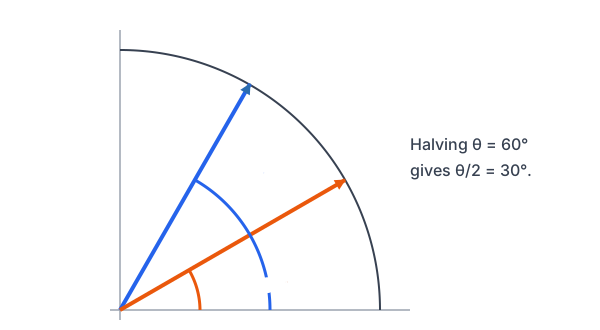
The Half-Angle Formulas
| Function | Formula |
|---|---|
| \sin \frac{\theta}{2} | \pm\sqrt{\frac{1 - \cos \theta}{2}} |
| \cos \frac{\theta}{2} | \pm\sqrt{\frac{1 + \cos \theta}{2}} |
| \tan \frac{\theta}{2} | \frac{1 - \cos \theta}{\sin \theta} or \frac{\sin \theta}{1 + \cos \theta} |
The tangent forms have no \pm, because their signs work out on their own. For sine and cosine, choose the sign from the quadrant of \frac{\theta}{2}, not of \theta.
- Write the angle as half of a known angle, such as 15^\circ = \frac{30^\circ}{2}.
- Find the quadrant of the half angle to choose the sign.
- Substitute \cos \theta into the formula.
- Simplify the fraction inside the root, then simplify the root.
Worked Examples
Example 1: Exact value of sin 15°
Find the exact value of \sin 15^\circ.
\sin 15^\circ = \sin \frac{30^\circ}{2}Write 15° as half of 30°.
\sin 15^\circ = \sqrt{\frac{1 - \cos 30^\circ}{2}}15° is in Quadrant I, so use the plus sign.
\sqrt{\frac{1 - \frac{\sqrt{3}}{2}}{2}}Substitute \cos 30^\circ = \frac{\sqrt{3}}{2}.
\sqrt{\frac{2 - \sqrt{3}}{4}}Multiply the top and bottom of the inner fraction by 2.
\frac{\sqrt{2 - \sqrt{3}}}{2}Take the square root of the denominator (see simplifying square roots)
Answer: \sin 15^\circ = \frac{\sqrt{2 - \sqrt{3}}}{2} \approx 0.2588. This equals \frac{\sqrt{6} - \sqrt{2}}{4} from the sum and difference formulas, written another way.
Example 2: Exact value of cos 22.5°
Find the exact value of \cos 22.5^\circ.
\cos 22.5^\circ = \cos \frac{45^\circ}{2}Write 22.5° as half of 45°.
\sqrt{\frac{1 + \cos 45^\circ}{2}}22.5° is in Quadrant I, so use the plus sign.
\sqrt{\frac{1 + \frac{\sqrt{2}}{2}}{2}}Substitute \cos 45^\circ = \frac{\sqrt{2}}{2}.
\sqrt{\frac{2 + \sqrt{2}}{4}}Multiply the top and bottom of the inner fraction by 2.
\frac{\sqrt{2 + \sqrt{2}}}{2}Take the square root of the denominator.
Answer: \cos 22.5^\circ = \frac{\sqrt{2 + \sqrt{2}}}{2} \approx 0.9239
Example 3: Tangent of a half angle
Find the exact value of \tan \frac{\pi}{8}.
\tan \frac{\pi}{8} = \frac{1 - \cos \frac{\pi}{4}}{\sin \frac{\pi}{4}}Write the angle as half of \frac{\pi}{4}.
\frac{1 - \frac{\sqrt{2}}{2}}{\frac{\sqrt{2}}{2}}Substitute.
\frac{2 - \sqrt{2}}{\sqrt{2}}Multiply the top and bottom by 2.
\frac{(2 - \sqrt{2})\sqrt{2}}{2} = \frac{2\sqrt{2} - 2}{2}Rationalize (see rationalizing the denominator)
\sqrt{2} - 1Divide each term by 2.
Answer: \tan \frac{\pi}{8} = \sqrt{2} - 1 \approx 0.414
Example 4: Choose the signs
If \cos \theta = -\frac{7}{25} and 180^\circ \lt \theta \lt 270^\circ, find \sin \frac{\theta}{2} and \cos \frac{\theta}{2}.
Divide the interval by 2 to locate the half angle: 90^\circ \lt \frac{\theta}{2} \lt 135^\circ, which is Quadrant II
\sin \frac{\theta}{2} = \sqrt{\frac{1 - (-\frac{7}{25})}{2}}In Quadrant II, sine is positive.
\sqrt{\frac{\frac{32}{25}}{2}} = \sqrt{\frac{16}{25}} = \frac{4}{5}Simplify inside.
\cos \frac{\theta}{2} = -\sqrt{\frac{1 + (-\frac{7}{25})}{2}}In Quadrant II, cosine is negative.
-\sqrt{\frac{\frac{18}{25}}{2}} = -\sqrt{\frac{9}{25}} = -\frac{3}{5}Simplify inside.
Answer: \sin \frac{\theta}{2} = \frac{4}{5} and \cos \frac{\theta}{2} = -\frac{3}{5}
Example 5: Word problem with a sonic boom
When a jet flies faster than sound, it makes a cone-shaped shock wave. If the cone’s full angle is \theta, the jet’s Mach number is M = \frac{1}{\sin \frac{\theta}{2}}. Use a half-angle formula to find M when \theta = 90^\circ.
\sin \frac{90^\circ}{2} = \sqrt{\frac{1 - \cos 90^\circ}{2}}The half angle is 45°, in Quadrant I.
\sqrt{\frac{1 - 0}{2}} = \sqrt{\frac{1}{2}} = \frac{\sqrt{2}}{2}Substitute \cos 90^\circ = 0.
M = \frac{1}{\frac{\sqrt{2}}{2}} = \frac{2}{\sqrt{2}} = \sqrt{2}Find M.
\sqrt{2} \approx 1.41Evaluate.
Answer: The jet is flying at about Mach 1.41, about 1.41 times the speed of sound. A narrower cone means a faster jet.
Common Mistakes
| Mistake | Example of the error | Fix |
|---|---|---|
| Halving the cosine | \cos 22.5^\circ = \frac{1}{2} \cos 45^\circ | Use \sqrt{\frac{1 + \cos 45^\circ}{2}}. |
| Using the quadrant of θ for the sign | Using a negative sine because \theta is in Quadrant III | Use the quadrant of \frac{\theta}{2}. In Example 4 it is Quadrant II, so sine is positive. |
| Mixing up the signs inside the root | \sin \frac{\theta}{2} = \sqrt{\frac{1 + \cos \theta}{2}} | Sine uses 1 - \cos \theta; cosine uses 1 + \cos \theta. |
| Subtracting a negative wrong | 1 - (-\frac{7}{25}) = \frac{18}{25} | Subtracting a negative adds: 1 + \frac{7}{25} = \frac{32}{25}. |
| Stopping before simplifying | Leaving \sqrt{\frac{2 - \sqrt{3}}{4}} | Take the square root of 4: \frac{\sqrt{2 - \sqrt{3}}}{2}. |
Related Methods
Power-reducing formulas
Squaring the half-angle formulas gives \sin^2 x = \frac{1 - \cos 2x}{2} and \cos^2 x = \frac{1 + \cos 2x}{2}. Calculus uses these to integrate \sin^2 x and \cos^2 x.
Two ways to find the same value
\sin 15^\circ can come from 45^\circ - 30^\circ or from half of 30°. The answers look different, \frac{\sqrt{6} - \sqrt{2}}{4} and \frac{\sqrt{2 - \sqrt{3}}}{2}, but both are about 0.2588.
Halving again
You can apply the formulas more than once: 22.5° is half of 45°, and 11.25° is half of 22.5°. Each step adds another nested square root.
Practice Problems
- Find the exact value of \sin 22.5^\circ.
- Find the exact value of \cos 15^\circ.
- Find the exact value of \tan 15^\circ.
- Find the exact value of \sin 105^\circ using a half-angle formula.
- Find the exact value of \cos 165^\circ using a half-angle formula.
- If \cos \theta = \frac{3}{5} and \theta is in Quadrant I, find \sin \frac{\theta}{2}.
- Use the angle in problem 6 to find \cos \frac{\theta}{2}.
- Use the angle in problem 6 to find \tan \frac{\theta}{2}.
- If \cos \theta = -\frac{5}{13} and \theta is in Quadrant II, find \sin \frac{\theta}{2}.
- A jet’s shock cone has a full angle of 120°. Use M = \frac{1}{\sin \frac{\theta}{2}} and a half-angle formula to find its Mach number, to the nearest hundredth.
Show answers
1.
\sqrt{\frac{1 - \cos 45^\circ}{2}}Write as half of 45°, in Quadrant I.
\sqrt{\frac{1 - \frac{\sqrt{2}}{2}}{2}} = \sqrt{\frac{2 - \sqrt{2}}{4}}Substitute.
\frac{\sqrt{2 - \sqrt{2}}}{2}Simplify.
Answer: \frac{\sqrt{2 - \sqrt{2}}}{2}
2.
\sqrt{\frac{1 + \cos 30^\circ}{2}}Write as half of 30°, in Quadrant I.
\sqrt{\frac{1 + \frac{\sqrt{3}}{2}}{2}} = \sqrt{\frac{2 + \sqrt{3}}{4}}Substitute.
\frac{\sqrt{2 + \sqrt{3}}}{2}Simplify.
Answer: \frac{\sqrt{2 + \sqrt{3}}}{2}
3.
\frac{1 - \cos 30^\circ}{\sin 30^\circ}Use the tangent formula with 30°.
\frac{1 - \frac{\sqrt{3}}{2}}{\frac{1}{2}}Substitute.
\frac{2 - \sqrt{3}}{1}Multiply the top and bottom by 2.
Answer: 2 - \sqrt{3}
4.
\sqrt{\frac{1 - \cos 210^\circ}{2}}105° is half of 210°, and 105° is in Quadrant II, so sine is positive.
\sqrt{\frac{1 + \frac{\sqrt{3}}{2}}{2}} = \sqrt{\frac{2 + \sqrt{3}}{4}}Substitute \cos 210^\circ = -\frac{\sqrt{3}}{2}.
\frac{\sqrt{2 + \sqrt{3}}}{2}Simplify.
Answer: \frac{\sqrt{2 + \sqrt{3}}}{2}
5.
-\sqrt{\frac{1 + \cos 330^\circ}{2}}165° is half of 330°, and 165° is in Quadrant II, so cosine is negative.
-\sqrt{\frac{2 + \sqrt{3}}{4}}Substitute \cos 330^\circ = \frac{\sqrt{3}}{2}.
-\frac{\sqrt{2 + \sqrt{3}}}{2}Simplify.
Answer: -\frac{\sqrt{2 + \sqrt{3}}}{2}
6.
\sqrt{\frac{1 - \frac{3}{5}}{2}} = \sqrt{\frac{\frac{2}{5}}{2}} = \sqrt{\frac{1}{5}}The half angle is in Quadrant I.
\frac{1}{\sqrt{5}} = \frac{\sqrt{5}}{5}Rationalize.
Answer: \frac{\sqrt{5}}{5}
7.
\sqrt{\frac{1 + \frac{3}{5}}{2}} = \sqrt{\frac{\frac{8}{5}}{2}} = \sqrt{\frac{4}{5}}Substitute.
\frac{2}{\sqrt{5}} = \frac{2\sqrt{5}}{5}Simplify and rationalize.
Answer: \frac{2\sqrt{5}}{5}
8.
\sin \theta = \sqrt{1 - \frac{9}{25}} = \frac{4}{5}Find sine.
\frac{\frac{4}{5}}{1 + \frac{3}{5}} = \frac{\frac{4}{5}}{\frac{8}{5}}Use \frac{\sin \theta}{1 + \cos \theta}.
\frac{1}{2}Divide.
Answer: \frac{1}{2}
9.
45^\circ \lt \frac{\theta}{2} \lt 90^\circLocate the half angle (Quadrant I).
\sqrt{\frac{1 - (-\frac{5}{13})}{2}} = \sqrt{\frac{\frac{18}{13}}{2}} = \sqrt{\frac{9}{13}}Substitute.
\frac{3}{\sqrt{13}} = \frac{3\sqrt{13}}{13}Simplify.
Answer: \frac{3\sqrt{13}}{13}
10.
\sin 60^\circ = \sqrt{\frac{1 - \cos 120^\circ}{2}}The half angle is 60°.
\sqrt{\frac{1 + \frac{1}{2}}{2}} = \sqrt{\frac{3}{4}} = \frac{\sqrt{3}}{2}Substitute \cos 120^\circ = -\frac{1}{2}.
M = \frac{1}{\frac{\sqrt{3}}{2}} = \frac{2}{\sqrt{3}} = \frac{2\sqrt{3}}{3}Find M.
\frac{2\sqrt{3}}{3} \approx 1.15Evaluate.
Answer: about Mach 1.15
FAQ
What are the half-angle formulas?
\sin \frac{\theta}{2} = \pm\sqrt{\frac{1 - \cos \theta}{2}}, \cos \frac{\theta}{2} = \pm\sqrt{\frac{1 + \cos \theta}{2}} and \tan \frac{\theta}{2} = \frac{1 - \cos \theta}{\sin \theta}.
How do you choose the plus or minus sign?
Find the quadrant of the half angle \frac{\theta}{2}, then use the sign of sine or cosine in that quadrant. The quadrant of \theta itself does not decide the sign.
Where do the half-angle formulas come from?
They come from the double-angle formulas for cosine. Solving \cos 2x = 1 - 2\sin^2 x for \sin x and replacing x with \frac{\theta}{2} gives the sine formula.
Why does tan(θ/2) have no plus or minus sign?
The forms \frac{1 - \cos \theta}{\sin \theta} and \frac{\sin \theta}{1 + \cos \theta} have no square root, so their signs come out correctly by themselves.
Summary
- \sin \frac{\theta}{2} = \pm\sqrt{\frac{1 - \cos \theta}{2}} and \cos \frac{\theta}{2} = \pm\sqrt{\frac{1 + \cos \theta}{2}}.
- \tan \frac{\theta}{2} = \frac{1 - \cos \theta}{\sin \theta} = \frac{\sin \theta}{1 + \cos \theta}.
- The sign depends on the quadrant of \frac{\theta}{2}.
- They come from the double-angle formulas for cosine.
- Use them for exact values like 15°, 22.5° and 105°.
Previous lesson: Double-Angle Formulas
Next lesson: Solving Trig Equations
Back to the Trigonometry Index