
Law of Sines
The law of sines says that in any triangle, each side divided by the sine of its opposite angle gives the same number: \frac{a}{\sin A} = \frac{b}{\sin B} = \frac{c}{\sin C}. Use it to find missing sides and angles of triangles that are not right triangles, when you know two angles and a side.
Before this lesson: You should know Solving Right Triangles, Trig Functions of Any Angle and Proportions.
What the Law of Sines Means
In a right triangle, you can use SOH CAH TOA. Most triangles have no right angle, though. These are called oblique triangles. The law of sines works for every triangle, oblique or right.
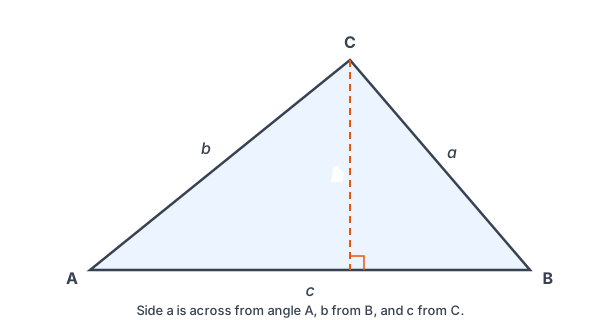
Label the angles with capital letters A, B and C. Label each side with the lowercase letter of the angle across from it. So side a is across from angle A.
The law says the bigger an angle is, the longer the side across from it, in a fixed ratio. If you know one full pair (a side and the angle across from it), you can find any other side or angle.
The Law of Sines Formula
\frac{a}{\sin A} = \frac{b}{\sin B} = \frac{c}{\sin C}You can also flip every fraction: \frac{\sin A}{a} = \frac{\sin B}{b} = \frac{\sin C}{c}. Put the unknown on top. Use the first form to find a side and the flipped form to find an angle.
Why it works
Drop the height h from C, as in the picture. It splits the triangle into two right triangles. In the left one, \sin A = \frac{h}{b}, so h = b \sin A. In the right one, \sin B = \frac{h}{a}, so h = a \sin B.
Both equal h, so b \sin A = a \sin B. Divide both sides by \sin A \sin B to get \frac{b}{\sin B} = \frac{a}{\sin A}. The same steps with a different height give the c part.
When to use it
- AAS: two angles and a side that is not between them.
- ASA: two angles and the side between them.
- SSA: two sides and an angle across from one of them. This case can give zero, one or two triangles, so it gets its own lesson.
For three sides (SSS) or two sides and the angle between them (SAS), use the law of cosines instead.
Worked Examples
Round sides to the nearest tenth and angles to the nearest tenth of a degree. Use a calculator in degree mode.
Example 1: Find a side (AAS)
In triangle ABC, A = 40^\circ, B = 65^\circ and a = 12. Find b.
\frac{a}{\sin A} = \frac{b}{\sin B}Write the part of the law with a and b.
\frac{12}{\sin 40^\circ} = \frac{b}{\sin 65^\circ}Substitute the known values.
b = \frac{12 \sin 65^\circ}{\sin 40^\circ}Multiply both sides by \sin 65^\circ.
b \approx \frac{12(0.9063)}{0.6428}Find the sines with a calculator.
b \approx \frac{10.8756}{0.6428}Multiply on top.
b \approx 16.9
Divide.
Answer: b \approx 16.9. This makes sense: B is bigger than A, so b is longer than a.
Example 2: Solve the whole triangle (ASA)
In triangle ABC, A = 50^\circ, B = 70^\circ and c = 20. Find C, a and b.
C = 180^\circ - 50^\circ - 70^\circ = 60^\circ
Use the triangle angle sum (see triangle angle sum theorem)
\frac{a}{\sin 50^\circ} = \frac{20}{\sin 60^\circ}Set up a proportion for a.
a = \frac{20 \sin 50^\circ}{\sin 60^\circ} \approx \frac{20(0.7660)}{0.8660}Multiply both sides by \sin 50^\circ.
a \approx \frac{15.32}{0.8660} \approx 17.7Simplify.
\frac{b}{\sin 70^\circ} = \frac{20}{\sin 60^\circ}Set up a proportion for b.
b = \frac{20 \sin 70^\circ}{\sin 60^\circ} \approx \frac{20(0.9397)}{0.8660}Multiply both sides by \sin 70^\circ.
b \approx \frac{18.794}{0.8660} \approx 21.7Simplify.
Answer: C = 60^\circ, a \approx 17.7, b \approx 21.7. Use the given side c = 20 in each step, not a rounded answer, so errors don’t build up.
Example 3: Find an angle
In triangle ABC, A = 35^\circ, a = 10 and b = 8. Find B.
\frac{\sin B}{b} = \frac{\sin A}{a}Use the flipped form, with the unknown on top.
\frac{\sin B}{8} = \frac{\sin 35^\circ}{10}Substitute.
\sin B = \frac{8 \sin 35^\circ}{10}Multiply both sides by 8.
\sin B \approx \frac{8(0.5736)}{10} \approx 0.4589Find the sine.
B \approx \sin^{-1}(0.4589) \approx 27.3^\circUse the inverse sine (see inverse trig functions)
Answer: B \approx 27.3^\circ. Here a is longer than b, so there is only one triangle. When the given angle is across from the shorter side, check for a second triangle, as in the ambiguous case of the law of sines.
Example 4: Word problem with fire towers
Two fire towers, A and B, are 10 miles apart. A ranger at A sees smoke at an angle of 52^\circ from the line between the towers. A ranger at B sees it at 61^\circ. How far is the fire from tower A?
F = 180^\circ - 52^\circ - 61^\circ = 67^\circ
Call the fire F. Find the angle at the fire.
The distance from A to the fire is across from the 61^\circ angle at B. The 10 miles is across from F.
\frac{d}{\sin 61^\circ} = \frac{10}{\sin 67^\circ}Set up the proportion.
d = \frac{10 \sin 61^\circ}{\sin 67^\circ}Multiply both sides by \sin 61^\circ.
d \approx \frac{10(0.8746)}{0.9205}Find the sines.
d \approx \frac{8.746}{0.9205} \approx 9.5Simplify.
Answer: The fire is about 9.5 miles from tower A.
Example 5: Height of a tower from two points
From point P, the angle of elevation to the top of a tower is 32^\circ. From point Q, 50 meters closer, it is 48^\circ. How tall is the tower?
Call the top T. The angle at Q inside triangle PQT is 180^\circ - 48^\circ = 132^\circ, because it forms a straight line with the 48^\circ angle.
T = 180^\circ - 32^\circ - 132^\circ = 16^\circ
Find the angle at the top.
\frac{QT}{\sin 32^\circ} = \frac{50}{\sin 16^\circ}Side QT is across from the 32^\circ angle at P. Set up the proportion.
QT = \frac{50 \sin 32^\circ}{\sin 16^\circ} \approx 96.13Multiply both sides by \sin 32^\circ, then use a calculator.
\sin 48^\circ = \frac{h}{QT}Now use the right triangle at Q (see trigonometric ratios)
h = QT \sin 48^\circ
Multiply both sides by QT.
h \approx 96.13(0.7431) \approx 71.4
Substitute.
Answer: The tower is about 71.4 meters tall. This mixes the law of sines with angles of elevation.
Common Mistakes
| Mistake | Example of the error | Fix |
|---|---|---|
| Pairing a side with the wrong angle | Using \frac{a}{\sin B} | Each side goes with the angle across from it: a with A. |
| Calculator in radian mode | \sin 40 gives about 0.7451 | Switch to degree mode: \sin 40^\circ \approx 0.6428. |
| Using it with SSS or SAS | Trying the law of sines with three sides only | You need one full side-angle pair. Use the law of cosines instead. |
| Rounding too early | Using a rounded side to find the next side | Use the given values, or keep extra digits until the end. |
| Forgetting the third angle | Stopping after one side in an ASA problem | Find the third angle first with the angle sum, 180^\circ. |
Related Methods
Law of cosines
If you know three sides, or two sides and the angle between them, there is no full side-angle pair. The law of cosines handles those cases.
Area with sine
The height h = b \sin A from the proof also gives the area: \text{Area} = \frac{1}{2} bc \sin A. This is useful when you know two sides and the angle between them. See area of oblique triangles.
Right triangles
If C = 90^\circ, then \sin C = 1, so \frac{a}{\sin A} = c. That gives a = c \sin A, the same as sine = opposite over hypotenuse.
Practice Problems
Round sides to the nearest hundredth and angles to the nearest tenth of a degree. Keep the calculator’s full values until the last step.
- In triangle ABC, A = 30^\circ, B = 45^\circ and a = 8. Find b.
- In triangle ABC, A = 72^\circ, C = 48^\circ and c = 15. Find a.
- In triangle ABC, A = 28^\circ, B = 102^\circ and c = 40. Find C, a and b.
- In triangle ABC, A = 30^\circ, B = 45^\circ and a = 6. Find the exact value of b.
- In triangle ABC, A = 110^\circ, a = 12 and b = 9. Find B.
- In triangle ABC, B = 64^\circ, b = 14 and c = 10. Find C.
- In triangle ABC, B = 36^\circ, C = 80^\circ and a = 25. Find A, b and c.
- In a right triangle, C = 90^\circ, c = 10 and A = 30^\circ. Use the law of sines to find a.
- Points A and B are 200 feet apart on one side of a river. A tree C is on the other side. Angle CAB is 54^\circ and angle CBA is 71^\circ. Find the distance from A to the tree.
- From point P, the angle of elevation to the top of a cliff is 25^\circ. From point Q, 100 feet closer, it is 40^\circ. How tall is the cliff?
Show answers
1.
\frac{b}{\sin 45^\circ} = \frac{8}{\sin 30^\circ}Set up the proportion.
b = \frac{8 \sin 45^\circ}{\sin 30^\circ}Multiply both sides by \sin 45^\circ.
b \approx \frac{8(0.7071)}{0.5}Find the sines.
b \approx \frac{5.6568}{0.5} \approx 11.31Simplify.
Answer: b \approx 11.31
2.
\frac{a}{\sin 72^\circ} = \frac{15}{\sin 48^\circ}Set up the proportion.
a = \frac{15 \sin 72^\circ}{\sin 48^\circ}Multiply both sides by \sin 72^\circ.
a \approx \frac{15(0.9511)}{0.7431}Find the sines.
a \approx \frac{14.2665}{0.7431} \approx 19.20Simplify.
Answer: a \approx 19.20
3.
C = 180^\circ - 28^\circ - 102^\circ = 50^\circ
Use the angle sum to find the third angle.
a = \frac{40 \sin 28^\circ}{\sin 50^\circ} \approx 24.51Find side a with the law of sines.
b = \frac{40 \sin 102^\circ}{\sin 50^\circ} \approx 51.08Find side b with the law of sines.
Answer: C = 50^\circ, a \approx 24.51, b \approx 51.08
4.
b = \frac{6 \sin 45^\circ}{\sin 30^\circ}Set up the proportion.
b = \frac{6 \cdot \frac{\sqrt{2}}{2}}{\frac{1}{2}}Use exact values.
b = \frac{3\sqrt{2}}{\frac{1}{2}}Simplify the top.
b = 6\sqrt{2}Dividing by \frac{1}{2} means multiplying by 2.
Answer: b = 6\sqrt{2} \approx 8.49
5.
\frac{\sin B}{9} = \frac{\sin 110^\circ}{12}Use the flipped form.
\sin B = \frac{9 \sin 110^\circ}{12}Multiply both sides by 9.
\sin B \approx \frac{9(0.9397)}{12} \approx 0.7048Find the sine.
B \approx \sin^{-1}(0.7048) \approx 44.8^\circTake the inverse sine.
Answer: B \approx 44.8^\circ (a triangle can’t have two obtuse angles, so this is the only answer)
6.
\frac{\sin C}{10} = \frac{\sin 64^\circ}{14}Use the flipped form.
\sin C = \frac{10 \sin 64^\circ}{14}Multiply both sides by 10.
\sin C \approx \frac{10(0.8988)}{14} \approx 0.6420Find the sine.
C \approx \sin^{-1}(0.6420) \approx 39.9^\circTake the inverse sine.
Answer: C \approx 39.9^\circ
7.
A = 180^\circ - 36^\circ - 80^\circ = 64^\circ
Use the angle sum to find the third angle.
b = \frac{25 \sin 36^\circ}{\sin 64^\circ} \approx \frac{25(0.5878)}{0.8988} \approx \frac{14.695}{0.8988} \approx 16.35Find side b with the law of sines.
c = \frac{25 \sin 80^\circ}{\sin 64^\circ} \approx \frac{25(0.9848)}{0.8988} \approx \frac{24.62}{0.8988} \approx 27.39Find side c with the law of sines.
Answer: A = 64^\circ, b \approx 16.35, c \approx 27.39
8.
\frac{a}{\sin 30^\circ} = \frac{10}{\sin 90^\circ}Set up the proportion.
\frac{a}{\sin 30^\circ} = 10Use \sin 90^\circ = 1.
a = 10 \sin 30^\circ
Multiply both sides by \sin 30^\circ.
a = 5
Use \sin 30^\circ = \frac{1}{2}.
Answer: a = 5, which matches sine = opposite over hypotenuse
9.
C = 180^\circ - 54^\circ - 71^\circ = 55^\circ
Angle at the tree.
\frac{AC}{\sin 71^\circ} = \frac{200}{\sin 55^\circ}AC is across from the 71^\circ angle at B.
AC = \frac{200 \sin 71^\circ}{\sin 55^\circ}Multiply both sides by \sin 71^\circ.
AC \approx 230.85
Use a calculator.
Answer: about 230.85 feet
10.
180^\circ - 40^\circ = 140^\circ
Angle at Q inside the triangle.
T = 180^\circ - 25^\circ - 140^\circ = 15^\circ
Angle at the top.
QT = \frac{100 \sin 25^\circ}{\sin 15^\circ} \approx \frac{100(0.4226)}{0.2588} \approx 163.29QT is across from the 25^\circ angle.
h = QT \sin 40^\circ \approx 163.29(0.6428) \approx 104.96
Right triangle at Q.
Answer: about 104.96 feet
FAQ
What is the law of sines used for?
It finds missing sides and angles in triangles that are not right triangles. You need at least one side and the angle across from it, plus one more side or angle.
When do you use the law of sines vs. the law of cosines?
Use the law of sines for AAS, ASA and SSA, where you know a side-angle pair. Use the law of cosines for SSS and SAS.
Does the law of sines work for right triangles?
Yes. Since \sin 90^\circ = 1, it turns into the usual sine ratio, opposite over hypotenuse.
Why can the law of sines give two answers?
When you solve for an angle, \sin B has the same value for an acute angle and for 180° minus that angle. In the SSA case, both angles can sometimes make a triangle.
Summary
- The law of sines: \frac{a}{\sin A} = \frac{b}{\sin B} = \frac{c}{\sin C}.
- Each side goes with the angle across from it.
- Use it for AAS, ASA and SSA, when you know a full side-angle pair.
- Find the third angle with the angle sum, 180^\circ.
- To find an angle, put the sines on top, then use the inverse sine.
Previous lesson: Solving Trig Equations with Identities
Next lesson: Ambiguous Case of the Law of Sines
Back to the Trigonometry Index