
Area of Oblique Triangles
The area of an oblique triangle (a triangle with no right angle) can be found without knowing its height. If you know two sides and the angle between them, use \text{Area} = \frac{1}{2}bc \sin A. If you know all three sides, use Heron’s formula: \text{Area} = \sqrt{s(s - a)(s - b)(s - c)}, where s is half the perimeter.
Before this lesson: You should know the Area of Triangles, the Law of Sines and the Law of Cosines.
Why the Sine Gives the Area
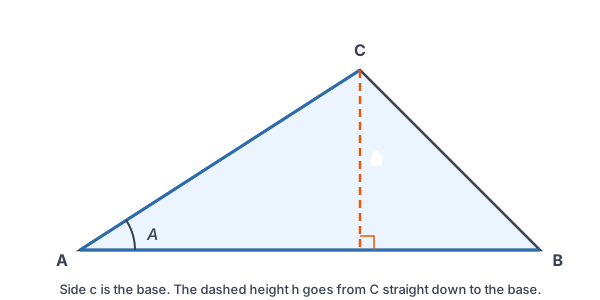
The usual formula is \text{Area} = \frac{1}{2} \cdot \text{base} \cdot \text{height}. In an oblique triangle, you often don’t know the height. But you can build it from a side and an angle.
In the picture, the height h makes a right triangle with side b. In that right triangle, \sin A = \frac{h}{b}, so h = b \sin A. Put that height into the usual formula with base c, and you get \frac{1}{2} c \cdot b \sin A.
Area Formulas for Oblique Triangles
Two sides and the angle between them (SAS)
\text{Area} = \frac{1}{2}bc \sin A = \frac{1}{2}ac \sin B = \frac{1}{2}ab \sin CPick the version whose angle sits between the two sides you know.
Three sides (SSS): Heron’s formula
s = \frac{a + b + c}{2}, \quad \text{Area} = \sqrt{s(s - a)(s - b)(s - c)}Here s is the semiperimeter, half the distance around the triangle. Heron’s formula needs no angles at all.
Other cases
For ASA, AAS or SSA, first use the law of sines to find a second side. Then you have two sides and the angle between them.
Worked Examples
Use a calculator in degree mode. Round areas to the nearest hundredth.
Example 1: Two sides and the angle between them
In triangle ABC, b = 9, c = 12 and A = 40^\circ. Find the area.
Angle A is between sides b and c, so use \text{Area} = \frac{1}{2}bc \sin A
\text{Area} = \frac{1}{2}(9)(12) \sin 40^\circSubstitute.
\text{Area} = 54 \sin 40^\circMultiply the numbers.
\text{Area} \approx 54(0.6428)Find the sine.
\text{Area} \approx 34.71Multiply.
Answer: about 34.71 square units
Example 2: An exact area with an obtuse angle
In triangle ABC, a = 6, b = 10 and C = 150^\circ. Find the exact area.
\text{Area} = \frac{1}{2}ab \sin CAngle C is between a and b.
\text{Area} = \frac{1}{2}(6)(10) \sin 150^\circSubstitute.
\text{Area} = 30 \sin 150^\circMultiply the numbers.
\sin 150^\circ = \sin 30^\circ = \frac{1}{2}Use the reference angle (see reference angles)
\text{Area} = 30 \cdot \frac{1}{2} = 15Multiply.
Answer: exactly 15 square units. The sine of an obtuse angle is positive, so the formula still works.
Example 3: Heron’s formula
Find the area of a triangle with sides 7, 8 and 9.
s = \frac{7 + 8 + 9}{2} = \frac{24}{2} = 12Find the semiperimeter.
Find each difference: s - a = 12 - 7 = 5, s - b = 12 - 8 = 4, s - c = 12 - 9 = 3
\text{Area} = \sqrt{12 \cdot 5 \cdot 4 \cdot 3}Substitute.
\text{Area} = \sqrt{720}Multiply under the root.
\sqrt{720} = \sqrt{144 \cdot 5} = 12\sqrt{5}Simplify the radical (see simplifying square roots)
12\sqrt{5} \approx 26.83Approximate.
Answer: 12\sqrt{5} \approx 26.83 square units
Example 4: Two angles and a side (ASA)
In triangle ABC, A = 35^\circ, B = 75^\circ and c = 20. Find the area.
C = 180^\circ - 35^\circ - 75^\circ = 70^\circ
Find the third angle.
b = \frac{20 \sin 75^\circ}{\sin 70^\circ} \approx \frac{20(0.9659)}{0.9397} \approx 20.558Use the law of sines to find b.
\text{Area} = \frac{1}{2}bc \sin ANow A is between b and c.
\text{Area} \approx \frac{1}{2}(20.558)(20) \sin 35^\circSubstitute.
\text{Area} \approx 205.58 \sin 35^\circMultiply the numbers.
\text{Area} \approx 205.58(0.5736) \approx 117.92Find the sine and multiply.
Answer: about 117.92 square units
Example 5: Word problem with a triangular lot
A triangular lot has sides of 120 ft, 150 ft and 200 ft. Sod costs $0.45 per square foot. About how much will it cost to cover the lot?
s = \frac{120 + 150 + 200}{2} = \frac{470}{2} = 235Find the semiperimeter.
Find each difference: 235 - 120 = 115, 235 - 150 = 85, 235 - 200 = 35
\text{Area} = \sqrt{235 \cdot 115 \cdot 85 \cdot 35}Substitute into Heron’s formula.
\text{Area} = \sqrt{80{,}399{,}375}Multiply under the root.
\text{Area} \approx 8966.57Take the square root (square feet).
8966.57 \cdot 0.45 \approx 4034.96
Multiply by the price.
Answer: about $4,034.96
Common Mistakes
| Mistake | Example of the error | Fix |
|---|---|---|
| Using an angle that is not between the sides | \frac{1}{2}bc \sin B | The angle must sit between the two sides: \frac{1}{2}bc \sin A. |
| Forgetting the one half | bc \sin A = 108 \sin 40^\circ | The formula starts with \frac{1}{2}, just like \frac{1}{2}bh. |
| Using the perimeter for s | s = 7 + 8 + 9 = 24 | s is half the perimeter: s = 12. |
| Calculator in radian mode | 54 \sin 40 \approx 40.24 | Use degree mode: 54 \sin 40^\circ \approx 34.71. |
| Rounding a side too early | Using b \approx 20.6 in Example 4 | Keep extra digits until the last step. |
Related Methods
Parallelograms
A parallelogram is two copies of the same triangle. With sides a and b and an angle \theta between them, its area is ab \sin \theta, with no one half.
Finding an angle from the area
If you know the area and two sides, solve the formula for the sine. For example, 30 = \frac{1}{2}(8)(10) \sin C gives \sin C = 0.75.
Right triangles
If the angle is 90^\circ, \sin 90^\circ = 1, and the formula becomes \frac{1}{2}ab, the usual area of a right triangle.
Practice Problems
Round answers to the nearest hundredth unless the problem asks for an exact value.
- Find the area of triangle ABC with a = 8, b = 11 and C = 30^\circ.
- Find the area of triangle ABC with a = 14, c = 9 and B = 72^\circ.
- Use Heron’s formula to find the exact area of a triangle with sides 5, 6 and 7.
- Use Heron’s formula to find the area of a triangle with sides 13, 14 and 15.
- Find the exact area of triangle ABC with b = 5, c = 8 and A = 120^\circ.
- A parallelogram has sides 7 and 12 with a 65^\circ angle between them. Find its area.
- A triangle has area 30, a = 8 and b = 10, and angle C is acute. Find C to the nearest tenth of a degree.
- Find the area of an isosceles triangle with sides 10, 10 and 12.
- In triangle ABC, A = 50^\circ, B = 60^\circ and a = 10. Find the area.
- A sail is a triangle with sides of 12 ft and 15 ft that meet at a 70^\circ angle. Find the area of the sail.
Show answers
1.
\text{Area} = \frac{1}{2}(8)(11) \sin 30^\circSubstitute.
\text{Area} = 44 \sin 30^\circMultiply.
\text{Area} = 22Use \sin 30^\circ = \frac{1}{2}.
Answer: 22 square units
2.
\text{Area} = \frac{1}{2}(14)(9) \sin 72^\circAngle B is between a and c.
\text{Area} = 63 \sin 72^\circMultiply.
\text{Area} \approx 63(0.9511) \approx 59.92Find the sine.
Answer: about 59.92 square units
3.
s = \frac{5 + 6 + 7}{2} = 9Find the semiperimeter.
Differences: 9 - 5 = 4, 9 - 6 = 3, 9 - 7 = 2
\text{Area} = \sqrt{9 \cdot 4 \cdot 3 \cdot 2} = \sqrt{216}Substitute.
\sqrt{216} = \sqrt{36 \cdot 6} = 6\sqrt{6}Simplify.
Answer: 6\sqrt{6} \approx 14.70 square units
4.
s = \frac{13 + 14 + 15}{2} = 21Find the semiperimeter.
Differences: 21 - 13 = 8, 21 - 14 = 7, 21 - 15 = 6
\text{Area} = \sqrt{21 \cdot 8 \cdot 7 \cdot 6} = \sqrt{7056}Substitute.
\sqrt{7056} = 84Take the square root.
Answer: 84 square units
5.
\text{Area} = \frac{1}{2}(5)(8) \sin 120^\circSubstitute.
\text{Area} = 20 \sin 120^\circMultiply.
\text{Area} = 20 \cdot \frac{\sqrt{3}}{2} = 10\sqrt{3}Use \sin 120^\circ = \frac{\sqrt{3}}{2}.
Answer: 10\sqrt{3} \approx 17.32 square units
6.
\text{Area} = (7)(12) \sin 65^\circUse the parallelogram area: the two sides times the sine of the angle.
\text{Area} = 84 \sin 65^\circMultiply.
\text{Area} \approx 84(0.9063) \approx 76.13Find the sine.
Answer: about 76.13 square units
7.
30 = \frac{1}{2}(8)(10) \sin CSubstitute.
30 = 40 \sin C
Multiply.
\sin C = 0.75
Divide both sides by 40.
C = \sin^{-1}(0.75) \approx 48.6^\circTake the inverse sine.
Answer: C \approx 48.6^\circ
8.
s = \frac{10 + 10 + 12}{2} = 16Find the semiperimeter.
Differences: 16 - 10 = 6, 16 - 10 = 6, 16 - 12 = 4
\text{Area} = \sqrt{16 \cdot 6 \cdot 6 \cdot 4} = \sqrt{2304}Substitute.
\sqrt{2304} = 48Take the square root.
Answer: 48 square units
9.
C = 180^\circ - 50^\circ - 60^\circ = 70^\circ
Use the angle sum to find the third angle.
b = \frac{10 \sin 60^\circ}{\sin 50^\circ} \approx \frac{10(0.8660)}{0.7660} \approx 11.305Law of sines.
\text{Area} \approx \frac{1}{2}(10)(11.305) \sin 70^\circC is between a and b.
\text{Area} \approx 56.525(0.9397) \approx 53.12Multiply.
Answer: about 53.12 square units
10.
\text{Area} = \frac{1}{2}(12)(15) \sin 70^\circThe angle is between the two sides.
\text{Area} = 90 \sin 70^\circMultiply.
\text{Area} \approx 90(0.9397) \approx 84.57Find the sine.
Answer: about 84.57 square feet
FAQ
How do you find the area of a triangle without the height?
Use two sides and the angle between them: \text{Area} = \frac{1}{2}ab \sin C. If you know all three sides, use Heron’s formula.
What is Heron’s formula?
It finds a triangle’s area from its three sides. Let s be half the perimeter; then the area is \sqrt{s(s - a)(s - b)(s - c)}.
Does the sine area formula work for obtuse angles?
Yes. The sine of an angle between 90^\circ and 180^\circ is positive, so the area comes out positive.
What is an oblique triangle?
It is any triangle without a right angle. It can be acute, with all angles under 90^\circ, or obtuse, with one angle over 90^\circ.
Summary
- SAS: \text{Area} = \frac{1}{2}ab \sin C, using the angle between the two sides.
- SSS: Heron’s formula, \sqrt{s(s - a)(s - b)(s - c)} with s = \frac{a + b + c}{2}.
- ASA, AAS or SSA: find a second side with the law of sines first.
- A parallelogram’s area is ab \sin \theta.
- Keep extra digits until the last step.
Previous lesson: Law of Cosines
Next lesson: Polar Coordinates
Back to the Trigonometry Index