
Compositions of Inverse Trig Functions
Compositions of inverse trig functions combine a trig function with an inverse trig function, like \sin(\arcsin x) or \cos(\arctan \frac{3}{4}). A function undoes its own inverse when the input is allowed: \sin(\arcsin x) = x. For a mixed pair, draw a right triangle for the inner angle and read the outer ratio from it.
Before this lesson: You should know Inverse Trig Functions, Composition of Functions and the Pythagorean Theorem.
Working From the Inside Out
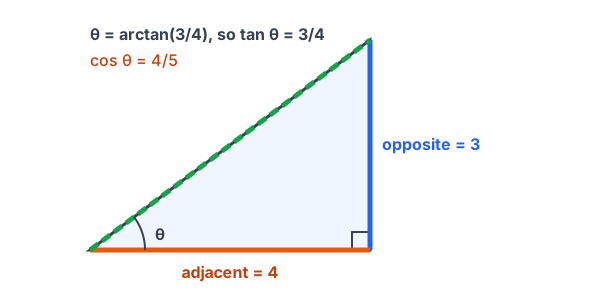
A composition is evaluated from the inside out, as in composition of functions. In \cos(\arctan \frac{3}{4}), the inner part \arctan \frac{3}{4} is an angle \theta with \tan \theta = \frac{3}{4}. The outer part asks for the cosine of that same angle.
You don’t need to know \theta in degrees. Draw a right triangle where tangent is \frac{3}{4}: opposite 3 and adjacent 4. The Pythagorean theorem gives a hypotenuse of 5, so \cos \theta = \frac{4}{5}.
Rules for Compositions
| Composition | Result | When it works |
|---|---|---|
| \sin(\arcsin x) | x | -1 \le x \le 1 |
| \cos(\arccos x) | x | -1 \le x \le 1 |
| \tan(\arctan x) | x | All real x |
| \arcsin(\sin \theta) | \theta | Only if -\frac{\pi}{2} \le \theta \le \frac{\pi}{2} |
| \arccos(\cos \theta) | \theta | Only if 0 \le \theta \le \pi |
| \arctan(\tan \theta) | \theta | Only if -\frac{\pi}{2} \lt \theta \lt \frac{\pi}{2} |
- If the outside and inside match, check the domain or range rule in the table.
- If they don’t match, or the angle is outside the range, evaluate the inside first.
- For a mixed pair, let \theta be the inner angle and sketch a right triangle from its ratio.
- Find the missing side with the Pythagorean theorem.
- Read the outer ratio. Give it the sign for the quadrant where \theta lies.
Worked Examples
Example 1: A function and its inverse
Evaluate \sin(\arcsin 0.4) and \cos(\arccos(-0.7)).
Check the domain: 0.4 is between −1 and 1
\sin(\arcsin 0.4) = 0.4
Sine undoes arcsine.
Check the domain: −0.7 is between −1 and 1
\cos(\arccos(-0.7)) = -0.7
Cosine undoes arccosine.
Answer: 0.4 and −0.7
Example 2: When the inverse does not undo
Evaluate \arcsin(\sin \frac{5\pi}{6}).
\sin \frac{5\pi}{6} = \frac{1}{2}The angle \frac{5\pi}{6} is outside arcsine’s range, so evaluate the inside first.
\frac{\pi}{6}Now find \arcsin \frac{1}{2}, the angle in [-\frac{\pi}{2}, \frac{\pi}{2}] with sine \frac{1}{2}.
Answer: \frac{\pi}{6}, not \frac{5\pi}{6}. The two angles have the same sine, but only \frac{\pi}{6} is in the range of arcsine.
Example 3: Use a right triangle
Evaluate \cos(\arctan \frac{3}{4}).
Let \theta = \arctan \frac{3}{4}, so \tan \theta = \frac{3}{4} and \theta is in Quadrant I
Draw a right triangle with opposite 3 and adjacent 4
c^2 = 3^2 + 4^2 = 9 + 16 = 25
Find the hypotenuse.
c = 5
Take the square root.
\cos \theta = \frac{4}{5}Read cosine, adjacent over hypotenuse.
Answer: \cos(\arctan \frac{3}{4}) = \frac{4}{5}
Example 4: An angle in Quadrant II
Evaluate \sin(\arccos(-\frac{5}{13})).
Let \theta = \arccos(-\frac{5}{13}). Arccosine of a negative value is in Quadrant II.
In Quadrant II, use x = -5 and r = 13
25 + y^2 = 169
Find y with x^2 + y^2 = r^2.
Subtract 25 from both sides: y^2 = 144, so y = 12 (positive in Quadrant II)
\sin \theta = \frac{y}{r} = \frac{12}{13}Read sine.
Answer: \frac{12}{13}. This uses the point method from trig functions of any angle.
Example 5: Word problem with a drone
A drone is 100 meters away from you horizontally. Its angle of elevation is \theta = \arctan \frac{h}{100}, where h is its height. When h = 75 meters, find \cos \theta and the straight-line distance d = \frac{100}{\cos \theta} to the drone.
\theta = \arctan \frac{75}{100} = \arctan \frac{3}{4}Substitute.
Draw the triangle: opposite 3, adjacent 4, hypotenuse 5 (scaled from 75, 100 and 125)
\cos \theta = \frac{4}{5}Read cosine.
d = \frac{100}{\frac{4}{5}} = 100 \cdot \frac{5}{4} = 125Find the distance.
Answer: \cos \theta = \frac{4}{5}, and the drone is 125 meters away. The Pythagorean theorem agrees: \sqrt{100^2 + 75^2} = \sqrt{15{,}625} = 125.
Common Mistakes
| Mistake | Example of the error | Fix |
|---|---|---|
| Canceling without checking the range | \arcsin(\sin \frac{5\pi}{6}) = \frac{5\pi}{6} | \frac{5\pi}{6} is outside [-\frac{\pi}{2}, \frac{\pi}{2}]. The answer is \frac{\pi}{6}. |
| Canceling outside the domain | \sin(\arcsin 2) = 2 | \arcsin 2 is undefined, so the composition is undefined. |
| Wrong sign from the triangle | \cos(\arcsin(-\frac{8}{17})) = -\frac{15}{17} | Arcsine of a negative is in Quadrant IV, where cosine is positive: \frac{15}{17}. |
| Using the wrong sides | For \arctan \frac{3}{4}, using hypotenuse 4 | Tangent is opposite over adjacent: opposite 3, adjacent 4. |
| Multiplying instead of composing | \cos(\arctan \frac{3}{4}) = \cos \cdot \frac{3}{4} | Find the angle first, then take its cosine. |
Related Methods
Algebraic expressions
The triangle method also works with a variable. For \cos(\arcsin x), draw opposite x and hypotenuse 1. The adjacent side is \sqrt{1 - x^2}, so \cos(\arcsin x) = \sqrt{1 - x^2}. Calculus uses results like this often.
Check with a calculator
You can check any answer numerically. In radian mode, \cos(\tan^{-1}(0.75)) = 0.8, which matches \frac{4}{5}.
Reciprocal outer functions
If the outer function is secant, cosecant or cotangent, find the matching ratio from the triangle and flip it. For example, \sec(\arctan 2) = \frac{\sqrt{5}}{1} = \sqrt{5}.
Practice Problems
- Evaluate \sin(\arcsin 0.25).
- Evaluate \tan(\arctan 7).
- Evaluate \arccos(\cos \frac{\pi}{3}).
- Evaluate \arcsin(\sin \frac{2\pi}{3}).
- Evaluate \arccos(\cos(-\frac{\pi}{4})).
- Evaluate \sin(\arctan \frac{5}{12}).
- Evaluate \tan(\arccos \frac{3}{5}).
- Evaluate \cos(\arcsin(-\frac{8}{17})).
- Evaluate \sec(\arctan 2).
- A 10-foot ladder leans against a wall at an angle \theta = \arccos \frac{6}{10} with the ground. Find how high the ladder reaches, 10 \sin \theta.
Show answers
1.
0.25 is between −1 and 1, so sine undoes arcsine
Answer: 0.25
2.
Tangent undoes arctangent for every real number
Answer: 7
3.
\frac{\pi}{3} is in [0, \pi], so arccosine undoes cosine
Answer: \frac{\pi}{3}
4.
\sin \frac{2\pi}{3} = \frac{\sqrt{3}}{2}Evaluate the inside.
\arcsin \frac{\sqrt{3}}{2} = \frac{\pi}{3}Find the arcsine.
Answer: \frac{\pi}{3}
5.
\cos(-\frac{\pi}{4}) = \frac{\sqrt{2}}{2}Evaluate the inside.
\arccos \frac{\sqrt{2}}{2} = \frac{\pi}{4}Find the arccosine.
Answer: \frac{\pi}{4}
6.
Triangle: opposite 5, adjacent 12
\sqrt{25 + 144} = \sqrt{169} = 13Find the hypotenuse with the Pythagorean theorem.
\frac{5}{13}Read sine.
Answer: \frac{5}{13}
7.
Triangle: adjacent 3, hypotenuse 5
\sqrt{25 - 9} = \sqrt{16} = 4Find the opposite side with the Pythagorean theorem.
\frac{4}{3}Read tangent.
Answer: \frac{4}{3}
8.
The angle is in Quadrant IV: y = -8, r = 17
Find x: x^2 = 289 - 64 = 225, so x = 15 (positive in Quadrant IV)
\frac{15}{17}Read cosine.
Answer: \frac{15}{17}
9.
Triangle: opposite 2, adjacent 1
\sqrt{4 + 1} = \sqrt{5}Find the hypotenuse with the Pythagorean theorem.
\frac{\sqrt{5}}{1}Secant is hypotenuse over adjacent.
Answer: \sqrt{5}
10.
Triangle: adjacent 6, hypotenuse 10
\sqrt{100 - 36} = \sqrt{64} = 8Find the opposite side with the Pythagorean theorem.
So \sin \theta = \frac{8}{10}
10 \cdot \frac{8}{10} = 8Find the height: multiply by the sine.
Answer: 8 feet
FAQ
Does sin(arcsin x) always equal x?
Yes, as long as x is between −1 and 1. For any other x, \arcsin x is undefined, so the composition is undefined.
Why doesn’t arcsin(sin x) always equal x?
Arcsine only returns angles from -\frac{\pi}{2} to \frac{\pi}{2}. If x is outside that range, arcsine returns a different angle with the same sine.
How do you evaluate cos(arctan x)?
Draw a right triangle with opposite x and adjacent 1. The hypotenuse is \sqrt{x^2 + 1}, so \cos(\arctan x) = \frac{1}{\sqrt{x^2 + 1}}.
How do you know the sign of the answer?
Use the range of the inner inverse function. Arcsine and arctangent of a negative value are in Quadrant IV, and arccosine of a negative value is in Quadrant II. Then apply the quadrant sign rules.
Summary
- Evaluate compositions from the inside out.
- \sin(\arcsin x) = x and \cos(\arccos x) = x for -1 \le x \le 1; \tan(\arctan x) = x for all x.
- \arcsin(\sin \theta) = \theta only when \theta is in arcsine’s range; otherwise evaluate the inside first.
- For mixed pairs, draw a right triangle for the inner angle and read the outer ratio.
- Use the inner function’s range to choose the quadrant and sign.
Previous lesson: Inverse Trig Functions
Next lesson: Fundamental Trig Identities
Back to the Trigonometry Index