
Integration by Partial Fractions
Integration by partial fractions integrates a rational function by splitting it into simpler fractions. Factor the denominator, write the fraction as a sum like A/(x − a) + B/(x − b), solve for the constants, and integrate each piece. Linear pieces give natural logs, and pieces over x² + a² can give arctangents.
Before this lesson: Partial Fraction Decomposition (Precalculus), Integrals That Give Natural Logarithms and Integrals That Give Inverse Trig Functions
Why splitting helps
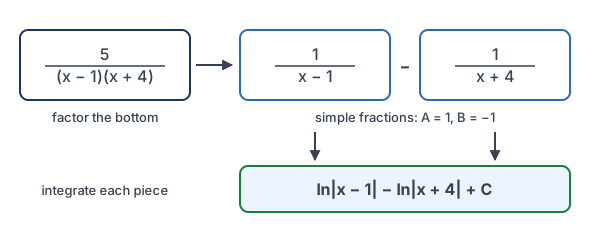
A fraction like 5/((x − 1)(x + 4)) has no basic antiderivative as written. But it equals 1/(x − 1) − 1/(x + 4), and each of those integrates to a natural log in one step.
Finding the pieces is the algebra skill of partial fraction decomposition. This lesson adds the last step: integrating the pieces.
Partial fraction forms
| Factor in the denominator | Terms in the split | Integrates to |
|---|---|---|
| Distinct linear (x − a) | \dfrac{A}{x - a} | A\ln|x - a| |
| Repeated linear (x − a)² | \dfrac{A}{x - a} + \dfrac{B}{(x - a)^2} | A\ln|x - a| - \dfrac{B}{x - a} |
| Irreducible quadratic x² + k² | \dfrac{Bx + D}{x^2 + k^2} | \dfrac{B}{2}\ln(x^2 + k^2) + \dfrac{D}{k}\arctan\dfrac{x}{k} |
Steps:
- If the top’s degree is at least the bottom’s, divide first (see polynomial long division).
- Factor the denominator completely.
- Write the split with one term for each factor, using the forms above.
- Multiply through by the denominator and solve for the constants. Plug in the roots, or match coefficients.
- Integrate each piece.
Integration by partial fractions examples
Example 1: Two distinct linear factors
Find \int \dfrac{5}{(x - 1)(x + 4)}\,dx.
\dfrac{5}{(x - 1)(x + 4)} = \dfrac{A}{x - 1} + \dfrac{B}{x + 4}One term for each linear factor.
5 = A(x + 4) + B(x - 1)
Multiply both sides by (x − 1)(x + 4).
5 = A(1 + 4) + B(1 - 1) = 5A
Put in x = 1 so the B term is 0.
A = 1
Divide both sides by 5.
5 = A(-4 + 4) + B(-4 - 1) = -5B
Put in x = −4 so the A term is 0.
B = -1
Divide both sides by −5.
\int \dfrac{5}{(x - 1)(x + 4)}\,dx = \int \left(\dfrac{1}{x - 1} - \dfrac{1}{x + 4}\right)dxRewrite with the pieces.
= \ln|x - 1| - \ln|x + 4| + C
Integrate each piece (see integrals that give natural logarithms).
Answer: \ln|x - 1| - \ln|x + 4| + C, which can also be written \ln\left|\dfrac{x - 1}{x + 4}\right| + C.
Example 2: Factor first
Find \int \dfrac{x + 7}{x^2 - x - 6}\,dx.
x^2 - x - 6 = (x - 3)(x + 2)
Factor the denominator (see factoring trinomials).
x + 7 = A(x + 2) + B(x - 3)
Write the split and clear the denominators.
10 = A(3 + 2) = 5A
Put in x = 3.
A = 2
Divide by 5.
5 = B(-2 - 3) = -5B
Put in x = −2.
B = -1
Divide by −5.
\int \left(\dfrac{2}{x - 3} - \dfrac{1}{x + 2}\right)dx = 2\ln|x - 3| - \ln|x + 2| + CIntegrate each piece.
Answer: 2\ln|x - 3| - \ln|x + 2| + C
Example 3: A repeated factor
Find \int \dfrac{2x + 3}{(x + 1)^2}\,dx.
\dfrac{2x + 3}{(x + 1)^2} = \dfrac{A}{x + 1} + \dfrac{B}{(x + 1)^2}A repeated factor needs a term for each power.
2x + 3 = A(x + 1) + B
Multiply by (x + 1)².
2(-1) + 3 = B
Put in x = −1.
B = 1
Simplify.
A = 2
Match the x terms: 2x = Ax.
\int \left(\dfrac{2}{x + 1} + \dfrac{1}{(x + 1)^2}\right)dx = 2\ln|x + 1| - \dfrac{1}{x + 1} + CThe second piece is (x + 1)⁻²; use the power rule.
Answer: 2\ln|x + 1| - \dfrac{1}{x + 1} + C
Example 4: An irreducible quadratic factor
Find \int \dfrac{3x^2 + 3x + 4}{x(x^2 + 4)}\,dx.
\dfrac{3x^2 + 3x + 4}{x(x^2 + 4)} = \dfrac{A}{x} + \dfrac{Bx + D}{x^2 + 4}x² + 4 can’t be factored, so its numerator is Bx + D.
3x^2 + 3x + 4 = A(x^2 + 4) + (Bx + D)x
Multiply by x(x² + 4).
4 = 4A
Put in x = 0, so A = 1.
3x^2 + 3x + 4 = (A + B)x^2 + Dx + 4A
Expand and group by powers of x.
B = 3 - A = 2, \; D = 3
Match the x² and x coefficients.
\int \left(\dfrac{1}{x} + \dfrac{2x}{x^2 + 4} + \dfrac{3}{x^2 + 4}\right)dxSplit (2x + 3)/(x² + 4) into two fractions.
= \ln|x| + \ln(x^2 + 4) + \dfrac{3}{2}\arctan\dfrac{x}{2} + CLog rule for the first two; arctangent rule with a = 2 for the third.
Answer: \ln|x| + \ln(x^2 + 4) + \dfrac{3}{2}\arctan\dfrac{x}{2} + C
Example 5: Water flowing into a tank
Water flows into a tank at a rate of r(t) = \dfrac{10}{(t + 1)(t + 2)} liters per minute. How much water flows in from t = 0 to t = 3?
\dfrac{10}{(t + 1)(t + 2)} = \dfrac{10}{t + 1} - \dfrac{10}{t + 2}Split: 10 = A(t + 2) + B(t + 1) gives A = 10 (t = −1) and B = −10 (t = −2).
\int_0^3 \left(\dfrac{10}{t + 1} - \dfrac{10}{t + 2}\right)dt = \Big[10\ln(t + 1) - 10\ln(t + 2)\Big]_0^3Integrate; both insides are positive here.
= (10\ln 4 - 10\ln 5) - (10\ln 1 - 10\ln 2)
Plug in the limits.
= 10\ln\dfrac{4 \cdot 2}{5} = 10\ln 1.6ln 1 = 0; combine the logs (see properties of logarithms).
\approx 4.70
ln 1.6 ≈ 0.4700.
Answer: about 4.70 liters.
Common mistakes
| Mistake | Example of the error | Fix |
|---|---|---|
| Skipping long division | Splitting \dfrac{x^2 + 1}{x^2 - 1} directly | The degrees are equal, so divide first: 1 + \dfrac{2}{x^2 - 1}. |
| Missing a term for a repeated factor | \dfrac{2x + 3}{(x + 1)^2} = \dfrac{B}{(x + 1)^2} | Include every power: \dfrac{A}{x + 1} + \dfrac{B}{(x + 1)^2}. |
| Using a constant over a quadratic | \dfrac{D}{x^2 + 4} alone | An irreducible quadratic needs \dfrac{Bx + D}{x^2 + 4}. |
| Integrating 1/(x + 1)² as a log | \int \dfrac{1}{(x + 1)^2}\,dx = \ln(x + 1)^2 | Only power −1 gives a log: the answer is -\dfrac{1}{x + 1} + C. |
| Sign errors when plugging in roots | x = −4 giving 5 = 5B | −4 − 1 = −5, so 5 = −5B and B = −1. |
Related methods
Completing the square instead
If the quadratic doesn’t factor, such as x² + 2x + 5, complete the square and use the log and arctangent rules. Practice problem 9 works one out.
Logistic models
The logistic differential equation leads to \int \dfrac{1}{P(K - P)}\,dP, which splits as \dfrac{1}{K}\left(\dfrac{1}{P} + \dfrac{1}{K - P}\right). Practice problem 10 uses this. Logistic growth is modeled in logistic functions.
Practice problems
- Find \int \dfrac{1}{x(x + 1)}\,dx.
- Find \int \dfrac{3}{x^2 - 9}\,dx.
- Find \int \dfrac{x - 1}{x^2 + 5x + 6}\,dx.
- Find \int \dfrac{4x}{(x - 1)^2}\,dx.
- Find \int \dfrac{2}{x^2(x + 2)}\,dx.
- Find \int \dfrac{x^2 + 1}{x^2 - 1}\,dx.
- Find \int \dfrac{5x^2 + 4}{x(x^2 + 4)}\,dx.
- Evaluate \int_2^4 \dfrac{1}{x^2 - 1}\,dx.
- Find \int \dfrac{2x + 5}{x^2 + 2x + 5}\,dx.
- A population grows by the logistic model, so the time to grow from 10 to 50 animals is t = \int_{10}^{50} \dfrac{100}{P(100 - P)}\,dP years. Find t.
Show answers
1.
1 = A(x + 1) + Bx
Clear denominators.
A = 1, \; B = -1
Put in x = 0, then x = −1.
\int \left(\dfrac{1}{x} - \dfrac{1}{x + 1}\right)dx = \ln|x| - \ln|x + 1| + CIntegrate each piece.
Answer: \ln|x| - \ln|x + 1| + C
2.
3 = A(x + 3) + B(x - 3)
x² − 9 = (x − 3)(x + 3) (see factoring difference of squares).
A = \dfrac{1}{2}, \; B = -\dfrac{1}{2}x = 3 gives 3 = 6A; x = −3 gives 3 = −6B.
\int \left(\dfrac{1/2}{x - 3} - \dfrac{1/2}{x + 3}\right)dx = \dfrac{1}{2}\ln|x - 3| - \dfrac{1}{2}\ln|x + 3| + CIntegrate each piece.
Answer: \dfrac{1}{2}\ln|x - 3| - \dfrac{1}{2}\ln|x + 3| + C
3.
x - 1 = A(x + 3) + B(x + 2)
x² + 5x + 6 = (x + 2)(x + 3).
A = -3, \; B = 4
x = −2 gives −3 = A; x = −3 gives −4 = −B.
\int \left(-\dfrac{3}{x + 2} + \dfrac{4}{x + 3}\right)dx = -3\ln|x + 2| + 4\ln|x + 3| + CIntegrate each piece.
Answer: -3\ln|x + 2| + 4\ln|x + 3| + C
4.
4x = A(x - 1) + B
Split as A/(x − 1) + B/(x − 1)².
B = 4, \; A = 4
x = 1 gives B = 4; matching x terms gives A = 4.
\int \left(\dfrac{4}{x - 1} + \dfrac{4}{(x - 1)^2}\right)dx = 4\ln|x - 1| - \dfrac{4}{x - 1} + CIntegrate each piece.
Answer: 4\ln|x - 1| - \dfrac{4}{x - 1} + C
5.
2 = Ax(x + 2) + B(x + 2) + Dx^2
Split as A/x + B/x² + D/(x + 2).
B = 1, \; D = \dfrac{1}{2}, \; A = -\dfrac{1}{2}x = 0 gives 2 = 2B; x = −2 gives 2 = 4D; the x² terms give 0 = A + D.
\int \left(-\dfrac{1/2}{x} + \dfrac{1}{x^2} + \dfrac{1/2}{x + 2}\right)dx = -\dfrac{1}{2}\ln|x| - \dfrac{1}{x} + \dfrac{1}{2}\ln|x + 2| + CIntegrate each piece.
Answer: -\dfrac{1}{2}\ln|x| - \dfrac{1}{x} + \dfrac{1}{2}\ln|x + 2| + C
6.
\dfrac{x^2 + 1}{x^2 - 1} = 1 + \dfrac{2}{x^2 - 1}Divide: x² + 1 = (x² − 1) + 2.
\dfrac{2}{x^2 - 1} = \dfrac{1}{x - 1} - \dfrac{1}{x + 1}Split: 2 = A(x + 1) + B(x − 1) gives A = 1, B = −1.
\int \left(1 + \dfrac{1}{x - 1} - \dfrac{1}{x + 1}\right)dx = x + \ln|x - 1| - \ln|x + 1| + CIntegrate each piece.
Answer: x + \ln|x - 1| - \ln|x + 1| + C
7.
5x^2 + 4 = A(x^2 + 4) + (Bx + D)x
Split as A/x + (Bx + D)/(x² + 4).
A = 1, \; B = 4, \; D = 0
x = 0 gives A = 1; x² terms: 5 = A + B; x terms: 0 = D.
\int \left(\dfrac{1}{x} + \dfrac{4x}{x^2 + 4}\right)dx = \ln|x| + 2\ln(x^2 + 4) + CThe top 4x is twice the derivative of x² + 4.
Answer: \ln|x| + 2\ln(x^2 + 4) + C
8.
\dfrac{1}{x^2 - 1} = \dfrac{1}{2}\left(\dfrac{1}{x - 1} - \dfrac{1}{x + 1}\right)Split as in problem 6.
\int_2^4 \dfrac{1}{x^2 - 1}\,dx = \dfrac{1}{2}\Big[\ln(x - 1) - \ln(x + 1)\Big]_2^4Integrate; both insides are positive on [2, 4].
= \dfrac{1}{2}\big((\ln 3 - \ln 5) - (\ln 1 - \ln 3)\big) = \dfrac{1}{2}\ln\dfrac{9}{5}Plug in the limits and combine the logs.
\approx 0.294
ln 1.8 ≈ 0.5878.
Answer: \dfrac{1}{2}\ln\dfrac{9}{5} \approx 0.294
9.
\dfrac{2x + 5}{x^2 + 2x + 5} = \dfrac{2x + 2}{x^2 + 2x + 5} + \dfrac{3}{(x + 1)^2 + 4}The bottom doesn’t factor. Split off its derivative, 2x + 2, and complete the square.
\int \dfrac{2x + 2}{x^2 + 2x + 5}\,dx = \ln(x^2 + 2x + 5) + CThe top is the derivative of the bottom.
\int \dfrac{3}{(x + 1)^2 + 4}\,dx = \dfrac{3}{2}\arctan\dfrac{x + 1}{2} + CArctangent rule with u = x + 1 and a = 2.
Answer: \ln(x^2 + 2x + 5) + \dfrac{3}{2}\arctan\dfrac{x + 1}{2} + C
10.
\dfrac{100}{P(100 - P)} = \dfrac{1}{P} + \dfrac{1}{100 - P}Split: 100 = A(100 − P) + BP gives A = 1 (P = 0) and B = 1 (P = 100).
\int_{10}^{50} \left(\dfrac{1}{P} + \dfrac{1}{100 - P}\right)dP = \Big[\ln P - \ln(100 - P)\Big]_{10}^{50}The integral of 1/(100 − P) is −ln(100 − P).
= (\ln 50 - \ln 50) - (\ln 10 - \ln 90) = \ln 9
Plug in the limits; ln 90 − ln 10 = ln 9.
\approx 2.20
ln 9 ≈ 2.197.
Answer: about 2.2 years
Integration by partial fractions FAQ
When do you use partial fractions to integrate?
Use it for a rational function, a polynomial over a polynomial, whose denominator factors and whose top has a smaller degree. If the top’s degree is too big, divide first.
How do you set up partial fractions with a repeated factor?
Give each power of the factor its own term. For (x + 1)², use A/(x + 1) + B/(x + 1)².
What do you do with an irreducible quadratic factor?
Give it a numerator of the form Bx + D. After you solve, split that piece into a log part and an arctangent part.
How do you find the constants A and B?
Multiply both sides by the denominator. Then plug in each root to make terms vanish, or expand and match the coefficients of each power of x.
Summary
- Divide first if the top’s degree is at least the bottom’s.
- Factor the denominator and write one term per factor (every power for repeated factors).
- Use Bx + D over an irreducible quadratic.
- Solve for the constants by plugging in roots or matching coefficients.
- Linear pieces give logs; repeated pieces give powers; quadratic pieces give logs and arctangents.
Previous lesson: Trigonometric Substitution
Next lesson: Hyperbolic Functions
Back to the Calculus 2 Index