
Logistic Functions
A logistic function models growth that starts out nearly exponential, then slows down and levels off at a maximum called the carrying capacity. Its common form is P(t) = \frac{C}{1 + ae^{-kt}}, where C is the carrying capacity, k \gt 0 sets the growth speed, and P(0) = \frac{C}{1 + a}. Growth is fastest when P = \frac{C}{2}.
Before this lesson: You should know Exponential Growth and Decay, The Number e and Solving Exponential Equations.
Why Growth Levels Off
Exponential growth never stops, but real populations do. A pond only has so much food, and a school only has so many students to hear a rumor. As the population gets close to that limit, growth slows.
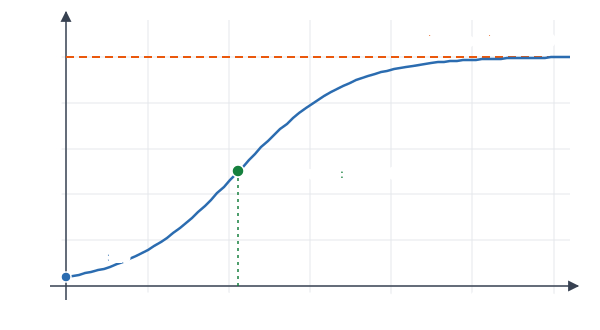
A logistic curve captures all three stages. At first, there is lots of room, so growth looks exponential. In the middle, growth is fastest. Near the limit C, growth slows to almost nothing, and the curve flattens into a horizontal asymptote at P = C.
Key Features of a Logistic Function
P(t) = \frac{C}{1 + ae^{-kt}}| Feature | Formula | Meaning |
|---|---|---|
| Carrying capacity | C | The level the function approaches; a horizontal asymptote |
| Initial value | P(0) = \frac{C}{1 + a} | The starting amount |
| Point of fastest growth | t = \frac{\ln a}{k}, where P = \frac{C}{2} | The inflection point, where the curve switches from concave up to concave down |
| Growth constant | k | Larger k makes a steeper S-curve |
To find a from a starting value, solve P(0) = \frac{C}{1 + a} for a: a = \frac{C}{P(0)} - 1.
Worked Examples
Use a calculator for powers of e and natural logs. Round to the nearest hundredth.
Example 1: Read the key features
For P(t) = \frac{500}{1 + 24e^{-0.3t}}, find the carrying capacity, the initial value and the time of fastest growth.
C = 500
Read the carrying capacity: the number on top.
P(0) = \frac{500}{1 + 24e^{0}} = \frac{500}{1 + 24} = \frac{500}{25} = 20Find the initial value: substitute t = 0.
t = \frac{\ln 24}{0.3} \approx \frac{3.178}{0.3} \approx 10.59Find the time of fastest growth.
P = \frac{500}{2} = 250At that time.
Answer: C = 500, P(0) = 20, fastest growth at t \approx 10.59, when P = 250. These match the graph above.
Example 2: Evaluate the function
For the same function, find P(10).
P(10) = \frac{500}{1 + 24e^{-0.3(10)}} = \frac{500}{1 + 24e^{-3}}Substitute.
e^{-3} \approx 0.04979Evaluate the power.
24(0.04979) \approx 1.1949
Multiply.
1 + 1.1949 = 2.1949
Add 1.
\frac{500}{2.1949} \approx 227.80Divide.
Answer: P(10) \approx 227.80
Example 3: Solve for the time
For the same function, when does P reach 400?
\frac{500}{1 + 24e^{-0.3t}} = 400Set up.
500 = 400(1 + 24e^{-0.3t})Multiply both sides by the denominator.
1.25 = 1 + 24e^{-0.3t}Divide both sides by 400.
0.25 = 24e^{-0.3t}Subtract 1.
e^{-0.3t} = \frac{0.25}{24} \approx 0.010417Divide by 24.
-0.3t = \ln 0.010417 \approx -4.564
Take the natural log of both sides.
t \approx 15.21
Divide by −0.3.
Answer: at about t = 15.21
Example 4: Build a model
A population has carrying capacity 1,000. It starts at 50 and reaches 200 at t = 4. Find a logistic model.
a = \frac{C}{P(0)} - 1 = \frac{1000}{50} - 1 = 20 - 1 = 19Find a.
\frac{1000}{1 + 19e^{-4k}} = 200Use the point (4, 200).
1 + 19e^{-4k} = \frac{1000}{200} = 5Rearrange.
e^{-4k} = \frac{4}{19}Subtract 1 and divide by 19.
-4k = \ln \frac{4}{19} \approx -1.558Take the natural log.
k \approx 0.3895
Divide by −4.
Answer: P(t) = \frac{1000}{1 + 19e^{-0.3895t}}
Example 5: Word problem with a rumor
In a school of 1,200 students, the number who have heard a rumor after t days is N(t) = \frac{1200}{1 + 59e^{-0.8t}}. How many start out knowing it? When have half the students heard it? How many know after 7 days?
N(0) = \frac{1200}{1 + 59} = \frac{1200}{60} = 20Start.
Half the school is \frac{1200}{2} = 600, reached at t = \frac{\ln 59}{0.8} \approx \frac{4.078}{0.8} \approx 5.10
N(7) = \frac{1200}{1 + 59e^{-5.6}}After 7 days.
59e^{-5.6} \approx 59(0.003698) \approx 0.2182Evaluate.
\frac{1200}{1.2182} \approx 985.1Divide.
Answer: 20 students at first; half the school by about 5.1 days; about 985 students after 7 days. The rumor spreads fastest around day 5.
Common Mistakes
| Mistake | Example of the error | Fix |
|---|---|---|
| Calling C the starting value | Saying the population starts at 500 | C is the limit. The start is \frac{C}{1 + a} = 20. |
| Dropping the negative exponent | Using e^{0.3t} in the denominator | It is e^{-kt}; that is what makes the curve level off. |
| Wrong order of operations | \frac{500}{1} + 24e^{-3} | Find the whole denominator 1 + 24e^{-3} first, then divide. |
| Expecting exponential forever | Predicting 5,000 students will hear a rumor in a school of 1,200 | A logistic model never passes C. |
| Wrong fastest-growth point | Fastest growth at P = C | Growth is fastest at P = \frac{C}{2}; it slows to 0 near C. |
Related Methods
Compare with exponential models
For small t, \frac{C}{1 + ae^{-kt}} is close to \frac{C}{a}e^{kt}, an exponential function. That is why exponential regression works well early on but overshoots later.
Logistic regression
Graphing calculators have a Logistic command that fits y = \frac{c}{1 + ae^{-bx}} to data, the same way ExpReg fits exponential models.
In calculus
In Calculus 2, logistic functions come from the differential equation \frac{dP}{dt} = kP(1 - \frac{P}{C}), which says growth slows as P nears C.
Practice Problems
Round answers to the nearest hundredth.
- For f(t) = \frac{80}{1 + 7e^{-0.5t}}, find the carrying capacity and f(0).
- For the same f, find f(4).
- For the same f, when does f reach half the carrying capacity?
- For the same f, when does f reach 60?
- Write a logistic model with carrying capacity 300, starting value 15 and k = 0.4.
- A population has carrying capacity 600, starts at 100 and reaches 200 at t = 2. Find k.
- What happens to \frac{C}{1 + ae^{-kt}} as t gets very large, and why?
- Find the point of fastest growth for g(t) = \frac{50}{1 + 9e^{-t}}.
- What is the long-run value of h(t) = \frac{12}{1 + 3e^{-2t}}?
- A lake is stocked with fish. The count after t years is F(t) = \frac{2000}{1 + 39e^{-0.5t}}. How many fish were stocked, and when will there be 1,500 fish?
Show answers
1.
C = 80
Read the carrying capacity: the number on top.
f(0) = \frac{80}{1 + 7} = \frac{80}{8} = 10Find the initial value: substitute 0.
Answer: C = 80, f(0) = 10
2.
f(4) = \frac{80}{1 + 7e^{-2}}Substitute 4.
7e^{-2} \approx 7(0.1353) \approx 0.9473Evaluate the power with a calculator.
\frac{80}{1.9473} \approx 41.08Divide.
Answer: about 41.08
3.
Half of C is 40, reached at t = \frac{\ln 7}{0.5}
\ln 7 \approx 1.946, so t \approx \frac{1.946}{0.5} \approx 3.89
Answer: about t = 3.89
4.
\frac{80}{1 + 7e^{-0.5t}} = 60 gives 1 + 7e^{-0.5t} = \frac{80}{60} = \frac{4}{3}
e^{-0.5t} = \frac{1}{21}Subtract 1 and divide by 7.
-0.5t = \ln \frac{1}{21} \approx -3.045Take the natural log of both sides.
t \approx 6.09
Divide both sides by −0.5.
Answer: about t = 6.09
5.
a = \frac{300}{15} - 1 = 20 - 1 = 19Find a: capacity over initial value, minus 1.
Answer: P(t) = \frac{300}{1 + 19e^{-0.4t}}
6.
a = \frac{600}{100} - 1 = 5Find a: capacity over initial value, minus 1.
\frac{600}{1 + 5e^{-2k}} = 200 gives 1 + 5e^{-2k} = 3, so e^{-2k} = 0.4
-2k = \ln 0.4 \approx -0.9163
Take the natural log of both sides.
k \approx 0.4581
Divide both sides by −2.
Answer: k \approx 0.46
7.
As t grows, e^{-kt} approaches 0
So the denominator approaches 1 + 0 = 1
Answer: the function approaches C, the carrying capacity
8.
Fastest growth at t = \frac{\ln 9}{1} \approx 2.20
g = \frac{50}{2} = 25 there
Answer: about (2.20, 25)
9.
As t grows, 3e^{-2t} approaches 0
Answer: h approaches \frac{12}{1} = 12
10.
F(0) = \frac{2000}{1 + 39} = \frac{2000}{40} = 50Find how many fish were stocked: substitute 0.
\frac{2000}{1 + 39e^{-0.5t}} = 1500 gives 1 + 39e^{-0.5t} = \frac{4}{3}, so e^{-0.5t} = \frac{1}{117}
-0.5t = \ln \frac{1}{117} \approx -4.762Take the natural log of both sides.
t \approx 9.52
Divide both sides by −0.5.
Answer: 50 fish stocked; 1,500 fish after about 9.52 years
FAQ
What is the difference between exponential and logistic growth?
Exponential growth keeps speeding up forever. Logistic growth starts out like exponential growth but slows down and levels off at the carrying capacity.
What is the carrying capacity?
It is the largest value the model approaches, the number C in the numerator. On the graph, it is a horizontal asymptote.
Where does a logistic function grow fastest?
At half the carrying capacity, P = \frac{C}{2}, which happens at t = \frac{\ln a}{k}. This is the inflection point of the S-shaped curve.
What are real examples of logistic growth?
Animal populations with limited food, the spread of a rumor or disease, and sales of a new product in a market of fixed size all follow logistic patterns.
Summary
- A logistic function \frac{C}{1 + ae^{-kt}} makes an S-shaped curve.
- C is the carrying capacity, a horizontal asymptote.
- The initial value is \frac{C}{1 + a}, so a = \frac{C}{P(0)} - 1.
- Growth is fastest at P = \frac{C}{2}, when t = \frac{\ln a}{k}.
- Solve for t by clearing the fraction, isolating e^{-kt} and taking \ln.
Previous lesson: Exponential Regression
Next lesson: Matrix Operations
Back to the Precalculus Index