
Properties of Logarithms
The properties of logarithms are rules for rewriting logs. The product rule turns the log of a product into a sum. The quotient rule turns the log of a quotient into a difference. The power rule moves an exponent to the front. The change of base formula lets you find any log with a calculator.
Before this lesson: You should know Logarithms, Exponent Rules and Graphing Logarithmic Functions.
Why the Log Rules Work
A logarithm is an exponent. \log_2 8 = 3 because 2^3 = 8. So every log rule comes from an exponent rule.
Look at three powers of 2. Since 2 \cdot 4 = 8 and 2^1 \cdot 2^2 = 2^3, the exponents add: 1 + 2 = 3. In log form, that says \log_2 2 + \log_2 4 = \log_2 8. Multiplying inside the log became adding outside it.
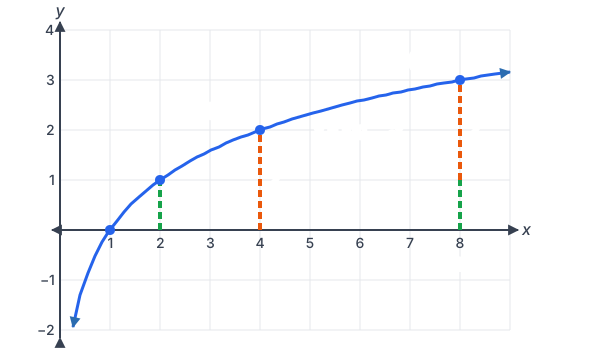
The Properties of Logarithms
For any base b \gt 0 with b \ne 1, and any positive numbers M and N:
| Property | Rule | Comes from |
|---|---|---|
| Product rule | \log_b (MN) = \log_b M + \log_b N | b^m \cdot b^n = b^{m + n} |
| Quotient rule | \log_b \frac{M}{N} = \log_b M - \log_b N | \frac{b^m}{b^n} = b^{m - n} |
| Power rule | \log_b M^p = p \log_b M | (b^m)^p = b^{mp} |
A few more facts help you simplify. They come straight from the definition of a log.
| Fact | Why it is true |
|---|---|
| \log_b 1 = 0 | b^0 = 1 |
| \log_b b = 1 | b^1 = b |
| \log_b b^x = x | The log undoes the power. |
| b^{\log_b x} = x | The power undoes the log. |
To expand a log means to rewrite one log as a sum or difference of simpler logs. To condense means to do the reverse and write several logs as one log.
The Change of Base Formula
Most calculators have only two log keys: LOG for base 10 and LN for base e. To find a log with any other base, divide two logs that share a base:
\log_b x = \frac{\log x}{\log b} = \frac{\ln x}{\ln b}Calculator note: For \log_4 50, press LOG, 50, ), ÷, LOG, 4, ), then ENTER.
Worked Examples
Example 1: Expand with the product rule
Expand \log_3 (9x).
\log_3 (9x) = \log_3 9 + \log_3 x
Use the product rule.
\log_3 9 = \log_3 3^2
Rewrite 9 as a power of 3.
\log_3 3^2 = 2
Use \log_b b^x = x.
\log_3 (9x) = 2 + \log_3 x
Replace \log_3 9 with 2.
Answer: \log_3 (9x) = 2 + \log_3 x
Example 2: Expand a quotient with a power
Expand \log_2 \frac{8x^5}{y}.
\log_2 \frac{8x^5}{y} = \log_2 (8x^5) - \log_2 yUse the quotient rule.
\log_2 (8x^5) = \log_2 8 + \log_2 x^5
Use the product rule on the first log.
\log_2 x^5 = 5 \log_2 x
Use the power rule.
Evaluate \log_2 8. Since 2^3 = 8, \log_2 8 = 3
\log_2 \frac{8x^5}{y} = 3 + 5 \log_2 x - \log_2 yPut the pieces together.
Answer: 3 + 5 \log_2 x - \log_2 y
Example 3: Condense into one log
Write 2 \log_5 x + \log_5 7 - \log_5 3 as a single logarithm.
2 \log_5 x = \log_5 x^2
Use the power rule backward.
\log_5 x^2 + \log_5 7 = \log_5 (7x^2)
Use the product rule backward.
\log_5 (7x^2) - \log_5 3 = \log_5 \frac{7x^2}{3}Use the quotient rule backward.
Answer: \log_5 \frac{7x^2}{3}
Example 4: Use the change of base formula
Find \log_4 50 to the nearest hundredth.
Estimate first: 4^2 = 16 and 4^3 = 64, so the answer is between 2 and 3.
\log_4 50 = \frac{\log 50}{\log 4}Use the change of base formula.
Evaluate each log with a calculator: \log 50 \approx 1.69897 and \log 4 \approx 0.60206
\frac{1.69897}{0.60206} \approx 2.822Divide.
2.822 \approx 2.82
Round to the nearest hundredth.
Check with a power: 4^{2.82} \approx 49.9, which is close to 50.
Answer: \log_4 50 \approx 2.82. Natural logs give the same answer: \frac{\ln 50}{\ln 4} \approx \frac{3.91202}{1.38629} \approx 2.82.
Example 5: Word problem with decibels
Sound level in decibels (dB) is L = 10 \log \frac{I}{I_0}, where I is the intensity of the sound and I_0 is the faintest sound people can hear. One speaker plays music at 70 dB. A second, identical speaker is turned on, which doubles the intensity to 2I. How loud is the music now?
10 \log \frac{I}{I_0} = 70Write the starting level.
L = 10 \log \frac{2I}{I_0}Write the new level with intensity 2I.
L = 10 \left( \log 2 + \log \frac{I}{I_0} \right)Use the product rule.
L = 10 \log 2 + 10 \log \frac{I}{I_0}Distribute the 10 (see distributive property)
L = 10 \log 2 + 70
Replace 10 \log \frac{I}{I_0} with 70.
\log 2 \approx 0.30103
Evaluate \log 2 with a calculator.
10 \cdot 0.30103 = 3.0103
Multiply by 10.
3.0103 + 70 = 73.0103
Add 70.
Answer: about 73 dB. Doubling the intensity adds only about 3 dB, not another 70 dB.
Common Mistakes
| Mistake | Example of the error | Fix |
|---|---|---|
| Splitting the log of a sum | \log (x + 5) = \log x + \log 5 | The product rule is for products only. \log (x + 5) cannot be expanded. |
| Dividing logs instead of subtracting | \log 12 - \log 3 = \frac{\log 12}{\log 3} | Combine into one log: \log 12 - \log 3 = \log 4. |
| Using the power rule on a squared log | (\log x)^2 = 2 \log x | The power rule needs the exponent inside the log: \log x^2 = 2 \log x. |
| Moving an exponent that belongs to one factor | \log 3x^2 = 2 \log 3x | The 2 belongs to x only: \log 3x^2 = \log 3 + 2 \log x. |
| Flipping the change of base fraction | \log_4 50 = \frac{\log 4}{\log 50} | The old base goes on the bottom: \frac{\log 50}{\log 4}. |
Related Methods
Change of base with natural logs
The formula works with any base, as long as the top and the bottom use the same one. Natural logs are common in science and in problems with the number e.
Using known logs to find others
If you know \log 2 \approx 0.301 and \log 3 \approx 0.477, you can find the log of any number built from 2 and 3. For example, \log 6 = \log 2 + \log 3 \approx 0.778 and \log 9 = 2 \log 3 \approx 0.954.
Bringing an exponent down
The power rule is the key to solving equations like 5^x = 40. Taking the log of both sides gives \log 5^x = x \log 5, so the variable is no longer in the exponent. You will use this in the next lesson.
Practice Problems
- Expand \log_2 (16x).
- Expand \log \frac{x}{100}.
- Expand \ln (x^4 y).
- Expand \log_3 \frac{x^2}{27}.
- Expand \log_5 \frac{\sqrt{x}}{25}.
- Write \log 4 + \log 25 as a single log. Then evaluate it.
- Write 3 \log_2 x - \log_2 y as a single logarithm.
- Use \log 2 \approx 0.301 and \log 3 \approx 0.477 to find \log 12.
- Find \log_3 20 to the nearest hundredth.
- The pH of a liquid is \text{pH} = -\log [\text{H}^+], where [\text{H}^+] is the hydrogen ion concentration. A cup of coffee has [\text{H}^+] = 4 \times 10^{-5}. Use \log 4 \approx 0.602 to find its pH.
Show answers
1.
\log_2 (16x) = \log_2 16 + \log_2 x
Use the product rule.
Since 2^4 = 16, \log_2 16 = 4
Answer: 4 + \log_2 x
2.
\log \frac{x}{100} = \log x - \log 100Use the quotient rule.
Since 10^2 = 100, \log 100 = 2
Answer: \log x - 2
3.
\ln (x^4 y) = \ln x^4 + \ln y
Use the product rule.
\ln x^4 = 4 \ln x
Use the power rule.
Answer: 4 \ln x + \ln y
4.
\log_3 \frac{x^2}{27} = \log_3 x^2 - \log_3 27Use the quotient rule.
\log_3 x^2 = 2 \log_3 x
Use the power rule.
Since 3^3 = 27, \log_3 27 = 3
Answer: 2 \log_3 x - 3
5.
\sqrt{x} = x^{\frac{1}{2}}Rewrite the root as a power (see rational exponents)
\log_5 \frac{x^{\frac{1}{2}}}{25} = \log_5 x^{\frac{1}{2}} - \log_5 25Use the quotient rule.
\log_5 x^{\frac{1}{2}} = \frac{1}{2} \log_5 xUse the power rule.
Since 5^2 = 25, \log_5 25 = 2
Answer: \frac{1}{2} \log_5 x - 2
6.
\log 4 + \log 25 = \log (4 \cdot 25)
Use the product rule backward.
4 \cdot 25 = 100
Multiply.
Since 10^2 = 100, \log 100 = 2
Answer: \log 100 = 2
7.
3 \log_2 x = \log_2 x^3
Use the power rule backward.
\log_2 x^3 - \log_2 y = \log_2 \frac{x^3}{y}Use the quotient rule backward.
Answer: \log_2 \frac{x^3}{y}
8.
12 = 2^2 \cdot 3
Factor 12 (see prime factorization)
\log 12 = \log 2^2 + \log 3
Use the product rule.
\log 2^2 = 2 \log 2
Use the power rule.
2 \log 2 + \log 3 \approx 2 \cdot 0.301 + 0.477
Substitute the values.
2 \cdot 0.301 = 0.602
Multiply.
0.602 + 0.477 = 1.079
Add.
Answer: \log 12 \approx 1.079
9.
\log_3 20 = \frac{\log 20}{\log 3}Use the change of base formula.
Evaluate each log: \log 20 \approx 1.30103 and \log 3 \approx 0.47712
\frac{1.30103}{0.47712} \approx 2.727Divide.
2.727 \approx 2.73
Round to the nearest hundredth.
Answer: \log_3 20 \approx 2.73
10.
\text{pH} = -\log (4 \times 10^{-5})Substitute.
-\log (4 \times 10^{-5}) = -(\log 4 + \log 10^{-5})Use the product rule.
\log 10^{-5} = -5Use \log_b b^x = x.
-(\log 4 + \log 10^{-5}) \approx -(0.602 - 5)Substitute the values.
0.602 - 5 = -4.398
Subtract inside the parentheses.
-(-4.398) = 4.398
Take the opposite.
Answer: the pH is about 4.40
FAQ
What are the three main properties of logarithms?
The product rule \log_b (MN) = \log_b M + \log_b N, the quotient rule \log_b \frac{M}{N} = \log_b M - \log_b N and the power rule \log_b M^p = p \log_b M. All three come from the exponent rules.
Is log(x + y) the same as log x + log y?
No. There is no rule for the log of a sum. The product rule says \log (xy) = \log x + \log y, which is about a product.
How do you use the change of base formula?
Divide the log of the number by the log of the base, using the same base for both: \log_b x = \frac{\log x}{\log b}. For example, \log_2 10 = \frac{\log 10}{\log 2} \approx 3.32.
Can you combine logs with different bases?
Not directly. The product and quotient rules only work when the logs have the same base. Use the change of base formula first to give them a common base.
Summary
- A logarithm is an exponent, so the log rules come from the exponent rules.
- Product rule: \log_b (MN) = \log_b M + \log_b N.
- Quotient rule: \log_b \frac{M}{N} = \log_b M - \log_b N.
- Power rule: \log_b M^p = p \log_b M.
- Change of base: \log_b x = \frac{\log x}{\log b}.
- There is no rule for \log (M + N).
Previous lesson: Graphing Logarithmic Functions
Next lesson: Solving Exponential Equations
Back to the Algebra 2 Index