
Integrals That Give Inverse Trig Functions
Integrals that give inverse trig functions have \sqrt{a^2 - u^2} or a^2 + u^2 in the denominator and a constant on top. The two main rules are \int \dfrac{1}{\sqrt{a^2 - u^2}}\,du = \arcsin\dfrac{u}{a} + C and \int \dfrac{1}{a^2 + u^2}\,du = \dfrac{1}{a}\arctan\dfrac{u}{a} + C. A third rule gives arcsecant.
Before this lesson: Derivatives of Inverse Trig Functions, U-Substitution and Integrals That Give Natural Logarithms
Where these integrals come from
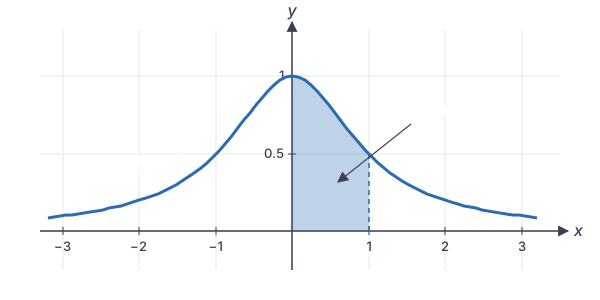
Each rule is a derivative read backward. You learned that (arcsin x)′ = 1/√(1 − x²) and (arctan x)′ = 1/(1 + x²). So the integrals of those two fractions are arcsin x + C and arctan x + C.
The number a stretches the pattern. Factor a² out of the denominator and substitute u/a, and you get the a-versions of the rules below. The area picture shows the simplest case.
Inverse trig integral formulas
For a positive constant a:
\int \dfrac{du}{\sqrt{a^2 - u^2}} = \arcsin\dfrac{u}{a} + C\int \dfrac{du}{a^2 + u^2} = \dfrac{1}{a}\arctan\dfrac{u}{a} + C\int \dfrac{du}{u\sqrt{u^2 - a^2}} = \dfrac{1}{a}\operatorname{arcsec}\dfrac{|u|}{a} + CArccosine, arccotangent and arccosecant don’t need their own rules. Their derivatives are just the negatives of the ones above.
How to use the rules:
- Check the top. It must be a constant (or the du from a substitution), not the derivative of the bottom. If it is the derivative of the bottom, use ln instead.
- Match the bottom to a² − u² under a root, a² + u², or u√(u² − a²). Find a and u.
- If u is not just x, find du and fix any constant.
- Apply the rule. Remember the 1/a in the arctan and arcsec rules.
Inverse trig integral examples
Example 1: Arcsine
Find \int \dfrac{1}{\sqrt{9 - x^2}}\,dx.
9 - x^2 = 3^2 - x^2
Match the form a² − u² with a = 3 and u = x.
\int \dfrac{1}{\sqrt{9 - x^2}}\,dx = \arcsin\dfrac{x}{3} + CApply the arcsine rule.
Answer: \arcsin\dfrac{x}{3} + C. Check: the derivative is \dfrac{1/3}{\sqrt{1 - x^2/9}}, which simplifies to \dfrac{1}{\sqrt{9 - x^2}}.
Example 2: Arctangent with a substitution
Find \int \dfrac{1}{1 + 9x^2}\,dx.
1 + 9x^2 = 1^2 + (3x)^2
Match a² + u² with a = 1 and u = 3x.
u = 3x
Let u = 3x.
du = 3\,dx
Differentiate u, so dx = du/3 (see u-substitution).
\int \dfrac{1}{1 + 9x^2}\,dx = \int \dfrac{1}{3}\cdot\dfrac{1}{1 + u^2}\,duRewrite in u.
= \dfrac{1}{3}\arctan u + CApply the arctangent rule with a = 1.
= \dfrac{1}{3}\arctan(3x) + CSubstitute back.
Answer: \dfrac{1}{3}\arctan(3x) + C
Example 3: A definite arcsine integral
Evaluate \int_0^1 \dfrac{1}{\sqrt{4 - x^2}}\,dx.
\int_0^1 \dfrac{1}{\sqrt{4 - x^2}}\,dx = \Big[\arcsin\dfrac{x}{2}\Big]_0^1Arcsine rule with a = 2.
= \arcsin\dfrac{1}{2} - \arcsin 0Plug in the limits and subtract.
= \dfrac{\pi}{6} - 0 = \dfrac{\pi}{6}sin(π/6) = 1/2 and sin 0 = 0 (see inverse trig functions).
Answer: \dfrac{\pi}{6} \approx 0.524
Example 4: Completing the square
Find \int \dfrac{1}{x^2 + 4x + 13}\,dx.
x^2 + 4x + 13 = (x^2 + 4x + 4) + 9
Split 13 into 4 + 9 to complete the square (see completing the square).
x^2 + 4x + 13 = (x + 2)^2 + 9
Factor the perfect square trinomial.
u = x + 2
Let u = x + 2; then du = dx.
\int \dfrac{1}{x^2 + 4x + 13}\,dx = \int \dfrac{1}{u^2 + 9}\,duRewrite in u. Here a = 3.
= \dfrac{1}{3}\arctan\dfrac{u}{3} + CApply the arctangent rule.
= \dfrac{1}{3}\arctan\dfrac{x + 2}{3} + CSubstitute back.
Answer: \dfrac{1}{3}\arctan\dfrac{x + 2}{3} + C
Example 5: A camera following a car
A security camera is 20 meters from a straight road. It turns to follow a car, and its angle changes at a rate of \theta'(t) = \dfrac{20}{400 + t^2} radians per second, where t is the car’s distance past the closest point in meters. How far does the camera turn while the car goes from t = 0 to t = 20?
\int_0^{20} \dfrac{20}{400 + t^2}\,dt = 20\int_0^{20} \dfrac{1}{20^2 + t^2}\,dtFactor out 20; the bottom is a² + u² with a = 20.
= 20\cdot\dfrac{1}{20}\Big[\arctan\dfrac{t}{20}\Big]_0^{20}Apply the arctangent rule.
= \arctan 1 - \arctan 0
20 · (1/20) = 1; plug in the limits.
= \dfrac{\pi}{4} - 0 = \dfrac{\pi}{4}tan(π/4) = 1.
Answer: the camera turns π/4 radians, which is 45°. That makes sense: when the car is 20 m past the closest point and the camera is 20 m from the road, the angle is 45°.
Common mistakes
| Mistake | Example of the error | Fix |
|---|---|---|
| Forgetting the 1/a | \int \dfrac{1}{16 + x^2}\,dx = \arctan\dfrac{x}{4} + C | Arctan needs 1/a in front: \dfrac{1}{4}\arctan\dfrac{x}{4} + C. |
| Using a² instead of a | \int \dfrac{1}{9 + x^2}\,dx = \dfrac{1}{9}\arctan\dfrac{x}{9} + C | a is the square root: a = 3, so \dfrac{1}{3}\arctan\dfrac{x}{3} + C. |
| Using ln for 1/(1 + x²) | \int \dfrac{1}{1 + x^2}\,dx = \ln(1 + x^2) + C | The top is not 2x, so this is \arctan x + C. |
| Using arcsine for a difference in the wrong order | \int \dfrac{1}{\sqrt{x^2 - 4}}\,dx = \arcsin\dfrac{x}{2} + C | Arcsine needs a² − u², with the constant first. This integral needs another method (trig substitution, Calculus 2). |
| Skipping the du constant | \int \dfrac{1}{1 + 9x^2}\,dx = \arctan(3x) + C | du = 3 dx, so the answer is \dfrac{1}{3}\arctan(3x) + C. |
Related methods
Split the numerator
If the top has an x term and a constant, split the fraction. For example, \int \dfrac{x + 1}{x^2 + 1}\,dx = \int \dfrac{x}{x^2 + 1}\,dx + \int \dfrac{1}{x^2 + 1}\,dx, which is \dfrac{1}{2}\ln(x^2 + 1) + \arctan x + C. The first piece uses the log rule from integrals that give natural logarithms.
Trig substitution
Roots like \sqrt{x^2 - 4} or \sqrt{x^2 + 9} alone, or powers of a² + x², need trigonometric substitution, a Calculus 2 method.
Practice problems
- Find \int \dfrac{1}{\sqrt{25 - x^2}}\,dx.
- Find \int \dfrac{1}{49 + x^2}\,dx.
- Find \int \dfrac{1}{\sqrt{1 - 4x^2}}\,dx.
- Find \int \dfrac{3}{1 + x^2}\,dx.
- Evaluate \int_0^{\sqrt{3}} \dfrac{1}{1 + x^2}\,dx.
- Evaluate \int_0^{3/2} \dfrac{1}{\sqrt{9 - x^2}}\,dx.
- Find \int \dfrac{e^x}{1 + e^{2x}}\,dx.
- Find \int \dfrac{1}{x\sqrt{x^2 - 16}}\,dx for x greater than 4.
- Find \int \dfrac{1}{x^2 - 6x + 10}\,dx.
- A robot arm turns at a rate of \dfrac{2}{\sqrt{4 - t^2}} radians per second. How far does it turn from t = 0 to t = 1 second?
Show answers
1.
\int \dfrac{1}{\sqrt{25 - x^2}}\,dx = \arcsin\dfrac{x}{5} + CArcsine rule with a = 5.
Answer: \arcsin\dfrac{x}{5} + C
2.
\int \dfrac{1}{49 + x^2}\,dx = \dfrac{1}{7}\arctan\dfrac{x}{7} + CArctangent rule with a = 7.
Answer: \dfrac{1}{7}\arctan\dfrac{x}{7} + C
3.
u = 2x
1 − 4x² = 1 − (2x)², so a = 1 and u = 2x.
du = 2\,dx
Differentiate u, so dx = du/2.
\int \dfrac{1}{\sqrt{1 - 4x^2}}\,dx = \int \dfrac{1}{2}\cdot\dfrac{1}{\sqrt{1 - u^2}}\,du = \dfrac{1}{2}\arcsin u + CRewrite and integrate.
= \dfrac{1}{2}\arcsin(2x) + CSubstitute back.
Answer: \dfrac{1}{2}\arcsin(2x) + C
4.
\int \dfrac{3}{1 + x^2}\,dx = 3\arctan x + CFactor out 3; arctangent rule with a = 1.
Answer: 3\arctan x + C
5.
\int_0^{\sqrt{3}} \dfrac{1}{1 + x^2}\,dx = \Big[\arctan x\Big]_0^{\sqrt{3}}Arctangent rule.
= \arctan\sqrt{3} - \arctan 0 = \dfrac{\pi}{3}tan(π/3) = √3 and tan 0 = 0.
Answer: \dfrac{\pi}{3}
6.
\int_0^{3/2} \dfrac{1}{\sqrt{9 - x^2}}\,dx = \Big[\arcsin\dfrac{x}{3}\Big]_0^{3/2}Arcsine rule with a = 3.
= \arcsin\dfrac{1}{2} - \arcsin 0 = \dfrac{\pi}{6}(3/2)/3 = 1/2.
Answer: \dfrac{\pi}{6}
7.
u = e^x
e²ˣ = (eˣ)², so let u = eˣ.
du = e^x\,dx
The numerator is du.
\int \dfrac{e^x}{1 + e^{2x}}\,dx = \int \dfrac{1}{1 + u^2}\,du = \arctan u + CRewrite and integrate.
= \arctan(e^x) + C
Substitute back.
Answer: \arctan(e^x) + C
8.
\int \dfrac{1}{x\sqrt{x^2 - 16}}\,dx = \dfrac{1}{4}\operatorname{arcsec}\dfrac{x}{4} + CArcsecant rule with a = 4; x is positive, so |x| = x.
Answer: \dfrac{1}{4}\operatorname{arcsec}\dfrac{x}{4} + C
9.
x^2 - 6x + 10 = (x - 3)^2 + 1
Complete the square: 10 = 9 + 1.
\int \dfrac{1}{(x - 3)^2 + 1}\,dx = \arctan(x - 3) + CLet u = x − 3, du = dx; arctangent rule with a = 1.
Answer: \arctan(x - 3) + C
10.
\int_0^1 \dfrac{2}{\sqrt{4 - t^2}}\,dt = \Big[2\arcsin\dfrac{t}{2}\Big]_0^1Factor out 2; arcsine rule with a = 2.
= 2\arcsin\dfrac{1}{2} - 2\arcsin 0 = \dfrac{\pi}{3}2 · (π/6) = π/3.
Answer: \dfrac{\pi}{3} \approx 1.047 radians, or 60°
Inverse trig integrals FAQ
What is the integral of 1/(1 + x²)?
It is arctan x + C. More generally, the integral of 1/(a² + x²) is (1/a) arctan(x/a) + C.
What is the integral of 1/√(1 − x²)?
It is arcsin x + C. With a constant a, the integral of 1/√(a² − x²) is arcsin(x/a) + C.
Why is there no arccos integral rule?
The derivative of arccos x is the negative of the derivative of arcsin x. So −arccos x + C gives the same family of answers as arcsin x + C.
How do you know whether to use ln or arctan?
If the top is the derivative of the bottom, use ln. If the top is a constant and the bottom is a² + u², use arctan.
Summary
- \int \dfrac{du}{\sqrt{a^2 - u^2}} = \arcsin\dfrac{u}{a} + C
- \int \dfrac{du}{a^2 + u^2} = \dfrac{1}{a}\arctan\dfrac{u}{a} + C
- \int \dfrac{du}{u\sqrt{u^2 - a^2}} = \dfrac{1}{a}\operatorname{arcsec}\dfrac{|u|}{a} + C
- a is the square root of the constant, not the constant itself.
- Complete the square when the bottom is a quadratic with an x term.
Previous lesson: Integrals That Give Natural Logarithms
Next lesson: Area Between Curves
Back to the Calculus 1 Index