
Area Between Curves
The area between curves y = f(x) and y = g(x) from x = a to x = b is \int_a^b \big(f(x) - g(x)\big)\,dx, where f is the top curve and g is the bottom curve. The limits are where the curves meet. If they cross in between, split the integral there so each piece is top minus bottom.
Before this lesson: Fundamental Theorem of Calculus, Part 2, Definite Integrals and Solving Quadratic Equations by Factoring
The idea: thin vertical strips
Slice the region into thin vertical strips. A strip at x has height (top curve) − (bottom curve) and a tiny width dx. Its area is about \big(f(x) - g(x)\big)\,dx.
The integral adds up all the strips from the left edge to the right edge. Because you subtract the bottom from the top, the height is positive even when both curves are below the x-axis.
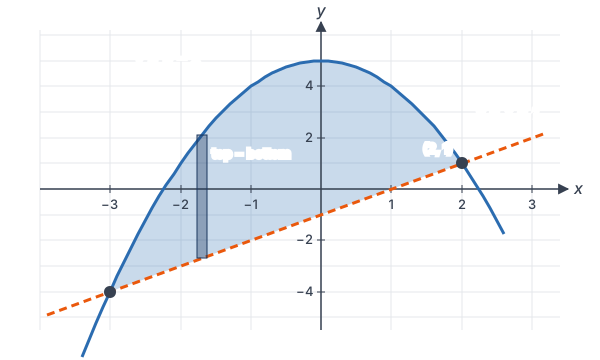
Area between curves formula
If f(x) ≥ g(x) on [a, b], the area between them is:
A = \int_a^b \big(f(x) - g(x)\big)\,dx
For curves written as x in terms of y, use horizontal strips, right curve minus left curve:
A = \int_c^d \big(\text{right}(y) - \text{left}(y)\big)\,dyHow to find the area between two curves:
- Sketch the curves, or test a point, to see which one is on top.
- Set the curves equal to find where they meet. These are your limits if none are given.
- If the curves cross inside the interval, split it at each crossing.
- Integrate top minus bottom on each piece and add the results.
Area between curves examples
Example 1: Limits given
Find the area between y = x^2 + 1 and y = x from x = 0 to x = 2.
(1)^2 + 1 = 2 \gt 1
Test x = 1: the parabola is above the line, so it is the top curve.
A = \int_0^2 \big((x^2 + 1) - x\big)\,dx
Top minus bottom.
= \Big[\dfrac{x^3}{3} + x - \dfrac{x^2}{2}\Big]_0^2Antidifferentiate each term (see fundamental theorem of calculus, part 2).
= \left(\dfrac{8}{3} + 2 - 2\right) - 0Plug in the limits and subtract.
= \dfrac{8}{3}Simplify.
Answer: \dfrac{8}{3} square units. (x² + 1 − x is always positive, so the curves never cross.)
Example 2: Finding the limits
Find the area of the region between y = 5 - x^2 and y = x - 1.
5 - x^2 = x - 1
Set the curves equal.
x^2 + x - 6 = 0
Move every term to one side.
(x + 3)(x - 2) = 0
Factor (see factoring trinomials).
x = -3, \; x = 2
Set each factor equal to 0.
A = \int_{-3}^{2} \big((5 - x^2) - (x - 1)\big)\,dxThe parabola is on top (test x = 0: 5 is greater than −1).
= \int_{-3}^{2} (6 - x - x^2)\,dxCombine like terms.
= \Big[6x - \dfrac{x^2}{2} - \dfrac{x^3}{3}\Big]_{-3}^{2}Antidifferentiate each term.
= \left(12 - 2 - \dfrac{8}{3}\right) - \left(-18 - \dfrac{9}{2} + 9\right)Plug in the limits, with parentheses around −3.
= \dfrac{22}{3} - \left(-\dfrac{27}{2}\right)Simplify each set of parentheses.
= \dfrac{44}{6} + \dfrac{81}{6} = \dfrac{125}{6}Use a common denominator and add.
Answer: \dfrac{125}{6} \approx 20.83 square units. This is the shaded region in the graph above.
Example 3: Curves that cross
Find the total area between y = x^3 and y = x from x = −1 to x = 1.
x^3 = x \text{ at } x = -1, 0, 1x³ − x = x(x − 1)(x + 1), so the curves cross at 0.
\int_{-1}^{0} (x^3 - x)\,dx = \Big[\dfrac{x^4}{4} - \dfrac{x^2}{2}\Big]_{-1}^{0} = 0 - \left(\dfrac{1}{4} - \dfrac{1}{2}\right) = \dfrac{1}{4}On [−1, 0], x³ is on top (test x = −1/2).
\int_0^1 (x - x^3)\,dx = \Big[\dfrac{x^2}{2} - \dfrac{x^4}{4}\Big]_0^1 = \dfrac{1}{2} - \dfrac{1}{4} = \dfrac{1}{4}On [0, 1], x is on top (test x = 1/2).
\dfrac{1}{4} + \dfrac{1}{4} = \dfrac{1}{2}Add the pieces.
Answer: \dfrac{1}{2} square unit. If you skipped the split, \int_{-1}^{1} (x - x^3)\,dx would give 0, because the two pieces cancel.
Example 4: Integrating with respect to y
Find the area between x = y^2 and x = 2y + 3.
y^2 = 2y + 3
Set the curves equal.
y^2 - 2y - 3 = 0
Move every term to one side.
(y - 3)(y + 1) = 0
Factor: y = 3 or y = −1.
A = \int_{-1}^{3} \big((2y + 3) - y^2\big)\,dyThe line is on the right (test y = 0: 3 is greater than 0).
= \Big[y^2 + 3y - \dfrac{y^3}{3}\Big]_{-1}^{3}Antidifferentiate each term.
= (9 + 9 - 9) - \left(1 - 3 + \dfrac{1}{3}\right)Plug in the limits and subtract.
= 9 - \left(-\dfrac{5}{3}\right) = \dfrac{32}{3}Simplify.
Answer: \dfrac{32}{3} square units. Horizontal strips work here because each strip runs from the parabola on the left to the line on the right.
Example 5: Extra sales from an ad campaign
With an ad campaign, a store’s sales rate is s_1(t) = 120 + 30t - 3t^2 dollars per day, t days after the ads start. Without the ads, it would be s_0(t) = 120 + 6t. How much extra money do the ads bring in over the first 8 days?
s_1(t) - s_0(t) = 24t - 3t^2
Top minus bottom: subtract the rates.
24t - 3t^2 = 3t(8 - t)
Factor out 3t; this is 0 or more for t from 0 to 8, so s₁ stays on top.
\int_0^8 (24t - 3t^2)\,dt = \Big[12t^2 - t^3\Big]_0^8
Antidifferentiate each term.
= 12(64) - 512
Plug in 8; both terms are 0 at t = 0.
= 768 - 512 = 256
Multiply and subtract.
Answer: the ads bring in about $256 of extra sales in the first 8 days. The area between two rate curves is the difference in the totals.
Common mistakes
| Mistake | Example of the error | Fix |
|---|---|---|
| Subtracting in the wrong order | \int_0^2 \big(x - (x^2 + 1)\big)\,dx = -\dfrac{8}{3} | Area is never negative. Use top minus bottom. |
| Not splitting where the curves cross | \int_{-1}^{1} (x - x^3)\,dx = 0 | Split at x = 0 and add the pieces: 1/4 + 1/4 = 1/2. |
| Guessing the limits | Using [0, 2] for 5 − x² and x − 1 | Set the curves equal and solve: x = −3 and x = 2. |
| Dropping parentheses | 5 - x^2 - x - 1 | Subtract the whole bottom curve: 5 - x^2 - (x - 1) = 6 - x - x^2. |
| Using x-limits with dy | Integrating (2y + 3) - y^2 from x = 1 to x = 9 | With dy, the limits are y-values: −1 to 3. |
Related methods
Choosing vertical or horizontal strips
Use vertical strips (dx) when the same curve is on top across the whole region. Use horizontal strips (dy) when the curves are written as x = … or when the left and right boundaries stay the same. Pick the one that needs fewer pieces.
Area under a curve is a special case
The area between y = f(x) and the x-axis is the case g(x) = 0. When f is below the axis, the top curve is y = 0, so the height is 0 − f(x). See definite integrals for signed area.
From area to volume
Spinning a region around an axis makes a solid. Its volume uses the same top-minus-bottom thinking in Volumes by Cross Sections and the disk method and washer method, later in this unit.
Practice problems
- Find the area between y = x + 3 and y = 1 from x = 0 to x = 2.
- Find the area between y = x^2 and y = 2x.
- Find the area between y = 8 - x^2 and y = x^2.
- Find the area between y = \sqrt{x} and y = x.
- Find the area between y = e^x and y = x from x = 0 to x = 1.
- Find the area between y = \cos x and y = \sin x from x = 0 to x = \dfrac{\pi}{4}.
- Find the area between y = x^2 - 9 and the x-axis.
- Find the area between x = y^2 and x = 4.
- Find the total area between y = \sin x and y = \cos x from x = 0 to x = \dfrac{\pi}{2}.
- Water flows into tank A at r_A(t) = 10 + 2t liters per minute and into tank B at r_B(t) = 4 + t^2 liters per minute. How much more water flows into tank A than tank B from t = 0 to t = 3?
Show answers
1.
A = \int_0^2 \big((x + 3) - 1\big)\,dx = \int_0^2 (x + 2)\,dx
Top minus bottom; combine like terms.
= \Big[\dfrac{x^2}{2} + 2x\Big]_0^2 = 2 + 4 = 6Integrate and evaluate.
Answer: 6
2.
x^2 = 2x
Set the curves equal.
x(x - 2) = 0
Factor: x = 0 or x = 2.
A = \int_0^2 (2x - x^2)\,dx
The line is on top (test x = 1: 2 is greater than 1).
= \Big[x^2 - \dfrac{x^3}{3}\Big]_0^2 = 4 - \dfrac{8}{3} = \dfrac{4}{3}Integrate and evaluate.
Answer: \dfrac{4}{3}
3.
8 - x^2 = x^2
Set the curves equal.
x^2 = 4
Add x² to both sides, then divide by 2: x = ±2.
A = \int_{-2}^{2} (8 - 2x^2)\,dx8 − x² is on top (test x = 0).
= \Big[8x - \dfrac{2x^3}{3}\Big]_{-2}^{2} = \left(16 - \dfrac{16}{3}\right) - \left(-16 + \dfrac{16}{3}\right)Integrate and plug in the limits.
= \dfrac{32}{3} + \dfrac{32}{3} = \dfrac{64}{3}Simplify.
Answer: \dfrac{64}{3}
4.
\sqrt{x} = x \text{ at } x = 0 \text{ and } x = 1Square both sides: x = x², so x(x − 1) = 0.
A = \int_0^1 (x^{1/2} - x)\,dx√x is on top (test x = 1/4: 1/2 is greater than 1/4).
= \Big[\dfrac{2}{3}x^{3/2} - \dfrac{x^2}{2}\Big]_0^1 = \dfrac{2}{3} - \dfrac{1}{2} = \dfrac{1}{6}Integrate and evaluate.
Answer: \dfrac{1}{6}
5.
A = \int_0^1 (e^x - x)\,dx
eˣ is always above y = x.
= \Big[e^x - \dfrac{x^2}{2}\Big]_0^1 = \left(e - \dfrac{1}{2}\right) - 1Integrate and plug in the limits; e⁰ = 1.
= e - \dfrac{3}{2} \approx 1.218Simplify.
Answer: e - \dfrac{3}{2} \approx 1.218
6.
A = \int_0^{\pi/4} (\cos x - \sin x)\,dxcos x is on top on [0, π/4].
= \Big[\sin x + \cos x\Big]_0^{\pi/4}Antidifferentiate each term.
= \left(\dfrac{\sqrt{2}}{2} + \dfrac{\sqrt{2}}{2}\right) - (0 + 1) = \sqrt{2} - 1Use the exact values (see trig values of special angles).
Answer: \sqrt{2} - 1 \approx 0.414
7.
x^2 - 9 = 0
Set the curve equal to the axis: x = ±3.
A = \int_{-3}^{3} \big(0 - (x^2 - 9)\big)\,dx = \int_{-3}^{3} (9 - x^2)\,dxThe axis is on top, since the parabola is below it.
= \Big[9x - \dfrac{x^3}{3}\Big]_{-3}^{3} = (27 - 9) - (-27 + 9) = 36Integrate and evaluate.
Answer: 36
8.
y^2 = 4
Set the curves equal: y = ±2.
A = \int_{-2}^{2} (4 - y^2)\,dyHorizontal strips: right (x = 4) minus left (x = y²).
= \Big[4y - \dfrac{y^3}{3}\Big]_{-2}^{2} = \left(8 - \dfrac{8}{3}\right) - \left(-8 + \dfrac{8}{3}\right) = \dfrac{32}{3}Integrate and evaluate.
Answer: \dfrac{32}{3}
9.
\int_0^{\pi/4} (\cos x - \sin x)\,dx = \sqrt{2} - 1On [0, π/4], cos x is on top (problem 6).
\int_{\pi/4}^{\pi/2} (\sin x - \cos x)\,dx = \Big[-\cos x - \sin x\Big]_{\pi/4}^{\pi/2}On [π/4, π/2], sin x is on top.
= (0 - 1) - \left(-\dfrac{\sqrt{2}}{2} - \dfrac{\sqrt{2}}{2}\right) = \sqrt{2} - 1Plug in the limits and subtract.
(\sqrt{2} - 1) + (\sqrt{2} - 1) = 2\sqrt{2} - 2Add the pieces.
Answer: 2\sqrt{2} - 2 \approx 0.828
10.
r_A(t) - r_B(t) = 6 + 2t - t^2
Subtract the rates; this is positive on [0, 3].
\int_0^3 (6 + 2t - t^2)\,dt = \Big[6t + t^2 - \dfrac{t^3}{3}\Big]_0^3Antidifferentiate each term.
= 18 + 9 - 9 = 18
Plug in 3; every term is 0 at t = 0.
Answer: 18 more liters flow into tank A.
Area between curves FAQ
What is the formula for the area between two curves?
It is \int_a^b \big(f(x) - g(x)\big)\,dx, where f is the top curve and g is the bottom curve on [a, b].
How do you find the limits of integration for area between curves?
Set the two equations equal and solve. The solutions are the x-values where the curves meet, and they bound the region.
What do you do if the curves cross?
Split the interval at each crossing point. On each piece, subtract the lower curve from the upper curve, then add the areas.
When should you integrate with respect to y?
Integrate with respect to y when the curves are given as x = f(y), or when vertical strips would need more than one formula. Then use right minus left.
Summary
- Area between curves: \int_a^b (\text{top} - \text{bottom})\,dx.
- Find the limits by setting the curves equal.
- Test a point to see which curve is on top.
- Split the integral where the curves cross.
- With horizontal strips, use \int_c^d (\text{right} - \text{left})\,dy and y-limits.
Previous lesson: Integrals That Give Inverse Trig Functions
Next lesson: Volumes by Cross Sections
Back to the Calculus 1 Index