
Volumes by Cross Sections
To find volumes by cross sections, slice the solid perpendicular to an axis, find the area A(x) of a typical slice, and integrate: V = \int_a^b A(x)\,dx. The slice’s size s comes from the base region. For squares A = s², for semicircles with diameter s A = πs²/8, and for equilateral triangles A = (√3/4)s².
Before this lesson: Area Between Curves, Cross Sections (Geometry) and Fundamental Theorem of Calculus, Part 2
The idea: stack thin slices
Think of a loaf of bread. Each slice is thin, with a face of area A(x) and thickness dx. Its volume is about A(x) dx. Adding up all the slices from one end to the other gives the volume of the loaf.
In these problems, the solid sits on a flat base region. Every slice stands straight up from the base, and its shape (square, semicircle, triangle) is given. The width of the base at x is the size s of that slice.
Volumes by cross sections formula
For slices perpendicular to the x-axis from x = a to x = b:
V = \int_a^b A(x)\,dx
For slices perpendicular to the y-axis, use V = \int_c^d A(y)\,dy. Here s is the length of the slice, top minus bottom (or right minus left).
| Cross section shape | Area in terms of s |
|---|---|
| Square with side s | A = s^2 |
| Semicircle with diameter s | A = \dfrac{\pi s^2}{8} |
| Equilateral triangle with side s | A = \dfrac{\sqrt{3}}{4}s^2 |
| Isosceles right triangle with leg s | A = \dfrac{s^2}{2} |
| Rectangle with base s and height h | A = sh |
The semicircle formula comes from radius s/2: \dfrac{1}{2}\pi\left(\dfrac{s}{2}\right)^2 = \dfrac{\pi s^2}{8}.
How to find the volume:
- Sketch the base region and draw one slice perpendicular to the given axis.
- Write the slice length s in terms of x (top minus bottom) or y (right minus left).
- Put s into the area formula for the shape to get A(x) or A(y).
- Find the limits from the base and integrate A from one end to the other.
Volumes by cross sections examples
Example 1: Square cross sections
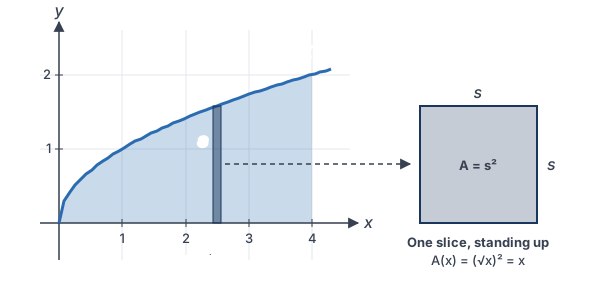
The base of a solid is the region under y = \sqrt{x} from x = 0 to x = 4. Cross sections perpendicular to the x-axis are squares. Find the volume.
s = \sqrt{x} - 0 = \sqrt{x}Slice length: top curve minus the x-axis.
A(x) = (\sqrt{x})^2 = xSquare: A = s².
V = \int_0^4 x\,dx
Integrate A(x) across the base.
= \Big[\dfrac{x^2}{2}\Big]_0^4 = 8 - 0 = 8Antidifferentiate and plug in the limits (see fundamental theorem of calculus, part 2).
Answer: 8 cubic units.
Example 2: Semicircle cross sections
The base is the region between y = x and y = x^2. Cross sections perpendicular to the x-axis are semicircles. Find the volume.
x = x^2 \text{ at } x = 0 \text{ and } x = 1Set the curves equal: x(x − 1) = 0.
s = x - x^2
Slice length: y = x is on top on [0, 1] (see area between curves).
A(x) = \dfrac{\pi}{8}(x - x^2)^2Semicircle: A = πs²/8.
(x - x^2)^2 = x^2 - 2x^3 + x^4
Square the binomial (see special products of binomials).
V = \dfrac{\pi}{8}\int_0^1 (x^2 - 2x^3 + x^4)\,dxIntegrate A(x) from 0 to 1.
= \dfrac{\pi}{8}\Big[\dfrac{x^3}{3} - \dfrac{x^4}{2} + \dfrac{x^5}{5}\Big]_0^1Antidifferentiate each term.
= \dfrac{\pi}{8}\left(\dfrac{1}{3} - \dfrac{1}{2} + \dfrac{1}{5}\right)Plug in 1; every term is 0 at 0.
= \dfrac{\pi}{8}\cdot\dfrac{1}{30} = \dfrac{\pi}{240}10/30 − 15/30 + 6/30 = 1/30.
Answer: \dfrac{\pi}{240} \approx 0.0131 cubic units. The base is small and thin, so the volume is small.
Example 3: Equilateral triangle cross sections
The base is the triangle with vertices (0, 0), (4, 0) and (0, 4). Cross sections perpendicular to the x-axis are equilateral triangles. Find the volume.
y = 4 - x
The slanted side of the base runs from (0, 4) to (4, 0).
s = 4 - x
Slice length: the line minus the x-axis.
A(x) = \dfrac{\sqrt{3}}{4}(4 - x)^2Equilateral triangle: A = (√3/4)s².
V = \dfrac{\sqrt{3}}{4}\int_0^4 (4 - x)^2\,dxIntegrate from 0 to 4.
= \dfrac{\sqrt{3}}{4}\Big[-\dfrac{(4 - x)^3}{3}\Big]_0^4Use u = 4 − x, du = −dx (see u-substitution).
= \dfrac{\sqrt{3}}{4}\left(0 + \dfrac{64}{3}\right)Plug in the limits and subtract.
= \dfrac{16\sqrt{3}}{3} \approx 9.24Multiply.
Answer: \dfrac{16\sqrt{3}}{3} \approx 9.24 cubic units.
Example 4: Slices perpendicular to the y-axis
The base is the region between x = y^2 and x = 4. Cross sections perpendicular to the y-axis are squares. Find the volume.
y^2 = 4 \text{ at } y = -2 \text{ and } y = 2Find where the curves meet.
s = 4 - y^2
Slice length: right (x = 4) minus left (x = y²).
A(y) = (4 - y^2)^2 = 16 - 8y^2 + y^4
Square the slice length.
V = \int_{-2}^{2} (16 - 8y^2 + y^4)\,dyIntegrate in y from −2 to 2.
= \Big[16y - \dfrac{8y^3}{3} + \dfrac{y^5}{5}\Big]_{-2}^{2}Antidifferentiate each term.
= 2\left(32 - \dfrac{64}{3} + \dfrac{32}{5}\right)The value at −2 is the negative of the value at 2, so the difference is twice the value at 2.
= 2\cdot\dfrac{256}{15} = \dfrac{512}{15}480/15 − 320/15 + 96/15 = 256/15.
Answer: \dfrac{512}{15} \approx 34.13 cubic units.
Example 5: A stone paperweight
A paperweight has a circular base of radius 3 cm, x^2 + y^2 \le 9. Cross sections perpendicular to the x-axis are squares. Find its volume. If the stone has a density of 2.5 grams per cubic centimeter, what is its mass?
y = \pm\sqrt{9 - x^2}Solve the circle equation for y (see equation of a circle).
s = 2\sqrt{9 - x^2}Slice length: top half minus bottom half.
A(x) = \left(2\sqrt{9 - x^2}\right)^2 = 4(9 - x^2)Square: A = s².
V = \int_{-3}^{3} (36 - 4x^2)\,dxIntegrate across the circle, from x = −3 to 3.
= \Big[36x - \dfrac{4x^3}{3}\Big]_{-3}^{3} = (108 - 36) - (-108 + 36)Antidifferentiate and plug in the limits.
= 72 + 72 = 144
Simplify.
144 \times 2.5 = 360
Mass = volume × density.
Answer: the volume is 144 cm³ and the mass is 360 g.
Common mistakes
| Mistake | Example of the error | Fix |
|---|---|---|
| Integrating s instead of A | V = \int_0^4 \sqrt{x}\,dx for square slices | Integrate the area: A(x) = s^2 = x. |
| Using s as the semicircle’s radius | A = \dfrac{1}{2}\pi s^2 | s is the diameter, so the radius is s/2 and A = \dfrac{\pi s^2}{8}. |
| Measuring s from the axis instead of between curves | s = x for the region between y = x and y = x² | Use top minus bottom: s = x - x^2. |
| Using x when slices are perpendicular to the y-axis | Writing s in terms of x for Example 4 | Slices perpendicular to the y-axis need s in terms of y and dy. |
| Forgetting the shape’s constant | A = s^2 for equilateral triangles | Use A = \dfrac{\sqrt{3}}{4}s^2. |
Related methods
The disk method is a special case
If you spin a region around an axis, every slice is a circle. Then A(x) = πr², and the cross-section formula becomes the disk method. That is the next lesson, Disk Method.
Checking with geometry
The cross-section idea also explains known formulas. A pyramid with a square base of side b and height h has square slices whose side shrinks to 0 at the top, and \int_0^h \left(\dfrac{b(h - y)}{h}\right)^2 dy = \dfrac{1}{3}b^2h, the formula from volume of pyramids and cones.
Practice problems
- The base is the region under y = 2x from x = 0 to x = 3. Cross sections perpendicular to the x-axis are squares. Find the volume.
- The base is the region between y = x^2 and y = 1. Cross sections perpendicular to the x-axis are squares. Find the volume.
- The base is the region under y = \sqrt{x} from x = 0 to x = 4. Cross sections perpendicular to the x-axis are semicircles. Find the volume.
- The base is the triangle under y = 3 - x from x = 0 to x = 3. Cross sections perpendicular to the x-axis are squares. Find the volume.
- Use the same base as problem 4, with equilateral triangle cross sections. Find the volume.
- The base is the region between y = x and y = x^2. Cross sections perpendicular to the x-axis are squares. Find the volume.
- The base is the region under y = e^x from x = 0 to x = 1. Cross sections perpendicular to the x-axis are squares. Find the volume.
- The base is the region between x = y^2 and x = 1. Cross sections perpendicular to the y-axis are isosceles right triangles with a leg in the base. Find the volume.
- The base is the disk x^2 + y^2 \le 4. Cross sections perpendicular to the x-axis are semicircles. Find the volume.
- A glass paperweight has a base bounded by y = 1 - \dfrac{x^2}{4} and the x-axis, in inches. Cross sections perpendicular to the x-axis are squares. Find its volume.
Show answers
1.
s = 2x, \; A(x) = 4x^2
Slice length and square area.
V = \int_0^3 4x^2\,dx = \Big[\dfrac{4x^3}{3}\Big]_0^3 = 36Integrate and evaluate.
Answer: 36
2.
x^2 = 1 \text{ at } x = \pm 1Find the limits.
A(x) = (1 - x^2)^2 = 1 - 2x^2 + x^4
s = 1 − x²; square it.
V = \int_{-1}^{1} (1 - 2x^2 + x^4)\,dx = \Big[x - \dfrac{2x^3}{3} + \dfrac{x^5}{5}\Big]_{-1}^{1}Integrate.
= 2\left(1 - \dfrac{2}{3} + \dfrac{1}{5}\right) = 2\cdot\dfrac{8}{15} = \dfrac{16}{15}Evaluate; the value at −1 is the negative of the value at 1.
Answer: \dfrac{16}{15}
3.
A(x) = \dfrac{\pi}{8}(\sqrt{x})^2 = \dfrac{\pi}{8}xs = √x; semicircle area.
V = \int_0^4 \dfrac{\pi}{8}x\,dx = \dfrac{\pi}{8}\Big[\dfrac{x^2}{2}\Big]_0^4 = \dfrac{\pi}{8}(8) = \piIntegrate and evaluate.
Answer: \pi \approx 3.14
4.
V = \int_0^3 (3 - x)^2\,dx = \Big[-\dfrac{(3 - x)^3}{3}\Big]_0^3s = 3 − x; A = s².
= 0 - \left(-\dfrac{27}{3}\right) = 9Evaluate.
Answer: 9
5.
V = \dfrac{\sqrt{3}}{4}\int_0^3 (3 - x)^2\,dx = \dfrac{\sqrt{3}}{4}(9)A = (√3/4)s²; the integral is 9 from problem 4.
= \dfrac{9\sqrt{3}}{4} \approx 3.90Multiply.
Answer: \dfrac{9\sqrt{3}}{4} \approx 3.90
6.
A(x) = (x - x^2)^2 = x^2 - 2x^3 + x^4
s = x − x² on [0, 1].
V = \int_0^1 (x^2 - 2x^3 + x^4)\,dx = \dfrac{1}{3} - \dfrac{1}{2} + \dfrac{1}{5} = \dfrac{1}{30}Integrate and evaluate (same integral as Example 2).
Answer: \dfrac{1}{30}
7.
A(x) = (e^x)^2 = e^{2x}s = eˣ.
V = \int_0^1 e^{2x}\,dx = \Big[\dfrac{e^{2x}}{2}\Big]_0^1 = \dfrac{e^2 - 1}{2}Integrate with u = 2x and evaluate.
\dfrac{e^2 - 1}{2} \approx 3.195Use e² ≈ 7.389.
Answer: \dfrac{e^2 - 1}{2} \approx 3.195
8.
s = 1 - y^2, \; A(y) = \dfrac{(1 - y^2)^2}{2}Right minus left; isosceles right triangle area s²/2.
V = \dfrac{1}{2}\int_{-1}^{1} (1 - 2y^2 + y^4)\,dy = \dfrac{1}{2}\cdot\dfrac{16}{15}Same integral as problem 2, in y.
= \dfrac{8}{15}Multiply.
Answer: \dfrac{8}{15}
9.
s = 2\sqrt{4 - x^2}Top half minus bottom half of the circle.
A(x) = \dfrac{\pi}{8}\cdot 4(4 - x^2) = \dfrac{\pi}{2}(4 - x^2)Semicircle area πs²/8.
V = \dfrac{\pi}{2}\int_{-2}^{2} (4 - x^2)\,dx = \dfrac{\pi}{2}\cdot\dfrac{32}{3} = \dfrac{16\pi}{3}Integrate and evaluate.
Answer: \dfrac{16\pi}{3} \approx 16.76. The solid is half of a ball of radius 2.
10.
1 - \dfrac{x^2}{4} = 0 \text{ at } x = \pm 2Find the limits.
A(x) = \left(1 - \dfrac{x^2}{4}\right)^2 = 1 - \dfrac{x^2}{2} + \dfrac{x^4}{16}Square the slice length.
V = \Big[x - \dfrac{x^3}{6} + \dfrac{x^5}{80}\Big]_{-2}^{2}Integrate each term.
= 2\left(2 - \dfrac{4}{3} + \dfrac{2}{5}\right) = 2\cdot\dfrac{16}{15} = \dfrac{32}{15}Evaluate: 8/6 = 4/3 and 32/80 = 2/5.
Answer: \dfrac{32}{15} \approx 2.13 cubic inches
Volumes by cross sections FAQ
How do you find the volume of a solid with known cross sections?
Find the area A(x) of a typical slice from its shape and its length s, then integrate A(x) over the base: V = \int_a^b A(x)\,dx.
What is the area of a semicircle cross section?
If the diameter is s, the radius is s/2, so the area is \dfrac{1}{2}\pi\left(\dfrac{s}{2}\right)^2 = \dfrac{\pi s^2}{8}.
When do you integrate with respect to y?
When the cross sections are perpendicular to the y-axis. Then the slice length is right minus left in terms of y, and the limits are y-values.
How is this different from the disk method?
The disk method is the case where every slice is a circle, made by spinning a region around an axis. Here the slices can be any shape.
Summary
- Volume by cross sections: V = \int_a^b A(x)\,dx, the sum of thin slices.
- s is the length of the slice in the base: top minus bottom, or right minus left.
- Square: s². Semicircle: πs²/8. Equilateral triangle: (√3/4)s².
- Slices perpendicular to the y-axis use A(y) and dy.
- Integrate the area, not the length.
Previous lesson: Area Between Curves
Next lesson: Disk Method
Back to the Calculus 1 Index