
Pumping Liquid Problems
Pumping liquid problems ask how much work it takes to pump liquid out of a tank. Slice the liquid into thin horizontal layers. Each layer’s work is its weight times the distance it must be lifted, so W = \int_a^b \rho\,A(y)\,(\text{distance lifted})\,dy, where ρ is the liquid’s weight per unit volume and A(y) is the layer’s area.
Before this lesson: Work Done by a Variable Force and Volumes by Cross Sections
Why layers?
If you lift a bucket, every drop rises the same distance. In a tank, the water at the bottom has to travel farther than the water at the top. So you can’t just use weight times distance for the whole tank.
Instead, cut the liquid into thin layers. Every drop in one layer rises about the same distance, so its work is weight times distance. Adding up the layers gives an integral.
Setting up a pumping problem
- Put y = 0 at the bottom of the tank, with y measured upward.
- Find the area A(y) of a horizontal slice at height y. A slice of thickness dy has volume A(y) dy, like a very flat prism or cylinder.
- Multiply by the weight density ρ to get the slice’s weight: ρ A(y) dy.
- Find the distance the slice is lifted: (height of the outlet) − y.
- Integrate over the heights where there is liquid.
W = \int_{\text{bottom of liquid}}^{\text{top of liquid}} \rho\,A(y)\,(h_{\text{out}} - y)\,dy| Liquid | Weight density ρ |
|---|---|
| Water (metric) | 1000 \cdot 9.8 = 9800 N/m³ |
| Water (US units) | 62.4 lb/ft³ |
In metric units, the density of water is 1000 kg/m³. Multiply by g = 9.8 m/s² to get weight per volume.
Pumping liquid examples
Example 1: A rectangular tank
A tank is a box 4 m long, 3 m wide and 2 m deep, full of water. How much work does it take to pump all the water out over the top?
A(y) = 4 \cdot 3 = 12
Every horizontal slice is a 4 m by 3 m rectangle.
\text{weight of a slice} = 9800 \cdot 12\,dy = 117{,}600\,dyMultiply by the weight density of water.
\text{distance lifted} = 2 - yThe top of the tank is at y = 2.
W = \int_0^2 117{,}600(2 - y)\,dyWater fills y = 0 to y = 2.
= 117{,}600\Big[2y - \dfrac{y^2}{2}\Big]_0^2 = 117{,}600(4 - 2)Integrate and plug in.
= 235{,}200Multiply.
Answer: 235,200 joules.
Example 2: Pumping to a pipe above the tank
For the tank in Example 1, the water must go out through a pipe 1 m above the top of the tank. Find the work.
\text{distance lifted} = 3 - yThe outlet is now at y = 2 + 1 = 3.
W = \int_0^2 117{,}600(3 - y)\,dySame slices, new distance.
= 117{,}600\Big[3y - \dfrac{y^2}{2}\Big]_0^2 = 117{,}600(6 - 2)Integrate and plug in.
= 470{,}400Multiply.
Answer: 470,400 joules, twice as much as Example 1.
Example 3: A partly full cylinder
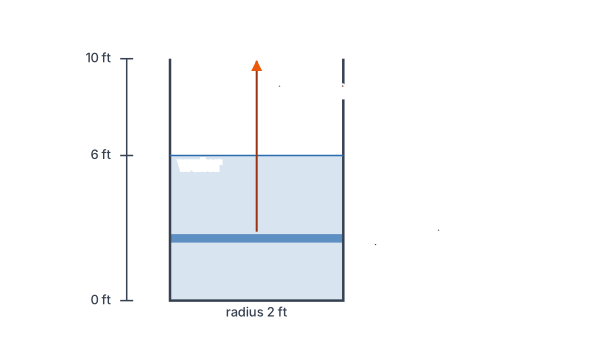
A cylindrical tank stands upright. It has radius 2 ft and height 10 ft, and holds water 6 ft deep. Find the work to pump the water out over the top.
A(y) = \pi(2)^2 = 4\pi
Each slice is a circle of radius 2 (see area of a circle).
\text{weight of a slice} = 62.4 \cdot 4\pi\,dy = 249.6\pi\,dyWater weighs 62.4 lb/ft³.
W = \int_0^6 249.6\pi(10 - y)\,dy
Water only fills y = 0 to y = 6, but it rises to y = 10.
= 249.6\pi\Big[10y - \dfrac{y^2}{2}\Big]_0^6 = 249.6\pi(60 - 18)Integrate and plug in.
= 10{,}483.2\pi \approx 32{,}934249.6 · 42 = 10,483.2.
Answer: about 32,934 ft-lb.
Example 4: A cone-shaped tank
A tank is a cone with its point at the bottom. It is 6 m tall, its top has radius 3 m, and it is full of water. Find the work to pump the water out over the top.
\dfrac{r}{y} = \dfrac{3}{6} \Rightarrow r = \dfrac{y}{2}Similar triangles: the radius grows in proportion to the height (see similar right triangles).
A(y) = \pi\left(\dfrac{y}{2}\right)^2 = \dfrac{\pi y^2}{4}Each slice is a circle.
W = \int_0^6 9800\cdot\dfrac{\pi y^2}{4}(6 - y)\,dy = 2450\pi\int_0^6 (6y^2 - y^3)\,dySet up; 9800/4 = 2450; distribute.
= 2450\pi\Big[2y^3 - \dfrac{y^4}{4}\Big]_0^6 = 2450\pi(432 - 324)Integrate and plug in.
= 264{,}600\pi \approx 831{,}2652450 · 108 = 264,600.
Answer: about 831,000 joules.
Example 5: A trough with triangle ends
A water trough is 10 ft long. Its ends are triangles, point down, 4 ft wide at the top and 2 ft deep. It is full. Find the work to pump the water out over the top.
w(y) = 2y
The width grows from 0 at y = 0 to 4 at y = 2, in proportion to y.
A(y) = 10 \cdot 2y = 20y
Each slice is a rectangle 10 ft long and w(y) wide.
W = \int_0^2 62.4\cdot 20y(2 - y)\,dy = 1248\int_0^2 (2y - y^2)\,dy
Set up and distribute.
= 1248\left(4 - \dfrac{8}{3}\right) = 1248\cdot\dfrac{4}{3}Integrate to y² − y³/3 and plug in 2.
= 1664
Multiply.
Answer: 1664 ft-lb.
Common mistakes
| Mistake | Example of the error | Fix |
|---|---|---|
| Using height instead of distance lifted | W = ∫ ρA(y) · y dy for pumping over the top | Use (outlet height − y). With y = 0 at the bottom, the bottom slice travels farthest. |
| Using mass instead of weight | ρ = 1000 for water in metric | Work needs weight: 1000 · 9.8 = 9800 N/m³. |
| Integrating where there’s no liquid | ∫₀¹⁰ for a 10 ft tank that’s 6 ft full | Integrate only over the liquid, 0 to 6. The outlet height goes in the distance. |
| Wrong radius for a cone | r = 3 for every slice | Use similar triangles: r = (top radius / height) · y. |
| Mixing units | Feet with 9800 N/m³ | Use 62.4 lb/ft³ with feet, 9800 N/m³ with meters. |
Related methods
Measuring y from the top
Some books put y = 0 at the top and measure down. Then the distance lifted is just y, and the slice areas change. Either choice works if you stay consistent.
Other liquids
For a liquid other than water, replace ρ with its weight density. For example, oil with density 900 kg/m³ has ρ = 900 · 9.8 = 8820 N/m³.
Force instead of work
The same slicing idea finds the force of water pressing on a wall or dam. That is the next lesson, hydrostatic force.
Practice problems
- A box-shaped tank is 5 m long, 2 m wide and 3 m deep, full of water. Find the work to pump the water out over the top.
- The tank in problem 1 holds water only 1.5 m deep. Find the work to pump it out over the top.
- An upright cylinder of radius 1 m and height 4 m is full of water. Find the work to pump it out over the top.
- For the tank in problem 3, the water leaves through a spout 1 m above the top. Find the work.
- An upright cylinder of radius 3 ft and height 8 ft is full of water. Find the work to pump it out over the top.
- A cone with its point down is 4 m tall, with top radius 2 m, and is full of water. Find the work to pump it out over the top.
- A box tank 2 m by 2 m and 1 m deep is full of oil with weight density 8820 N/m³. Find the work to pump it out over the top.
- A trough is 6 ft long, with triangle ends (point down) 2 ft wide at the top and 1 ft deep. It is full of water. Find the work to pump it out over the top.
- A hemispherical bowl of radius 1 m, flat side up, is full of water. Find the work to pump it out over the rim.
- For the tank in Example 1, find the work to pump out only the top 1 m of water.
Show answers
1.
A(y) = 10, \; \rho A = 98{,}0005 · 2 = 10 m², times 9800.
W = \int_0^3 98{,}000(3 - y)\,dy = 98{,}000\Big[3y - \tfrac{y^2}{2}\Big]_0^3Set up and integrate.
= 98{,}000(9 - 4.5) = 441{,}000Plug in 3.
Answer: 441,000 J
2.
W = \int_0^{1.5} 98{,}000(3 - y)\,dy = 98{,}000\Big[3y - \tfrac{y^2}{2}\Big]_0^{1.5}Water fills 0 to 1.5 but rises to 3.
= 98{,}000(4.5 - 1.125) = 98{,}000(3.375) = 330{,}750Plug in and multiply.
Answer: 330,750 J
3.
A(y) = \pi, \; W = \int_0^4 9800\pi(4 - y)\,dy
Circle of radius 1.
= 9800\pi\Big[4y - \tfrac{y^2}{2}\Big]_0^4 = 9800\pi(8) = 78{,}400\piIntegrate and plug in.
Answer: 78,400π ≈ 246,301 J
4.
W = \int_0^4 9800\pi(5 - y)\,dy = 9800\pi\Big[5y - \tfrac{y^2}{2}\Big]_0^4The outlet is at y = 5.
= 9800\pi(20 - 8) = 117{,}600\piPlug in.
Answer: 117,600π ≈ 369,451 J
5.
\rho A = 62.4 \cdot 9\pi = 561.6\pi
Circle of radius 3: area 9π.
W = \int_0^8 561.6\pi(8 - y)\,dy = 561.6\pi\Big[8y - \tfrac{y^2}{2}\Big]_0^8 = 561.6\pi(32)Set up, integrate and plug in.
= 17{,}971.2\piMultiply.
Answer: about 56,458 ft-lb
6.
r = \dfrac{y}{2}, \; A(y) = \dfrac{\pi y^2}{4}Similar triangles: 2/4 = r/y.
W = 2450\pi\int_0^4 (4y^2 - y^3)\,dy = 2450\pi\Big[\tfrac{4y^3}{3} - \tfrac{y^4}{4}\Big]_0^49800/4 = 2450; distribute and integrate.
= 2450\pi\left(\dfrac{256}{3} - 64\right) = 2450\pi\cdot\dfrac{64}{3} = \dfrac{156{,}800\pi}{3}Plug in and simplify.
Answer: about 164,201 J
7.
\rho A = 8820 \cdot 4 = 35{,}280Each slice is 2 m by 2 m.
W = \int_0^1 35{,}280(1 - y)\,dy = 35{,}280\cdot\tfrac{1}{2} = 17{,}640∫₀¹ (1 − y) dy = 1/2.
Answer: 17,640 J
8.
w(y) = 2y, \; A(y) = 6 \cdot 2y = 12y
Width grows from 0 to 2 as y goes from 0 to 1.
W = \int_0^1 62.4\cdot 12y(1 - y)\,dy = 748.8\left(\tfrac{1}{2} - \tfrac{1}{3}\right)Set up, distribute and integrate.
= 748.8\cdot\tfrac{1}{6} = 124.8Multiply.
Answer: 124.8 ft-lb
9.
y \text{ from } -1 \text{ to } 0, \; A(y) = \pi(1 - y^2)Put y = 0 at the rim; a slice at height y is a circle with r² = 1 − y².
\text{distance lifted} = 0 - y = -yEvery slice rises to the rim, y = 0.
W = 9800\pi\int_{-1}^{0} (1 - y^2)(-y)\,dy = 9800\pi\Big[-\tfrac{y^2}{2} + \tfrac{y^4}{4}\Big]_{-1}^{0}Set up and integrate.
= 9800\pi\left(0 - \left(-\tfrac{1}{2} + \tfrac{1}{4}\right)\right) = 2450\piPlug in.
Answer: 2450π ≈ 7697 J
10.
W = \int_1^2 117{,}600(2 - y)\,dyOnly the water from y = 1 to y = 2.
= 117{,}600\Big[2y - \tfrac{y^2}{2}\Big]_1^2 = 117{,}600(2 - 1.5) = 58{,}800Integrate and plug in.
Answer: 58,800 J, only a quarter of the full job
Pumping liquid problems FAQ
How do you set up a work problem for pumping water?
Slice the water into horizontal layers. Each layer’s work is weight density times its area times dy times the distance it rises. Integrate over the depth of the water.
What is the weight density of water?
About 62.4 pounds per cubic foot, or 9800 newtons per cubic meter (1000 kg/m³ times 9.8 m/s²).
Why can’t you use weight times distance for the whole tank?
Each layer rises a different distance. The bottom layer travels farthest, so the total work depends on the tank’s shape, and you add the layers with an integral.
What changes if the tank is only partly full?
Only the limits of integration change. Integrate from the bottom to the water’s surface, but keep the distance lifted measured to the outlet.
Summary
- Slice the liquid into horizontal layers of thickness dy.
- Layer weight = ρ · A(y) dy; layer distance = outlet height − y.
- W = ∫ ρ A(y)(outlet − y) dy over the depth of the liquid.
- Water: 9800 N/m³ or 62.4 lb/ft³.
- For cones and troughs, find the slice size with similar triangles.
Previous lesson: Work Done by a Variable Force
Next lesson: Hydrostatic Force
Back to the Calculus 2 Index