
Hydrostatic Force
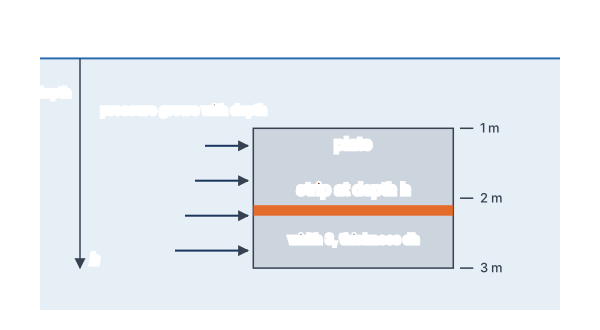
Hydrostatic force is the total force a still liquid puts on a submerged surface, such as a dam or a window in a tank. Pressure grows with depth, so slice the plate into thin horizontal strips at depth h. Then F = \int_a^b \rho\,h\,w(h)\,dh, where ρ is the weight density and w(h) is the strip’s width.
Before this lesson: Pumping Liquid Problems and Definite Integrals
Why depth matters
Dive to the bottom of a pool and you feel the water press harder on your ears. Pressure in a liquid depends only on depth: at depth h, it is P = ρh, the weight of the column of liquid above each unit of area.
On a flat plate lying level at one depth, the force is just pressure times area. On an upright plate, the bottom feels more pressure than the top. So slice the plate into thin horizontal strips. Each strip is at about one depth, so its force is ρ · h · (its area), and the integral adds the strips.
Hydrostatic force formula
F = \int_a^b \rho\,h\,w(h)\,dh
Here h is the depth below the surface (measured downward), the plate runs from depth a to depth b, and w(h) is the width of the plate at depth h.
| Quantity | Formula |
|---|---|
| Pressure at depth h | P = ρh |
| Force on a level plate of area A at depth h | F = ρhA |
| Force on an upright plate | F = \int_a^b \rho\,h\,w(h)\,dh |
| Water | ρ = 9800 N/m³ or 62.4 lb/ft³ |
- Draw the plate and measure depth h downward from the surface.
- Find the width w(h) of a horizontal strip at depth h.
- Write the strip’s force: ρ · h · w(h) dh.
- Integrate from the top depth of the plate to the bottom depth.
Hydrostatic force examples
Example 1: A rectangular plate
A rectangular plate 3 m wide and 2 m tall stands upright in water, with its top edge 1 m below the surface. Find the force of the water on one side.
w(h) = 3, \; 1 \le h \le 3
The width is constant; the plate runs from depth 1 to depth 1 + 2 = 3.
F = \int_1^3 9800\cdot h\cdot 3\,dh = 29{,}400\int_1^3 h\,dhSet up the force integral.
= 29{,}400\Big[\dfrac{h^2}{2}\Big]_1^3 = 29{,}400\left(\dfrac{9}{2} - \dfrac{1}{2}\right)Integrate with the power rule and plug in.
= 29{,}400(4) = 117{,}600Multiply.
Answer: 117,600 newtons.
Example 2: A level plate needs no integral
A flat plate with area 2 m² lies level on the bottom of a pool, 4 m deep. Find the force on its top.
P = 9800 \cdot 4 = 39{,}200Every point is at depth 4, so the pressure is the same everywhere.
F = PA = 39{,}200 \cdot 2 = 78{,}400Constant pressure times area.
Answer: 78,400 newtons.
Example 3: A triangular plate
A triangular plate hangs point down in water. Its top side, 6 ft long, lies along the surface, and its point is 4 ft deep. Find the force on one side.
w(h) = 6\left(1 - \dfrac{h}{4}\right) = 6 - 1.5hThe width shrinks in proportion from 6 at h = 0 to 0 at h = 4 (see similar right triangles).
F = \int_0^4 62.4\,h(6 - 1.5h)\,dh
Set up.
= 62.4\int_0^4 (6h - 1.5h^2)\,dh = 62.4\Big[3h^2 - 0.5h^3\Big]_0^4
Distribute and integrate.
= 62.4(48 - 32) = 62.4(16) = 998.4
Plug in 4.
Answer: 998.4 lb.
Example 4: A round window
A circular window of radius 1 m is set in the side of a tank. Its center is 5 m below the surface. Find the force on it.
h = 5 + y, \; w = 2\sqrt{1 - y^2}, \; -1 \le y \le 1Let y be the distance below the center; a strip’s width comes from x² + y² = 1.
F = \int_{-1}^{1} 9800(5 + y)\cdot 2\sqrt{1 - y^2}\,dySet up.
= 49{,}000\int_{-1}^{1} 2\sqrt{1 - y^2}\,dy + 9800\int_{-1}^{1} 2y\sqrt{1 - y^2}\,dySplit the sum.
\int_{-1}^{1} 2y\sqrt{1 - y^2}\,dy = 0The integrand is odd (see even and odd functions).
\int_{-1}^{1} 2\sqrt{1 - y^2}\,dy = \piThis is the area of the unit circle (see area of a circle).
F = 49{,}000\pi \approx 153{,}938Multiply.
Answer: about 153,900 newtons. It equals the pressure at the center times the area: 9800 · 5 · π.
Example 5: The face of a dam
The face of a dam is a trapezoid. It is 40 m wide at the water’s surface, 20 m wide at the bottom and 10 m deep. Find the force of the water on the dam.
w(h) = 40 - 2h
The width drops by 20 m over 10 m of depth, so it shrinks 2 m per meter.
F = \int_0^{10} 9800\,h(40 - 2h)\,dhSet up.
= 9800\Big[20h^2 - \dfrac{2}{3}h^3\Big]_0^{10}Distribute and integrate.
= 9800\left(2000 - \dfrac{2000}{3}\right) = 9800\cdot\dfrac{4000}{3}Plug in 10.
\approx 13{,}066{,}667Multiply.
Answer: about 1.31 × 10⁷ newtons, about the weight of 1330 tonnes.
Common mistakes
| Mistake | Example of the error | Fix |
|---|---|---|
| Measuring h up from the bottom | Using height above the bottom as the depth | Pressure uses depth below the surface. Measure h downward, or use (surface − y). |
| Treating pressure as constant | F = 9800 · 1 · 6 for the plate in Example 1 | Pressure grows with depth. Integrate, or use the depth of the center (see Related methods). |
| Forgetting the width changes | w = 6 for the whole triangle in Example 3 | Find w(h) at each depth with similar triangles or the shape’s equation. |
| Using mass density | ρ = 1000 for water in metric | Use weight density: 9800 N/m³. |
| Wrong limits | ∫₀² for a plate whose top is 1 m deep | Integrate from the top depth to the bottom depth: ∫₁³. |
Related methods
The centroid shortcut
For a flat upright plate, the force equals ρ times the depth of the plate’s centroid times its area. In Example 1, the centroid is 2 m deep and the area is 6 m², so F = 9800 · 2 · 6 = 117,600 N. Finding centroids is the next lesson, Center of Mass.
Pressure doesn’t depend on the tank’s shape
At depth h, the pressure is ρh whether the tank is narrow or wide. This surprising fact is called the hydrostatic paradox.
Slanted plates
If a plate is tilted, a strip’s true width along the slant is larger than its vertical thickness dh. Divide by the sine of the tilt angle to account for this.
Practice problems
Find the force of the water on one side of each plate.
- A rectangle 4 ft wide and 3 ft tall, upright, with its top edge at the surface.
- The rectangle from problem 1, lowered so its top edge is 2 ft below the surface.
- A square 2 m on a side, upright, with its top edge 1 m below the surface.
- A triangle, point up, with its point at the surface and its 4 m base at depth 3 m.
- A triangle, point down, with its 2 m top side at the surface and its point 3 m deep.
- A level plate with area 0.5 m², 10 m deep.
- A circular porthole of radius 0.5 m with its center 3 m deep.
- The end of an aquarium, 0.6 m wide, with water 0.5 m deep.
- A trapezoid gate, 6 ft wide at the surface, 4 ft wide at the bottom, 2 ft tall.
- A half-disk of radius 2 ft, with its straight side along the surface and its curved side down.
Show answers
1.
F = \int_0^3 62.4\,h\cdot 4\,dh = 249.6\Big[\dfrac{h^2}{2}\Big]_0^3Width 4, depth 0 to 3.
= 249.6(4.5) = 1123.2
Plug in.
Answer: 1123.2 lb
2.
F = 249.6\Big[\dfrac{h^2}{2}\Big]_2^5 = 249.6\left(\dfrac{25}{2} - \dfrac{4}{2}\right)Depth now runs from 2 to 5.
= 249.6(10.5) = 2620.8
Multiply.
Answer: 2620.8 lb
3.
F = \int_1^3 9800\,h\cdot 2\,dh = 19{,}600\Big[\dfrac{h^2}{2}\Big]_1^3Width 2, depth 1 to 3.
= 19{,}600(4) = 78{,}4009/2 − 1/2 = 4.
Answer: 78,400 N
4.
w(h) = \dfrac{4}{3}hWidth grows from 0 at the surface to 4 at depth 3.
F = \int_0^3 9800\,h\cdot\dfrac{4}{3}h\,dh = \dfrac{39{,}200}{3}\Big[\dfrac{h^3}{3}\Big]_0^3Set up and integrate.
= \dfrac{39{,}200}{3}(9) = 117{,}600Plug in.
Answer: 117,600 N
5.
w(h) = 2 - \dfrac{2h}{3}Width shrinks from 2 to 0 over depth 3.
F = 9800\int_0^3 \left(2h - \dfrac{2h^2}{3}\right)dh = 9800\Big[h^2 - \dfrac{2h^3}{9}\Big]_0^3Distribute and integrate.
= 9800(9 - 6) = 29{,}400Plug in 3.
Answer: 29,400 N
6.
F = \rho hA = 9800(10)(0.5)
Constant depth.
= 49{,}000Multiply.
Answer: 49,000 N
7.
F = 9800(3)\cdot\pi(0.5)^2
As in Example 4: pressure at the center times the area.
= 7350\pi \approx 23{,}091Multiply.
Answer: about 23,091 N
8.
F = \int_0^{0.5} 9800\,h(0.6)\,dh = 5880\Big[\dfrac{h^2}{2}\Big]_0^{0.5}Width 0.6.
= 5880(0.125) = 735
Plug in.
Answer: 735 N
9.
w(h) = 6 - h
Width drops from 6 to 4 over 2 ft of depth.
F = 62.4\int_0^2 (6h - h^2)\,dh = 62.4\left(12 - \dfrac{8}{3}\right)Distribute, integrate and plug in.
= 62.4\cdot\dfrac{28}{3} = 582.4Multiply.
Answer: 582.4 lb
10.
w(h) = 2\sqrt{4 - h^2}From x² + h² = 4.
F = 62.4\int_0^2 2h\sqrt{4 - h^2}\,dhSet up.
u = 4 - h^2, \; du = -2h\,dh: \; \int_0^2 2h\sqrt{4 - h^2}\,dh = \int_0^4 \sqrt{u}\,du = \dfrac{16}{3}Substitute; u goes from 4 to 0, and flipping the limits removes the minus (see u-substitution with definite integrals).
F = 62.4\cdot\dfrac{16}{3} = 332.8Multiply.
Answer: 332.8 lb
Hydrostatic force FAQ
What is hydrostatic force?
It is the total push of a still liquid on a submerged surface. Because pressure grows with depth, the force on an upright plate is found with an integral.
What is the formula for hydrostatic pressure?
P = ρh, where ρ is the weight density of the liquid and h is the depth. For water, that’s 9800h N/m² or 62.4h lb/ft².
How do you set up a hydrostatic force integral?
Measure depth h downward from the surface. Find the width w(h) of a horizontal strip, then integrate ρ h w(h) dh from the top of the plate to the bottom.
Does the shape of the container change the pressure?
No. Pressure depends only on depth and the liquid, not on how wide or narrow the container is.
Summary
- Pressure at depth h: P = ρh; it acts equally in all directions.
- Level plate: F = ρhA, no integral needed.
- Upright plate: F = ∫ ρ h w(h) dh, with h measured down from the surface.
- Find w(h) from the plate’s shape, often with similar triangles.
- Shortcut: F = ρ · (depth of centroid) · area.
Previous lesson: Pumping Liquid Problems
Next lesson: Center of Mass
Back to the Calculus 2 Index