
Center of Mass
The center of mass is the balance point of an object. For a flat region of uniform density between y = f(x) on top and y = g(x) below, it is the centroid (x̄, ȳ): \bar{x} = \dfrac{1}{A}\int_a^b x\big(f(x) - g(x)\big)\,dx and \bar{y} = \dfrac{1}{A}\int_a^b \dfrac{1}{2}\big(f(x)^2 - g(x)^2\big)\,dx, where A is the region’s area.
Before this lesson: Area Between Curves and Definite Integrals
Balancing a flat plate
Two kids on a seesaw balance when each one’s weight times distance from the pivot is the same. That product, mass times distance, is called a moment. The center of mass is the point where the moments on every side cancel.
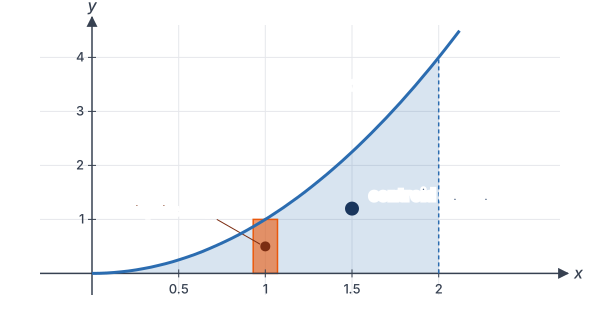
For a flat plate, cut it into thin vertical strips. Each strip’s mass sits at its middle. Adding the strips’ moments with integrals, then dividing by the total area, gives the balance point. When density is the same everywhere, the center of mass is called the centroid, and it depends only on the shape.
Center of mass formulas
| Object | Center of mass |
|---|---|
| Point masses on a line | \bar{x} = \dfrac{\sum m_i x_i}{\sum m_i} |
| Point masses in a plane | \bar{x} = \dfrac{\sum m_i x_i}{\sum m_i}, \; \bar{y} = \dfrac{\sum m_i y_i}{\sum m_i} |
| Rod with density ρ(x) | \bar{x} = \dfrac{\int_a^b x\rho(x)\,dx}{\int_a^b \rho(x)\,dx} |
| Flat region (uniform density) | \bar{x} = \dfrac{M_y}{A}, \; \bar{y} = \dfrac{M_x}{A} |
For the region between y = f(x) (top) and y = g(x) (bottom) on [a, b]:
A = \int_a^b \big(f - g\big)\,dx, \qquad M_y = \int_a^b x\big(f - g\big)\,dx, \qquad M_x = \int_a^b \dfrac{1}{2}\big(f^2 - g^2\big)\,dxM_y is the moment about the y-axis, so it gives x̄. M_x is the moment about the x-axis, so it gives ȳ. The 1/2 comes from each strip’s midpoint height, (f + g)/2, times its height f − g.
Center of mass examples
Example 1: Masses on a line
Masses of 3 kg, 5 kg and 2 kg sit at x = 1, x = 4 and x = −2. Find the center of mass.
\sum m_i = 3 + 5 + 2 = 10
Total mass.
\sum m_i x_i = 3(1) + 5(4) + 2(-2) = 3 + 20 - 4 = 19
Total moment (see multiplying and dividing integers).
\bar{x} = \dfrac{19}{10} = 1.9Divide.
Answer: x̄ = 1.9, closer to the heavy 5 kg mass.
Example 2: Masses in a plane
Masses of 2, 3 and 5 kg sit at (1, 1), (4, −1) and (−2, 3). Find the center of mass.
\sum m_i = 10
Total mass.
M_y = 2(1) + 3(4) + 5(-2) = 4
Moment about the y-axis uses the x-coordinates.
M_x = 2(1) + 3(-1) + 5(3) = 14
Moment about the x-axis uses the y-coordinates.
\bar{x} = \dfrac{4}{10} = 0.4, \; \bar{y} = \dfrac{14}{10} = 1.4Divide each by the total mass.
Answer: (0.4, 1.4).
Example 3: The region under a parabola
Find the centroid of the region under y = x² from x = 0 to x = 2.
A = \int_0^2 x^2\,dx = \dfrac{8}{3}Area (see antiderivatives).
M_y = \int_0^2 x\cdot x^2\,dx = \Big[\dfrac{x^4}{4}\Big]_0^2 = 4Here f = x² and g = 0.
\bar{x} = \dfrac{4}{8/3} = \dfrac{3}{2}Divide by the area.
M_x = \int_0^2 \dfrac{1}{2}(x^2)^2\,dx = \dfrac{1}{2}\cdot\dfrac{32}{5} = \dfrac{16}{5}∫₀² x⁴ dx = 32/5.
\bar{y} = \dfrac{16/5}{8/3} = \dfrac{16}{5}\cdot\dfrac{3}{8} = \dfrac{6}{5}Divide by multiplying by the reciprocal (see multiplying and dividing fractions).
Answer: the centroid is (1.5, 1.2).
Example 4: Between two curves
Find the centroid of the region between y = x (top) and y = x² (bottom).
x = x^2 \Rightarrow x = 0, 1
The curves meet at x = 0 and x = 1.
A = \int_0^1 (x - x^2)\,dx = \dfrac{1}{2} - \dfrac{1}{3} = \dfrac{1}{6}Area between the curves.
M_y = \int_0^1 x(x - x^2)\,dx = \dfrac{1}{3} - \dfrac{1}{4} = \dfrac{1}{12}Distribute and integrate.
\bar{x} = \dfrac{1/12}{1/6} = \dfrac{1}{2}Divide.
M_x = \int_0^1 \dfrac{1}{2}(x^2 - x^4)\,dx = \dfrac{1}{2}\left(\dfrac{1}{3} - \dfrac{1}{5}\right) = \dfrac{1}{15}Square each curve, not their difference.
\bar{y} = \dfrac{1/15}{1/6} = \dfrac{6}{15} = \dfrac{2}{5}Divide and simplify.
Answer: the centroid is (1/2, 2/5) = (0.5, 0.4).
Example 5: Balancing a half-disk sign
A metal sign is a half-disk of radius 3 ft, with its straight edge along the bottom. Where is its balance point?
\bar{x} = 0The shape is symmetric about the y-axis.
A = \dfrac{1}{2}\pi(3)^2 = \dfrac{9\pi}{2}Half the area of a circle.
M_x = \int_{-3}^{3} \dfrac{1}{2}\left(\sqrt{9 - x^2}\right)^2 dx = \dfrac{1}{2}\int_{-3}^{3} (9 - x^2)\,dxThe top is y = √(9 − x²) and the bottom is y = 0.
= \dfrac{1}{2}\Big[9x - \dfrac{x^3}{3}\Big]_{-3}^{3} = \dfrac{1}{2}(18 - (-18)) = 18Integrate and plug in.
\bar{y} = \dfrac{18}{9\pi/2} = \dfrac{36}{9\pi} = \dfrac{4}{\pi} \approx 1.27Divide.
Answer: the balance point is on the center line, about 1.27 ft above the straight edge. In general, a half-disk’s centroid is 4r/(3π) above its diameter.
Common mistakes
| Mistake | Example of the error | Fix |
|---|---|---|
| Forgetting to divide | x̄ = M_y | Divide by the total mass or area: x̄ = M_y / A. |
| Mixing up M_x and M_y | Using M_x to find x̄ | M_y (with x in the integrand) gives x̄; M_x gives ȳ. |
| Squaring the difference | \dfrac{1}{2}\int (f - g)^2\,dx for M_x | Square each curve first: \dfrac{1}{2}\int (f^2 - g^2)\,dx. |
| Dropping the 1/2 | M_x = \int f^2\,dx | A strip’s mass sits at its midpoint, so M_x has the 1/2. |
| Ignoring symmetry | Integrating to find x̄ for a symmetric shape | If the region is symmetric about a line, the centroid is on that line. |
Related methods
Pappus’s theorem
Spinning a region around an axis makes a solid whose volume is the area times the distance the centroid travels: V = A · 2πd. For Example 4 around the y-axis, V = (1/6) · 2π · (1/2) = π/6, the same answer as the shell method gives.
Centroids and fluid force
The force of water on an upright plate equals ρ times the centroid’s depth times the area. See hydrostatic force.
Rods with changing density
If a rod’s density is ρ(x), its mass is \int_a^b \rho(x)\,dx and its moment about 0 is \int_a^b x\rho(x)\,dx. Divide to get x̄. Practice problem 8 is an example.
Practice problems
- Masses of 4 kg and 6 kg sit at x = 0 and x = 5. Find the center of mass.
- Masses of 1, 2 and 3 kg sit at (0, 0), (3, 0) and (0, 4). Find the center of mass.
- Use the formulas to find the centroid of the rectangle 0 ≤ x ≤ 4, 0 ≤ y ≤ 2.
- Find the centroid of the triangle under y = x from x = 0 to x = 3.
- Find the centroid of the region under y = √x from x = 0 to x = 4.
- Find the centroid of the region under y = 4 − x² and above the x-axis.
- Find the centroid of the region between y = 2x (top) and y = x² (bottom).
- A rod from x = 0 to x = 4 m has density ρ(x) = 1 + x kg/m. Find its center of mass.
- Find the centroid of the quarter-disk x² + y² ≤ 4 in the first quadrant.
- Use Pappus’s theorem and Example 3 to find the volume when the region under y = x² from 0 to 2 spins around the x-axis.
Show answers
1.
\bar{x} = \dfrac{4(0) + 6(5)}{4 + 6} = \dfrac{30}{10}Moment over total mass.
= 3
Divide.
Answer: x̄ = 3
2.
\sum m_i = 6, \; M_y = 1(0) + 2(3) + 3(0) = 6, \; M_x = 1(0) + 2(0) + 3(4) = 12
Total mass and both moments.
\bar{x} = \dfrac{6}{6} = 1, \; \bar{y} = \dfrac{12}{6} = 2Divide.
Answer: (1, 2)
3.
A = 8, \; M_y = \int_0^4 2x\,dx = 16, \; M_x = \int_0^4 \dfrac{1}{2}(2)^2\,dx = 8Here f = 2 and g = 0.
\bar{x} = \dfrac{16}{8} = 2, \; \bar{y} = \dfrac{8}{8} = 1Divide.
Answer: (2, 1), the center of the rectangle
4.
A = \dfrac{9}{2}, \; M_y = \int_0^3 x^2\,dx = 9, \; M_x = \int_0^3 \dfrac{x^2}{2}\,dx = \dfrac{9}{2}Here f = x and g = 0.
\bar{x} = \dfrac{9}{9/2} = 2, \; \bar{y} = \dfrac{9/2}{9/2} = 1Divide.
Answer: (2, 1), the average of the corners (0, 0), (3, 0) and (3, 3)
5.
A = \int_0^4 x^{1/2}\,dx = \dfrac{2}{3}(8) = \dfrac{16}{3}4^(3/2) = 8.
M_y = \int_0^4 x^{3/2}\,dx = \dfrac{2}{5}(32) = \dfrac{64}{5}, \; \bar{x} = \dfrac{64}{5}\cdot\dfrac{3}{16} = \dfrac{12}{5}4^(5/2) = 32.
M_x = \int_0^4 \dfrac{x}{2}\,dx = 4, \; \bar{y} = 4\cdot\dfrac{3}{16} = \dfrac{3}{4}(√x)² = x.
Answer: (12/5, 3/4) = (2.4, 0.75)
6.
\bar{x} = 0, \; A = \int_{-2}^{2} (4 - x^2)\,dx = \dfrac{32}{3}Symmetric about the y-axis; the curve meets the x-axis at ±2.
M_x = \dfrac{1}{2}\int_{-2}^{2} (16 - 8x^2 + x^4)\,dx = \dfrac{1}{2}\left(64 - \dfrac{128}{3} + \dfrac{64}{5}\right) = \dfrac{256}{15}Square (4 − x²) and integrate.
\bar{y} = \dfrac{256}{15}\cdot\dfrac{3}{32} = \dfrac{8}{5}Divide.
Answer: (0, 8/5) = (0, 1.6)
7.
A = \int_0^2 (2x - x^2)\,dx = 4 - \dfrac{8}{3} = \dfrac{4}{3}The curves meet at x = 0 and x = 2.
M_y = \int_0^2 (2x^2 - x^3)\,dx = \dfrac{16}{3} - 4 = \dfrac{4}{3}, \; \bar{x} = 1Divide by A.
M_x = \dfrac{1}{2}\int_0^2 (4x^2 - x^4)\,dx = \dfrac{1}{2}\left(\dfrac{32}{3} - \dfrac{32}{5}\right) = \dfrac{32}{15}, \; \bar{y} = \dfrac{32}{15}\cdot\dfrac{3}{4} = \dfrac{8}{5}Square each curve.
Answer: (1, 8/5)
8.
m = \int_0^4 (1 + x)\,dx = 4 + 8 = 12
Total mass.
\int_0^4 x(1 + x)\,dx = 8 + \dfrac{64}{3} = \dfrac{88}{3}Moment about 0.
\bar{x} = \dfrac{88/3}{12} = \dfrac{22}{9} \approx 2.44Divide.
Answer: about 2.44 m from the light end
9.
\bar{x} = \bar{y}, \; A = \dfrac{1}{4}\pi(2)^2 = \piSymmetric about y = x.
M_x = \int_0^2 \dfrac{1}{2}(4 - x^2)\,dx = \dfrac{1}{2}\left(8 - \dfrac{8}{3}\right) = \dfrac{8}{3}Top curve y = √(4 − x²).
\bar{y} = \dfrac{8/3}{\pi} = \dfrac{8}{3\pi} \approx 0.849Divide.
Answer: (8/(3π), 8/(3π)) ≈ (0.849, 0.849)
10.
V = A\cdot 2\pi\bar{y} = \dfrac{8}{3}\cdot 2\pi\cdot\dfrac{6}{5}The centroid travels a circle of radius ȳ = 6/5.
= \dfrac{32\pi}{5}Multiply.
Answer: 32π/5, which matches the disk method: π∫₀² x⁴ dx = 32π/5
Center of mass FAQ
What is the center of mass?
It is the point where an object balances. For point masses, it is the weighted average of their positions, with each position weighted by its mass.
What is the difference between center of mass and centroid?
The centroid is the geometric center of a shape. The center of mass takes density into account. When the density is the same everywhere, they are the same point.
How do you find the centroid of a region between two curves?
Find the area A, then M_y = ∫ x(f − g) dx and M_x = ∫ ½(f² − g²) dx. The centroid is (M_y/A, M_x/A).
Can the center of mass be outside the object?
Yes. A ring or a boomerang balances at a point that is not on the object itself.
Summary
- Center of mass = total moment ÷ total mass.
- Point masses: x̄ = Σmᵢxᵢ / Σmᵢ, and the same for ȳ.
- Region between f (top) and g (bottom): x̄ = (1/A)∫ x(f − g) dx and ȳ = (1/A)∫ ½(f² − g²) dx.
- Use symmetry to skip integrals.
- Pappus: volume of revolution = area × 2π × (distance from the centroid to the axis).
Previous lesson: Hydrostatic Force
Next lesson: Verifying Solutions to Differential Equations
Back to the Calculus 2 Index