
Disk Method
The disk method finds the volume of a solid made by spinning a region around an axis. Each slice perpendicular to the axis is a disk with radius R(x), so V = \pi\int_a^b \big(R(x)\big)^2\,dx. The radius is the distance from the axis of rotation to the edge of the region.
Before this lesson: Volumes by Cross Sections, Area Between Curves and Circumference and Area of Circles
What the disk method means
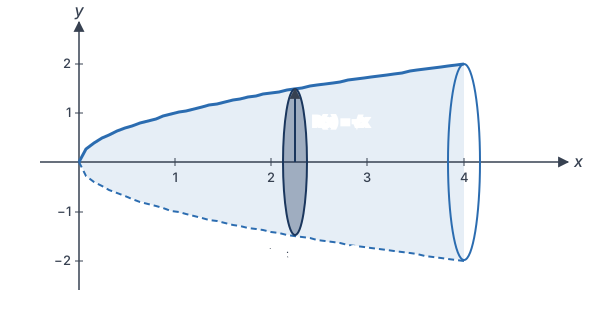
Spin the region under y = √x from x = 0 to 4 around the x-axis. It sweeps out a solid shaped like the bell of a horn. Every slice you cut perpendicular to the x-axis is a circle, called a disk.
The disk at x has radius equal to the height of the curve there, R(x) = √x. Its area is πR(x)², so this is the cross-section method with A(x) = πR(x)².
Disk method formula
Rotating around the x-axis (or any horizontal line), with slices perpendicular to it:
V = \pi\int_a^b \big(R(x)\big)^2\,dx
Rotating around the y-axis (or any vertical line), write the radius in terms of y:
V = \pi\int_c^d \big(R(y)\big)^2\,dy
How to use the disk method:
- Sketch the region and the axis of rotation. Draw one slice perpendicular to the axis.
- Check that the region touches the axis along the whole slice. If there is a gap, use the washer method instead.
- Write R as the distance from the axis to the edge of the region, in terms of x for a horizontal axis or y for a vertical axis.
- Integrate πR² between the limits.
Disk method examples
Example 1: Around the x-axis
Find the volume when the region under y = \sqrt{x} from x = 0 to x = 4 is rotated around the x-axis.
R(x) = \sqrt{x}The radius is the height of the curve above the axis.
V = \pi\int_0^4 (\sqrt{x})^2\,dx = \pi\int_0^4 x\,dxDisk formula; (√x)² = x.
= \pi\Big[\dfrac{x^2}{2}\Big]_0^4Antidifferentiate (see fundamental theorem of calculus, part 2).
= \pi(8 - 0) = 8\pi
Plug in the limits and subtract.
Answer: 8\pi \approx 25.13 cubic units.
Example 2: A power of x
Find the volume when the region under y = x^2 from x = 0 to x = 2 is rotated around the x-axis.
R(x) = x^2
The radius is the height of the curve.
V = \pi\int_0^2 (x^2)^2\,dx = \pi\int_0^2 x^4\,dx
Square the radius (see exponent rules).
= \pi\Big[\dfrac{x^5}{5}\Big]_0^2 = \pi\cdot\dfrac{32}{5}Antidifferentiate and plug in the limits.
= \dfrac{32\pi}{5}Simplify.
Answer: \dfrac{32\pi}{5} \approx 20.11 cubic units.
Example 3: Around the y-axis
The region between y = x^3, the y-axis and the line y = 8 is rotated around the y-axis. Find the volume.
x = y^{1/3}Slices are perpendicular to the y-axis, so solve for x (see rational exponents).
R(y) = y^{1/3}, \; 0 \le y \le 8The radius is the distance from the y-axis to the curve.
V = \pi\int_0^8 (y^{1/3})^2\,dy = \pi\int_0^8 y^{2/3}\,dyDisk formula in y.
= \pi\Big[\dfrac{3}{5}y^{5/3}\Big]_0^8Power rule: add 1 to get 5/3, then divide by 5/3.
= \pi\cdot\dfrac{3}{5}(32) = \dfrac{96\pi}{5}8 to the 5/3 is 2⁵ = 32.
Answer: \dfrac{96\pi}{5} \approx 60.32 cubic units.
Example 4: Around a line other than an axis
The region between y = x^2 and y = 4 is rotated around the line y = 4. Find the volume.
x^2 = 4 \text{ at } x = \pm 2Find where the curve meets the line.
R(x) = 4 - x^2
The radius is the distance from the line y = 4 down to the curve.
(4 - x^2)^2 = 16 - 8x^2 + x^4
Square the radius (see special products of binomials).
V = \pi\int_{-2}^{2} (16 - 8x^2 + x^4)\,dxDisk formula.
= \pi\Big[16x - \dfrac{8x^3}{3} + \dfrac{x^5}{5}\Big]_{-2}^{2}Antidifferentiate each term.
= 2\pi\left(32 - \dfrac{64}{3} + \dfrac{32}{5}\right)The value at −2 is the negative of the value at 2.
= 2\pi\cdot\dfrac{256}{15} = \dfrac{512\pi}{15}480/15 − 320/15 + 96/15 = 256/15.
Answer: \dfrac{512\pi}{15} \approx 107.2 cubic units. The region touches the line y = 4 along its whole top edge, so every slice is a solid disk.
Example 5: A model football
A model football is made by rotating y = 3 - \dfrac{3x^2}{16} from x = −4 to x = 4 around the x-axis. Lengths are in inches. Find its volume.
R(x) = 3 - \dfrac{3x^2}{16}The radius is the height of the curve.
R(x)^2 = 9 - \dfrac{9x^2}{8} + \dfrac{9x^4}{256}Square: 2 · 3 · 3/16 = 9/8, and (3/16)² = 9/256.
V = \pi\int_{-4}^{4} \left(9 - \dfrac{9x^2}{8} + \dfrac{9x^4}{256}\right)dxDisk formula.
= 2\pi\Big[9x - \dfrac{3x^3}{8} + \dfrac{9x^5}{1280}\Big]_0^4The integrand is even, so take twice the integral from 0 to 4 (see even and odd functions).
= 2\pi\left(36 - 24 + \dfrac{9216}{1280}\right)Plug in 4: 3 · 64/8 = 24 and 9 · 1024 = 9216.
= 2\pi(12 + 7.2) = 38.4\pi
9216/1280 = 7.2.
\approx 120.6
Multiply by π ≈ 3.14159.
Answer: about 120.6 cubic inches.
Common mistakes
| Mistake | Example of the error | Fix |
|---|---|---|
| Forgetting π | V = \int_0^4 x\,dx = 8 | Each slice is a circle with area πR²: V = 8\pi. |
| Squaring after integrating | \pi\left(\int_0^4 \sqrt{x}\,dx\right)^2 | Square the radius first, then integrate: \pi\int_0^4 x\,dx. |
| Using x when rotating around the y-axis | \pi\int_0^2 (x^3)^2\,dx for Example 3 | Slices perpendicular to the y-axis need R(y) and dy. |
| Measuring the radius from the wrong line | R = x² when rotating around y = 4 | The radius runs from the axis of rotation: R = 4 − x². |
| Using disks when there is a gap | Disks for the region between y = x and y = x² around the x-axis | The region doesn’t touch the axis, so each slice has a hole. Use the washer method. |
Related methods
Volume formulas from the disk method
Spinning y = \sqrt{r^2 - x^2} from −r to r gives a ball: \pi\int_{-r}^{r} (r^2 - x^2)\,dx = \dfrac{4}{3}\pi r^3. Spinning y = (r/h)x from 0 to h gives a cone with volume \dfrac{1}{3}\pi r^2 h. These match surface area and volume of spheres and volume of pyramids and cones.
Regions with a hole
When the region doesn’t touch the axis, each slice is a washer: a disk with a smaller disk removed. That is the next lesson, Washer Method.
Shells
Some solids are easier to slice parallel to the axis instead. That is the shell method, in Calculus 2.
Practice problems
- Rotate the region under y = 2x from x = 0 to x = 3 around the x-axis. Find the volume.
- Rotate the region under y = x^2 from x = 0 to x = 1 around the x-axis. Find the volume.
- Rotate the region under y = \sqrt{x} from x = 1 to x = 9 around the x-axis. Find the volume.
- Rotate the region under y = e^x from x = 0 to x = 1 around the x-axis. Find the volume.
- Rotate the region under y = \sqrt{\sin x} from x = 0 to x = π around the x-axis. Find the volume.
- Rotate the region under y = \dfrac{1}{x} from x = 1 to x = 3 around the x-axis. Find the volume.
- Rotate the region between x = y^2, the y-axis and y = 2 around the y-axis. Find the volume.
- Rotate the region under y = \sqrt{9 - x^2} around the x-axis. Find the volume.
- Rotate the region between y = x^2 and y = 1 around the line y = 1. Find the volume.
- A bowl’s inside is made by rotating x = \sqrt{y} from y = 0 to y = 9 around the y-axis, in centimeters. How much water does it hold?
Show answers
1.
V = \pi\int_0^3 (2x)^2\,dx = \pi\int_0^3 4x^2\,dx
R = 2x; square it.
= \pi\Big[\dfrac{4x^3}{3}\Big]_0^3 = 36\piIntegrate and evaluate.
Answer: 36\pi. The solid is a cone with radius 6 and height 3.
2.
V = \pi\int_0^1 x^4\,dx = \pi\Big[\dfrac{x^5}{5}\Big]_0^1 = \dfrac{\pi}{5}R = x², so R² = x⁴.
Answer: \dfrac{\pi}{5}
3.
V = \pi\int_1^9 x\,dx = \pi\Big[\dfrac{x^2}{2}\Big]_1^9R² = x.
= \pi\left(\dfrac{81}{2} - \dfrac{1}{2}\right) = 40\piEvaluate.
Answer: 40\pi
4.
V = \pi\int_0^1 e^{2x}\,dx = \pi\Big[\dfrac{e^{2x}}{2}\Big]_0^1 = \dfrac{\pi(e^2 - 1)}{2}R² = e²ˣ; integrate with u = 2x.
\dfrac{\pi(e^2 - 1)}{2} \approx 10.04Use e² ≈ 7.389.
Answer: \dfrac{\pi(e^2 - 1)}{2} \approx 10.04
5.
V = \pi\int_0^{\pi} \sin x\,dx = \pi\Big[-\cos x\Big]_0^{\pi}R² = sin x.
= \pi(1 + 1) = 2\pi
−cos π = 1 and −cos 0 = −1.
Answer: 2\pi
6.
V = \pi\int_1^3 x^{-2}\,dx = \pi\Big[-\dfrac{1}{x}\Big]_1^3R² = 1/x².
= \pi\left(-\dfrac{1}{3} + 1\right) = \dfrac{2\pi}{3}Evaluate.
Answer: \dfrac{2\pi}{3}
7.
V = \pi\int_0^2 (y^2)^2\,dy = \pi\int_0^2 y^4\,dy
R(y) = y², the distance from the y-axis.
= \pi\Big[\dfrac{y^5}{5}\Big]_0^2 = \dfrac{32\pi}{5}Integrate and evaluate.
Answer: \dfrac{32\pi}{5}
8.
V = \pi\int_{-3}^{3} (9 - x^2)\,dx = \pi\Big[9x - \dfrac{x^3}{3}\Big]_{-3}^{3}R² = 9 − x².
= \pi\big((27 - 9) - (-27 + 9)\big) = 36\pi
Evaluate.
Answer: 36\pi, the volume of a ball of radius 3.
9.
R(x) = 1 - x^2, \; -1 \le x \le 1
Distance from y = 1 down to the curve.
V = \pi\int_{-1}^{1} (1 - 2x^2 + x^4)\,dxSquare the radius.
= \pi\Big[x - \dfrac{2x^3}{3} + \dfrac{x^5}{5}\Big]_{-1}^{1} = 2\pi\cdot\dfrac{8}{15} = \dfrac{16\pi}{15}Integrate and evaluate.
Answer: \dfrac{16\pi}{15}
10.
V = \pi\int_0^9 (\sqrt{y})^2\,dy = \pi\int_0^9 y\,dyR(y) = √y.
= \pi\Big[\dfrac{y^2}{2}\Big]_0^9 = \dfrac{81\pi}{2} \approx 127.2Integrate and evaluate.
Answer: about 127.2 cm³, or 127 mL
Disk method FAQ
What is the disk method formula?
V = \pi\int_a^b \big(R(x)\big)^2\,dx, where R(x) is the distance from the axis of rotation to the edge of the region.
When do you use the disk method?
Use it when the region touches the axis of rotation, so every slice perpendicular to the axis is a solid disk with no hole.
How do you use the disk method around the y-axis?
Solve the curve for x in terms of y. Then R(y) is that x-value, and you integrate πR(y)² with respect to y using y-limits.
What is the difference between the disk and washer methods?
A disk is a solid circle. A washer has a hole in the middle, so its area is πR² − πr², an outer disk minus an inner disk.
Summary
- Disk method: V = \pi\int_a^b \big(R(x)\big)^2\,dx.
- R is the distance from the axis of rotation to the edge of the region.
- Around a vertical axis, use R(y) and dy.
- Around a line like y = 4, measure R from that line.
- Square the radius before you integrate, and keep the π.
- If there is a gap between the region and the axis, use washers.
Previous lesson: Volumes by Cross Sections
Next lesson: Washer Method
Back to the Calculus 1 Index