
Shell Method
The shell method finds the volume of a solid of revolution by slicing the region into thin strips parallel to the axis. Each strip spins into a cylindrical shell with volume about 2π · radius · height · thickness. Adding the shells gives V = \int_a^b 2\pi r(x)h(x)\,dx.
Before this lesson: Disk Method, Washer Method and Area Between Curves
Why shells?
With disks and washers, you slice across the axis. For a region spun around the y-axis, that means writing everything in terms of y, which can mean solving a hard equation for x.
Shells avoid that. Cut the region into thin vertical strips and spin each one around the y-axis. A strip becomes a thin tube, like the label on a soup can. Unroll the tube and it is almost a flat box: 2πr long, h tall and dx thick.
Shell method formula
V = \int_a^b 2\pi\,r(x)\,h(x)\,dx
Here r(x) is the distance from the strip to the axis, and h(x) is the strip’s height (top curve minus bottom curve). The strips must be parallel to the axis.
| Axis of rotation | Strips | Radius r | Height h |
|---|---|---|---|
| y-axis | Vertical, in x | x | top − bottom |
| x = c, with the region to the left (c bigger than x) | Vertical, in x | c − x | top − bottom |
| x = c, with the region to the right (c smaller than x) | Vertical, in x | x − c | top − bottom |
| x-axis | Horizontal, in y | y | right − left |
- Sketch the region, the axis and one strip parallel to the axis.
- Write the radius r and the height h in terms of the strip’s variable.
- Find the limits of integration.
- Integrate 2πrh.
Shell method examples
Example 1: Around the y-axis
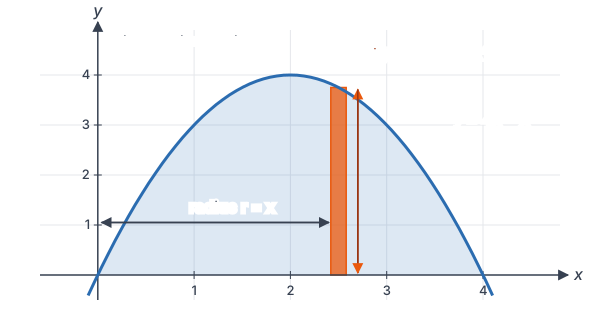
Find the volume when the region under y = 4x - x^2, from x = 0 to x = 4, is rotated around the y-axis.
r = x, \; h = 4x - x^2
Vertical strips; the radius is the distance to the y-axis.
V = \int_0^4 2\pi x(4x - x^2)\,dx
Set up the shell integral.
= 2\pi\int_0^4 (4x^2 - x^3)\,dx
Distribute x (see distributive property).
= 2\pi\Big[\dfrac{4x^3}{3} - \dfrac{x^4}{4}\Big]_0^4Integrate with the power rule (see antiderivatives).
= 2\pi\left(\dfrac{256}{3} - 64\right)Plug in 4; the 0 terms are 0.
= 2\pi\cdot\dfrac{64}{3} = \dfrac{128\pi}{3}256/3 − 192/3 = 64/3.
Answer: V = \dfrac{128\pi}{3} \approx 134.04. With washers, you would have to solve y = 4x − x² for x.
Example 2: Between two curves
The region between y = x and y = x² is rotated around the y-axis. Find the volume.
x = x^2 \Rightarrow x = 0 \text{ or } x = 1The curves meet at x = 0 and x = 1.
r = x, \; h = x - x^2
On (0, 1), x is above x².
V = 2\pi\int_0^1 x(x - x^2)\,dx = 2\pi\int_0^1 (x^2 - x^3)\,dx
Set up and distribute.
= 2\pi\left(\dfrac{1}{3} - \dfrac{1}{4}\right)Integrate and plug in.
= 2\pi\cdot\dfrac{1}{12} = \dfrac{\pi}{6}Subtract the fractions.
Answer: V = \dfrac{\pi}{6}.
Example 3: Around a line that isn’t an axis
The region under y = \sqrt{x} from x = 0 to x = 4 is rotated around the line x = −1. Find the volume.
r = x - (-1) = x + 1, \; h = \sqrt{x}The radius is the distance from x to the line x = −1.
V = 2\pi\int_0^4 (x + 1)x^{1/2}\,dxSet up.
= 2\pi\int_0^4 \left(x^{3/2} + x^{1/2}\right)dxDistribute; x · x^(1/2) = x^(3/2) (see rational exponents).
= 2\pi\Big[\dfrac{2}{5}x^{5/2} + \dfrac{2}{3}x^{3/2}\Big]_0^4Integrate.
= 2\pi\left(\dfrac{2}{5}\cdot 32 + \dfrac{2}{3}\cdot 8\right)4^(5/2) = 32 and 4^(3/2) = 8.
= 2\pi\left(\dfrac{192}{15} + \dfrac{80}{15}\right) = \dfrac{544\pi}{15}Use the common denominator 15.
Answer: V = \dfrac{544\pi}{15} \approx 113.94.
Example 4: Around the x-axis
The region in the first quadrant bounded by x = 4 - y^2 and the axes is rotated around the x-axis. Find the volume with shells.
r = y, \; h = 4 - y^2
Rotating around the x-axis, so use horizontal strips in y; h is right minus left, 4 − y² − 0.
0 \le y \le 2
The curve meets the y-axis where 4 − y² = 0.
V = 2\pi\int_0^2 y(4 - y^2)\,dy = 2\pi\int_0^2 (4y - y^3)\,dy
Set up and distribute.
= 2\pi\Big[2y^2 - \dfrac{y^4}{4}\Big]_0^2 = 2\pi(8 - 4)Integrate and plug in.
= 8\pi
Multiply.
Answer: V = 8\pi \approx 25.13.
Example 5: A napkin ring
A hole of radius 1 cm is drilled straight through the center of a wooden ball of radius 2 cm. What volume of wood is left?
x^2 + y^2 = 4 \Rightarrow y = \pm\sqrt{4 - x^2}Model the ball by spinning a circle of radius 2 around the y-axis (see equation of a circle).
r = x, \; h = 2\sqrt{4 - x^2}, \; 1 \le x \le 2The wood left is between the hole (x = 1) and the outside (x = 2).
V = \int_1^2 2\pi x\cdot 2\sqrt{4 - x^2}\,dx = 4\pi\int_1^2 x\sqrt{4 - x^2}\,dxSet up.
u = 4 - x^2, \; du = -2x\,dx; \; x = 1 \to u = 3, \; x = 2 \to u = 0
Substitute and change the limits (see u-substitution with definite integrals).
= 4\pi\int_3^0 \sqrt{u}\left(-\dfrac{1}{2}\right)du = 2\pi\int_0^3 u^{1/2}\,duFlip the limits to remove the minus sign.
= 2\pi\cdot\dfrac{2}{3}u^{3/2}\Big|_0^3 = \dfrac{4\pi}{3}\cdot 3\sqrt{3}Integrate; 3^(3/2) = 3√3.
= 4\sqrt{3}\,\pi \approx 21.77Simplify.
Answer: about 21.8 cubic centimeters of wood are left.
Common mistakes
| Mistake | Example of the error | Fix |
|---|---|---|
| Using x as the radius for every axis | r = x when rotating around x = 3 | The radius is the distance to the axis: r = 3 − x. |
| Forgetting 2π | \int_0^4 x(4x - x^2)\,dx | The shell’s length is its circumference, 2πr: \int_0^4 2\pi x(4x - x^2)\,dx. |
| Strips in the wrong direction | dx shells for rotation around the x-axis | Shells are parallel to the axis. For the x-axis, use horizontal strips and dy. |
| Using only the top curve | h = x for the region between y = x and y = x² | Height is top minus bottom: h = x − x². |
| Mixing in the disk formula | \int 2\pi r^2 h\,dx | Shells use 2πrh, with no square. Squares belong to disks: πr². |
Related methods
Shells or washers?
| Slices are… | Method | Formula |
|---|---|---|
| Perpendicular to the axis | Disks or washers | \int \pi(R^2 - r^2) |
| Parallel to the axis | Shells | \int 2\pi rh |
Pick the method whose strips are easier to describe. If the curves are given as y = f(x) and the axis is vertical, shells usually win. Both methods give the same volume.
Checking with a cone
Spin the region under y = 3 − x, from 0 to 3, around the y-axis. Shells give 9π, which matches the cone formula (1/3)π(3)²(3) = 9π (see volume of pyramids and cones).
Practice problems
Use the shell method to find each volume.
- The region under y = x, from 0 to 2, around the y-axis.
- The region under y = x³, from 0 to 1, around the y-axis.
- The region under y = 1/x, from 1 to 3, around the y-axis.
- The region under y = √x, from 0 to 1, around the y-axis.
- The region between y = 2x and y = x², around the y-axis.
- The region under y = x², from 0 to 2, around the line x = 2.
- The region under y = e^{-x^2}, from 0 to 1, around the y-axis.
- The region under y = sin x, from 0 to π, around the y-axis.
- The region bounded by y = x, y = 0 and x = 1, around the x-axis (use shells in y).
- A pile of sand is made by spinning the region under y = 3 − x, from 0 to 3, around the y-axis (in meters). Find its volume.
Show answers
1.
V = 2\pi\int_0^2 x\cdot x\,dx = 2\pi\Big[\dfrac{x^3}{3}\Big]_0^2r = x and h = x.
= 2\pi\cdot\dfrac{8}{3} = \dfrac{16\pi}{3}Plug in and multiply.
Answer: \dfrac{16\pi}{3}
2.
V = 2\pi\int_0^1 x\cdot x^3\,dx = 2\pi\Big[\dfrac{x^5}{5}\Big]_0^1r = x and h = x³.
= \dfrac{2\pi}{5}Plug in.
Answer: \dfrac{2\pi}{5}
3.
V = 2\pi\int_1^3 x\cdot\dfrac{1}{x}\,dx = 2\pi\int_1^3 1\,dxr = x and h = 1/x; they cancel.
= 2\pi(3 - 1) = 4\pi
Integrate and plug in.
Answer: 4\pi
4.
V = 2\pi\int_0^1 x\cdot x^{1/2}\,dx = 2\pi\int_0^1 x^{3/2}\,dxr = x and h = √x.
= 2\pi\cdot\dfrac{2}{5} = \dfrac{4\pi}{5}Integrate to (2/5)x^(5/2) and plug in.
Answer: \dfrac{4\pi}{5}
5.
x^2 = 2x \Rightarrow x = 0 \text{ or } x = 2Find where the curves meet.
V = 2\pi\int_0^2 x(2x - x^2)\,dx = 2\pi\Big[\dfrac{2x^3}{3} - \dfrac{x^4}{4}\Big]_0^2h = 2x − x², since 2x is on top.
= 2\pi\left(\dfrac{16}{3} - 4\right) = \dfrac{8\pi}{3}Plug in and simplify.
Answer: \dfrac{8\pi}{3}
6.
r = 2 - x, \; h = x^2
The region is to the left of x = 2.
V = 2\pi\int_0^2 (2 - x)x^2\,dx = 2\pi\Big[\dfrac{2x^3}{3} - \dfrac{x^4}{4}\Big]_0^2Distribute and integrate.
= 2\pi\left(\dfrac{16}{3} - 4\right) = \dfrac{8\pi}{3}Plug in and simplify.
Answer: \dfrac{8\pi}{3}
7.
V = 2\pi\int_0^1 xe^{-x^2}\,dxr = x and h = e^(−x²).
= 2\pi\Big[-\dfrac{1}{2}e^{-x^2}\Big]_0^1Use u = −x², du = −2x dx.
= \pi\left(1 - e^{-1}\right) \approx 1.986Plug in 1 and 0.
Answer: \pi\left(1 - e^{-1}\right) \approx 1.986
8.
V = 2\pi\int_0^{\pi} x\sin x\,dxr = x and h = sin x.
= 2\pi\Big[-x\cos x + \sin x\Big]_0^{\pi}Integration by parts with u = x (see integration by parts).
= 2\pi\big[(-\pi)(-1) + 0 - 0\big] = 2\pi^2
cos π = −1 and sin π = 0.
Answer: 2\pi^2 \approx 19.74
9.
r = y, \; h = 1 - y, \; 0 \le y \le 1
Horizontal strips run from x = y to x = 1.
V = 2\pi\int_0^1 (y - y^2)\,dy = 2\pi\left(\dfrac{1}{2} - \dfrac{1}{3}\right) = \dfrac{\pi}{3}Distribute, integrate and plug in.
Answer: \dfrac{\pi}{3}, which matches the disk method.
10.
V = 2\pi\int_0^3 x(3 - x)\,dx = 2\pi\Big[\dfrac{3x^2}{2} - \dfrac{x^3}{3}\Big]_0^3r = x and h = 3 − x.
= 2\pi\left(\dfrac{27}{2} - 9\right) = 9\piPlug in and simplify.
Answer: 9π ≈ 28.3 cubic meters, the volume of a cone with radius 3 and height 3.
Shell method FAQ
What is the shell method formula?
V = ∫ 2π r h dx, where r is the distance from a strip to the axis and h is the strip’s height. For rotation around the x-axis, use V = ∫ 2π y h dy.
When should I use the shell method instead of disks?
Use shells when strips parallel to the axis are easier to describe. A common case is a region under y = f(x) spun around the y-axis, where disks would need x in terms of y.
How do you find the radius in the shell method?
The radius is the distance from the strip to the axis of rotation. For the y-axis it is x; for the line x = c it is |x − c|.
Can you use the shell method around the x-axis?
Yes. Use horizontal strips, so the radius is y, the height is the right curve minus the left curve, and you integrate with respect to y.
Summary
- Shells come from strips parallel to the axis of rotation.
- V = ∫ 2π r h, with r the distance to the axis and h the strip’s height.
- Around a vertical axis, use dx; around a horizontal axis, use dy.
- For an axis like x = c, the radius is |x − c|.
- Shells and washers give the same volume; pick the easier setup.
Previous lesson: Comparison Test for Improper Integrals
Next lesson: Arc Length of a Curve
Back to the Calculus 2 Index