
Washer Method
The washer method finds the volume of a solid of revolution that has a hole. Each slice is a washer: a disk with outer radius R and a hole of inner radius r. The volume is V = \pi\int_a^b \big(R(x)^2 - r(x)^2\big)\,dx, where R reaches the far edge of the region and r reaches the near edge.
Before this lesson: Disk Method and Area Between Curves
What the washer method means
Spin the region between y = x and y = x² around the x-axis. The region doesn’t touch the axis, so the solid has a hollow center, like a funnel with thick walls.
Slice it perpendicular to the axis and each slice is a flat ring called a washer. Its area is the big disk minus the hole: πR² − πr². Add up the washers to get the volume.
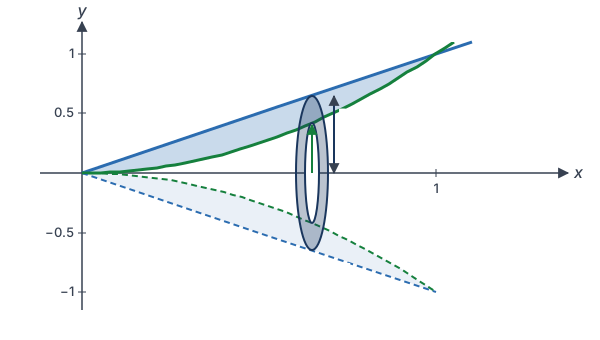
Washer method formula
Rotating around a horizontal axis, with slices perpendicular to it:
V = \pi\int_a^b \big(R(x)^2 - r(x)^2\big)\,dx
Rotating around a vertical axis, write both radii in terms of y and use dy. When r = 0 the formula is the disk method.
How to use the washer method:
- Sketch the region, the axis and one slice perpendicular to the axis.
- Find the limits where the curves meet.
- Outer radius R: the distance from the axis to the farther curve. Inner radius r: the distance to the nearer curve.
- Square each radius, subtract, and integrate. Then multiply by π.
Washer method examples
Example 1: Between a line and a parabola
The region between y = x and y = x^2 is rotated around the x-axis. Find the volume.
x = x^2 \text{ at } x = 0 \text{ and } x = 1Find the limits: x(x − 1) = 0.
R(x) = x, \; r(x) = x^2
On [0, 1], the line is farther from the x-axis than the parabola.
V = \pi\int_0^1 (x^2 - x^4)\,dx
Washer formula: R² − r² = x² − x⁴.
= \pi\Big[\dfrac{x^3}{3} - \dfrac{x^5}{5}\Big]_0^1Antidifferentiate each term (see fundamental theorem of calculus, part 2).
= \pi\left(\dfrac{1}{3} - \dfrac{1}{5}\right) = \dfrac{2\pi}{15}Plug in 1 and subtract the fractions (see adding and subtracting fractions).
Answer: \dfrac{2\pi}{15} \approx 0.419 cubic units.
Example 2: Root and line
The region between y = \sqrt{x} and y = \dfrac{x}{2} is rotated around the x-axis. Find the volume.
\sqrt{x} = \dfrac{x}{2} \text{ at } x = 0 \text{ and } x = 4Square both sides: x = x²/4, so x(x − 4) = 0.
R(x) = \sqrt{x}, \; r(x) = \dfrac{x}{2}Test x = 1: √1 = 1 is above 1/2, so the root curve is farther out.
V = \pi\int_0^4 \left(x - \dfrac{x^2}{4}\right)dxR² − r² = x − x²/4.
= \pi\Big[\dfrac{x^2}{2} - \dfrac{x^3}{12}\Big]_0^4Antidifferentiate each term.
= \pi\left(8 - \dfrac{64}{12}\right) = \pi\left(8 - \dfrac{16}{3}\right) = \dfrac{8\pi}{3}Plug in 4 and simplify.
Answer: \dfrac{8\pi}{3} \approx 8.38 cubic units.
Example 3: Around the y-axis
The region between y = x and y = x^2 is rotated around the y-axis. Find the volume.
x = y \text{ and } x = \sqrt{y}, \; 0 \le y \le 1Solve each curve for x, since slices are perpendicular to the y-axis.
R(y) = \sqrt{y}, \; r(y) = yTest y = 1/4: √(1/4) = 1/2 is farther from the y-axis than 1/4.
V = \pi\int_0^1 (y - y^2)\,dy
R² − r² = y − y².
= \pi\Big[\dfrac{y^2}{2} - \dfrac{y^3}{3}\Big]_0^1 = \pi\left(\dfrac{1}{2} - \dfrac{1}{3}\right) = \dfrac{\pi}{6}Integrate and evaluate.
Answer: \dfrac{\pi}{6} \approx 0.524 cubic units. The same region gives a different volume around a different axis.
Example 4: Around the line y = −1
The region between y = x and y = x^2 is rotated around the line y = −1. Find the volume.
R(x) = x - (-1) = x + 1
Outer radius: from y = −1 up to the farther curve, y = x.
r(x) = x^2 - (-1) = x^2 + 1
Inner radius: from y = −1 up to the nearer curve, y = x².
(x + 1)^2 - (x^2 + 1)^2 = (x^2 + 2x + 1) - (x^4 + 2x^2 + 1)
Square each radius (see special products of binomials).
= -x^4 - x^2 + 2x
Combine like terms.
V = \pi\int_0^1 (-x^4 - x^2 + 2x)\,dx = \pi\Big[-\dfrac{x^5}{5} - \dfrac{x^3}{3} + x^2\Big]_0^1Integrate.
= \pi\left(-\dfrac{1}{5} - \dfrac{1}{3} + 1\right) = \dfrac{7\pi}{15}−3/15 − 5/15 + 15/15 = 7/15.
Answer: \dfrac{7\pi}{15} \approx 1.466 cubic units. Moving the axis away from the region adds 1 to each radius.
Example 5: A metal ring
A ring is made by rotating the region between y = 4 - x^2 and y = 3 around the x-axis. Lengths are in centimeters. Find the volume of metal.
4 - x^2 = 3 \text{ at } x = \pm 1Find the limits: x² = 1.
R(x) = 4 - x^2, \; r(x) = 3
The parabola is farther from the axis; the line y = 3 forms the hole.
(4 - x^2)^2 - 3^2 = 7 - 8x^2 + x^4
(4 − x²)² = 16 − 8x² + x⁴; subtract 9.
V = \pi\int_{-1}^{1} (7 - 8x^2 + x^4)\,dxWasher formula.
= 2\pi\Big[7x - \dfrac{8x^3}{3} + \dfrac{x^5}{5}\Big]_0^1The integrand is even, so double the integral from 0 to 1.
= 2\pi\left(7 - \dfrac{8}{3} + \dfrac{1}{5}\right) = 2\pi\cdot\dfrac{68}{15}105/15 − 40/15 + 3/15 = 68/15.
= \dfrac{136\pi}{15} \approx 28.48Multiply.
Answer: about 28.5 cm³ of metal.
Common mistakes
| Mistake | Example of the error | Fix |
|---|---|---|
| Squaring the difference | \pi\int_0^1 (x - x^2)^2\,dx | Square each radius, then subtract: \pi\int_0^1 (x^2 - x^4)\,dx. |
| Swapping R and r | \pi\int_0^1 (x^4 - x^2)\,dx, a negative volume | R is the farther curve. Test a point to see which is farther from the axis. |
| Measuring from the x-axis for a different line | R = x, r = x² when rotating around y = −1 | Measure from the axis of rotation: R = x + 1, r = x² + 1. |
| Using x when rotating around the y-axis | Writing R = x for Example 3 | Solve for x in terms of y, and integrate with dy. |
| Forgetting π | Example 1 answer 2/15 | Each washer’s area has a π: the answer is 2π/15. |
Related methods
Rotating around a vertical line
For an axis like x = −2, add 2 to each x-distance, just as Example 4 added 1 for y = −1. Then write each radius in terms of y.
The shell method
Rotating around the y-axis often needs solving for x, which can be hard. The shell method slices parallel to the axis and avoids that step. It is in Calculus 2, Unit 3.
Volumes by slicing
Washers, disks and general volumes by cross sections all use the same idea: integrate the area of a slice.
Practice problems
- The region between y = x and y = x^3 in the first quadrant is rotated around the x-axis. Find the volume.
- The region between y = x^2 and y = 1 is rotated around the x-axis. Find the volume.
- The region between y = \sqrt{x} and y = x is rotated around the x-axis. Find the volume.
- The region between y = x + 1 and y = 1 from x = 0 to x = 2 is rotated around the x-axis. Find the volume.
- The region between y = x and y = x^2 is rotated around the line y = 2. Find the volume.
- The region between y = \sqrt{x} and y = x is rotated around the line y = −1. Find the volume.
- The region between y = 2x and y = x^2 is rotated around the y-axis. Find the volume.
- The region between y = e^x and y = 1 from x = 0 to x = 1 is rotated around the x-axis. Find the volume.
- The region between y = x^2 and y = 1 is rotated around the line y = 2. Find the volume.
- A pipe is made by rotating the region between y = 2 and y = 3 from x = 0 to x = 10 around the x-axis, in inches. How much material is in the pipe?
Show answers
1.
x = x^3 \text{ at } x = 0 \text{ and } x = 1x(x − 1)(x + 1) = 0; keep the first quadrant.
V = \pi\int_0^1 (x^2 - x^6)\,dx
R = x and r = x³.
= \pi\left(\dfrac{1}{3} - \dfrac{1}{7}\right) = \dfrac{4\pi}{21}Integrate and evaluate.
Answer: \dfrac{4\pi}{21}
2.
V = \pi\int_{-1}^{1} (1 - x^4)\,dxR = 1 (the line) and r = x²; they meet at x = ±1.
= \pi\Big[x - \dfrac{x^5}{5}\Big]_{-1}^{1} = \pi\left(2 - \dfrac{2}{5}\right) = \dfrac{8\pi}{5}Integrate and evaluate.
Answer: \dfrac{8\pi}{5}
3.
V = \pi\int_0^1 (x - x^2)\,dx
R = √x and r = x on [0, 1].
= \pi\left(\dfrac{1}{2} - \dfrac{1}{3}\right) = \dfrac{\pi}{6}Integrate and evaluate.
Answer: \dfrac{\pi}{6}
4.
V = \pi\int_0^2 \big((x + 1)^2 - 1\big)\,dx = \pi\int_0^2 (x^2 + 2x)\,dx
R = x + 1 and r = 1.
= \pi\Big[\dfrac{x^3}{3} + x^2\Big]_0^2 = \pi\left(\dfrac{8}{3} + 4\right) = \dfrac{20\pi}{3}Integrate and evaluate.
Answer: \dfrac{20\pi}{3}
5.
R(x) = 2 - x^2, \; r(x) = 2 - x
From y = 2 down: the parabola is farther away than the line.
(2 - x^2)^2 - (2 - x)^2 = x^4 - 5x^2 + 4x
Expand both squares and subtract.
V = \pi\int_0^1 (x^4 - 5x^2 + 4x)\,dx = \pi\left(\dfrac{1}{5} - \dfrac{5}{3} + 2\right) = \dfrac{8\pi}{15}Integrate and evaluate.
Answer: \dfrac{8\pi}{15}
6.
R(x) = \sqrt{x} + 1, \; r(x) = x + 1Add 1 to each height for the axis y = −1.
(\sqrt{x} + 1)^2 - (x + 1)^2 = 2\sqrt{x} - x - x^2Expand both squares and subtract.
V = \pi\int_0^1 (2x^{1/2} - x - x^2)\,dx = \pi\left(\dfrac{4}{3} - \dfrac{1}{2} - \dfrac{1}{3}\right) = \dfrac{\pi}{2}Integrate and evaluate.
Answer: \dfrac{\pi}{2}
7.
R(y) = \sqrt{y}, \; r(y) = \dfrac{y}{2}, \; 0 \le y \le 4Solve y = x² and y = 2x for x; they meet at y = 0 and y = 4.
V = \pi\int_0^4 \left(y - \dfrac{y^2}{4}\right)dy = \pi\left(8 - \dfrac{16}{3}\right) = \dfrac{8\pi}{3}Integrate and evaluate.
Answer: \dfrac{8\pi}{3}
8.
V = \pi\int_0^1 (e^{2x} - 1)\,dxR = eˣ and r = 1.
= \pi\Big[\dfrac{e^{2x}}{2} - x\Big]_0^1 = \pi\left(\dfrac{e^2}{2} - 1 - \dfrac{1}{2}\right) = \dfrac{\pi(e^2 - 3)}{2}Integrate and evaluate.
\dfrac{\pi(e^2 - 3)}{2} \approx 6.894Use e² ≈ 7.389.
Answer: \dfrac{\pi(e^2 - 3)}{2} \approx 6.894
9.
R(x) = 2 - x^2, \; r(x) = 1
From y = 2: the parabola is farther away than y = 1.
(2 - x^2)^2 - 1 = 3 - 4x^2 + x^4
Expand and subtract 1.
V = \pi\int_{-1}^{1} (3 - 4x^2 + x^4)\,dx = 2\pi\left(3 - \dfrac{4}{3} + \dfrac{1}{5}\right) = \dfrac{56\pi}{15}Integrate and evaluate.
Answer: \dfrac{56\pi}{15}
10.
V = \pi\int_0^{10} (3^2 - 2^2)\,dx = \pi\int_0^{10} 5\,dx = 50\piR = 3 and r = 2 are constant.
50\pi \approx 157.1
Multiply.
Answer: about 157 cubic inches
Washer method FAQ
What is the washer method formula?
V = \pi\int_a^b \big(R(x)^2 - r(x)^2\big)\,dx, where R is the outer radius and r is the inner radius, both measured from the axis of rotation.
When do you use the washer method instead of the disk method?
Use washers when there is a gap between the region and the axis, so each slice has a hole. If the region touches the axis, r = 0 and you have disks.
How do you find the outer and inner radius?
Draw a slice perpendicular to the axis. The outer radius is the distance from the axis to the farther curve, and the inner radius is the distance to the nearer curve.
Why isn’t the washer area π(R − r)²?
The washer is a big disk with a small disk removed, so its area is πR² − πr². That is not the same as π(R − r)².
Summary
- Washer method: V = \pi\int_a^b \big(R^2 - r^2\big)\,dx.
- R goes to the farther curve and r to the nearer curve.
- Measure both radii from the axis of rotation, not always from the x-axis.
- Square each radius before you subtract.
- Around a vertical axis, use y and dy.
Previous lesson: Disk Method
Next course: Calculus 2 Index
Back to the Calculus 1 Index