
Fundamental Theorem of Calculus, Part 2
The fundamental theorem of calculus, part 2 says that if f is continuous on [a, b] and F is any antiderivative of f, then \int_a^b f(x)\,dx = F(b) - F(a). To evaluate a definite integral, find an antiderivative, plug in the top and bottom limits, and subtract. You don’t need a Riemann sum.
Before this lesson: Definite Integrals, Antiderivatives and Indefinite Integrals and Fundamental Theorem of Calculus, Part 1
What the theorem means
A definite integral adds up tiny pieces f(x) dx from a to b. If f is a rate of change, those pieces are tiny changes in an amount. Adding all the tiny changes gives the total change, which is the final amount minus the starting amount.
That is the whole idea. If F′ = f, then F is the amount and f is its rate, so \int_a^b f(x)\,dx = F(b) - F(a). The area under the curve equals the net change in any antiderivative.
Why it works: By Part 1, the area function G(x) = \int_a^x f(t)\,dt is an antiderivative of f. Any other antiderivative is F = G + C. So F(b) − F(a) = G(b) − G(a), and G(a) = 0, which leaves G(b), the integral from a to b.
Fundamental theorem of calculus part 2 formula
If f is continuous on [a, b] and F is any antiderivative of f, then:
\int_a^b f(x)\,dx = \Big[F(x)\Big]_a^b = F(b) - F(a)
The bracket with a and b is evaluation notation. It means “plug in b, plug in a, and subtract.”
How to evaluate a definite integral:
- Check that f is continuous on [a, b].
- Find an antiderivative F. You can leave off + C, because it cancels when you subtract.
- Find F(b) and F(a).
- Subtract: top value minus bottom value.
Fundamental theorem of calculus part 2 examples
Example 1: A power function
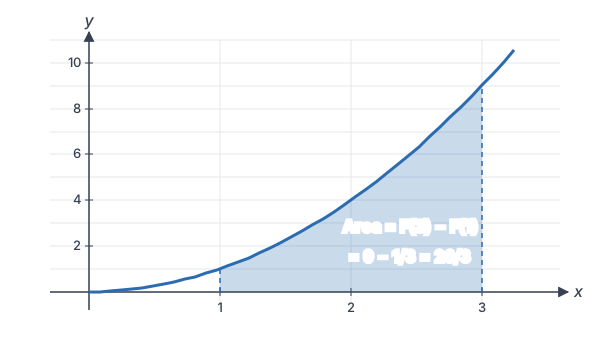
Evaluate \int_1^3 x^2\,dx.
\int_1^3 x^2\,dx = \Big[\dfrac{x^3}{3}\Big]_1^3Find an antiderivative with the power rule for integrals (see antiderivatives).
= \dfrac{3^3}{3} - \dfrac{1^3}{3}Plug in the top limit, then subtract the bottom limit’s value.
= \dfrac{27}{3} - \dfrac{1}{3}Cube 3 and 1.
= \dfrac{26}{3}Subtract the fractions (see adding and subtracting fractions).
Answer: \dfrac{26}{3}, about 8.67. This is the shaded area in the graph above.
Example 2: A polynomial with a negative limit
Evaluate \int_{-1}^{2} (3x^2 - 4x + 5)\,dx.
F(x) = x^3 - 2x^2 + 5x
Antidifferentiate each term: 3x² → x³, −4x → −2x², 5 → 5x.
F(2) = 2^3 - 2(2)^2 + 5(2)
Plug in the top limit.
F(2) = 8 - 8 + 10 = 10
Evaluate each term and combine.
F(-1) = (-1)^3 - 2(-1)^2 + 5(-1)
Plug in the bottom limit, with parentheses around −1.
F(-1) = -1 - 2 - 5 = -8
Evaluate each term and combine.
\int_{-1}^{2} (3x^2 - 4x + 5)\,dx = 10 - (-8)Top value minus bottom value.
= 18
Subtracting a negative adds (see adding and subtracting integers).
Answer: 18. The parentheses around −1 and around −8 are what keep the signs right.
Example 3: A trig function
Evaluate \int_{\pi/6}^{\pi/2} \cos x\,dx.
\int_{\pi/6}^{\pi/2} \cos x\,dx = \Big[\sin x\Big]_{\pi/6}^{\pi/2}An antiderivative of cos x is sin x, since the derivative of sin x is cos x.
= \sin\dfrac{\pi}{2} - \sin\dfrac{\pi}{6}Plug in the limits and subtract.
= 1 - \dfrac{1}{2}Use the exact values (see trig values of special angles).
= \dfrac{1}{2}Subtract.
Answer: \dfrac{1}{2}. Keep the calculator in radian mode if you check this with one.
Example 4: A root and a reciprocal
Evaluate \int_1^4 \left(\sqrt{x} + \dfrac{2}{x}\right)dx.
\sqrt{x} + \dfrac{2}{x} = x^{1/2} + \dfrac{2}{x}Write the root as a power (see rational exponents).
\int_1^4 \left(x^{1/2} + \dfrac{2}{x}\right)dx = \Big[\dfrac{2}{3}x^{3/2} + 2\ln x\Big]_1^4Power rule for the first term; an antiderivative of 1/x is ln x for positive x.
= \left(\dfrac{2}{3}(4)^{3/2} + 2\ln 4\right) - \left(\dfrac{2}{3}(1)^{3/2} + 2\ln 1\right)Plug in the limits and subtract.
= \left(\dfrac{2}{3}(8) + 2\ln 4\right) - \left(\dfrac{2}{3} + 0\right)4 to the 3/2 is 8, 1 to any power is 1, and ln 1 = 0.
= \dfrac{16}{3} - \dfrac{2}{3} + 2\ln 4Multiply and remove the parentheses.
= \dfrac{14}{3} + 2\ln 4Combine the fractions.
\approx 7.44
Use ln 4 ≈ 1.386 to get a decimal.
Answer: \dfrac{14}{3} + 2\ln 4, about 7.44. The exact form is the better final answer unless a decimal is asked for.
Example 5: Drinks sold at a coffee shop
A coffee shop sells drinks at a rate of r(t) = 30 + 12t - 3t^2 drinks per hour, where t is the number of hours after 6 a.m. How many drinks does it sell from 6 a.m. to 10 a.m.?
\int_0^4 (30 + 12t - 3t^2)\,dt
The total is the integral of the rate from t = 0 to t = 4.
= \Big[30t + 6t^2 - t^3\Big]_0^4
Antidifferentiate each term.
= \left(30(4) + 6(4)^2 - 4^3\right) - 0
Plug in 4; every term is 0 at t = 0.
= 120 + 96 - 64
Multiply and find the powers.
= 152
Add and subtract.
Answer: about 152 drinks. The integral of a rate gives the total change, here the number of drinks sold.
Common mistakes
| Mistake | Example of the error | Fix |
|---|---|---|
| Subtracting in the wrong order | \int_1^3 x^2\,dx = \dfrac{1}{3} - 9 | Always top minus bottom: 9 - \dfrac{1}{3}. |
| Dropping parentheses with a negative limit | (-1)^2 written as -1^2 = -1 | Put every substituted value in parentheses: (-1)^2 = 1. |
| Assuming the bottom value is 0 | \int_0^\pi \sin x\,dx = -\cos\pi = 1 | -\cos 0 = -1, not 0: the answer is 1 - (-1) = 2. |
| Differentiating instead of integrating | \int_1^2 x^3\,dx = \Big[3x^2\Big]_1^2 | Go backward: \Big[\dfrac{x^4}{4}\Big]_1^2. |
| Using the theorem when f is not continuous | \int_{-1}^{1} \dfrac{1}{x^2}\,dx = \Big[-\dfrac{1}{x}\Big]_{-1}^{1} = -2 | 1/x² is not continuous at 0, so Part 2 does not apply. This is an improper integral (Calculus 2). |
Related methods
The net change theorem
Since F′ is the rate of change of F, Part 2 can be written \int_a^b F'(x)\,dx = F(b) - F(a). The integral of a rate is the net change in the amount. If v(t) is a velocity, the integral of v from a to b is the change in position (see position, velocity and acceleration).
Splitting an integral first
For a piecewise function or an absolute value, split the interval where the formula changes. Then apply Part 2 to each piece and add (see properties of definite integrals).
When no antiderivative is easy to find
Some functions, like e^{-x^2}, have no antiderivative made of basic functions. Then you estimate the integral with Riemann sums or the trapezoidal rule.
Practice problems
- Evaluate \int_0^3 (2x + 1)\,dx.
- Evaluate \int_1^2 x^4\,dx.
- Evaluate \int_{-2}^{1} (x^2 - 1)\,dx.
- Evaluate \int_1^9 \dfrac{1}{\sqrt{x}}\,dx.
- Evaluate \int_0^{\pi} \sin x\,dx.
- Evaluate \int_0^{\pi/4} \sec^2 x\,dx.
- Evaluate \int_0^1 e^x\,dx.
- Evaluate \int_1^{e^2} \dfrac{3}{x}\,dx.
- Evaluate \int_1^2 \dfrac{x^3 + 2}{x^2}\,dx.
- A balloon fills with air at a rate of 6\sqrt{t} cubic inches per second, t seconds after you start. How much air goes in from t = 1 to t = 4?
Show answers
1.
\int_0^3 (2x + 1)\,dx = \Big[x^2 + x\Big]_0^3
Antidifferentiate each term.
= (3^2 + 3) - (0^2 + 0)
Plug in the limits and subtract.
= 12 - 0 = 12
Simplify.
Answer: 12
2.
\int_1^2 x^4\,dx = \Big[\dfrac{x^5}{5}\Big]_1^2Power rule for integrals.
= \dfrac{2^5}{5} - \dfrac{1^5}{5}Plug in the limits and subtract.
= \dfrac{32}{5} - \dfrac{1}{5} = \dfrac{31}{5}Find the powers, then subtract.
Answer: \dfrac{31}{5}
3.
\int_{-2}^{1} (x^2 - 1)\,dx = \Big[\dfrac{x^3}{3} - x\Big]_{-2}^{1}Antidifferentiate each term.
= \left(\dfrac{1^3}{3} - 1\right) - \left(\dfrac{(-2)^3}{3} - (-2)\right)Plug in the limits, with parentheses around −2.
= \left(\dfrac{1}{3} - 1\right) - \left(-\dfrac{8}{3} + 2\right)Find the powers; subtracting −2 adds 2.
= -\dfrac{2}{3} - \left(-\dfrac{2}{3}\right)Simplify each set of parentheses.
= 0
Subtract.
Answer: 0. The area below the axis cancels the area above it.
4.
\dfrac{1}{\sqrt{x}} = x^{-1/2}Write the root as a power.
\int_1^9 x^{-1/2}\,dx = \Big[2x^{1/2}\Big]_1^9Power rule: add 1 to get 1/2, then divide by 1/2.
= 2\sqrt{9} - 2\sqrt{1}Plug in the limits and subtract.
= 6 - 2 = 4
Take the square roots and subtract.
Answer: 4
5.
\int_0^{\pi} \sin x\,dx = \Big[-\cos x\Big]_0^{\pi}An antiderivative of sin x is −cos x.
= -\cos\pi - (-\cos 0)
Plug in the limits and subtract.
= -(-1) - (-1)
cos π = −1 and cos 0 = 1.
= 1 + 1 = 2
Simplify.
Answer: 2
6.
\int_0^{\pi/4} \sec^2 x\,dx = \Big[\tan x\Big]_0^{\pi/4}The derivative of tan x is sec² x.
= \tan\dfrac{\pi}{4} - \tan 0Plug in the limits and subtract.
= 1 - 0 = 1
Use the exact values.
Answer: 1
7.
\int_0^1 e^x\,dx = \Big[e^x\Big]_0^1
e to the x is its own antiderivative.
= e^1 - e^0
Plug in the limits and subtract.
= e - 1
Any nonzero number to the 0 power is 1.
\approx 1.718
Use e ≈ 2.71828.
Answer: e - 1, about 1.718
8.
\int_1^{e^2} \dfrac{3}{x}\,dx = \Big[3\ln x\Big]_1^{e^2}An antiderivative of 3/x is 3 ln x for positive x.
= 3\ln e^2 - 3\ln 1
Plug in the limits and subtract.
= 3(2) - 3(0)
ln e² = 2 and ln 1 = 0 (see properties of logarithms).
= 6
Multiply and subtract.
Answer: 6
9.
\dfrac{x^3 + 2}{x^2} = x + 2x^{-2}Divide each term by x².
\int_1^2 (x + 2x^{-2})\,dx = \Big[\dfrac{x^2}{2} - \dfrac{2}{x}\Big]_1^2Power rule: 2x⁻² becomes −2x⁻¹, which is −2/x.
= \left(\dfrac{4}{2} - \dfrac{2}{2}\right) - \left(\dfrac{1}{2} - 2\right)Plug in the limits and subtract.
= 1 - \left(-\dfrac{3}{2}\right)Simplify each set of parentheses.
= \dfrac{5}{2}Subtracting a negative adds.
Answer: \dfrac{5}{2}
10.
\int_1^4 6t^{1/2}\,dt = \Big[4t^{3/2}\Big]_1^4Power rule: 6 divided by 3/2 is 4.
= 4(4)^{3/2} - 4(1)^{3/2}Plug in the limits and subtract.
= 4(8) - 4(1)
4 to the 3/2 is the square root of 4, cubed, which is 8.
= 32 - 4 = 28
Multiply and subtract.
Answer: 28 cubic inches
Fundamental theorem of calculus part 2 FAQ
What does the fundamental theorem of calculus part 2 say?
If f is continuous on [a, b] and F′ = f, then the integral of f from a to b equals F(b) − F(a). You evaluate a definite integral with any antiderivative.
Why don’t you add + C to a definite integral?
The constant shows up in both F(b) and F(a), so it cancels when you subtract. Any antiderivative gives the same answer.
Can a definite integral be negative?
Yes. Area below the x-axis counts as negative. If more of the area is below the axis than above it, the integral is negative.
What is the net change theorem?
It is Part 2 applied to a rate: the integral of F′ from a to b equals F(b) − F(a). Integrating a rate of change gives the total change in the amount.
Summary
- Part 2: if F′ = f and f is continuous on [a, b], then \int_a^b f(x)\,dx = F(b) - F(a).
- Steps: find an antiderivative, plug in both limits, subtract top minus bottom.
- Leave off + C; it cancels.
- Put substituted values in parentheses, especially negative ones.
- The integral of a rate is the net change in the amount.
- The function must be continuous on the whole interval.
Previous lesson: Fundamental Theorem of Calculus, Part 1
Next lesson: Average Value of a Function
Back to the Calculus 1 Index