
Improper Integrals with Infinite Discontinuities
An improper integral with an infinite discontinuity has an integrand that blows up at an endpoint or inside the interval, like \int_0^1 \dfrac{1}{\sqrt{x}}\,dx. Replace the bad point with t, integrate, and take a one-sided limit. A finite limit means the integral converges; otherwise it diverges.
Before this lesson: Improper Integrals, One-Sided Limits and Infinite Limits
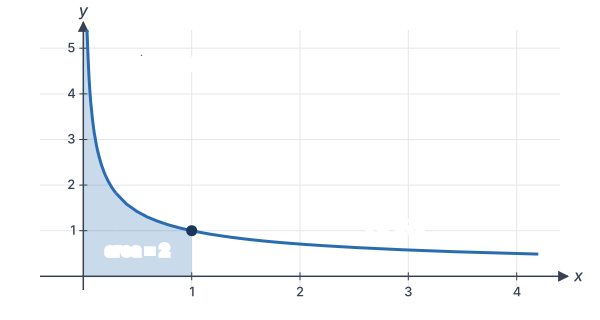
Area next to a vertical asymptote
The graph of y = 1/√x shoots up as x gets close to 0. The region under it from 0 to 1 is infinitely tall, yet its area is exactly 2. The region is tall but very thin near the asymptote.
The danger is that these integrals look normal. \int_{-1}^{1} \dfrac{1}{x^2}\,dx has ordinary-looking limits, but 1/x² blows up at x = 0. Always check where the integrand is undefined before you integrate.
Definitions for infinite discontinuities
If f is continuous on [a, b) and blows up at b, or continuous on (a, b] and blows up at a:
\int_a^b f(x)\,dx = \lim_{t \to b^-} \int_a^t f(x)\,dx \qquad \int_a^b f(x)\,dx = \lim_{t \to a^+} \int_t^b f(x)\,dxIf f blows up at a point c inside [a, b], split the integral at c. It converges only if both pieces converge.
\int_a^b f(x)\,dx = \int_a^c f(x)\,dx + \int_c^b f(x)\,dx
The p-rule near 0: \int_0^1 \dfrac{1}{x^p}\,dx converges to \dfrac{1}{1 - p} if p is less than 1 and diverges if p ≥ 1. This is the reverse of the rule for \int_1^{\infty}.
Improper integral examples with infinite discontinuities
Example 1: Blowing up at the left end
Evaluate \int_0^1 \dfrac{1}{\sqrt{x}}\,dx.
\int_0^1 x^{-1/2}\,dx = \lim_{t \to 0^+} \int_t^1 x^{-1/2}\,dxThe integrand blows up at 0, so replace 0 with t.
= \lim_{t \to 0^+} \Big[2\sqrt{x}\Big]_t^1Integrate with the power rule (see antiderivatives).
= \lim_{t \to 0^+} (2 - 2\sqrt{t})Plug in 1 and t.
= 2 - 0 = 2
√t → 0.
Answer: the integral converges to 2.
Example 2: A divergent one
Evaluate \int_0^1 \dfrac{1}{x^2}\,dx.
\int_0^1 x^{-2}\,dx = \lim_{t \to 0^+} \Big[-\dfrac{1}{x}\Big]_t^1Replace 0 with t and integrate.
= \lim_{t \to 0^+} \left(-1 + \dfrac{1}{t}\right)Plug in 1 and t.
= \infty
1/t grows without bound as t → 0⁺.
Answer: the integral diverges. Here p = 2 ≥ 1.
Example 3: A discontinuity inside the interval
Evaluate \int_0^3 \dfrac{1}{(x - 1)^{2/3}}\,dx.
(x - 1)^{2/3} = 0 \text{ at } x = 1The integrand blows up at x = 1, inside [0, 3].
\int (x - 1)^{-2/3}\,dx = 3(x - 1)^{1/3} + CPower rule with u = x − 1.
\int_0^1 = \lim_{t \to 1^-} \Big[3(x - 1)^{1/3}\Big]_0^t = 0 - 3(-1) = 3Left piece; the cube root of −1 is −1 (see cube roots).
\int_1^3 = \lim_{t \to 1^+} \Big[3(x - 1)^{1/3}\Big]_t^3 = 3\sqrt[3]{2} - 0Right piece.
3 + 3\sqrt[3]{2} \approx 6.780Both pieces converge, so add them.
Answer: the integral converges to 3 + 3\sqrt[3]{2} \approx 6.780.
Example 4: A logarithm at 0
Evaluate \int_0^1 \ln x\,dx.
\int \ln x\,dx = x\ln x - x + C
Use parts with u = ln x and dv = dx (see integration by parts).
\int_0^1 \ln x\,dx = \lim_{t \to 0^+} \Big[x\ln x - x\Big]_t^1ln x blows up at 0, so use a limit.
= \lim_{t \to 0^+} \big[(0 - 1) - (t\ln t - t)\big]Plug in 1 and t; ln 1 = 0.
\lim_{t \to 0^+} t\ln t = \lim_{t \to 0^+} \dfrac{\ln t}{1/t} = \lim_{t \to 0^+} \dfrac{1/t}{-1/t^2} = \lim_{t \to 0^+} (-t) = 0Rewrite as ∞/∞ and use L’Hôpital’s rule (see L’Hôpital’s rule).
= -1 - (0 - 0) = -1
Finish the limit.
Answer: the integral converges to −1. It is negative because ln x is negative on (0, 1).
Example 5: A tank that drains faster and faster
Water drains from a tank at a rate of r(t) = \dfrac{6}{\sqrt{4 - t}} liters per minute for t from 0 up to 4. The rate blows up as t nears 4 minutes. How much water drains in those 4 minutes?
\int_0^4 6(4 - t)^{-1/2}\,dt = \lim_{b \to 4^-} \int_0^b 6(4 - t)^{-1/2}\,dtThe rate blows up at t = 4.
\int 6(4 - t)^{-1/2}\,dt = -12\sqrt{4 - t} + CLet u = 4 − t, so du = −dt (see u-substitution).
= \lim_{b \to 4^-} \left(-12\sqrt{4 - b} + 12\sqrt{4}\right)Plug in b and 0.
= 0 + 24 = 24
√(4 − b) → 0, and 12 · 2 = 24.
Answer: 24 liters drain, even though the rate becomes infinite.
Common mistakes
| Mistake | Example of the error | Fix |
|---|---|---|
| Missing a discontinuity inside | \int_{-1}^{1} \dfrac{1}{x^2}\,dx = \Big[-\dfrac{1}{x}\Big]_{-1}^{1} = -2 | 1/x² blows up at 0. Split there; \int_0^1 \dfrac{1}{x^2}\,dx diverges, so the whole integral diverges. |
| Using the wrong p-rule | \int_0^1 \dfrac{1}{x^2}\,dx converges since p = 2 is more than 1 | Near 0 the rule flips: it converges only when p is less than 1. |
| Letting the pieces cancel | \int_{-1}^{1} \dfrac{1}{x}\,dx = 0 by symmetry | Each piece diverges on its own, so the integral diverges. |
| Wrong side of the limit | \lim_{t \to 0^-} for \int_0^1 | The interval is to the right of 0, so use t → 0⁺. |
| Plugging in the bad point | \Big[x\ln x - x\Big]_0^1 with ln 0 | ln 0 is undefined. Use a limit as t → 0⁺. |
Related methods
Both kinds at once
Some integrals are improper in two ways, like \int_0^{\infty} \dfrac{1}{\sqrt{x}(1 + x)}\,dx. Split it at a point such as x = 1, so each piece has only one problem, and check each piece. This one converges to π.
Deciding without an antiderivative
If you can’t integrate, compare. Near the bad point, an integrand smaller than a convergent p-integral also converges. That is the comparison test, the next lesson.
The p-rule near 0
For p ≠ 1, \int_t^1 x^{-p}\,dx = \dfrac{1 - t^{1-p}}{1 - p}. If p is less than 1, t¹⁻ᵖ → 0 and the integral approaches 1/(1 − p). If p is more than 1, t¹⁻ᵖ → ∞. For p = 1, you get −ln t → ∞.
Practice problems
Decide whether each integral converges or diverges. If it converges, find its value.
- \int_0^4 \dfrac{1}{\sqrt{x}}\,dx
- \int_0^1 \dfrac{1}{x}\,dx
- \int_0^8 x^{-1/3}\,dx
- \int_1^2 \dfrac{1}{x - 1}\,dx
- \int_0^2 \dfrac{1}{\sqrt{2 - x}}\,dx
- \int_{-1}^{1} \dfrac{1}{x^{2/3}}\,dx
- \int_0^{\pi/2} \tan x\,dx
- \int_0^1 x\ln x\,dx
- \int_0^1 \dfrac{1}{\sqrt{1 - x^2}}\,dx
- Use the p-rule to find \int_0^1 x^{-0.9}\,dx.
Show answers
1.
\lim_{t \to 0^+} \Big[2\sqrt{x}\Big]_t^4Replace 0 with t and integrate.
= \lim_{t \to 0^+} (4 - 2\sqrt{t}) = 4Plug in; √t → 0.
Answer: converges to 4
2.
\lim_{t \to 0^+} \Big[\ln x\Big]_t^1 = \lim_{t \to 0^+} (0 - \ln t)Integrate 1/x and plug in.
= \infty
ln t → −∞ as t → 0⁺.
Answer: diverges
3.
\lim_{t \to 0^+} \Big[\tfrac{3}{2}x^{2/3}\Big]_t^8Integrate x^(−1/3).
= \tfrac{3}{2}(8)^{2/3} - 0 = \tfrac{3}{2}(4) = 68^(2/3) = 4 (see rational exponents).
Answer: converges to 6
4.
\lim_{t \to 1^+} \Big[\ln(x - 1)\Big]_t^2 = \lim_{t \to 1^+} \big(0 - \ln(t - 1)\big)Integrate and plug in; ln 1 = 0.
= \infty
ln(t − 1) → −∞.
Answer: diverges
5.
\lim_{t \to 2^-} \Big[-2\sqrt{2 - x}\Big]_0^tIntegrate with u = 2 − x.
= \lim_{t \to 2^-} \left(-2\sqrt{2 - t} + 2\sqrt{2}\right) = 2\sqrt{2}√(2 − t) → 0.
Answer: converges to 2√2 ≈ 2.828
6.
\int x^{-2/3}\,dx = 3x^{1/3} + CBlows up at 0, inside [−1, 1].
\int_{-1}^{0} = 0 - 3(-1) = 3, \quad \int_0^1 = 3 - 0 = 3Each piece is a limit at 0.
3 + 3 = 6
Both converge, so add.
Answer: converges to 6
7.
\int \tan x\,dx = -\ln(\cos x) + C
On (0, π/2), cos x is positive (see integrals that give natural logarithms).
\lim_{t \to \pi/2^-} \big(-\ln(\cos t) + \ln 1\big) = \inftycos t → 0⁺, so ln(cos t) → −∞.
Answer: diverges
8.
\int x\ln x\,dx = \dfrac{x^2}{2}\ln x - \dfrac{x^2}{4} + CParts with u = ln x, dv = x dx.
\lim_{t \to 0^+} \left[\left(0 - \dfrac{1}{4}\right) - \left(\dfrac{t^2}{2}\ln t - \dfrac{t^2}{4}\right)\right]Plug in 1 and t.
= -\dfrac{1}{4} - 0 = -\dfrac{1}{4}t² ln t → 0 by L’Hôpital’s rule.
Answer: converges to −1/4
9.
\lim_{t \to 1^-} \Big[\arcsin x\Big]_0^t = \lim_{t \to 1^-} \arcsin t - 0The integrand blows up at 1 (see integrals that give inverse trig functions).
= \dfrac{\pi}{2}arcsin 1 = π/2.
Answer: converges to π/2
10.
p = 0.9, \text{ which is less than } 1The p-rule near 0 applies.
\dfrac{1}{1 - 0.9} = \dfrac{1}{0.1} = 10Use 1/(1 − p).
Answer: converges to 10
Infinite discontinuities FAQ
What is an infinite discontinuity in an integral?
It is a point where the integrand blows up to ±∞, usually at a vertical asymptote. If it lies in the interval, the integral is improper.
How do you evaluate an improper integral with a vertical asymptote?
Replace the bad point with t, integrate, and take a one-sided limit toward it. If the asymptote is inside the interval, split there and do each side.
Does the integral of 1/x from 0 to 1 converge?
No. It equals the limit of −ln t as t → 0⁺, which is infinite, so it diverges.
Can you integrate 1/x² from −1 to 1?
Not as a normal integral, because 1/x² blows up at 0. Split at 0. Each piece diverges, so the integral diverges. The answer −2 from plugging in is wrong.
Summary
- Check where the integrand blows up before integrating.
- Replace the bad point with t and take a one-sided limit.
- Split at a bad point inside the interval; both pieces must converge.
- ∫ from 0 to 1 of 1/xᵖ converges only when p is less than 1, to 1/(1 − p).
- An infinitely tall region can still have a finite area.
Previous lesson: Improper Integrals
Next lesson: Comparison Test for Improper Integrals
Back to the Calculus 2 Index