
One-Sided Limits
One-sided limits describe what a function approaches from just one side of a number. The left-hand limit \lim_{x \to a^-} f(x) uses x-values less than a, and the right-hand limit \lim_{x \to a^+} f(x) uses x-values greater than a. The two-sided limit exists only when both one-sided limits exist and are equal.
Before this lesson: Introduction to Limits, Piecewise Functions and Absolute Value Functions
Why one side at a time
Some graphs break apart at a point. A parking fee jumps from $7 to $10 the moment you pass 2 hours. Near the jump, the values just before and just after are different, so “the” value the function approaches depends on the direction you come from.
One-sided limits handle this. The small minus sign in a^- means “from the left,” and the plus sign in a^+ means “from the right.” Neither sign has anything to do with a being negative or positive.
The rule that connects them: \lim_{x \to a} f(x) = L exactly when \lim_{x \to a^-} f(x) = L and \lim_{x \to a^+} f(x) = L. If the two sides differ, or either side grows without bound, the two-sided limit does not exist.
How to find one-sided limits
| Situation | What to do |
|---|---|
| Piecewise function | For the left-hand limit, use the piece for x less than a; for the right-hand limit, use the piece for x greater than a. Substitute x = a into that piece. |
| Absolute value over the same expression | Rewrite without bars on each side: |u| = −u when u is negative and |u| = u when u is positive. |
| Division by something near 0 | Check the sign of the numerator and the denominator on each side to decide between growing without bound positively or negatively. |
| A graph | Trace toward x = a from each side and read the height. Ignore the dot exactly at x = a. |
One-sided limits examples
Example 1: A jump in a piecewise function
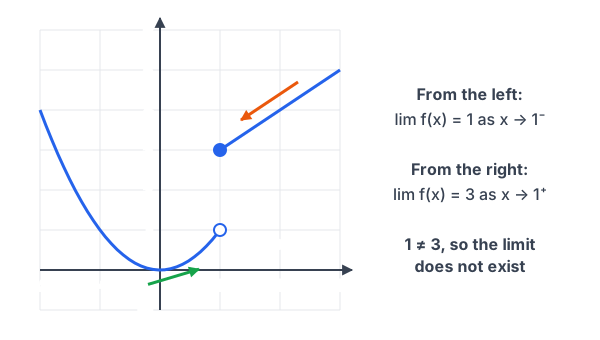
Let f(x) = x^2 for x \lt 1 and f(x) = x + 2 for x \ge 1. Find both one-sided limits at x = 1 and decide whether \lim_{x \to 1} f(x) exists.
\lim_{x \to 1^-} f(x) = 1^2 = 1From the left, x is less than 1, so use the piece x^2. Substitute 1.
\lim_{x \to 1^+} f(x) = 1 + 2 = 3From the right, x is greater than 1, so use the piece x + 2. Substitute 1.
1 \ne 3
Compare the two sides. They are different.
Answer: the left-hand limit is 1 and the right-hand limit is 3, so \lim_{x \to 1} f(x) does not exist. (Also, f(1) = 3, from the second piece.)
Example 2: Two pieces that meet
Let g(x) = 2x + 1 for x \lt 3 and g(x) = x^2 - 2 for x \ge 3. Find \lim_{x \to 3} g(x).
\lim_{x \to 3^-} g(x) = 2(3) + 1From the left, use 2x + 1.
\lim_{x \to 3^-} g(x) = 7Simplify.
\lim_{x \to 3^+} g(x) = 3^2 - 2From the right, use x^2 - 2.
\lim_{x \to 3^+} g(x) = 7Simplify: 9 − 2 = 7.
Answer: both sides equal 7, so \lim_{x \to 3} g(x) = 7. The pieces meet, and the graph has no break at x = 3.
Example 3: Absolute value over x
Find the one-sided limits of h(x) = \frac{|x|}{x} at x = 0.
\frac{|x|}{x} = \frac{-x}{x} = -1For x less than 0, |x| = −x (see absolute value). Simplify.
\lim_{x \to 0^-} h(x) = -1The function equals −1 for every negative x.
\frac{|x|}{x} = \frac{x}{x} = 1For x greater than 0, |x| = x.
\lim_{x \to 0^+} h(x) = 1The function equals 1 for every positive x.
Answer: the left-hand limit is −1 and the right-hand limit is 1, so \lim_{x \to 0} \frac{|x|}{x} does not exist. The graph is two flat rays with a jump at 0.
Example 4: Growing without bound on each side
Find \lim_{x \to 2^-} \frac{1}{x - 2} and \lim_{x \to 2^+} \frac{1}{x - 2}.
| x | 1.9 | 1.99 | 1.999 | 2 | 2.001 | 2.01 | 2.1 |
|---|---|---|---|---|---|---|---|
| \frac{1}{x - 2} | −10 | −100 | −1000 | undefined | 1000 | 100 | 10 |
\frac{1}{1.99 - 2} = \frac{1}{-0.01} = -100Find one value from the left. The denominator is a small negative number.
\frac{1}{2.01 - 2} = \frac{1}{0.01} = 100Find one value from the right. The denominator is a small positive number.
Answer: from the left the values decrease without bound, \lim_{x \to 2^-} \frac{1}{x - 2} = -\infty. From the right they increase without bound, \lim_{x \to 2^+} \frac{1}{x - 2} = \infty. Neither is a number, and the two-sided limit does not exist. The line x = 2 is a vertical asymptote.
Example 5: Word problem with a parking fee
A garage charges $4 for up to 1 hour, $7 for more than 1 hour up to 2 hours, and $10 for more than 2 hours up to 3 hours. Let C(t) be the cost for t hours. Find the one-sided limits at t = 2 and C(2).
\lim_{t \to 2^-} C(t) = 7Just under 2 hours, such as 1.9 or 1.99 hours, the fee is $7.
\lim_{t \to 2^+} C(t) = 10Just over 2 hours, such as 2.01 hours, the fee is $10.
C(2) = 7
Exactly 2 hours is in the “more than 1 up to 2” group.
Answer: the left-hand limit is $7, the right-hand limit is $10, and C(2) = $7. The limit as t approaches 2 does not exist, which matches the sudden jump in price.
Common mistakes
| Mistake | Example of the error | Fix |
|---|---|---|
| Reading the minus sign as a negative number | Thinking x \to 1^- means x approaches −1 | It means x approaches 1 from the left, through values like 0.99. |
| Using the wrong piece | Using x + 2 for the left-hand limit in Example 1 | Left means x less than a, so use the piece for x less than 1. |
| Using the function value as the limit | Saying \lim_{x \to 1^-} f(x) = 3 because f(1) = 3 | One-sided limits look near a, not at a. The left side heads to 1. |
| Calling a limit equal when only one side is checked | Saying \lim_{x \to 1} f(x) = 1 from the left side alone | Check both sides; here they differ, so the limit does not exist. |
| Getting the sign of an infinite limit wrong | \lim_{x \to 2^-} \frac{1}{x - 2} = \infty | On the left, x − 2 is negative, so the values go to -\infty. |
| Ignoring where a function is defined | Looking for \lim_{x \to 0^-} \sqrt{x} | \sqrt{x} is not defined for x less than 0, so only the right-hand limit makes sense. |
Related methods
Endpoints of a domain
At the edge of a domain, only one side is available. For \sqrt{x} at 0, the right-hand limit is \lim_{x \to 0^+} \sqrt{x} = 0, and there is no left-hand limit to check.
Looking ahead to continuity
A function is continuous at a when its two one-sided limits agree and equal f(a). In Example 2, both sides are 7 and g(3) = 7, so g is continuous at 3. In Example 1 the jump breaks continuity. Calculus 1 studies this in detail.
Practice problems
- Let f(x) = 2x for x \lt 3 and f(x) = x + 4 for x \ge 3. Find both one-sided limits at 3. Does the limit exist?
- Let f(x) = x^2 + 1 for x \lt 0 and f(x) = 1 − x for x \ge 0. Find \lim_{x \to 0} f(x).
- Find the one-sided limits of \frac{|x - 4|}{x - 4} at x = 4.
- Find \lim_{x \to 5^-} \frac{1}{x - 5} and \lim_{x \to 5^+} \frac{1}{x - 5}.
- Find \lim_{x \to 0^+} \sqrt{x}. Why is there no left-hand limit?
- Find the value of k so that f(x) = kx + 1 for x \lt 2 and f(x) = x^2 for x \ge 2 has a limit at x = 2.
- The floor function \lfloor x \rfloor gives the greatest whole number less than or equal to x. Find \lim_{x \to 3^-} \lfloor x \rfloor and \lim_{x \to 3^+} \lfloor x \rfloor.
- Let h(x) = 3 − x for x \le 1 and h(x) = 2x for x \gt 1. Find both one-sided limits at 1, the limit and h(1).
- Find \lim_{x \to -1^-} \frac{x + 3}{x + 1} and \lim_{x \to -1^+} \frac{x + 3}{x + 1}.
- Shipping costs $5 for packages up to 2 pounds and $8 for packages over 2 pounds up to 5 pounds. Find the one-sided limits of the cost at 2 pounds.
Show answers
1.
\lim_{x \to 3^-} f(x) = 2(3) = 6From the left, use 2x.
\lim_{x \to 3^+} f(x) = 3 + 4 = 7From the right, use x + 4.
Answer: 6 and 7. They differ, so the limit does not exist.
2.
\lim_{x \to 0^-} f(x) = 0^2 + 1 = 1From the left, use x^2 + 1.
\lim_{x \to 0^+} f(x) = 1 - 0 = 1From the right, use 1 − x.
Answer: both sides are 1, so the limit is 1.
3.
\frac{|x - 4|}{x - 4} = \frac{-(x - 4)}{x - 4} = -1For x less than 4, x − 4 is negative, so |x - 4| = -(x - 4).
\frac{|x - 4|}{x - 4} = \frac{x - 4}{x - 4} = 1For x greater than 4, x − 4 is positive.
Answer: the left-hand limit is −1 and the right-hand limit is 1, so the limit does not exist.
4.
\frac{1}{4.99 - 5} = -100From the left the denominator is a small negative number.
\frac{1}{5.01 - 5} = 100From the right it is a small positive number.
Answer: -\infty from the left and \infty from the right.
5.
\lim_{x \to 0^+} \sqrt{x} = \sqrt{0} = 0Square roots of small positive numbers are close to 0.
Answer: 0. There is no left-hand limit because \sqrt{x} is not a real number for x less than 0 (see square roots).
6.
\lim_{x \to 2^-} f(x) = 2k + 1From the left, substitute 2 into kx + 1.
\lim_{x \to 2^+} f(x) = 2^2 = 4From the right, substitute 2 into x^2.
2k + 1 = 4
For a limit to exist, the sides must be equal.
2k = 3
Subtract 1 from both sides.
k = 1.5
Divide both sides by 2.
Answer: k = \frac{3}{2}
7.
\lim_{x \to 3^-} \lfloor x \rfloor = 2Just below 3, such as 2.99, the floor is 2.
\lim_{x \to 3^+} \lfloor x \rfloor = 3Just above 3, such as 3.01, the floor is 3.
Answer: 2 from the left and 3 from the right, so the limit at 3 does not exist.
8.
\lim_{x \to 1^-} h(x) = 3 - 1 = 2From the left, use 3 − x.
\lim_{x \to 1^+} h(x) = 2(1) = 2From the right, use 2x.
h(1) = 3 - 1 = 2
x = 1 belongs to the first piece.
Answer: both one-sided limits are 2, the limit is 2, and h(1) = 2.
9.
\frac{-1.01 + 3}{-1.01 + 1} = \frac{1.99}{-0.01} = -199From the left, the top is near 2 and the bottom is a small negative number.
\frac{-0.99 + 3}{-0.99 + 1} = \frac{2.01}{0.01} = 201From the right, the bottom is a small positive number.
Answer: -\infty from the left and \infty from the right.
10.
\lim_{w \to 2^-} C(w) = 5Just under 2 pounds, the cost is $5.
\lim_{w \to 2^+} C(w) = 8Just over 2 pounds, the cost is $8.
Answer: $5 from the left and $8 from the right, so the limit at 2 pounds does not exist.
One-sided limits FAQ
What is a one-sided limit?
It is the value a function approaches as x gets close to a number from only one side, either the left (values less than a) or the right (values greater than a).
What does x → a⁻ mean?
It means x approaches a from the left, through values smaller than a. The superscript minus does not make a negative.
When does a two-sided limit exist?
When the left-hand and right-hand limits both exist and are equal. Their shared value is the limit.
Can a one-sided limit be infinite?
Yes. Near a vertical asymptote, a one-sided limit can be \infty or -\infty, which describes how the values grow. It is still not a real-number limit.
Summary
- \lim_{x \to a^-} f(x) uses x-values less than a; \lim_{x \to a^+} f(x) uses x-values greater than a.
- The two-sided limit exists only when both one-sided limits exist and are equal.
- For piecewise functions, use the piece that applies on each side.
- Jumps give different one-sided limits; vertical asymptotes give \infty or -\infty.
- At the edge of a domain, only one side can be checked.
Previous lesson: Introduction to Limits
Next course: Calculus 1 Index
Back to the Precalculus Index