
Absolute Value Functions
An absolute value function has the form f(x) = a|x - h| + k. Its graph is a V shape with its vertex at (h, k). The V opens up when a \gt 0 and down when a \lt 0. The number a is the slope of the right side, and the left side has slope -a.
Before this lesson: You should know Transformations of Functions, Absolute Value Equations and Slope.
The Parent Graph and Its Changes
The parent function is f(x) = |x|. For x \ge 0 it equals x, and for x \lt 0 it equals -x. So its graph is two rays that meet at the origin: a V with slopes 1 and −1.
Every other absolute value function is a transformation of this V. In f(x) = a|x - h| + k:
- The vertex is (h, k). It is the lowest point if a \gt 0 and the highest point if a \lt 0.
- The axis of symmetry is the vertical line x = h. The two sides of the V are mirror images across it.
- The right side has slope a and the left side has slope -a. A bigger |a| makes a narrower V.
- The domain is all real numbers, (-\infty, \infty). The range is [k, \infty) if a \gt 0 and (-\infty, k] if a \lt 0.
How to Graph an Absolute Value Function
- Read a, h and k. Rewrite |x + 3| as |x - (-3)|, so h = -3.
- Plot the vertex (h, k).
- From the vertex, move 1 unit right and a units up (or down if a \lt 0). Plot that point.
- Plot the mirror point 1 unit left of the vertex at the same height.
- Draw two rays from the vertex through the points.
To find the x-intercepts, set f(x) = 0 and solve the absolute value equation.
Worked Examples
Example 1: Graph and find intercepts
Describe g(x) = |x + 3| - 2. Give the vertex, the range and the x-intercepts.
- Rewrite the inside: |x - (-3)|, so h = -3. With k = -2, the vertex is (−3, −2).
- Here a = 1 \gt 0, so the V opens up with slopes 1 and −1.
- The lowest y-value is −2, so the range is [-2, \infty).
- Set g(x) = 0: |x + 3| - 2 = 0
- Add 2 to both sides: |x + 3| = 2
- Split into two equations: x + 3 = 2 or x + 3 = -2
- Subtract 3 from both sides of each: x = -1 or x = -5
Answer: Vertex (−3, −2), range [-2, \infty), x-intercepts (−1, 0) and (−5, 0).
Example 2: A V that opens down
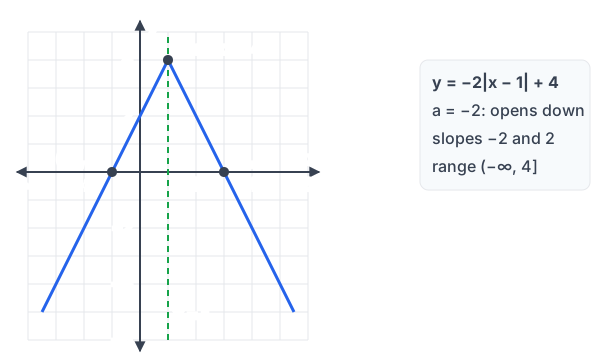
Describe g(x) = -2|x - 1| + 4. Give the vertex, the slopes, the range and the x-intercepts.
- The vertex is (h, k) = (1, 4).
- a = -2 \lt 0, so the V opens down. The right side has slope −2 and the left side has slope 2.
- The highest y-value is 4, so the range is (-\infty, 4].
- Set g(x) = 0: -2|x - 1| + 4 = 0
- Subtract 4 from both sides: -2|x - 1| = -4
- Divide both sides by −2: |x - 1| = 2
- Split: x - 1 = 2 or x - 1 = -2
- Add 1 to both sides of each: x = 3 or x = -1
Answer: Vertex (1, 4), slopes −2 and 2, range (-\infty, 4], x-intercepts (3, 0) and (−1, 0). This is the graph above.
Example 3: A wider V
Graph g(x) = \tfrac{1}{2}|x| - 3 by plotting points.
- The vertex is (0, −3), and a = \tfrac{1}{2}, so the V opens up and is wider than |x|.
- Right 2 from the vertex: g(2) = \tfrac{1}{2}(2) - 3 = 1 - 3 = -2. Point (2, −2).
- Left 2 from the vertex: g(-2) = \tfrac{1}{2}(2) - 3 = -2. Point (−2, −2).
- Right 6: g(6) = \tfrac{1}{2}(6) - 3 = 3 - 3 = 0. Point (6, 0), an x-intercept.
- By symmetry, (−6, 0) is the other x-intercept.
Answer: Draw rays from (0, −3) through (2, −2) and (−2, −2). The x-intercepts are (6, 0) and (−6, 0).
Example 4: Write the equation from a graph
The vertex of a V-shaped graph is (2, −1), and the graph passes through (4, 5). Write its equation.
- Start with the vertex: f(x) = a|x - 2| - 1
- Substitute the point (4, 5): 5 = a|4 - 2| - 1
- Simplify inside: 5 = a|2| - 1
- Take the absolute value: 5 = 2a - 1
- Add 1 to both sides: 6 = 2a
- Divide both sides by 2: a = 3
Answer: f(x) = 3|x - 2| - 1
Example 5: Word problem with a train
A train moves at 60 mi/h on a straight track. It passes a station at t = 3 hours. Its distance from the station is d(t) = 60|t - 3|. At what times is the train 90 miles from the station?
- Set the distance equal to 90: 60|t - 3| = 90
- Divide both sides by 60: |t - 3| = 1.5
- Split: t - 3 = 1.5 or t - 3 = -1.5
- Add 3 to both sides of each: t = 4.5 or t = 1.5
Answer: At 1.5 hours (before it reaches the station) and at 4.5 hours (after it passes). The graph of d is a V with its vertex at (3, 0).
Common Mistakes
| Mistake | Example of the error | Fix |
|---|---|---|
| Using the wrong sign for the vertex | |x + 3| gives vertex at x = 3 | Inside, the sign flips: x = -3. |
| Forgetting that a controls direction | Saying -2|x - 1| + 4 opens up | A negative a opens the V down. |
| Giving one slope only | “The slope is 3” | The sides have slopes a and -a: 3 and −3. |
| Solving only one case | |x - 1| = 2 gives only x = 3 | Also solve x - 1 = -2, so x = -1. |
| Wrong range for a downward V | [4, \infty) for -2|x - 1| + 4 | The vertex is the highest point: (-\infty, 4]. |
Practice Problems
- Give the vertex of f(x) = |x - 4|.
- Give the vertex and range of f(x) = |x| + 6.
- For f(x) = -|x + 2| + 5, give the vertex, direction, range and x-intercepts.
- What are the slopes of the two sides of f(x) = 3|x|?
- Find the x-intercepts and y-intercept of f(x) = 2|x - 3| - 8.
- For f(x) = \tfrac{1}{4}|x + 4|, give the vertex and two other points.
- Write the equation of the V with vertex (−1, 3) that passes through (1, −1).
- Write the equation of the V with vertex (0, −4) that opens up with slopes 2 and −2.
- Does f(x) = |x - 1| + 2 have any x-intercepts? Explain.
- A town’s average temperature is modeled by T(m) = -3|m - 6| + 80, where m is the month number. What is the highest average temperature, and in which months is it 71°?
Show answers
- h = 4, k = 0: vertex (4, 0)
- Vertex (0, 6). It opens up, so the range is [6, \infty).
- Rewrite: -|x - (-2)| + 5, so the vertex is (−2, 5)
a = -1 \lt 0: opens down
Range: (-\infty, 5]
Set to 0: -|x + 2| + 5 = 0
Subtract 5 from both sides: -|x + 2| = -5
Multiply both sides by −1: |x + 2| = 5
Split: x + 2 = 5 or x + 2 = -5
Subtract 2: x = 3 or x = -7 - The right side has slope 3 and the left side has slope −3.
- Set to 0: 2|x - 3| - 8 = 0
Add 8 to both sides: 2|x - 3| = 8
Divide both sides by 2: |x - 3| = 4
Split: x - 3 = 4 or x - 3 = -4
Add 3: x = 7 or x = -1
y-intercept: f(0) = 2|0 - 3| - 8 = 2(3) - 8 = 6 - 8 = -2, so (0, −2) - Vertex (−4, 0)
Right 4: f(0) = \tfrac{1}{4}|4| = 1, point (0, 1)
Left 4: f(-8) = \tfrac{1}{4}|-4| = 1, point (−8, 1) - Start: f(x) = a|x + 1| + 3
Substitute (1, −1): -1 = a|1 + 1| + 3
Simplify: -1 = 2a + 3
Subtract 3 from both sides: -4 = 2a
Divide by 2: a = -2
Equation: f(x) = -2|x + 1| + 3 - Vertex (0, −4) and a = 2: f(x) = 2|x| - 4
- No. The V opens up and its lowest point is the vertex (1, 2). Since 2 is above 0, the graph never reaches the x-axis.
- The highest value is at the vertex, m = 6: T(6) = 80 degrees
Set T(m) = 71: -3|m - 6| + 80 = 71
Subtract 80 from both sides: -3|m - 6| = -9
Divide both sides by −3: |m - 6| = 3
Split: m - 6 = 3 or m - 6 = -3
Add 6: m = 9 or m = 3. The months are March and September.
FAQ
How do you find the vertex of an absolute value function?
Write the function as f(x) = a|x - h| + k. The vertex is (h, k). For |x + 3| - 2, the vertex is (−3, −2).
What is the range of an absolute value function?
If a \gt 0, the range is [k, \infty). If a \lt 0, the range is (-\infty, k]. The domain is always all real numbers.
What does the a value do in an absolute value function?
Its sign tells you whether the V opens up or down. Its size sets the slopes of the sides, a and -a, so a larger |a| makes a narrower V.
How is an absolute value function different from an absolute value equation?
An equation like |x - 1| = 2 has a few solutions. A function like f(x) = |x - 1| has a whole graph. Solving f(x) = 0 gives the graph’s x-intercepts.
Summary
- f(x) = a|x - h| + k has a V-shaped graph with vertex (h, k) and axis of symmetry x = h.
- It opens up if a \gt 0 and down if a \lt 0. The sides have slopes a and -a.
- Domain (-\infty, \infty). Range [k, \infty) or (-\infty, k].
- Find x-intercepts by solving f(x) = 0 as two cases.
Previous lesson: Transformations of Functions
Next lesson: Piecewise Functions
Back to the Algebra 2 Index