
Introduction to Limits
A limit is the value a function approaches as x gets closer and closer to a number. We write \lim_{x \to a} f(x) = L when f(x) can be made as close to L as we like by taking x close enough to a, from both sides. The function does not even have to be defined at a.
Before this lesson: Function Notation, Graphing Rational Functions, Piecewise Functions and Difference Quotient
What a limit means
A limit asks where a function is headed, not where it lands. Imagine walking toward a door. Your limit is the door, even if the door is locked and you never step through it.
That is why limits are useful at points where a function has a hole. The function f(x) = \frac{x^2 - 4}{x - 2} is undefined at x = 2, because it gives \frac{0}{0}. Its values still close in on 4 as x gets near 2, so its limit there is 4.
For a limit to exist, the function must approach the same value from the left (x less than a) and from the right (x greater than a). If the two sides disagree, or the values grow without bound, the limit does not exist.
How to estimate a limit
| Method | How it works | Watch for |
|---|---|---|
| From a table | Pick x-values closer and closer to a from both sides, such as 1.9, 1.99, 1.999 and 2.1, 2.01, 2.001, and see what f(x) approaches | Use values on both sides |
| From a graph | Trace the curve toward x = a from the left and from the right and read the height it heads toward | Ignore any dot exactly at x = a |
| By substitution | For polynomials and other smooth functions, \lim_{x \to a} f(x) = f(a) | If you get \frac{0}{0}, use a table, a graph or algebra instead |
The limit \lim_{x \to a} f(x) and the value f(a) are different questions. They are equal for many functions, but a hole, a jump or a moved point can make them differ.
Introduction to limits examples
Example 1: Estimate a limit from a table
Estimate \lim_{x \to 2} \frac{x^2 - 4}{x - 2}.
| x | 1.9 | 1.99 | 1.999 | 2 | 2.001 | 2.01 | 2.1 |
|---|---|---|---|---|---|---|---|
| f(x) | 3.9 | 3.99 | 3.999 | undefined | 4.001 | 4.01 | 4.1 |
f(1.9) = \frac{1.9^2 - 4}{1.9 - 2}Find one table value to see how the table is made. Substitute 1.9.
f(1.9) = \frac{3.61 - 4}{-0.1}Square 1.9 and subtract in the denominator.
f(1.9) = \frac{-0.39}{-0.1}Subtract in the numerator.
f(1.9) = 3.9
Divide. A negative over a negative is positive.
Answer: from both sides the values approach 4, so \lim_{x \to 2} \frac{x^2 - 4}{x - 2} = 4. Algebra agrees: the fraction simplifies to x + 2 when x \ne 2, and 2 + 2 = 4.
Example 2: Read a limit from a graph
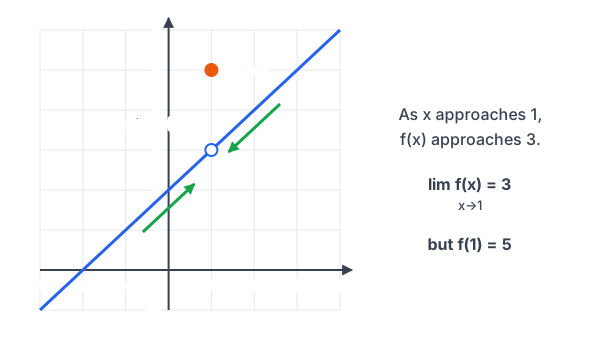
Use the graph above. Find \lim_{x \to 1} f(x) and f(1).
\lim_{x \to 1^-} f(x) = 3Trace the line from the left toward x = 1. It heads to the open circle at height 3.
\lim_{x \to 1^+} f(x) = 3Trace from the right. It heads to the same height.
\lim_{x \to 1} f(x) = 3Both sides agree, so the limit is 3.
f(1) = 5
The filled dot shows the actual value at x = 1.
Answer: the limit is 3, but f(1) = 5. The limit only cares about values near 1, not the value at 1.
Example 3: A famous trig limit
Estimate \lim_{x \to 0} \frac{\sin x}{x}, with x in radians.
| x | −0.1 | −0.01 | −0.001 | 0 | 0.001 | 0.01 | 0.1 |
|---|---|---|---|---|---|---|---|
| f(x) | 0.99833 | 0.99998 | 0.9999998 | undefined | 0.9999998 | 0.99998 | 0.99833 |
f(0.1) = \frac{\sin 0.1}{0.1}Substitute 0.1. Set the calculator to radian mode (see radians).
f(0.1) \approx \frac{0.099833}{0.1}Find the sine.
f(0.1) \approx 0.99833
Divide.
Answer: the values approach 1 from both sides, so \lim_{x \to 0} \frac{\sin x}{x} = 1. Substituting x = 0 gives \frac{0}{0}, which tells you nothing, so the table is the way in. Calculus 1 proves this limit exactly.
Example 4: A limit that does not exist
Estimate \lim_{x \to 3} \frac{1}{(x - 3)^2}.
| x | 2.9 | 2.99 | 2.999 | 3 | 3.001 | 3.01 | 3.1 |
|---|---|---|---|---|---|---|---|
| f(x) | 100 | 10,000 | 1,000,000 | undefined | 1,000,000 | 10,000 | 100 |
f(2.99) = \frac{1}{(2.99 - 3)^2}Substitute 2.99.
f(2.99) = \frac{1}{(-0.01)^2}Subtract inside the parentheses.
f(2.99) = \frac{1}{0.0001}Square. The result is positive.
f(2.99) = 10000
Divide.
Answer: the values grow without bound, so the limit does not exist. The graph has a vertical asymptote at x = 3. (Some books write \lim_{x \to 3} f(x) = \infty to say how it fails to exist.)
Example 5: Word problem with speed
A ball is thrown upward, and its height after t seconds is s(t) = 64t - 16t^2 feet. Its average velocity from t = 1 to t = 1 + \Delta t is \frac{s(1 + \Delta t) - s(1)}{\Delta t}. Estimate the limit as \Delta t \to 0, the ball’s velocity at t = 1.
| Δt | 0.1 | 0.01 | 0.001 |
|---|---|---|---|
| Average velocity (ft/s) | 30.4 | 31.84 | 31.984 |
s(1) = 64(1) - 16(1)^2 = 48
Find the height at t = 1.
s(1.1) = 64(1.1) - 16(1.1)^2
Find the height at t = 1.1, which is Δt = 0.1.
s(1.1) = 70.4 - 19.36 = 51.04
Multiply, then subtract.
\frac{s(1.1) - s(1)}{0.1} = \frac{51.04 - 48}{0.1}Substitute into the average velocity.
\frac{s(1.1) - s(1)}{0.1} = 30.4Subtract, then divide. This is the first table entry; the others are found the same way.
Answer: the averages approach 32, so the velocity at t = 1 is 32 ft/s. This is how calculus defines instantaneous speed, using the difference quotient.
Common mistakes
| Mistake | Example of the error | Fix |
|---|---|---|
| Thinking the limit must equal f(a) | Saying \lim_{x \to 1} f(x) = 5 because f(1) = 5 in Example 2 | The limit is where the graph heads, 3. The value at the point does not matter. |
| Stopping at 0/0 | Saying \lim_{x \to 2} \frac{x^2 - 4}{x - 2} does not exist because it gives \frac{0}{0} | \frac{0}{0} means “look closer.” A table or algebra gives 4. |
| Checking only one side | Using only x = 1.9, 1.99, 1.999 | Check x-values greater than a too; both sides must agree. |
| Radian-mode errors | Getting 0.01745 for \frac{\sin 0.1}{0.1} | That is degree mode. Use radians for limits like this. |
| Taking too few values | Guessing from x = 1.9 alone | Use several values that get steadily closer to a. |
| Calling an infinite limit a number | Writing a limit of 1,000,000 in Example 4 | The values never settle, so the limit does not exist. |
Related methods
Direct substitution
For polynomials, \lim_{x \to a} p(x) = p(a). For example, \lim_{x \to 3} (x^2 + 1) = 3^2 + 1 = 10. The limit laws behind this, and algebra methods such as factoring, are in Calculus 1, Unit 1.
Left and right sides
The notation x \to a^- means x approaches a from the left, and x \to a^+ means from the right. The next lesson covers these one-sided limits and jumps, where the two sides disagree.
Practice problems
- Use a table with x = 0.9, 0.99, 1.01 and 1.1 to estimate \lim_{x \to 1} \frac{x^2 - 1}{x - 1}.
- Use a table to estimate \lim_{x \to 0} \frac{e^x - 1}{x}.
- The graph of f has an open circle at (2, −1) and a filled dot at (2, 3), and otherwise is a smooth curve through the open circle. Find \lim_{x \to 2} f(x) and f(2).
- Find \lim_{x \to 4} (3x - 5) by substitution.
- Find \lim_{x \to -3} (x^2 + 2x) by substitution.
- Use a table to estimate \lim_{x \to 5} \frac{x - 5}{x^2 - 25}.
- Describe \lim_{x \to 0} \frac{1}{x^2}.
- Use a table to estimate \lim_{x \to 0} \frac{1 - \cos x}{x}, with x in radians.
- Let g(x) = x + 1 for x \ne 2 and g(2) = 7. Find \lim_{x \to 2} g(x) and g(2).
- Water fills a tank so the volume after t minutes is V(t) = t^3 liters. Estimate the rate of filling at t = 2 by finding \frac{V(2 + h) - V(2)}{h} for h = 0.1, 0.01 and 0.001.
Show answers
1.
f(0.9) = \frac{0.81 - 1}{-0.1} = 1.9Substitute 0.9: 0.9^2 = 0.81.
f(0.99) = \frac{0.9801 - 1}{-0.01} = 1.99Substitute 0.99.
f(1.01) = \frac{1.0201 - 1}{0.01} = 2.01Substitute 1.01.
f(1.1) = \frac{1.21 - 1}{0.1} = 2.1Substitute 1.1.
Answer: both sides approach 2, so the limit is 2.
2.
f(-0.1) \approx 0.95163
\frac{e^{-0.1} - 1}{-0.1}; see the number e.
f(-0.01) \approx 0.99502
Substitute −0.01.
f(0.01) \approx 1.00502
Substitute 0.01.
f(0.1) \approx 1.05171
Substitute 0.1.
Answer: both sides approach 1, so the limit is 1.
3.
\lim_{x \to 2} f(x) = -1The curve heads to the open circle from both sides.
f(2) = 3
The filled dot gives the value.
Answer: the limit is −1 and f(2) = 3.
4.
\lim_{x \to 4} (3x - 5) = 3(4) - 5A polynomial, so substitute x = 4.
\lim_{x \to 4} (3x - 5) = 7Simplify.
Answer: 7
5.
\lim_{x \to -3} (x^2 + 2x) = (-3)^2 + 2(-3)Substitute x = −3.
\lim_{x \to -3} (x^2 + 2x) = 9 - 6 = 3Simplify.
Answer: 3
6.
f(4.9) = \frac{-0.1}{-0.99} \approx 0.10101Substitute 4.9: 4.9^2 - 25 = -0.99.
f(4.99) \approx 0.10010
Substitute 4.99.
f(5.01) \approx 0.09990
Substitute 5.01.
f(5.1) = \frac{0.1}{1.01} \approx 0.09901Substitute 5.1: 5.1^2 - 25 = 1.01.
Answer: both sides approach 0.1, so the limit is \frac{1}{10}. (It simplifies to \frac{1}{x + 5} for x \ne 5.)
7.
f(0.1) = \frac{1}{0.01} = 100Try x = 0.1.
f(0.01) = \frac{1}{0.0001} = 10000Try x = 0.01. Negative x-values give the same results, since x^2 is positive.
Answer: the values grow without bound, so the limit does not exist.
8.
f(0.1) \approx 0.04996
\frac{1 - \cos 0.1}{0.1} in radian mode.
f(0.01) \approx 0.00500
Substitute 0.01.
f(-0.01) \approx -0.00500
Substitute −0.01.
f(-0.1) \approx -0.04996
Substitute −0.1.
Answer: both sides approach 0, so the limit is 0.
9.
\lim_{x \to 2} g(x) = 2 + 1 = 3Near 2, g(x) = x + 1, which heads to 3.
g(2) = 7
The value at 2 is defined separately.
Answer: the limit is 3 and g(2) = 7.
10.
\frac{(2.1)^3 - 8}{0.1} = \frac{9.261 - 8}{0.1} = 12.61For h = 0.1.
\frac{(2.01)^3 - 8}{0.01} = \frac{8.120601 - 8}{0.01} = 12.0601For h = 0.01.
\frac{(2.001)^3 - 8}{0.001} \approx 12.006For h = 0.001.
Answer: the values approach 12, so the tank is filling at about 12 liters per minute at t = 2.
Introduction to limits FAQ
What is a limit in math?
It is the value a function gets closer to as the input gets closer to a certain number. It describes where the function is headed near that number.
Can a limit exist if the function is undefined at that point?
Yes. \frac{x^2 - 4}{x - 2} is undefined at 2, but its limit there is 4. A limit only depends on values near the point.
When does a limit not exist?
It does not exist when the left and right sides approach different values, when the values grow without bound, or when they keep jumping around without settling.
How do you find a limit from a table?
Use x-values that get closer to a from both sides and see what number the outputs approach. If both sides approach the same number, that is the limit.
Summary
- \lim_{x \to a} f(x) = L means f(x) gets as close to L as we like when x is close enough to a.
- Estimate limits with tables from both sides, with graphs, or by substitution for polynomials.
- The limit can differ from f(a), and f(a) may not even exist.
- \frac{0}{0} after substituting means “look closer,” not “no limit.”
- If the sides disagree or the values grow without bound, the limit does not exist.
Previous lesson: Mathematical Induction
Next lesson: One-Sided Limits
Back to the Precalculus Index