
Limit Laws
The limit laws let you break a hard limit into easy pieces. If \lim_{x \to a} f(x) and \lim_{x \to a} g(x) both exist, the limit of a sum, difference, constant multiple, product, quotient (when the bottom limit is not 0), power or root equals that same combination of the separate limits.
Before this lesson: Introduction to Limits, One-Sided Limits and Parent Functions
Why the limit laws work
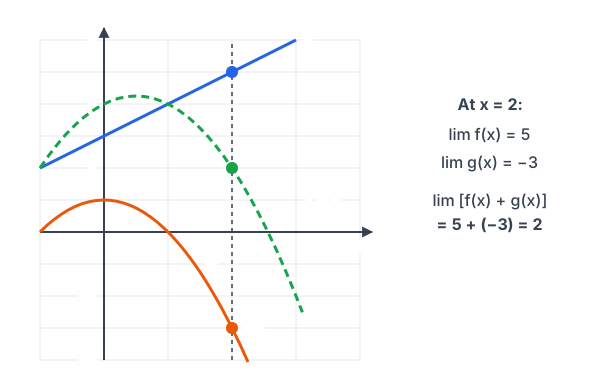
If f(x) is getting close to 5 and g(x) is getting close to −3, then f(x) + g(x) must be getting close to 5 + (−3) = 2. Limits respect the ordinary operations of arithmetic. The graph below shows this for a sum.
The laws need one condition: each separate limit must exist as a real number. And a quotient only works when the limit of the denominator is not 0. When it is 0, you need the algebra methods in the next lesson.
Two basic limits get every calculation started. A constant stays the same, \lim_{x \to a} c = c, and x itself approaches a, \lim_{x \to a} x = a.
The limit laws
Suppose \lim_{x \to a} f(x) = L and \lim_{x \to a} g(x) = M, where L and M are real numbers, and c is a constant.
| Law | Rule |
|---|---|
| Sum | \lim_{x \to a} [f(x) + g(x)] = L + M |
| Difference | \lim_{x \to a} [f(x) - g(x)] = L - M |
| Constant multiple | \lim_{x \to a} [c\,f(x)] = cL |
| Product | \lim_{x \to a} [f(x)\,g(x)] = LM |
| Quotient | \lim_{x \to a} \frac{f(x)}{g(x)} = \frac{L}{M}, if M \ne 0 |
| Power | \lim_{x \to a} [f(x)]^n = L^n for a positive whole number n |
| Root | \lim_{x \to a} \sqrt[n]{f(x)} = \sqrt[n]{L} (for even n, L must be positive or 0) |
Direct substitution property: putting these laws together, if p is a polynomial, then \lim_{x \to a} p(x) = p(a). If r is a rational function and a is in its domain, then \lim_{x \to a} r(x) = r(a).
Limit laws examples
Example 1: Sum and constant multiple laws
Given \lim_{x \to 2} f(x) = 5 and \lim_{x \to 2} g(x) = -3, find \lim_{x \to 2} [2f(x) + g(x)].
\lim_{x \to 2} [2f(x) + g(x)] = \lim_{x \to 2} 2f(x) + \lim_{x \to 2} g(x)Sum law: split the limit of the sum.
\lim_{x \to 2} [2f(x) + g(x)] = 2\lim_{x \to 2} f(x) + \lim_{x \to 2} g(x)Constant multiple law: move the 2 outside.
\lim_{x \to 2} [2f(x) + g(x)] = 2(5) + (-3)Substitute the given limits.
\lim_{x \to 2} [2f(x) + g(x)] = 7Simplify.
Answer: 7.
Example 2: Product, power and quotient laws
With the same f and g, find \lim_{x \to 2} f(x)g(x) and \lim_{x \to 2} \frac{[f(x)]^2}{g(x)}.
\lim_{x \to 2} f(x)g(x) = \lim_{x \to 2} f(x) \cdot \lim_{x \to 2} g(x)Product law.
\lim_{x \to 2} f(x)g(x) = 5(-3) = -15Substitute and multiply.
\lim_{x \to 2} \frac{[f(x)]^2}{g(x)} = \frac{[\lim_{x \to 2} f(x)]^2}{\lim_{x \to 2} g(x)}Quotient law (the bottom limit, −3, is not 0) and power law.
\lim_{x \to 2} \frac{[f(x)]^2}{g(x)} = \frac{5^2}{-3} = -\frac{25}{3}Substitute and simplify.
Answer: −15 and -\frac{25}{3}.
Example 3: A polynomial, law by law
Find \lim_{x \to 3} (2x^2 - 5x + 1) and name the law used at each step.
\lim_{x \to 3} (2x^2 - 5x + 1) = 2\lim_{x \to 3} x^2 - 5\lim_{x \to 3} x + \lim_{x \to 3} 1Sum, difference and constant multiple laws.
\lim_{x \to 3} (2x^2 - 5x + 1) = 2\left(\lim_{x \to 3} x\right)^2 - 5\lim_{x \to 3} x + \lim_{x \to 3} 1Power law.
\lim_{x \to 3} (2x^2 - 5x + 1) = 2(3)^2 - 5(3) + 1Basic limits: \lim_{x \to 3} x = 3 and \lim_{x \to 3} 1 = 1.
\lim_{x \to 3} (2x^2 - 5x + 1) = 18 - 15 + 1 = 4Simplify.
Answer: 4. This is the same as substituting x = 3 directly, which the direct substitution property allows for any polynomial.
Example 4: A rational function
Find \lim_{x \to -1} \frac{x^2 + 3}{x - 4}.
\lim_{x \to -1} (x - 4) = -1 - 4 = -5Check the denominator first. Its limit is −5, not 0, so the quotient law applies.
\lim_{x \to -1} \frac{x^2 + 3}{x - 4} = \frac{\lim_{x \to -1} (x^2 + 3)}{\lim_{x \to -1} (x - 4)}Quotient law.
\lim_{x \to -1} \frac{x^2 + 3}{x - 4} = \frac{(-1)^2 + 3}{-5}Direct substitution in the numerator.
\lim_{x \to -1} \frac{x^2 + 3}{x - 4} = \frac{4}{-5} = -\frac{4}{5}Simplify.
Answer: -\frac{4}{5}.
Example 5: Word problem with average cost
A bike shop’s average cost per bike, when it builds x bikes, is A(x) = \frac{1200 + 15x}{x} dollars. Find \lim_{x \to 40} A(x) and explain what it means.
\lim_{x \to 40} x = 40Check the denominator: its limit is 40, not 0.
\lim_{x \to 40} A(x) = \frac{\lim_{x \to 40} (1200 + 15x)}{\lim_{x \to 40} x}Quotient law.
\lim_{x \to 40} A(x) = \frac{1200 + 15(40)}{40}Direct substitution.
\lim_{x \to 40} A(x) = \frac{1200 + 600}{40} = \frac{1800}{40}Multiply, then add.
\lim_{x \to 40} A(x) = 45Divide.
Answer: $45. When the shop builds close to 40 bikes, the average cost per bike is close to $45.
Common mistakes
| Mistake | Example of the error | Fix |
|---|---|---|
| Using the quotient law when the bottom limit is 0 | \lim_{x \to 2} \frac{x^2 - 4}{x - 2} = \frac{0}{0}, so “no limit” | The quotient law does not apply. Factor first (next lesson); the limit is 4. |
| Splitting a limit that does not exist | Using the sum law on \frac{1}{x} + \left(-\frac{1}{x}\right) at 0 | The laws need each separate limit to exist. Combine first: the sum is 0. |
| Squaring only part of a limit | \lim [f(x)]^2 = 2L instead of L^2 | Power law: square the limit, L^2. |
| Dropping the constant | \lim 2f(x) = L | Keep the constant: 2L. |
| Taking an even root of a negative limit | \lim \sqrt{f(x)} with L = −4 given as 2 | The root law needs L ≥ 0 for even roots; here the limit is not a real number. |
| Forgetting to check the denominator | Substituting into \frac{x + 1}{x - 3} at x = 3 | The bottom limit is 0, so look at one-sided limits instead. |
Related methods
When direct substitution gives 0/0
A result of \frac{0}{0} means the quotient law cannot be used yet. Factoring, canceling, or rationalizing usually turns the limit into one where direct substitution works. That is the topic of the next lesson.
One-sided limits and the laws
Every limit law also works for one-sided limits. For example, \lim_{x \to 0^+} (\sqrt{x} + 3) = 0 + 3 = 3.
Practice problems
For problems 1–6, use \lim_{x \to 1} f(x) = 6, \lim_{x \to 1} g(x) = 2 and \lim_{x \to 1} h(x) = -1.
- Find \lim_{x \to 1} [f(x) + g(x)].
- Find \lim_{x \to 1} [f(x) - 4h(x)].
- Find \lim_{x \to 1} f(x)g(x).
- Find \lim_{x \to 1} \frac{f(x)}{g(x)}.
- Find \lim_{x \to 1} [g(x)]^3.
- Find \lim_{x \to 1} \sqrt{f(x) + 3g(x)}.
- Find \lim_{x \to -2} (x^3 - 4x + 7).
- Find \lim_{x \to 3} \frac{x + 5}{2x - 1}.
- Find \lim_{x \to 4} \sqrt{x^2 + 9}.
- The concentration of a medicine in the blood t hours after a dose is C(t) = \frac{20t}{t^2 + 4} mg/L. Find \lim_{t \to 2} C(t).
Show answers
1.
\lim_{x \to 1} [f(x) + g(x)] = 6 + 2Sum law.
\lim_{x \to 1} [f(x) + g(x)] = 8Add.
Answer: 8
2.
\lim_{x \to 1} [f(x) - 4h(x)] = 6 - 4(-1)Difference and constant multiple laws.
\lim_{x \to 1} [f(x) - 4h(x)] = 10Simplify: 6 + 4.
Answer: 10
3.
\lim_{x \to 1} f(x)g(x) = 6(2) = 12Product law.
Answer: 12
4.
\lim_{x \to 1} \frac{f(x)}{g(x)} = \frac{6}{2} = 3Quotient law; the bottom limit is 2, not 0.
Answer: 3
5.
\lim_{x \to 1} [g(x)]^3 = 2^3 = 8Power law.
Answer: 8
6.
\lim_{x \to 1} \sqrt{f(x) + 3g(x)} = \sqrt{6 + 3(2)}Root law, then sum and constant multiple laws inside.
\lim_{x \to 1} \sqrt{f(x) + 3g(x)} = \sqrt{12} = 2\sqrt{3}Simplify the root (see simplifying square roots).
Answer: 2\sqrt{3} \approx 3.46
7.
\lim_{x \to -2} (x^3 - 4x + 7) = (-2)^3 - 4(-2) + 7Direct substitution for a polynomial.
\lim_{x \to -2} (x^3 - 4x + 7) = -8 + 8 + 7 = 7Simplify.
Answer: 7
8.
\lim_{x \to 3} (2x - 1) = 5Check the denominator: not 0.
\lim_{x \to 3} \frac{x + 5}{2x - 1} = \frac{3 + 5}{5} = \frac{8}{5}Quotient law and direct substitution.
Answer: \frac{8}{5}
9.
\lim_{x \to 4} \sqrt{x^2 + 9} = \sqrt{4^2 + 9}Root law and direct substitution.
\lim_{x \to 4} \sqrt{x^2 + 9} = \sqrt{25} = 5Simplify.
Answer: 5
10.
\lim_{t \to 2} (t^2 + 4) = 8Check the denominator: not 0.
\lim_{t \to 2} C(t) = \frac{20(2)}{8}Quotient law and direct substitution.
\lim_{t \to 2} C(t) = \frac{40}{8} = 5Simplify.
Answer: 5 mg/L. Near 2 hours after the dose, the concentration is close to 5 mg/L.
Limit laws FAQ
What are the limit laws?
They are rules that say the limit of a sum, difference, constant multiple, product, quotient, power or root is the same combination of the separate limits, as long as those limits exist (and the denominator’s limit is not 0).
When can you use direct substitution to find a limit?
For polynomials at any number, and for rational functions at any number where the denominator is not 0. It also works for roots, trig, exponential and log functions inside their domains.
What happens if the denominator’s limit is 0?
The quotient law does not apply. If the numerator also goes to 0, try factoring or rationalizing. If only the denominator goes to 0, check one-sided limits for a vertical asymptote.
Do the limit laws work for one-sided limits?
Yes. Every law works the same way for left-hand and right-hand limits.
Summary
- If both limits exist, the limit of a sum, difference, constant multiple, product, power or root is that combination of the limits.
- The quotient law needs the limit of the denominator to be nonzero.
- Start from \lim_{x \to a} c = c and \lim_{x \to a} x = a.
- Direct substitution works for polynomials, and for rational functions where the denominator is not 0.
- A result of \frac{0}{0} means “do more algebra,” not “no limit.”
Previous lesson: Parent Functions
Previous course: Precalculus Index
Next lesson: Evaluating Limits Algebraically
Back to the Calculus 1 Index