
Evaluating Limits Algebraically
Evaluating limits algebraically means finding a limit exactly instead of estimating it. First try direct substitution. If that gives a number, it is the limit. If it gives \frac{0}{0}, rewrite the expression by factoring and canceling, multiplying by a conjugate, or combining fractions, then substitute again.
Before this lesson: Limit Laws, Factoring Trinomials, Rationalizing the Denominator and Complex Rational Expressions
Why 0/0 needs more work
Direct substitution gives the limit of any polynomial, and of any rational function where the denominator is not 0. When both the top and the bottom become 0, the result \frac{0}{0} is called an indeterminate form. It does not mean the limit is 0, 1 or undefined. It means the expression must be rewritten first.
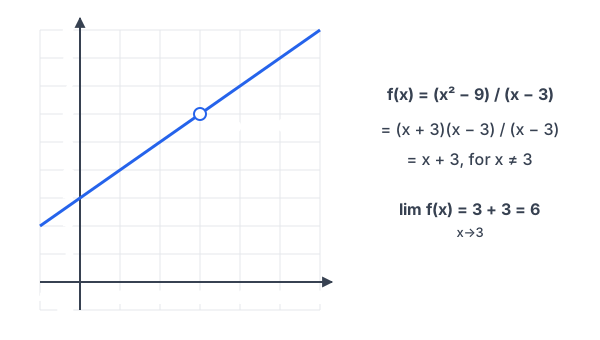
A \frac{0}{0} result usually comes from a common factor hiding in the top and the bottom. For \frac{x^2 - 9}{x - 3}, both share the factor x − 3. Canceling it gives x + 3, which agrees with the original function everywhere except at x = 3. Since a limit ignores the value at x = 3 itself, both functions have the same limit there.
Strategy for evaluating limits algebraically
| Result of direct substitution | What to do |
|---|---|
| A number | That number is the limit. |
| \frac{\text{nonzero}}{0} | The limit does not exist as a number. Check one-sided limits for \infty or -\infty. |
| \frac{0}{0} with polynomials | Factor the top and bottom, cancel the common factor, and substitute again. |
| \frac{0}{0} with a square root | Multiply the top and bottom by the conjugate, simplify, cancel and substitute. |
| \frac{0}{0} with fractions inside fractions | Combine into one fraction over a common denominator, cancel and substitute. |
Evaluating limits algebraically examples
Example 1: Factor and cancel
Find \lim_{x \to 3} \frac{x^2 - 9}{x - 3}.
\frac{3^2 - 9}{3 - 3} = \frac{0}{0}Try direct substitution. It gives 0/0, so rewrite first.
\lim_{x \to 3} \frac{x^2 - 9}{x - 3} = \lim_{x \to 3} \frac{(x + 3)(x - 3)}{x - 3}Factor the difference of squares (see factoring the difference of squares).
\lim_{x \to 3} \frac{x^2 - 9}{x - 3} = \lim_{x \to 3} (x + 3)Cancel x − 3. This is allowed because x ≠ 3 while x approaches 3.
\lim_{x \to 3} \frac{x^2 - 9}{x - 3} = 3 + 3 = 6Substitute x = 3.
Answer: 6, the height of the hole in the graph above.
Example 2: Factor a trinomial
Find \lim_{x \to -2} \frac{x^2 + 5x + 6}{x^2 - 4}.
\frac{4 - 10 + 6}{4 - 4} = \frac{0}{0}Direct substitution gives 0/0.
\lim_{x \to -2} \frac{x^2 + 5x + 6}{x^2 - 4} = \lim_{x \to -2} \frac{(x + 3)(x + 2)}{(x - 2)(x + 2)}Factor the trinomial and the difference of squares.
\lim_{x \to -2} \frac{x^2 + 5x + 6}{x^2 - 4} = \lim_{x \to -2} \frac{x + 3}{x - 2}Cancel the common factor x + 2.
\lim_{x \to -2} \frac{x^2 + 5x + 6}{x^2 - 4} = \frac{-2 + 3}{-2 - 2} = -\frac{1}{4}Substitute x = −2.
Answer: -\frac{1}{4}.
Example 3: Multiply by the conjugate
Find \lim_{x \to 9} \frac{\sqrt{x} - 3}{x - 9}.
\frac{\sqrt{9} - 3}{9 - 9} = \frac{0}{0}Direct substitution gives 0/0.
\lim_{x \to 9} \frac{\sqrt{x} - 3}{x - 9} = \lim_{x \to 9} \frac{(\sqrt{x} - 3)(\sqrt{x} + 3)}{(x - 9)(\sqrt{x} + 3)}Multiply the top and bottom by the conjugate \sqrt{x} + 3.
\lim_{x \to 9} \frac{\sqrt{x} - 3}{x - 9} = \lim_{x \to 9} \frac{x - 9}{(x - 9)(\sqrt{x} + 3)}Multiply out the top: (\sqrt{x})^2 - 3^2 = x - 9.
\lim_{x \to 9} \frac{\sqrt{x} - 3}{x - 9} = \lim_{x \to 9} \frac{1}{\sqrt{x} + 3}Cancel x − 9.
\lim_{x \to 9} \frac{\sqrt{x} - 3}{x - 9} = \frac{1}{3 + 3} = \frac{1}{6}Substitute x = 9.
Answer: \frac{1}{6}. Another route: factor x − 9 as (\sqrt{x} - 3)(\sqrt{x} + 3) and cancel.
Example 4: Combine fractions
Find \lim_{x \to 0} \frac{\frac{1}{x + 4} - \frac{1}{4}}{x}.
\frac{\frac{1}{4} - \frac{1}{4}}{0} = \frac{0}{0}Direct substitution gives 0/0.
\frac{1}{x + 4} - \frac{1}{4} = \frac{4 - (x + 4)}{4(x + 4)}Combine the top over the common denominator 4(x + 4) (see adding and subtracting rational expressions).
\frac{1}{x + 4} - \frac{1}{4} = \frac{-x}{4(x + 4)}Simplify the numerator: 4 − x − 4 = −x.
\lim_{x \to 0} \frac{\frac{1}{x + 4} - \frac{1}{4}}{x} = \lim_{x \to 0} \frac{-x}{4x(x + 4)}Dividing by x is multiplying the bottom by x.
\lim_{x \to 0} \frac{\frac{1}{x + 4} - \frac{1}{4}}{x} = \lim_{x \to 0} \frac{-1}{4(x + 4)}Cancel x.
\lim_{x \to 0} \frac{\frac{1}{x + 4} - \frac{1}{4}}{x} = \frac{-1}{4(4)} = -\frac{1}{16}Substitute x = 0.
Answer: -\frac{1}{16}.
Example 5: Word problem with a falling rock
A rock dropped from a cliff falls s(t) = 4.9t^2 meters in t seconds. Its velocity at t = 3 is \lim_{h \to 0} \frac{s(3 + h) - s(3)}{h}. Find it.
s(3 + h) = 4.9(3 + h)^2 = 4.9(9 + 6h + h^2)
Square the binomial (see special products of binomials).
s(3 + h) = 44.1 + 29.4h + 4.9h^2
Distribute 4.9.
s(3) = 4.9(9) = 44.1
Find the distance at t = 3.
\lim_{h \to 0} \frac{s(3 + h) - s(3)}{h} = \lim_{h \to 0} \frac{29.4h + 4.9h^2}{h}Subtract: the 44.1 terms cancel. Substituting h = 0 now would give 0/0.
\lim_{h \to 0} \frac{s(3 + h) - s(3)}{h} = \lim_{h \to 0} (29.4 + 4.9h)Factor out h and cancel it.
\lim_{h \to 0} \frac{s(3 + h) - s(3)}{h} = 29.4Substitute h = 0.
Answer: 29.4 meters per second. This limit of a difference quotient is the idea behind the derivative.
Common mistakes
| Mistake | Example of the error | Fix |
|---|---|---|
| Saying 0/0 means the limit is 0 or does not exist | \lim_{x \to 3} \frac{x^2 - 9}{x - 3} “does not exist” | 0/0 is indeterminate. Factor and cancel: the limit is 6. |
| Canceling terms instead of factors | \frac{x^2 - 9}{x - 3} = \frac{x^2}{x} - \frac{9}{3} | Only common factors cancel. Factor the top first. |
| Dropping the limit symbol too soon | Writing “= (x + 3) = 6” without the limit | Keep \lim_{x \to 3} on every line until you substitute. |
| Multiplying only the top by the conjugate | \frac{(\sqrt{x} - 3)(\sqrt{x} + 3)}{x - 9} | Multiply the top and the bottom by the same conjugate. |
| Sign errors when combining fractions | 4 - (x + 4) = x | Distribute the minus sign: 4 - x - 4 = -x. |
| Forgetting that nonzero/0 is different | Factoring \frac{x + 1}{x - 3} at x = 3, looking for a cancel | Nonzero over 0 cannot be fixed by canceling. Check one-sided limits instead. |
Related methods
Tables and graphs as a check
After finding a limit algebraically, a quick table, as in Introduction to Limits, can confirm it. For Example 3, x = 9.01 gives about 0.16662, close to \frac{1}{6} \approx 0.16667.
Other indeterminate forms
Forms such as \frac{\infty}{\infty} and \infty - \infty also need rewriting. Limits at infinity and L’Hôpital’s rule, later in Calculus 1, handle them.
Practice problems
- Find \lim_{x \to 5} \frac{x^2 - 25}{x - 5}.
- Find \lim_{x \to 1} \frac{x^2 + 2x - 3}{x - 1}.
- Find \lim_{x \to -3} \frac{x^2 + x - 6}{x + 3}.
- Find \lim_{x \to 2} \frac{x^3 - 8}{x - 2}.
- Find \lim_{x \to 4} \frac{\sqrt{x} - 2}{x - 4}.
- Find \lim_{x \to 0} \frac{\sqrt{x + 1} - 1}{x}.
- Find \lim_{h \to 0} \frac{(2 + h)^2 - 4}{h}.
- Find \lim_{x \to 0} \frac{\frac{1}{x + 2} - \frac{1}{2}}{x}.
- Find \lim_{x \to 3} \frac{x^2 - 9}{x^2 - 5x + 6}.
- A tank holds V(t) = t^3 liters after t minutes. Find its exact rate of filling at t = 2, \lim_{h \to 0} \frac{V(2 + h) - V(2)}{h}.
Show answers
1.
\lim_{x \to 5} \frac{x^2 - 25}{x - 5} = \lim_{x \to 5} \frac{(x + 5)(x - 5)}{x - 5}Substitution gives 0/0. Factor the difference of squares.
\lim_{x \to 5} \frac{x^2 - 25}{x - 5} = \lim_{x \to 5} (x + 5) = 10Cancel and substitute.
Answer: 10
2.
\lim_{x \to 1} \frac{x^2 + 2x - 3}{x - 1} = \lim_{x \to 1} \frac{(x + 3)(x - 1)}{x - 1}Factor the trinomial.
\lim_{x \to 1} \frac{x^2 + 2x - 3}{x - 1} = \lim_{x \to 1} (x + 3) = 4Cancel and substitute.
Answer: 4
3.
\lim_{x \to -3} \frac{x^2 + x - 6}{x + 3} = \lim_{x \to -3} \frac{(x + 3)(x - 2)}{x + 3}Factor the trinomial.
\lim_{x \to -3} \frac{x^2 + x - 6}{x + 3} = \lim_{x \to -3} (x - 2) = -5Cancel and substitute.
Answer: −5
4.
\lim_{x \to 2} \frac{x^3 - 8}{x - 2} = \lim_{x \to 2} \frac{(x - 2)(x^2 + 2x + 4)}{x - 2}Factor the difference of cubes (see sum and difference of cubes).
\lim_{x \to 2} \frac{x^3 - 8}{x - 2} = \lim_{x \to 2} (x^2 + 2x + 4)Cancel x − 2.
\lim_{x \to 2} \frac{x^3 - 8}{x - 2} = 4 + 4 + 4 = 12Substitute x = 2.
Answer: 12
5.
\lim_{x \to 4} \frac{\sqrt{x} - 2}{x - 4} = \lim_{x \to 4} \frac{\sqrt{x} - 2}{(\sqrt{x} - 2)(\sqrt{x} + 2)}Factor x − 4 as a difference of squares in \sqrt{x}.
\lim_{x \to 4} \frac{\sqrt{x} - 2}{x - 4} = \lim_{x \to 4} \frac{1}{\sqrt{x} + 2} = \frac{1}{4}Cancel and substitute.
Answer: \frac{1}{4}
6.
\lim_{x \to 0} \frac{\sqrt{x + 1} - 1}{x} = \lim_{x \to 0} \frac{(x + 1) - 1}{x(\sqrt{x + 1} + 1)}Multiply the top and bottom by the conjugate \sqrt{x + 1} + 1.
\lim_{x \to 0} \frac{\sqrt{x + 1} - 1}{x} = \lim_{x \to 0} \frac{x}{x(\sqrt{x + 1} + 1)}Simplify the top.
\lim_{x \to 0} \frac{\sqrt{x + 1} - 1}{x} = \lim_{x \to 0} \frac{1}{\sqrt{x + 1} + 1} = \frac{1}{2}Cancel x and substitute.
Answer: \frac{1}{2}
7.
\lim_{h \to 0} \frac{(2 + h)^2 - 4}{h} = \lim_{h \to 0} \frac{4 + 4h + h^2 - 4}{h}Square the binomial.
\lim_{h \to 0} \frac{(2 + h)^2 - 4}{h} = \lim_{h \to 0} \frac{h(4 + h)}{h}Simplify and factor out h.
\lim_{h \to 0} \frac{(2 + h)^2 - 4}{h} = \lim_{h \to 0} (4 + h) = 4Cancel and substitute.
Answer: 4
8.
\frac{1}{x + 2} - \frac{1}{2} = \frac{2 - (x + 2)}{2(x + 2)} = \frac{-x}{2(x + 2)}Combine the top over the common denominator.
\lim_{x \to 0} \frac{\frac{1}{x + 2} - \frac{1}{2}}{x} = \lim_{x \to 0} \frac{-1}{2(x + 2)}Divide by x and cancel.
\lim_{x \to 0} \frac{\frac{1}{x + 2} - \frac{1}{2}}{x} = \frac{-1}{4}Substitute x = 0.
Answer: -\frac{1}{4}
9.
\lim_{x \to 3} \frac{x^2 - 9}{x^2 - 5x + 6} = \lim_{x \to 3} \frac{(x + 3)(x - 3)}{(x - 2)(x - 3)}Factor the top and the bottom.
\lim_{x \to 3} \frac{x^2 - 9}{x^2 - 5x + 6} = \lim_{x \to 3} \frac{x + 3}{x - 2} = \frac{6}{1} = 6Cancel x − 3 and substitute.
Answer: 6
10.
V(2 + h) = (2 + h)^3 = 8 + 12h + 6h^2 + h^3
Expand the cube (see binomial theorem).
\lim_{h \to 0} \frac{V(2 + h) - V(2)}{h} = \lim_{h \to 0} \frac{12h + 6h^2 + h^3}{h}Subtract V(2) = 8.
\lim_{h \to 0} \frac{V(2 + h) - V(2)}{h} = \lim_{h \to 0} (12 + 6h + h^2) = 12Cancel h and substitute.
Answer: 12 liters per minute, the value the table in Introduction to Limits suggested.
Evaluating limits algebraically FAQ
What does 0/0 mean when finding a limit?
It is an indeterminate form. It tells you that substitution did not settle the limit and the expression needs rewriting, usually by factoring, using a conjugate or combining fractions.
Why can you cancel a factor when finding a limit?
As x approaches a, x never equals a, so the factor x − a is never 0 and can be canceled. The new expression has the same values near a, so it has the same limit.
When should you use the conjugate?
Use it when the expression has a square root plus or minus a number and substitution gives 0/0. Multiplying by the conjugate removes the root from the numerator.
What if substitution gives a nonzero number over 0?
Then the limit is not a real number. Check the one-sided limits to see whether the function goes to \infty or -\infty, which signals a vertical asymptote.
Summary
- Always try direct substitution first.
- A number means you are done; nonzero over 0 means no real limit; 0/0 means rewrite.
- Rewrite by factoring and canceling, multiplying by the conjugate, or combining fractions.
- Keep the limit symbol on each line until you substitute.
- The limit of a difference quotient as h approaches 0 gives an instantaneous rate of change.
Previous lesson: Limit Laws
Next lesson: Infinite Limits
Back to the Calculus 1 Index