
Limits at Infinity
A limit at infinity describes what f(x) approaches as x grows without bound, written \lim_{x \to \infty} f(x) or \lim_{x \to -\infty} f(x). If the limit is a number L, the line y = L is a horizontal asymptote. For rational functions, divide every term by the highest power of x in the denominator.
Before this lesson: Infinite Limits, End Behavior of Polynomials and Graphing Rational Functions
What a limit at infinity means
Think about \frac{1}{x} for x = 10, 100, 1000 and 1,000,000. The values 0.1, 0.01, 0.001 and 0.000001 get closer and closer to 0. So \lim_{x \to \infty} \frac{1}{x} = 0. The same is true for \frac{1}{x^2}, \frac{1}{x^3} and any constant over a positive power of x.
That one fact powers this whole lesson. To find the long-run value of a fraction, rewrite it so every piece is either a constant or a constant over a power of x. The constant over a power of x pieces disappear, and what remains is the limit.
Infinite limits (last lesson) have x approaching a number and y blowing up. Limits at infinity have x blowing up. If y settles on a number, the graph has a horizontal asymptote.
Rules for limits at infinity
For any constant c and any positive power n: \lim_{x \to \pm\infty} \frac{c}{x^n} = 0.
For a rational function \frac{p(x)}{q(x)}, compare the degrees (highest powers) of the top and bottom:
| Degrees | Limit as x → ±∞ | Example |
|---|---|---|
| Top degree less than bottom degree | 0, so y = 0 is the horizontal asymptote | \frac{4x + 1}{x^2 - 7} \to 0 |
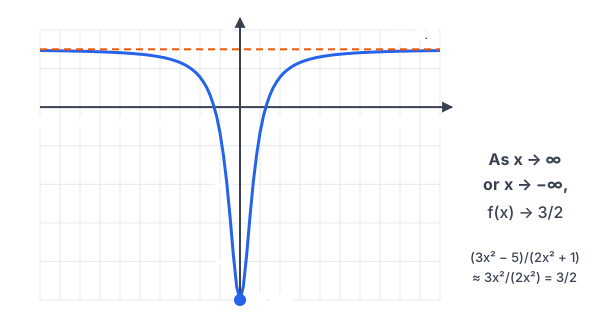
| Degrees equal | Ratio of the leading coefficients | \frac{3x^2 - 5}{2x^2 + 1} \to \frac{3}{2} |
| Top degree greater than bottom degree | \infty or -\infty (no horizontal asymptote) | \frac{x^3 + 2}{5x^2 - 1} \to -\infty as x \to -\infty |
The table is a shortcut. The method behind it, and the one to show on tests, is to divide every term by the highest power of x in the denominator, then use \frac{c}{x^n} \to 0.
Limits at infinity examples
Example 1: Equal degrees
Find \lim_{x \to \infty} \frac{3x^2 - 5}{2x^2 + 1}.
\lim_{x \to \infty} \frac{3x^2 - 5}{2x^2 + 1} = \lim_{x \to \infty} \frac{\frac{3x^2}{x^2} - \frac{5}{x^2}}{\frac{2x^2}{x^2} + \frac{1}{x^2}}Divide every term by x^2, the highest power in the denominator.
\lim_{x \to \infty} \frac{3x^2 - 5}{2x^2 + 1} = \lim_{x \to \infty} \frac{3 - \frac{5}{x^2}}{2 + \frac{1}{x^2}}Simplify each term.
\lim_{x \to \infty} \frac{3x^2 - 5}{2x^2 + 1} = \frac{3 - 0}{2 + 0} = \frac{3}{2}Each \frac{c}{x^2} goes to 0.
Answer: \frac{3}{2}, so y = 1.5 is a horizontal asymptote (see the graph above). The same steps give \frac{3}{2} as x \to -\infty.
Example 2: Bottom degree bigger
Find \lim_{x \to \infty} \frac{4x + 1}{x^2 - 7}.
\lim_{x \to \infty} \frac{4x + 1}{x^2 - 7} = \lim_{x \to \infty} \frac{\frac{4}{x} + \frac{1}{x^2}}{1 - \frac{7}{x^2}}Divide every term by x^2.
\lim_{x \to \infty} \frac{4x + 1}{x^2 - 7} = \frac{0 + 0}{1 - 0} = 0Every fraction with x in the bottom goes to 0.
Answer: 0, so y = 0 (the x-axis) is a horizontal asymptote.
Example 3: Top degree bigger
Find \lim_{x \to -\infty} \frac{x^3 + 2}{5x^2 - 1}.
\lim_{x \to -\infty} \frac{x^3 + 2}{5x^2 - 1} = \lim_{x \to -\infty} \frac{x + \frac{2}{x^2}}{5 - \frac{1}{x^2}}Divide every term by x^2.
x + \frac{2}{x^2} \to -\inftyAs x \to -\infty, the term x decreases without bound and \frac{2}{x^2} \to 0.
5 - \frac{1}{x^2} \to 5The denominator approaches 5.
\lim_{x \to -\infty} \frac{x^3 + 2}{5x^2 - 1} = -\inftyA quantity going to -\infty divided by 5 still goes to -\infty.
Answer: -\infty. There is no horizontal asymptote; the graph behaves like \frac{x}{5} far out (a slant asymptote, see slant asymptotes).
Example 4: A square root and two different asymptotes
Find \lim_{x \to \infty} \frac{\sqrt{9x^2 + 1}}{2x - 3} and \lim_{x \to -\infty} \frac{\sqrt{9x^2 + 1}}{2x - 3}.
\sqrt{9x^2 + 1} = |x|\sqrt{9 + \frac{1}{x^2}}Factor x^2 out of the root: \sqrt{x^2} = |x|.
\lim_{x \to \infty} \frac{x\sqrt{9 + \frac{1}{x^2}}}{x\left(2 - \frac{3}{x}\right)} = \frac{\sqrt{9}}{2} = \frac{3}{2}For x greater than 0, |x| = x. Cancel x and let the small terms go to 0.
\lim_{x \to -\infty} \frac{-x\sqrt{9 + \frac{1}{x^2}}}{x\left(2 - \frac{3}{x}\right)} = \frac{-3}{2}For x less than 0, |x| = −x. The minus sign stays after canceling x.
Answer: \frac{3}{2} to the right and -\frac{3}{2} to the left. This graph has two horizontal asymptotes, y = 1.5 and y = −1.5. The key is \sqrt{x^2} = |x| (see absolute value).
Example 5: Word problem with a mixing tank
A tank starts with 200 liters of pure water. Brine with 30 grams of salt per liter flows in at 4 liters per minute, and nothing flows out. After t minutes, the salt concentration is C(t) = \frac{120t}{200 + 4t} grams per liter. Find \lim_{t \to \infty} C(t).
\lim_{t \to \infty} \frac{120t}{200 + 4t} = \lim_{t \to \infty} \frac{120}{\frac{200}{t} + 4}Divide every term by t.
\lim_{t \to \infty} \frac{120t}{200 + 4t} = \frac{120}{0 + 4}\frac{200}{t} \to 0.
\lim_{t \to \infty} \frac{120t}{200 + 4t} = 30Divide.
Answer: 30 grams per liter. Over a long time, the tank’s concentration approaches the concentration of the brine flowing in, which makes sense.
Common mistakes
| Mistake | Example of the error | Fix |
|---|---|---|
| Treating ∞/∞ as 1 | \lim_{x \to \infty} \frac{3x^2 - 5}{2x^2 + 1} = \frac{\infty}{\infty} = 1 | ∞/∞ is indeterminate. Divide by x^2 to get \frac{3}{2}. |
| Dividing only some terms by the power of x | \frac{3 - 5}{2x^2 + 1} | Divide every term, top and bottom, by the same power. |
| Using the ratio of coefficients when degrees differ | \frac{4x + 1}{x^2 - 7} \to 4 | The top degree is smaller, so the limit is 0. |
| Writing \sqrt{x^2} = x for negative x | Getting \frac{3}{2} for both directions in Example 4 | \sqrt{x^2} = |x|, which is −x when x is negative. |
| Forgetting the sign when the top degree is bigger | \frac{x^3 + 2}{5x^2 - 1} \to \infty as x \to -\infty | It behaves like \frac{x}{5}, which goes to -\infty. |
| Mixing up infinite limits and limits at infinity | Looking for a horizontal asymptote with x \to 3 | Horizontal asymptotes come from x \to \pm\infty; vertical ones come from x approaching a number. |
Related methods
Conjugates for differences that both grow
A difference like \sqrt{x^2 + 6x} - x is the form \infty - \infty. Multiply by the conjugate over itself to turn it into a fraction, then divide by x. Practice problem 9 works through it.
Exponential functions
Exponential decay goes to 0: \lim_{x \to \infty} e^{-x} = 0. Models such as 3 + 2e^{-x} level off at 3, the horizontal asymptote of the exponential function.
Practice problems
- Find \lim_{x \to \infty} \frac{7}{x^3}.
- Find \lim_{x \to \infty} \frac{5x - 2}{3x + 4}.
- Find \lim_{x \to \infty} \frac{2x^2 + 1}{x^3 - x}.
- Find \lim_{x \to -\infty} \frac{6x^3 - x}{2x^3 + 5}.
- Find \lim_{x \to \infty} \frac{x^2 + 3}{x + 1}.
- Find the horizontal asymptote of f(x) = \frac{8x^2 - 3x}{4x^2 + 1}.
- Find \lim_{x \to \infty} \frac{\sqrt{4x^2 + x}}{x + 1}.
- Find \lim_{x \to \infty} (3 + 2e^{-x}).
- Find \lim_{x \to \infty} \left(\sqrt{x^2 + 6x} - x\right).
- A company’s average cost to make x phone cases is A(x) = \frac{5000 + 12x}{x} dollars. Find \lim_{x \to \infty} A(x) and explain it.
Show answers
1.
\lim_{x \to \infty} \frac{7}{x^3} = 0A constant over a positive power of x goes to 0.
Answer: 0
2.
\lim_{x \to \infty} \frac{5x - 2}{3x + 4} = \lim_{x \to \infty} \frac{5 - \frac{2}{x}}{3 + \frac{4}{x}}Divide every term by x.
\lim_{x \to \infty} \frac{5x - 2}{3x + 4} = \frac{5}{3}The small terms go to 0.
Answer: \frac{5}{3}
3.
\lim_{x \to \infty} \frac{2x^2 + 1}{x^3 - x} = \lim_{x \to \infty} \frac{\frac{2}{x} + \frac{1}{x^3}}{1 - \frac{1}{x^2}}Divide every term by x^3.
\lim_{x \to \infty} \frac{2x^2 + 1}{x^3 - x} = \frac{0}{1} = 0The small terms go to 0.
Answer: 0
4.
\lim_{x \to -\infty} \frac{6x^3 - x}{2x^3 + 5} = \lim_{x \to -\infty} \frac{6 - \frac{1}{x^2}}{2 + \frac{5}{x^3}}Divide every term by x^3.
\lim_{x \to -\infty} \frac{6x^3 - x}{2x^3 + 5} = \frac{6}{2} = 3The small terms go to 0.
Answer: 3
5.
\lim_{x \to \infty} \frac{x^2 + 3}{x + 1} = \lim_{x \to \infty} \frac{x + \frac{3}{x}}{1 + \frac{1}{x}}Divide every term by x.
x + \frac{3}{x} \to \inftyThe top grows without bound while the bottom approaches 1.
Answer: \infty (no horizontal asymptote)
6.
\lim_{x \to \pm\infty} \frac{8x^2 - 3x}{4x^2 + 1} = \frac{8}{4} = 2Equal degrees: divide by x^2, leaving the ratio of the leading coefficients.
Answer: y = 2
7.
\frac{\sqrt{4x^2 + x}}{x + 1} = \frac{x\sqrt{4 + \frac{1}{x}}}{x\left(1 + \frac{1}{x}\right)}Factor x^2 out of the root; |x| = x for positive x.
\lim_{x \to \infty} \frac{\sqrt{4x^2 + x}}{x + 1} = \frac{\sqrt{4}}{1} = 2Cancel x and let the small terms go to 0.
Answer: 2
8.
\lim_{x \to \infty} (3 + 2e^{-x}) = 3 + 2(0) = 3e^{-x} = \frac{1}{e^x} \to 0.
Answer: 3
9.
\sqrt{x^2 + 6x} - x = \frac{(x^2 + 6x) - x^2}{\sqrt{x^2 + 6x} + x}Multiply by the conjugate over itself.
\sqrt{x^2 + 6x} - x = \frac{6x}{\sqrt{x^2 + 6x} + x}Simplify the top.
\lim_{x \to \infty} \frac{6x}{\sqrt{x^2 + 6x} + x} = \lim_{x \to \infty} \frac{6}{\sqrt{1 + \frac{6}{x}} + 1}Divide every term by x (for positive x, \frac{\sqrt{x^2 + 6x}}{x} = \sqrt{1 + \frac{6}{x}}).
\lim_{x \to \infty} \frac{6x}{\sqrt{x^2 + 6x} + x} = \frac{6}{1 + 1} = 3The small term goes to 0.
Answer: 3
10.
\lim_{x \to \infty} \frac{5000 + 12x}{x} = \lim_{x \to \infty} \left(\frac{5000}{x} + 12\right)Divide each term by x.
\lim_{x \to \infty} \frac{5000 + 12x}{x} = 0 + 12 = 12\frac{5000}{x} \to 0.
Answer: $12. As production grows, the fixed $5,000 is spread over more cases, and the average cost approaches the $12 cost of each case.
Limits at infinity FAQ
What is a limit at infinity?
It is the value f(x) approaches as x grows without bound (or decreases without bound). It describes the end behavior of the graph.
How do you find limits at infinity of rational functions?
Divide every term by the highest power of x in the denominator, then use the fact that a constant over a power of x goes to 0.
How are limits at infinity related to horizontal asymptotes?
If \lim_{x \to \infty} f(x) = L or \lim_{x \to -\infty} f(x) = L, then y = L is a horizontal asymptote of the graph.
Can a function have two horizontal asymptotes?
Yes. Functions with square roots or exponentials can approach different values on the left and the right, as in Example 4.
Summary
- \lim_{x \to \infty} f(x) = L means f(x) approaches L as x grows; then y = L is a horizontal asymptote.
- \frac{c}{x^n} \to 0 as x \to \pm\infty for any positive n.
- For rational functions, divide every term by the highest power of x in the denominator.
- Top degree smaller: 0. Equal: ratio of leading coefficients. Bigger: \pm\infty.
- Use \sqrt{x^2} = |x| with roots, and watch the sign as x \to -\infty.
Previous lesson: Infinite Limits
Next lesson: Squeeze Theorem
Back to the Calculus 1 Index