
Infinite Limits
An infinite limit describes a function whose values grow without bound as x approaches a number. We write \lim_{x \to a} f(x) = \infty (or -\infty) when f(x) becomes larger (or more negative) than any number you choose. If either one-sided limit at a is infinite, the line x = a is a vertical asymptote.
Before this lesson: One-Sided Limits, Evaluating Limits Algebraically and Graphing Rational Functions
What an infinite limit means
Divide 1 by smaller and smaller positive numbers: \frac{1}{0.1} = 10, \frac{1}{0.01} = 100, \frac{1}{0.001} = 1000. The results grow past any bound. That is the heart of every infinite limit: a nonzero number divided by something that shrinks toward 0.
The symbol \infty is not a number. Writing \lim_{x \to a} f(x) = \infty is a way of saying the limit does not exist, and also describing how it fails: the values blow up in the positive direction.
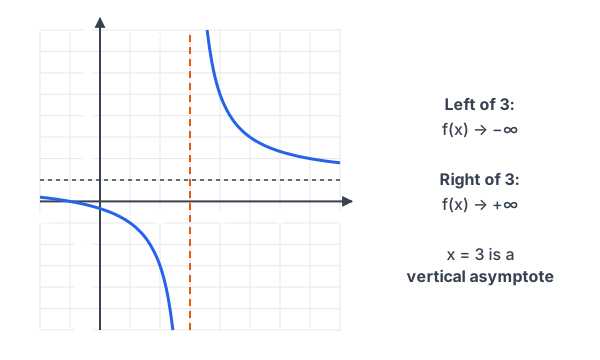
On a graph, an infinite limit shows up as a vertical asymptote, a vertical line the curve hugs as it shoots up or down.
How to find infinite limits
When direct substitution gives a nonzero number over 0, the one-sided limits are infinite. Their signs decide whether each is \infty or -\infty.
- Substitute x = a. Confirm the numerator approaches a nonzero number and the denominator approaches 0. (If both approach 0, simplify first.)
- Find the sign of the numerator near a.
- Find the sign of the denominator just left of a and just right of a. Write 0^+ for a tiny positive number and 0^- for a tiny negative number.
- Divide the signs: same signs give \infty, opposite signs give -\infty.
- If both one-sided limits match, the two-sided limit is that infinity; if not, write each side separately.
| Numerator near a | Denominator | Limit |
|---|---|---|
| Positive | 0^+ | \infty |
| Positive | 0^- | -\infty |
| Negative | 0^+ | -\infty |
| Negative | 0^- | \infty |
Infinite limits examples
Example 1: An even power in the denominator
Find \lim_{x \to 0} \frac{1}{x^2}.
\frac{1}{0^2} = \frac{1}{0}Substitute: a nonzero number over 0, so the limit is infinite.
x^2 \gt 0
For any x near 0 except 0 itself, x^2 is a tiny positive number, 0^+, on both sides.
\frac{1}{0^+}Positive over 0^+ is positive and huge.
\lim_{x \to 0} \frac{1}{x^2} = \inftyBoth sides go to \infty, so the two-sided limit is \infty.
Answer: \infty. The y-axis, x = 0, is a vertical asymptote.
Example 2: Different signs on each side
Find \lim_{x \to 3^-} \frac{x + 1}{x - 3} and \lim_{x \to 3^+} \frac{x + 1}{x - 3}.
x + 1 \to 4
The numerator approaches 4, a positive number.
x - 3 \to 0^-
For x just left of 3, such as 2.99, x − 3 is a tiny negative number.
\lim_{x \to 3^-} \frac{x + 1}{x - 3} = -\inftyPositive over 0^- gives -\infty.
x - 3 \to 0^+
For x just right of 3, such as 3.01, x − 3 is a tiny positive number.
\lim_{x \to 3^+} \frac{x + 1}{x - 3} = \inftyPositive over 0^+ gives \infty.
Answer: -\infty from the left and \infty from the right, as in the graph above. The two-sided limit does not exist, and x = 3 is a vertical asymptote. Check: x = 3.01 gives \frac{4.01}{0.01} = 401.
Example 3: A negative numerator
Find \lim_{x \to -2} \frac{x - 1}{(x + 2)^2}.
x - 1 \to -3
The numerator approaches −3, a negative number.
(x + 2)^2 \to 0^+
A square is positive, so the denominator is 0^+ on both sides.
\lim_{x \to -2} \frac{x - 1}{(x + 2)^2} = -\inftyNegative over 0^+ gives -\infty on both sides.
Answer: -\infty. Both branches of the graph head down along x = −2.
Example 4: Asymptote or hole?
Find the vertical asymptotes of f(x) = \frac{x^2 - 1}{x^2 - x - 2} and describe the limits there.
f(x) = \frac{(x - 1)(x + 1)}{(x - 2)(x + 1)}Factor the top and the bottom (see factoring trinomials).
f(x) = \frac{x - 1}{x - 2}Cancel x + 1, for x \ne -1.
\lim_{x \to -1} f(x) = \frac{-1 - 1}{-1 - 2} = \frac{2}{3}At x = −1 the factor canceled, so there is a hole, not an asymptote.
x - 1 \to 1
At x = 2 the numerator approaches 1, which is positive.
\lim_{x \to 2^-} f(x) = -\inftyLeft of 2 the denominator is 0^-: positive over negative.
\lim_{x \to 2^+} f(x) = \inftyRight of 2 the denominator is 0^+: positive over positive.
Answer: the only vertical asymptote is x = 2, with -\infty on the left and \infty on the right. At x = −1 the graph has a hole at \left(-1, \frac{2}{3}\right).
Example 5: Word problem with pollution cleanup
The cost, in thousands of dollars, to remove p percent of a pollutant from a lake is C(p) = \frac{50p}{100 - p}. Find \lim_{p \to 100^-} C(p) and explain what it means.
50p \to 5000
The numerator approaches 50(100) = 5000, which is positive.
100 - p \to 0^+
For p just under 100, such as 99.9, 100 − p is a tiny positive number.
\lim_{p \to 100^-} C(p) = \inftyPositive over 0^+ gives \infty.
C(99) = \frac{4950}{1} = 4950Check: removing 99% costs $4,950,000.
C(99.9) = \frac{4995}{0.1} = 49950Removing 99.9% costs $49,950,000.
Answer: \infty. The cost grows without bound as p approaches 100, so removing all of the pollutant is impossible at any price.
Common mistakes
| Mistake | Example of the error | Fix |
|---|---|---|
| Treating ∞ as a number | \infty - \infty = 0 | ∞ describes growth without bound; it does not follow ordinary arithmetic. |
| Calling every zero denominator an asymptote | Saying x = −1 is an asymptote of Example 4 | If the factor cancels, it is a hole. Simplify first. |
| Getting the sign wrong on one side | \lim_{x \to 3^-} \frac{x + 1}{x - 3} = \infty | Left of 3, x − 3 is negative, so the limit is -\infty. |
| Writing a two-sided limit when the sides differ | \lim_{x \to 3} \frac{x + 1}{x - 3} = \infty | The sides are -\infty and \infty, so give each side separately. |
| Forgetting that squares are positive | Using 0^- for (x + 2)^2 left of −2 | A square is never negative: 0^+ on both sides. |
| Stopping at nonzero/0 and writing “undefined” | “The limit is 4/0, undefined” | Do the sign analysis to say whether it is \infty or -\infty. |
Related methods
Trig and log functions
Infinite limits also come from other functions. \tan x = \frac{\sin x}{\cos x} blows up where \cos x = 0, so \lim_{x \to \pi/2^-} \tan x = \infty. The logarithm has \lim_{x \to 0^+} \ln x = -\infty (see graphing logarithmic functions).
Infinite limits versus limits at infinity
An infinite limit has x approaching a number and y blowing up, which gives a vertical asymptote. A limit at infinity has x growing without bound, which can give a horizontal asymptote. That is the next lesson.
Practice problems
- Find \lim_{x \to 4} \frac{3}{(x - 4)^2}.
- Find \lim_{x \to 1^-} \frac{2}{x - 1} and \lim_{x \to 1^+} \frac{2}{x - 1}.
- Find \lim_{x \to -3^+} \frac{x}{x + 3}.
- Find \lim_{x \to -3^-} \frac{x}{x + 3}.
- Find \lim_{x \to 0} \frac{-5}{x^4}.
- Find the vertical asymptotes of f(x) = \frac{x + 2}{x^2 - 9}.
- Does g(x) = \frac{x^2 - 4}{x - 2} have a vertical asymptote at x = 2? Explain.
- Find \lim_{x \to \pi/2^-} \tan x.
- Find \lim_{x \to 0^+} \ln x.
- A pool loses 20 liters per minute through a leak. With a pump that adds r liters per minute, the time to add 600 liters is T(r) = \frac{600}{r - 20} minutes. Find \lim_{r \to 20^+} T(r) and explain it.
Show answers
1.
(x - 4)^2 \to 0^+
The numerator is 3, and the square is positive on both sides.
\lim_{x \to 4} \frac{3}{(x - 4)^2} = \inftyPositive over 0^+.
Answer: \infty
2.
x - 1 \to 0^-
Left of 1 the denominator is negative.
\lim_{x \to 1^-} \frac{2}{x - 1} = -\inftyPositive over 0^-.
\lim_{x \to 1^+} \frac{2}{x - 1} = \inftyRight of 1 the denominator is 0^+.
Answer: -\infty and \infty
3.
x \to -3
The numerator approaches −3, negative.
x + 3 \to 0^+
Right of −3, such as −2.99, x + 3 is positive.
\lim_{x \to -3^+} \frac{x}{x + 3} = -\inftyNegative over 0^+.
Answer: -\infty
4.
x + 3 \to 0^-
Left of −3, such as −3.01, x + 3 is negative; the numerator is still near −3.
\lim_{x \to -3^-} \frac{x}{x + 3} = \inftyNegative over 0^- is positive.
Answer: \infty
5.
x^4 \to 0^+
An even power is positive on both sides.
\lim_{x \to 0} \frac{-5}{x^4} = -\inftyNegative over 0^+.
Answer: -\infty
6.
x^2 - 9 = (x - 3)(x + 3)
Factor the denominator. It is 0 at x = 3 and x = −3.
3 + 2 = 5
At x = 3 the numerator is 5, not 0, so x = 3 is an asymptote.
-3 + 2 = -1
At x = −3 the numerator is −1, not 0, so x = −3 is an asymptote.
Answer: x = 3 and x = −3
7.
\frac{x^2 - 4}{x - 2} = \frac{(x + 2)(x - 2)}{x - 2} = x + 2Factor and cancel, for x \ne 2.
\lim_{x \to 2} g(x) = 2 + 2 = 4The limit is a number.
Answer: no. The factor x − 2 cancels, so there is a hole at (2, 4), not an asymptote.
8.
\sin x \to 1
Near \frac{\pi}{2}, the sine is close to 1.
\cos x \to 0^+
Just left of \frac{\pi}{2} (in Quadrant I), the cosine is small and positive (see the unit circle).
\lim_{x \to \pi/2^-} \tan x = \inftyPositive over 0^+.
Answer: \infty
9.
\ln 0.01 \approx -4.6
Try small inputs.
\ln 0.000001 \approx -13.8
The outputs keep decreasing without bound.
Answer: -\infty
10.
600 \gt 0
The numerator is a positive constant.
r - 20 \to 0^+
For r just over 20, r − 20 is a tiny positive number.
\lim_{r \to 20^+} T(r) = \inftyPositive over 0^+.
Answer: \infty. When the pump barely beats the leak, the time to add 600 liters grows without bound.
Infinite limits FAQ
What is an infinite limit?
It is a limit where the function values grow without bound, positively or negatively, as x approaches a number. It is written with \infty or -\infty.
Does an infinite limit exist?
No. Writing \infty describes how the limit fails to exist; the values do not settle on a real number.
How do you find a vertical asymptote with limits?
The line x = a is a vertical asymptote if at least one one-sided limit at a is \infty or -\infty. For rational functions, look for zeros of the denominator that do not cancel.
How do you know if the limit is positive or negative infinity?
Check the sign of the numerator and the sign of the tiny denominator on that side. Same signs give \infty; opposite signs give -\infty.
Summary
- \lim_{x \to a} f(x) = \infty means f(x) grows without bound as x approaches a; the limit still does not exist as a number.
- Nonzero over 0 after substituting signals an infinite limit.
- Use sign analysis on each side: same signs give \infty, opposite signs give -\infty.
- An infinite one-sided limit at a means x = a is a vertical asymptote.
- Simplify first: a canceled factor makes a hole, not an asymptote.
Previous lesson: Evaluating Limits Algebraically
Next lesson: Limits at Infinity
Back to the Calculus 1 Index