
Binomial Theorem
The binomial theorem expands a power of a binomial without multiplying it out by hand: (a + b)^n = \sum_{k=0}^{n} \binom{n}{k} a^{n-k} b^k. The coefficients \binom{n}{k} come from combinations or from row n of Pascal’s triangle. The powers of a go down from n to 0 while the powers of b go up from 0 to n.
Before this lesson: Permutations and Combinations, Special Products of Binomials and Sigma Notation
The pattern behind the binomial theorem
Multiply out a few powers of (a + b) and a pattern appears:
(a + b)^2 = a^2 + 2ab + b^2
(a + b)^3 = a^3 + 3a^2b + 3ab^2 + b^3
Each power has n + 1 terms. The exponent on a starts at n and drops by 1 each term, and the exponent on b starts at 0 and rises by 1. In every term the two exponents add to n.
The coefficients 1, 2, 1 and 1, 3, 3, 1 are rows of Pascal’s triangle, where each number is the sum of the two numbers above it. They are also the combinations \binom{n}{k}, which count how many ways to pick b from k of the n factors.
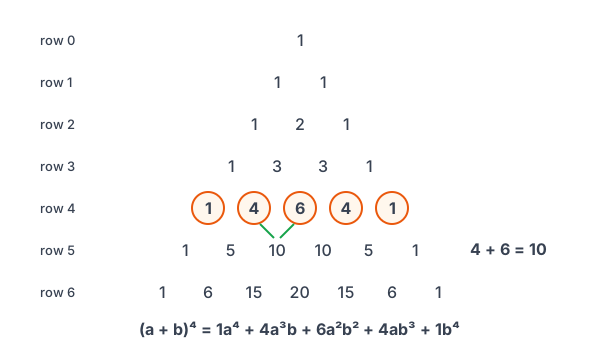
The binomial theorem formula
(a + b)^n = \binom{n}{0}a^n + \binom{n}{1}a^{n-1}b + \binom{n}{2}a^{n-2}b^2 + \cdots + \binom{n}{n}b^nThe binomial coefficient is \binom{n}{k} = \frac{n!}{k!\,(n - k)!}, the same as C(n, k).
To find one term without the whole expansion, use the general term. The term with b^k is term number k + 1:
\text{term } k + 1 = \binom{n}{k} a^{n-k} b^k| Step | What to do |
|---|---|
| 1 | Identify a, b and n. If the binomial has a minus sign, make b negative. |
| 2 | Get the coefficients from row n of Pascal’s triangle or from \binom{n}{k}. |
| 3 | Write each term: coefficient, then a^{n-k}, then b^k. |
| 4 | Simplify each term, keeping parentheses around a and b when you raise them to powers. |
Binomial theorem examples
Example 1: Expand with Pascal’s triangle
Expand (x + 2)^4.
(x + 2)^4 = 1x^4 + 4x^3(2) + 6x^2(2)^2 + 4x(2)^3 + 1(2)^4
Use row 4 of Pascal’s triangle, 1, 4, 6, 4, 1, with a = x and b = 2.
(x + 2)^4 = x^4 + 4x^3(2) + 6x^2(4) + 4x(8) + 16
Find each power of 2 (see exponents).
(x + 2)^4 = x^4 + 8x^3 + 24x^2 + 32x + 16
Multiply the coefficients.
Answer: x^4 + 8x^3 + 24x^2 + 32x + 16.
Example 2: A binomial with a coefficient and a minus sign
Expand (2x - 3)^3.
(2x - 3)^3 = 1(2x)^3 + 3(2x)^2(-3) + 3(2x)(-3)^2 + 1(-3)^3
Use row 3, 1, 3, 3, 1, with a = 2x and b = −3.
(2x - 3)^3 = 8x^3 + 3(4x^2)(-3) + 3(2x)(9) + (-27)
Find each power. Keep the parentheses: (2x)^2 = 4x^2.
(2x - 3)^3 = 8x^3 - 36x^2 + 54x - 27
Multiply. The signs alternate because b is negative.
Answer: 8x^3 - 36x^2 + 54x - 27.
Example 3: Find one term
Find the 4th term of (x + 3)^7.
k = 3
The 4th term is term number k + 1, so k = 3.
\binom{7}{3} x^{7-3} (3)^3Use the general term with n = 7, a = x and b = 3.
\binom{7}{3} = \frac{7 \cdot 6 \cdot 5}{3 \cdot 2 \cdot 1} = 35Find the coefficient (see combinations).
35 \cdot x^4 \cdot 27
Simplify the exponent and find 3^3 = 27.
945x^4
Multiply.
Answer: 945x^4.
Example 4: Find a coefficient
Find the coefficient of x^5 in (2x - 1)^8.
\binom{8}{k}(2x)^{8-k}(-1)^kWrite the general term with a = 2x, b = −1 and n = 8.
8 - k = 5
The power of x comes from (2x)^{8-k}, so set the exponent equal to 5.
k = 3
Solve.
\binom{8}{3}(2x)^5(-1)^3Substitute k = 3.
56 \cdot 32x^5 \cdot (-1)
\binom{8}{3} = 56, (2x)^5 = 32x^5 and (-1)^3 = -1.
-1792x^5
Multiply.
Answer: the coefficient is −1792.
Example 5: Word problem with savings growth
A savings account grows 2% per year, so $1,000 becomes 1000(1.02)^{10} dollars after 10 years. Use the first three terms of the binomial theorem to estimate it.
(1 + 0.02)^{10} \approx \binom{10}{0} + \binom{10}{1}(0.02) + \binom{10}{2}(0.02)^2Write 1.02 as 1 + 0.02 and keep the first three terms. Every power of 1 is 1.
(1 + 0.02)^{10} \approx 1 + 10(0.02) + 45(0.0004)Find the coefficients and square 0.02.
(1 + 0.02)^{10} \approx 1 + 0.2 + 0.018Multiply.
(1 + 0.02)^{10} \approx 1.218Add.
1000(1.218) = 1218
Multiply by the starting amount.
Answer: about $1,218. The exact value is $1,218.99, so three terms come within about a dollar, because the later terms use tiny powers of 0.02. For more on growth like this, see compound interest.
Common mistakes
| Mistake | Example of the error | Fix |
|---|---|---|
| Raising each term to the power | (x + 2)^4 = x^4 + 16 | Use all n + 1 terms of the binomial theorem. |
| Forgetting parentheses on a coefficient | (2x)^3 written as 2x^3 | Cube both parts: (2x)^3 = 8x^3. |
| Dropping the negative sign of b | (2x - 3)^3 expanded with b = 3, so every term is positive | Use b = −3; the signs then alternate. |
| Off by one on the term number | Using k = 4 for the 4th term | The 4th term has k = 3, since k starts at 0. |
| Using the wrong row of Pascal’s triangle | Using 1, 3, 3, 1 for a 4th power | Count rows from 0: the 4th power uses 1, 4, 6, 4, 1. |
| Leaving the number out of a coefficient | Calling the coefficient of x^5 in Example 4 just 56 | Include 2^5 and (-1)^3: the coefficient is −1792. |
Related methods
Building Pascal’s triangle
Start with a 1 on top. Each row begins and ends with 1, and every other number is the sum of the two numbers just above it. This works because \binom{n}{k} = \binom{n-1}{k-1} + \binom{n-1}{k}.
Sum of the coefficients
Setting every variable equal to 1 adds up all the coefficients. For (a + b)^n that sum is 2^n, which is also the sum of row n of Pascal’s triangle.
Practice problems
- Write row 5 of Pascal’s triangle.
- Expand (x + 1)^5.
- Expand (a - b)^4.
- Expand (3x + 2)^3.
- Expand (x^2 + 1)^3.
- Find the 3rd term of (x + 5)^6.
- Find the coefficient of x^3 in (x - 2)^7.
- Find the constant term of \left(x + \frac{1}{x}\right)^6.
- Find the sum of the coefficients of (2x + 1)^5.
- Use the first three terms of the binomial theorem to estimate 0.99^6.
Show answers
1.
1, 4, 6, 4, 1
Start from row 4.
1, 5, 10, 10, 5, 1
Add neighbors: 1 + 4 = 5, 4 + 6 = 10, 6 + 4 = 10, 4 + 1 = 5, with 1 at each end.
Answer: 1, 5, 10, 10, 5, 1
2.
(x + 1)^5 = x^5 + 5x^4(1) + 10x^3(1)^2 + 10x^2(1)^3 + 5x(1)^4 + (1)^5
Use row 5 with a = x and b = 1.
(x + 1)^5 = x^5 + 5x^4 + 10x^3 + 10x^2 + 5x + 1
Every power of 1 is 1.
Answer: x^5 + 5x^4 + 10x^3 + 10x^2 + 5x + 1
3.
(a - b)^4 = a^4 + 4a^3(-b) + 6a^2(-b)^2 + 4a(-b)^3 + (-b)^4
Use row 4 with the second term −b.
(a - b)^4 = a^4 - 4a^3b + 6a^2b^2 - 4ab^3 + b^4
Odd powers of −b are negative and even powers are positive.
Answer: a^4 - 4a^3b + 6a^2b^2 - 4ab^3 + b^4
4.
(3x + 2)^3 = (3x)^3 + 3(3x)^2(2) + 3(3x)(2)^2 + (2)^3
Use row 3 with a = 3x and b = 2.
(3x + 2)^3 = 27x^3 + 3(9x^2)(2) + 3(3x)(4) + 8
Find each power.
(3x + 2)^3 = 27x^3 + 54x^2 + 36x + 8
Multiply.
Answer: 27x^3 + 54x^2 + 36x + 8
5.
(x^2 + 1)^3 = (x^2)^3 + 3(x^2)^2(1) + 3(x^2)(1)^2 + (1)^3
Use row 3 with a = x^2 and b = 1.
(x^2 + 1)^3 = x^6 + 3x^4 + 3x^2 + 1
Multiply exponents for a power of a power (see exponent rules).
Answer: x^6 + 3x^4 + 3x^2 + 1
6.
\binom{6}{2}x^{4}(5)^2The 3rd term has k = 2. Use the general term with n = 6.
15 \cdot x^4 \cdot 25
\binom{6}{2} = 15 and 5^2 = 25.
375x^4
Multiply.
Answer: 375x^4
7.
7 - k = 3
The term is \binom{7}{k}x^{7-k}(-2)^k. Set the power of x equal to 3.
k = 4
Solve.
\binom{7}{4}(-2)^4 = 35 \cdot 16Find the coefficient.
\binom{7}{4}(-2)^4 = 560Multiply.
Answer: 560
8.
\binom{6}{k}x^{6-k}\left(\frac{1}{x}\right)^k = \binom{6}{k}x^{6-2k}Write the general term and combine the powers of x.
6 - 2k = 0
The constant term has x^0.
k = 3
Solve.
\binom{6}{3} = 20Find the coefficient.
Answer: 20
9.
(2(1) + 1)^5 = 3^5
Substitute x = 1 to add up all the coefficients.
3^5 = 243
Multiply.
Answer: 243
10.
(1 - 0.01)^6 \approx 1 + 6(-0.01) + 15(-0.01)^2
Write 0.99 as 1 + (−0.01) and keep three terms.
(1 - 0.01)^6 \approx 1 - 0.06 + 0.0015
Multiply.
(1 - 0.01)^6 \approx 0.9415
Add.
Answer: about 0.9415 (the exact value is about 0.94148).
Binomial theorem FAQ
What is the binomial theorem used for?
It expands powers like (a + b)^n quickly and finds a single term or coefficient without the full expansion. It also helps estimate powers such as 1.02^{10}.
How is Pascal’s triangle related to the binomial theorem?
Row n of Pascal’s triangle lists the coefficients of (a + b)^n. Each entry equals \binom{n}{k}.
How many terms are in the expansion of (a + b)^n?
There are n + 1 terms. For example, (a + b)^4 has 5 terms.
How do you find a specific term in a binomial expansion?
The term with b^k is \binom{n}{k}a^{n-k}b^k, and it is term number k + 1. Set the exponent you want equal to the right power and solve for k.
Summary
- (a + b)^n = \sum_{k=0}^{n} \binom{n}{k}a^{n-k}b^k, with n + 1 terms.
- Coefficients come from row n of Pascal’s triangle or from \binom{n}{k}.
- Powers of a count down from n; powers of b count up from 0; each term’s exponents add to n.
- Keep parentheses around a and b, and use a negative b for a minus sign.
- Term k + 1 is \binom{n}{k}a^{n-k}b^k.
Previous lesson: Permutations and Combinations
Next lesson: Mathematical Induction
Back to the Precalculus Index