
Binomial Series
The binomial series extends the binomial theorem to any real power k: (1 + x)^k = 1 + kx + \frac{k(k - 1)}{2!}x^2 + \frac{k(k - 1)(k - 2)}{3!}x^3 + \cdots. When k is a whole number, the series stops. Otherwise it never ends, and it converges for |x| < 1.
Before this lesson: Binomial Theorem, Maclaurin Series and Radius and Interval of Convergence
From the binomial theorem to the binomial series
The binomial theorem expands (1 + x)^4 into five terms with the coefficients 1, 4, 6, 4, 1. Those coefficients can also be written as \frac{4 \cdot 3}{2!} = 6 and so on. That form makes sense for any k, not just whole numbers.
When k is a fraction or a negative number, the factors k, k − 1, k − 2, … never reach 0, so the terms never stop. The result is the Maclaurin series of (1 + x)^k, and it works only near 0.
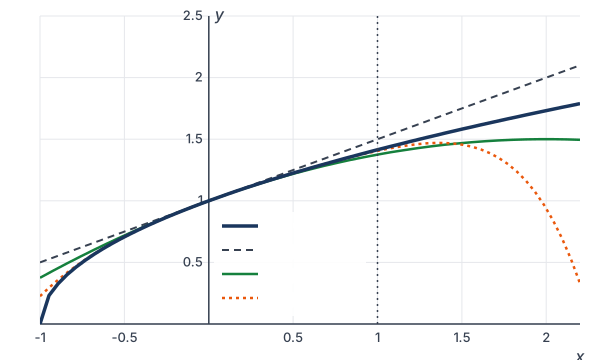
The binomial series formula
(1 + x)^k = \sum_{n=0}^{\infty} \binom{k}{n} x^n, \quad |x| \lt 1\binom{k}{n} = \dfrac{k(k - 1)(k - 2)\cdots(k - n + 1)}{n!}, \quad \binom{k}{0} = 1- The top of \binom{k}{n} has n factors, starting at k and going down by 1 each time.
- If k is a whole number, the series stops after the x^k term; this is the binomial theorem.
- Otherwise the radius of convergence is 1. Whether the endpoints x = ±1 are included depends on k.
- For (a + x)^k, factor out a first: (a + x)^k = a^k\left(1 + \frac{x}{a}\right)^k, valid for |x| < |a|.
How to use the binomial series
- Write the expression as (1 + u)^k, factoring out a constant if needed.
- Find the coefficients \binom{k}{0}, \binom{k}{1}, \binom{k}{2}, \binom{k}{3}, \ldots one at a time.
- Multiply each by the matching power of u and simplify.
- State where it is valid: |u| < 1.
Binomial series examples
Example 1: The series for a square root
Find the first four terms of the binomial series for \sqrt{1 + x} = (1 + x)^{1/2}.
\binom{1/2}{1} = \dfrac{1}{2}One factor: k = 1/2.
\binom{1/2}{2} = \dfrac{\frac{1}{2}\left(-\frac{1}{2}\right)}{2!} = \dfrac{-1/4}{2} = -\dfrac{1}{8}Two factors: 1/2 and 1/2 − 1 = −1/2. Divide by 2! = 2.
\binom{1/2}{3} = \dfrac{\frac{1}{2}\left(-\frac{1}{2}\right)\left(-\frac{3}{2}\right)}{3!} = \dfrac{3/8}{6} = \dfrac{1}{16}Three factors; multiply the fractions, then divide by 3! = 6.
\sqrt{1 + x} = 1 + \dfrac{1}{2}x - \dfrac{1}{8}x^2 + \dfrac{1}{16}x^3 - \cdotsPut the coefficients on the powers of x.
Answer: \sqrt{1 + x} = 1 + \frac{x}{2} - \frac{x^2}{8} + \frac{x^3}{16} - \cdots for |x| < 1 (and at both endpoints too).
Example 2: A negative power
Find the first four terms of the series for \dfrac{1}{(1 + x)^3}.
\dfrac{1}{(1 + x)^3} = (1 + x)^{-3}Rewrite with a negative exponent (see zero and negative exponents).
\binom{-3}{1} = -3, \quad \binom{-3}{2} = \dfrac{(-3)(-4)}{2} = 6Use the formula with k = −3.
\binom{-3}{3} = \dfrac{(-3)(-4)(-5)}{6} = \dfrac{-60}{6} = -10Three factors, divided by 3! = 6.
(1 + x)^{-3} = 1 - 3x + 6x^2 - 10x^3 + \cdotsPut the coefficients on the powers of x.
Answer: \frac{1}{(1 + x)^3} = 1 - 3x + 6x^2 - 10x^3 + \cdots for |x| < 1.
Example 3: Estimate a cube root
Use four terms of the binomial series to estimate \sqrt[3]{1.06}.
\sqrt[3]{1.06} = (1 + 0.06)^{1/3}k = 1/3 and x = 0.06, which is inside |x| < 1.
\binom{1/3}{1} = \dfrac{1}{3}, \quad \binom{1/3}{2} = \dfrac{\frac{1}{3}\left(-\frac{2}{3}\right)}{2} = -\dfrac{1}{9}Find the first coefficients.
\binom{1/3}{3} = \dfrac{\frac{1}{3}\left(-\frac{2}{3}\right)\left(-\frac{5}{3}\right)}{6} = \dfrac{10/27}{6} = \dfrac{5}{81}Three factors, divided by 3! = 6.
1 + \dfrac{0.06}{3} - \dfrac{0.0036}{9} + \dfrac{5(0.000216)}{81}0.06² = 0.0036 and 0.06³ = 0.000216.
1 + 0.02 - 0.0004 + 0.0000133 \approx 1.0196133
Divide, then combine.
Answer: \sqrt[3]{1.06} \approx 1.019613. (The true value is 1.019613 to six decimal places.)
Example 4: Building an arcsine series
Find the series for \dfrac{1}{\sqrt{1 - x^2}}, then integrate it to get a series for arcsin x.
\dfrac{1}{\sqrt{1 - x^2}} = (1 + u)^{-1/2}, \quad u = -x^2Rewrite in the form (1 + u)ᵏ.
\binom{-1/2}{1} = -\dfrac{1}{2}, \; \binom{-1/2}{2} = \dfrac{3}{8}, \; \binom{-1/2}{3} = -\dfrac{5}{16}For example, (−1/2)(−3/2)/2 = 3/8 and (−1/2)(−3/2)(−5/2)/6 = −5/16.
(1 - x^2)^{-1/2} = 1 + \dfrac{1}{2}x^2 + \dfrac{3}{8}x^4 + \dfrac{5}{16}x^6 + \cdotsPut u = −x² into each term; the minus signs cancel in pairs.
\arcsin x = x + \dfrac{x^3}{6} + \dfrac{3x^5}{40} + \dfrac{5x^7}{112} + \cdotsIntegrate term by term (see integrating power series); C = arcsin 0 = 0.
Answer: \arcsin x = x + \frac{x^3}{6} + \frac{3x^5}{40} + \cdots for |x| < 1.
Example 5: Time dilation (word problem)
In relativity, a clock moving at speed v runs slow by the factor \gamma = \left(1 - \frac{v^2}{c^2}\right)^{-1/2}, where c is the speed of light. Use three terms of the binomial series to find γ when v = 0.1c.
\gamma = (1 + u)^{-1/2}, \quad u = -\dfrac{v^2}{c^2} = -0.01With v = 0.1c, v²/c² = 0.01.
\gamma \approx 1 - \dfrac{1}{2}u + \dfrac{3}{8}u^2Use the coefficients from Example 4.
1 - \dfrac{1}{2}(-0.01) + \dfrac{3}{8}(0.0001) = 1 + 0.005 + 0.0000375(−0.01)² = 0.0001.
1 + 0.005 + 0.0000375 = 1.0050375
Combine.
Answer: γ ≈ 1.00504, so the moving clock runs about 0.5% slow. (The true value is 1.0050378.)
Common mistakes
| Mistake | Example of the error | Fix |
|---|---|---|
| Using ordinary binomial coefficients | Treating \binom{1/2}{2} as “1/2 choose 2” from Pascal’s triangle | Use the formula: \frac{(1/2)(-1/2)}{2!} = -\frac{1}{8}. |
| Forgetting n! in the bottom | Writing \binom{-3}{3} = (-3)(-4)(-5) = -60 | Divide by 3! = 6 to get −10. |
| Not factoring out the constant | Expanding \sqrt{4 + x} as (1 + (3 + x))^{1/2} | Write 2\left(1 + \frac{x}{4}\right)^{1/2} so the inside is small. |
| Using it outside |x| < 1 | Putting x = 3 into the series for \sqrt{1 + x} to find 2 | The series diverges there. Factor so the inside is less than 1. |
| Missing the sign of u | For (1 - x^2)^{-1/2}, using u = x² | Here u = −x², so each power of u brings its own sign. |
| Thinking the series stops for k = 1/2 | Stopping after the x term | Only whole-number k stops; for other k the series goes on forever. |
Related methods
The geometric series is a binomial series
With k = −1 and x replaced by −x, the binomial series gives (1 - x)^{-1} = 1 + x + x^2 + \cdots, the geometric series from power series. With k = −2 it gives \frac{1}{(1 - x)^2} = \sum (n + 1)x^n.
Quick approximations
The first two terms, (1 + x)^k \approx 1 + kx, are the linear approximation of (1 + x)^k at x = 0. Physics and engineering use this shortcut constantly for small x.
Practice problems
- Find the first four terms of the binomial series for (1 + x)^{1/3}.
- Find the first four terms of the series for \dfrac{1}{(1 + x)^2}.
- Find the first four terms of the series for \sqrt{1 + 2x}, and say where it is valid.
- Find the first four terms of the series for \sqrt{4 + x}.
- Use three terms to estimate \sqrt{1.04}.
- What is the radius of convergence of the series for \left(1 + \frac{x}{3}\right)^{-1/2}?
- Use the binomial series to expand (1 + x)^4. What happens?
- Use the binomial series with k = −2 to find the series for \dfrac{1}{(1 - x)^2}.
- Find the coefficient of x^3 in the series for (1 + x)^{3/2}.
- A cube-shaped box has a volume of 1030 cm³. Its edge is \sqrt[3]{1030} = 10(1 + 0.03)^{1/3} cm. Use three terms to estimate the edge.
Show answers
1.
\binom{1/3}{1} = \dfrac{1}{3}, \; \binom{1/3}{2} = -\dfrac{1}{9}, \; \binom{1/3}{3} = \dfrac{5}{81}From Example 3.
Answer: 1 + \dfrac{x}{3} - \dfrac{x^2}{9} + \dfrac{5x^3}{81} - \cdots
2.
\binom{-2}{1} = -2, \; \binom{-2}{2} = \dfrac{(-2)(-3)}{2} = 3Use k = −2.
\binom{-2}{3} = \dfrac{(-2)(-3)(-4)}{6} = -4Three factors, divided by 3! = 6.
Answer: 1 - 2x + 3x^2 - 4x^3 + \cdots for |x| < 1
3.
(1 + 2x)^{1/2} = 1 + \dfrac{1}{2}(2x) - \dfrac{1}{8}(2x)^2 + \dfrac{1}{16}(2x)^3Use the coefficients from Example 1 with u = 2x.
1 + x - \dfrac{4x^2}{8} + \dfrac{8x^3}{16} = 1 + x - \dfrac{x^2}{2} + \dfrac{x^3}{2}(2x)² = 4x² and (2x)³ = 8x³.
|2x| \lt 1 \quad \Leftrightarrow \quad |x| \lt \dfrac{1}{2}The series needs |u| < 1.
Answer: 1 + x - \dfrac{x^2}{2} + \dfrac{x^3}{2} - \cdots for |x| < 1/2
4.
\sqrt{4 + x} = 2\left(1 + \dfrac{x}{4}\right)^{1/2}Factor out 4; √4 = 2.
2\left[1 + \dfrac{1}{2} \cdot \dfrac{x}{4} - \dfrac{1}{8} \cdot \dfrac{x^2}{16} + \dfrac{1}{16} \cdot \dfrac{x^3}{64}\right]Use u = x/4.
2 + \dfrac{x}{4} - \dfrac{x^2}{64} + \dfrac{x^3}{512}Multiply each term by 2.
Answer: 2 + \dfrac{x}{4} - \dfrac{x^2}{64} + \dfrac{x^3}{512} - \cdots for |x| < 4
5.
\sqrt{1.04} \approx 1 + \dfrac{0.04}{2} - \dfrac{(0.04)^2}{8}x = 0.04.
1 + 0.02 - \dfrac{0.0016}{8} = 1 + 0.02 - 0.0002 = 1.0198Divide, then combine.
Answer: about 1.0198 (true value 1.019804)
6.
\left|\dfrac{x}{3}\right| \lt 1The series in u = x/3 needs |u| < 1.
|x| \lt 3
Multiply by 3.
Answer: R = 3
7.
\binom{4}{1} = 4, \; \binom{4}{2} = 6, \; \binom{4}{3} = 4, \; \binom{4}{4} = 1For example, (4)(3)(2)/3! = 4.
\binom{4}{5} = \dfrac{4 \cdot 3 \cdot 2 \cdot 1 \cdot 0}{5!} = 0From n = 5 on, a factor of 0 appears.
Answer: 1 + 4x + 6x^2 + 4x^3 + x^4; the series stops, matching the binomial theorem
8.
(1 + u)^{-2} = 1 - 2u + 3u^2 - 4u^3 + \cdotsFrom #2, with u in place of x.
(1 - x)^{-2} = 1 + 2x + 3x^2 + 4x^3 + \cdotsPut in u = −x; every sign becomes +.
Answer: \sum_{n=0}^{\infty} (n + 1)x^n for |x| < 1
9.
\binom{3/2}{3} = \dfrac{\frac{3}{2} \cdot \frac{1}{2} \cdot \left(-\frac{1}{2}\right)}{3!}Three factors: 3/2, 1/2 and −1/2.
\dfrac{-3/8}{6} = -\dfrac{3}{48} = -\dfrac{1}{16}Multiply, then divide by 6.
Answer: −1/16
10.
10(1 + 0.03)^{1/3} \approx 10\left[1 + \dfrac{0.03}{3} - \dfrac{(0.03)^2}{9}\right]Use the coefficients 1, 1/3 and −1/9 from Example 3.
10\left[1 + 0.01 - 0.0001\right] = 10(1.0099) = 10.099
0.03² = 0.0009 and 0.0009/9 = 0.0001.
Answer: about 10.099 cm (true value 10.09902)
Binomial series FAQ
What is the binomial series?
It is the Maclaurin series of (1 + x)^k for any real number k: \sum \binom{k}{n} x^n, where \binom{k}{n} = \frac{k(k - 1)\cdots(k - n + 1)}{n!}.
When does the binomial series converge?
If k is a whole number, it is a finite sum and works for every x. Otherwise it converges for |x| < 1; the endpoints depend on k.
What is the difference between the binomial theorem and the binomial series?
The binomial theorem expands (a + b)^n for a whole number n and always stops. The binomial series handles any real power, so it usually never stops.
How do you find a binomial coefficient for a fraction?
Multiply n factors starting at k and going down by 1, then divide by n!. For example, \binom{1/2}{2} = \frac{(1/2)(-1/2)}{2} = -\frac{1}{8}.
Summary
- (1 + x)^k = \sum \binom{k}{n} x^n for |x| < 1, with \binom{k}{n} = \frac{k(k-1)\cdots(k-n+1)}{n!}.
- Whole-number k gives a finite sum: the binomial theorem.
- Factor out constants so the expression is (1 + u)^k with |u| < 1.
- Use it for roots, negative powers and quick estimates like (1 + x)ᵏ ≈ 1 + kx.
- Integrating a binomial series can give series for functions like arcsin x.
Previous lesson: Differentiating and Integrating Power Series
Next course: Statistics Index
Back to the Calculus 2 Index