
Maclaurin Series
A Maclaurin series is a Taylor series centered at 0: f(x) = \sum_{n=0}^{\infty} \frac{f^{(n)}(0)}{n!}x^n. The ones to know are the series for e^x, sin x, cos x, \frac{1}{1 - x}, ln(1 + x) and arctan x. To get a new series, substitute into one of these, such as −x² for x in the series for e^x.
Before this lesson: Taylor Series, Power Series and Taylor Polynomials
Why Maclaurin series are so useful
Centering at 0 makes the derivatives easy to evaluate, and the series use plain powers of x. A handful of these series can be memorized, and then hundreds of other series can be built from them without taking a single derivative.
Calculators use the same idea: to find sin 0.3, they add a few terms of the sine series. The terms shrink so quickly that a few are enough.
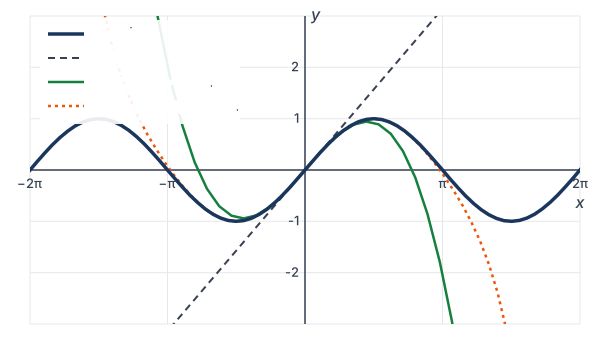
Common Maclaurin series
| Function | Maclaurin series | Valid for |
|---|---|---|
| e^x | \sum_{n=0}^{\infty} \frac{x^n}{n!} = 1 + x + \frac{x^2}{2!} + \frac{x^3}{3!} + \cdots | every x |
| \sin x | \sum_{n=0}^{\infty} \frac{(-1)^n x^{2n+1}}{(2n+1)!} = x - \frac{x^3}{3!} + \frac{x^5}{5!} - \cdots | every x |
| \cos x | \sum_{n=0}^{\infty} \frac{(-1)^n x^{2n}}{(2n)!} = 1 - \frac{x^2}{2!} + \frac{x^4}{4!} - \cdots | every x |
| \frac{1}{1 - x} | \sum_{n=0}^{\infty} x^n = 1 + x + x^2 + \cdots | −1 < x < 1 |
| \ln(1 + x) | \sum_{n=1}^{\infty} \frac{(-1)^{n-1} x^n}{n} = x - \frac{x^2}{2} + \frac{x^3}{3} - \cdots | −1 < x ≤ 1 |
| \arctan x | \sum_{n=0}^{\infty} \frac{(-1)^n x^{2n+1}}{2n + 1} = x - \frac{x^3}{3} + \frac{x^5}{5} - \cdots | −1 ≤ x ≤ 1 |
Patterns help you remember them. Sine is odd, so it has only odd powers; cosine is even, so it has only even powers. The ln(1 + x) and arctan x series look like the sine and cosine pattern but divide by n instead of n!.
How to build a new Maclaurin series
- Find the known series that matches the outer function.
- Replace every x in that series with the new inside expression, such as 2x or −x².
- Multiply or divide every term by any outside factor, such as x or x².
- Change the interval to match: for example, |−x²| < 1 instead of |x| < 1.
Maclaurin series examples
Example 1: The series for eˣ
Find the Maclaurin series of e^x and show that it converges for every x.
f^{(n)}(0) = e^0 = 1Every derivative of eˣ is eˣ (see derivatives of exponential functions).
c_n = \dfrac{1}{n!}Divide by n!.
e^x = \sum_{n=0}^{\infty} \dfrac{x^n}{n!}Write the series in powers of x.
\left|\dfrac{x^{n+1}/(n + 1)!}{x^n/n!}\right| = \dfrac{|x|}{n + 1} \to 0Ratio test: the limit is 0 for every x, so R = ∞.
Answer: e^x = 1 + x + \frac{x^2}{2!} + \frac{x^3}{3!} + \cdots for every x. At x = 1 this gives e = 1 + 1 + \frac{1}{2} + \frac{1}{6} + \cdots \approx 2.718.
Example 2: Substitute into the series for eˣ
Find the Maclaurin series of e^{-x^2}.
e^u = \sum_{n=0}^{\infty} \dfrac{u^n}{n!}Start from the known series, with u in place of x.
e^{-x^2} = \sum_{n=0}^{\infty} \dfrac{(-x^2)^n}{n!}Replace u with −x².
\sum_{n=0}^{\infty} \dfrac{(-x^2)^n}{n!} = \sum_{n=0}^{\infty} \dfrac{(-1)^n x^{2n}}{n!}(−x²)ⁿ = (−1)ⁿx²ⁿ (see exponent rules).
Answer: e^{-x^2} = 1 - x^2 + \frac{x^4}{2!} - \frac{x^6}{3!} + \cdots for every x.
Example 3: Substitute, then multiply
Find the Maclaurin series of x\sin(2x) and its first three nonzero terms.
\sin(2x) = \sum_{n=0}^{\infty} \dfrac{(-1)^n (2x)^{2n+1}}{(2n+1)!}Replace x with 2x in the sine series.
\sum_{n=0}^{\infty} \dfrac{(-1)^n (2x)^{2n+1}}{(2n+1)!} = \sum_{n=0}^{\infty} \dfrac{(-1)^n 2^{2n+1} x^{2n+1}}{(2n+1)!}(2x)²ⁿ⁺¹ = 2²ⁿ⁺¹x²ⁿ⁺¹.
x\sin(2x) = \sum_{n=0}^{\infty} \dfrac{(-1)^n 2^{2n+1} x^{2n+2}}{(2n+1)!}Multiply every term by x: add 1 to each exponent.
n = 0, 1, 2: \quad \dfrac{2x^2}{1!}, \; -\dfrac{8x^4}{3!}, \; \dfrac{32x^6}{5!}Put in n = 0, 1 and 2.
2x^2 - \dfrac{4}{3}x^4 + \dfrac{4}{15}x^6Simplify: 8/6 = 4/3 and 32/120 = 4/15.
Answer: x\sin(2x) = 2x^2 - \frac{4}{3}x^4 + \frac{4}{15}x^6 - \cdots for every x.
Example 4: Use a series to find a limit
Find \lim_{x \to 0} \dfrac{\sin x - x}{x^3}.
\sin x - x = \left(x - \dfrac{x^3}{6} + \dfrac{x^5}{120} - \cdots\right) - xReplace sin x with its series; 3! = 6 and 5! = 120.
\sin x - x = -\dfrac{x^3}{6} + \dfrac{x^5}{120} - \cdotsThe x terms cancel.
\dfrac{\sin x - x}{x^3} = -\dfrac{1}{6} + \dfrac{x^2}{120} - \cdotsDivide every term by x³.
\lim_{x \to 0} \left(-\dfrac{1}{6} + \dfrac{x^2}{120} - \cdots\right) = -\dfrac{1}{6}Every term with a power of x goes to 0.
Answer: the limit is −1/6. This is faster than using L’Hôpital’s rule three times.
Example 5: Continuous interest (word problem)
A bank pays 4% interest compounded continuously, so $5,000 grows to 5000e^{0.04} dollars in one year. Use the first three terms of the series for e^x to estimate the balance.
e^{0.04} \approx 1 + 0.04 + \dfrac{(0.04)^2}{2}Use 1 + x + x²/2 with x = 0.04.
1 + 0.04 + \dfrac{0.0016}{2} = 1 + 0.04 + 0.0008 = 1.0408Square, divide, then add.
5000(1.0408) = 5204
Multiply by the starting amount.
5000 \cdot \dfrac{(0.04)^3}{6} \approx 0.05The next term is the size of the error, roughly.
Answer: about $5,204.00. The next term adds only about 5 cents; the exact balance is $5,204.05.
Common mistakes
| Mistake | Example of the error | Fix |
|---|---|---|
| Substituting into only part of the term | Writing e^{2x} = \sum \frac{2x^n}{n!} | Replace all of x with 2x: \sum \frac{(2x)^n}{n!} = \sum \frac{2^n x^n}{n!}. |
| Mixing up the sine and cosine powers | Writing \sin x = 1 - \frac{x^2}{2!} + \cdots | Sine is odd: x, x³, x⁵. Cosine is even: 1, x², x⁴. |
| Confusing (2n)! with 2n! | Writing (2n)! = 2 · n! | (2n)! is the factorial of 2n: for n = 2 it is 4! = 24, not 2 · 2! = 4. |
| Forgetting where a series is valid | Using the ln(1 + x) series at x = 3 | It works only for −1 < x ≤ 1. |
| Not changing the interval after substituting | Saying \frac{1}{1 + x^2} = \sum (-1)^n x^{2n} for all x | The geometric series needs |−x²| < 1, so |x| < 1. |
| Dropping the sign pattern | Writing \cos x = 1 + \frac{x^2}{2!} + \frac{x^4}{4!} + \cdots | The signs alternate: 1 - \frac{x^2}{2!} + \frac{x^4}{4!} - \cdots. |
Related methods
Where ln(1 + x) and arctan x come from
These two series come from the geometric series. Integrating \frac{1}{1 + x} = \sum (-1)^n x^n term by term gives ln(1 + x), and integrating \frac{1}{1 + x^2} gives arctan x. The next lesson shows how to differentiate and integrate power series this way.
Series for any center
When you need a series centered somewhere other than 0, use the general Taylor series formula with powers of (x − a).
Practice problems
- Find the Maclaurin series of e^{3x}.
- Find the Maclaurin series of \cos(x^2).
- Find the Maclaurin series of x^2 e^x.
- Find the Maclaurin series of \dfrac{\sin x}{x} (for x ≠ 0).
- Find the Maclaurin series of ln(1 + 3x) and where it is valid.
- Find the first three nonzero terms of the Maclaurin series of arctan(2x).
- Use a series to find \lim_{x \to 0} \dfrac{1 - \cos x}{x^2}.
- Use the Maclaurin series of sin(2x) to find the fifth derivative of sin(2x) at x = 0.
- What function has the Maclaurin series \sum_{n=0}^{\infty} \dfrac{(-1)^n 9^n x^{2n}}{(2n)!}?
- A radioactive sample keeps the fraction e^{-0.06} of its mass after 3 years. Use three terms of the series for e^x to estimate this fraction.
Show answers
1.
e^{3x} = \sum_{n=0}^{\infty} \dfrac{(3x)^n}{n!}Replace x with 3x.
\sum_{n=0}^{\infty} \dfrac{(3x)^n}{n!} = \sum_{n=0}^{\infty} \dfrac{3^n x^n}{n!}(3x)ⁿ = 3ⁿxⁿ.
Answer: \sum \dfrac{3^n x^n}{n!} = 1 + 3x + \dfrac{9x^2}{2} + \cdots for every x
2.
\cos(x^2) = \sum_{n=0}^{\infty} \dfrac{(-1)^n (x^2)^{2n}}{(2n)!}Replace x with x² in the cosine series.
\sum_{n=0}^{\infty} \dfrac{(-1)^n (x^2)^{2n}}{(2n)!} = \sum_{n=0}^{\infty} \dfrac{(-1)^n x^{4n}}{(2n)!}(x²)²ⁿ = x⁴ⁿ.
Answer: 1 - \dfrac{x^4}{2!} + \dfrac{x^8}{4!} - \cdots for every x
3.
x^2 e^x = x^2 \sum_{n=0}^{\infty} \dfrac{x^n}{n!}Start from the series for eˣ.
x^2 \sum_{n=0}^{\infty} \dfrac{x^n}{n!} = \sum_{n=0}^{\infty} \dfrac{x^{n+2}}{n!}Multiply every term by x².
Answer: x^2 + x^3 + \dfrac{x^4}{2!} + \dfrac{x^5}{3!} + \cdots for every x
4.
\dfrac{\sin x}{x} = \dfrac{1}{x}\sum_{n=0}^{\infty} \dfrac{(-1)^n x^{2n+1}}{(2n+1)!}Start from the sine series.
\dfrac{1}{x}\sum_{n=0}^{\infty} \dfrac{(-1)^n x^{2n+1}}{(2n+1)!} = \sum_{n=0}^{\infty} \dfrac{(-1)^n x^{2n}}{(2n+1)!}Divide every term by x: subtract 1 from each exponent.
Answer: 1 - \dfrac{x^2}{3!} + \dfrac{x^4}{5!} - \cdots
5.
\ln(1 + 3x) = \sum_{n=1}^{\infty} \dfrac{(-1)^{n-1}(3x)^n}{n} = \sum_{n=1}^{\infty} \dfrac{(-1)^{n-1} 3^n x^n}{n}Replace x with 3x.
-1 \lt 3x \le 1 \quad \Leftrightarrow \quad -\dfrac{1}{3} \lt x \le \dfrac{1}{3}Divide the interval for ln(1 + x) by 3.
Answer: 3x - \dfrac{9x^2}{2} + 9x^3 - \cdots for −1/3 < x ≤ 1/3
6.
\arctan(2x) = 2x - \dfrac{(2x)^3}{3} + \dfrac{(2x)^5}{5} - \cdotsReplace x with 2x in the arctan series.
2x - \dfrac{8x^3}{3} + \dfrac{32x^5}{5}(2x)³ = 8x³ and (2x)⁵ = 32x⁵.
Answer: 2x - \dfrac{8}{3}x^3 + \dfrac{32}{5}x^5
7.
1 - \cos x = \dfrac{x^2}{2} - \dfrac{x^4}{24} + \cdotsSubtract the cosine series from 1; the 1s cancel.
\dfrac{1 - \cos x}{x^2} = \dfrac{1}{2} - \dfrac{x^2}{24} + \cdotsDivide by x².
Answer: the limit is 1/2
8.
\sin(2x) = 2x - \dfrac{8x^3}{6} + \dfrac{32x^5}{120} - \cdotsReplace x with 2x in the sine series.
\dfrac{f^{(5)}(0)}{5!} = \dfrac{32}{120}The x⁵ coefficient of a Maclaurin series is f⁽⁵⁾(0)/5!.
f^{(5)}(0) = 32Multiply both sides by 5! = 120.
Answer: 32
9.
\dfrac{(-1)^n 9^n x^{2n}}{(2n)!} = \dfrac{(-1)^n (3x)^{2n}}{(2n)!}9ⁿx²ⁿ = (3x)²ⁿ.
\sum_{n=0}^{\infty} \dfrac{(-1)^n (3x)^{2n}}{(2n)!} = \cos(3x)This is the cosine series with 3x in place of x.
Answer: cos(3x)
10.
e^{-0.06} \approx 1 - 0.06 + \dfrac{(0.06)^2}{2}Use 1 + x + x²/2 with x = −0.06.
1 - 0.06 + \dfrac{0.0036}{2} = 1 - 0.06 + 0.0018 = 0.9418Square, divide, then combine.
Answer: about 0.9418, or 94.18% of the mass (true value 0.94176)
Maclaurin series FAQ
What is a Maclaurin series?
It is a Taylor series centered at x = 0: \sum \frac{f^{(n)}(0)}{n!}x^n. It writes a function as an infinite polynomial in powers of x.
Which Maclaurin series should I memorize?
Learn the series for e^x, sin x, cos x and \frac{1}{1 - x}, with their intervals. The series for ln(1 + x) and arctan x are also worth knowing, since they come up often.
How do you find a Maclaurin series by substitution?
Start from a known series, replace every x with the new expression, then simplify. For example, e^{2x} = \sum \frac{(2x)^n}{n!} = \sum \frac{2^n x^n}{n!}.
What is the Maclaurin series for eˣ?
e^x = 1 + x + \frac{x^2}{2!} + \frac{x^3}{3!} + \cdots = \sum_{n=0}^{\infty} \frac{x^n}{n!}, and it is valid for every real number x.
Summary
- A Maclaurin series is a Taylor series centered at 0.
- Know the series for eˣ, sin x, cos x and 1/(1 − x), plus ln(1 + x) and arctan x.
- Build new series by substituting for x and multiplying by powers of x.
- Update the interval after substituting.
- Series give quick estimates and make some limits easy.
Previous lesson: Taylor Series
Next lesson: Differentiating and Integrating Power Series
Back to the Calculus 2 Index