
Ratio Test
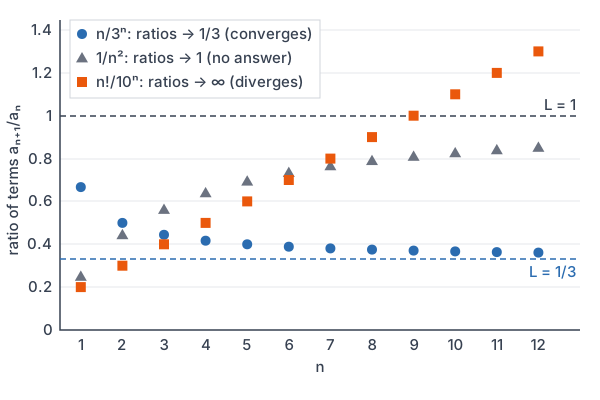
The ratio test decides whether a series converges by looking at the ratio of consecutive terms. Find L = \lim_{n \to \infty} \left|\dfrac{a_{n+1}}{a_n}\right|. If L < 1, the series converges absolutely. If L > 1 (or L = ∞), it diverges. If L = 1, the test gives no answer.
Before this lesson: Absolute and Conditional Convergence, Infinite Geometric Series, Permutations and Combinations (for factorials) and Limits at Infinity
Why the ratio of terms matters
In a geometric series, each term is r times the one before, and the series converges exactly when |r| < 1. Many other series act like this in the long run: far out, each term is about L times the one before.
If L is less than 1, the terms eventually shrink at least as fast as a convergent geometric series, so the series converges. If L is more than 1, the terms eventually grow, so they cannot approach 0 and the series diverges.
The ratio test
L = \lim_{n \to \infty} \left|\dfrac{a_{n+1}}{a_n}\right|- If L < 1, then \sum a_n converges absolutely (and so it converges).
- If L > 1 or L = ∞, then \sum a_n diverges.
- If L = 1, the test is inconclusive. Use a different test.
The ratio test works best when the terms contain factorials like n! or exponentials like 3^n, because those simplify nicely in a ratio. For terms that are just powers of n, such as \frac{1}{n^2}, L is always 1, so use a p-series or comparison test instead.
Factorial facts. (n + 1)! = (n + 1) \cdot n!, so \dfrac{(n + 1)!}{n!} = n + 1. Likewise \dfrac{3^{n+1}}{3^n} = 3.
How to use the ratio test
- Write a_{n+1} by replacing every n in a_n with n + 1.
- Form \left|\dfrac{a_{n+1}}{a_n}\right| and multiply by the reciprocal of a_n.
- Cancel factorials and powers, then find the limit L.
- Compare L with 1.
Ratio test examples
Example 1: A power of n over an exponential
Does \sum_{n=1}^{\infty} \dfrac{n}{3^n} converge?
a_{n+1} = \dfrac{n + 1}{3^{n+1}}Replace n with n + 1.
\dfrac{a_{n+1}}{a_n} = \dfrac{n + 1}{3^{n+1}} \cdot \dfrac{3^n}{n}Multiply by the reciprocal of aₙ.
\dfrac{n + 1}{3^{n+1}} \cdot \dfrac{3^n}{n} = \dfrac{n + 1}{3n}Cancel: 3ⁿ⁺¹ ÷ 3ⁿ = 3 (see exponent rules).
L = \lim_{n \to \infty} \dfrac{n + 1}{3n} = \lim_{n \to \infty} \dfrac{1 + \frac{1}{n}}{3} = \dfrac{1}{3}Divide the top and bottom by n (see limits at infinity).
\dfrac{1}{3} \lt 1Compare L with 1.
Answer: the series converges absolutely. (Its sum is 3/4.)
Example 2: A factorial in the denominator
Does \sum_{n=0}^{\infty} \dfrac{5^n}{n!} converge?
\dfrac{a_{n+1}}{a_n} = \dfrac{5^{n+1}}{(n + 1)!} \cdot \dfrac{n!}{5^n}Multiply by the reciprocal of aₙ.
\dfrac{5^{n+1}}{5^n} \cdot \dfrac{n!}{(n + 1)!} = 5 \cdot \dfrac{1}{n + 1}Group the powers and the factorials; (n + 1)! = (n + 1) · n!.
L = \lim_{n \to \infty} \dfrac{5}{n + 1} = 0The denominator grows without bound.
0 \lt 1
Compare L with 1.
Answer: the series converges absolutely. Factorials grow faster than any exponential. (Its sum is e⁵ ≈ 148.4.)
Example 3: A factorial in the numerator
Does \sum_{n=1}^{\infty} \dfrac{n!}{10^n} converge?
\dfrac{a_{n+1}}{a_n} = \dfrac{(n + 1)!}{10^{n+1}} \cdot \dfrac{10^n}{n!}Multiply by the reciprocal of aₙ.
\dfrac{(n + 1)!}{n!} \cdot \dfrac{10^n}{10^{n+1}} = \dfrac{n + 1}{10}Cancel the factorials and the powers of 10.
L = \lim_{n \to \infty} \dfrac{n + 1}{10} = \inftyThe ratio grows without bound.
Answer: the series diverges. The terms shrink at first (0.1, 0.02, 0.006, …), but from n = 10 on each term is at least as big as the one before, so the terms never approach 0 and the series fails the divergence test.
Example 4: When the ratio test fails
Apply the ratio test to \sum_{n=1}^{\infty} \dfrac{1}{n} and to \sum_{n=1}^{\infty} \dfrac{1}{n^2}.
\dfrac{a_{n+1}}{a_n} = \dfrac{1}{n + 1} \cdot \dfrac{n}{1} = \dfrac{n}{n + 1}For the harmonic series, aₙ = 1/n. Multiply by the reciprocal of aₙ.
L = \lim_{n \to \infty} \dfrac{n}{n + 1} = 1Divide the top and bottom by n.
\dfrac{a_{n+1}}{a_n} = \dfrac{1}{(n + 1)^2} \cdot \dfrac{n^2}{1} = \left(\dfrac{n}{n + 1}\right)^2For aₙ = 1/n², multiply by the reciprocal of aₙ.
L = \left(\lim_{n \to \infty} \dfrac{n}{n + 1}\right)^2 = 1^2 = 1The inside limit is 1, as before.
\text{Both give } L = 1The test is inconclusive for both.
Answer: the ratio test says nothing here. Yet the first series diverges and the second converges, as the p-series test shows. This is why L = 1 never decides anything.
Example 5: Copies of a file (word problem)
A file-sharing model predicts 100 \cdot \dfrac{n^2}{2^n} new copies of a file on day n. Is the total number of copies over all time finite? (The model’s total turns out to be 600 copies.)
a_n = \dfrac{100n^2}{2^n}Write the term.
\dfrac{a_{n+1}}{a_n} = \dfrac{100(n + 1)^2}{2^{n+1}} \cdot \dfrac{2^n}{100n^2}Multiply by the reciprocal of aₙ.
\dfrac{100(n + 1)^2}{2^{n+1}} \cdot \dfrac{2^n}{100n^2} = \dfrac{1}{2}\left(\dfrac{n + 1}{n}\right)^2Cancel the 100s, and 2ⁿ ÷ 2ⁿ⁺¹ = 1/2.
L = \lim_{n \to \infty} \dfrac{1}{2}\left(1 + \dfrac{1}{n}\right)^2 = \dfrac{1}{2}1/n goes to 0.
\dfrac{1}{2} \lt 1Compare L with 1.
Answer: yes, the total converges. New copies peak around day 3 (about 113) and then fall off, so the all-time total levels off at 600 copies.
Common mistakes
| Mistake | Example of the error | Fix |
|---|---|---|
| Deciding anything when L = 1 | “L = 1 for \sum 1/n^2, so it diverges” | L = 1 gives no answer. Use another test; here the p-series test shows convergence. |
| Mishandling factorials | Writing \frac{(n+1)!}{n!} = 1 or (n + 1)! = n! + 1 | (n + 1)! = (n + 1) \cdot n!, so the ratio is n + 1. |
| Flipping the ratio | Using \frac{a_n}{a_{n+1}} | The test uses \frac{a_{n+1}}{a_n}: the next term over the current one. Flipping it changes L to 1/L. |
| Forgetting the absolute value | Getting L = −1/2 for \sum (-1)^n/2^n and saying it is less than 1 “by a lot” | Take the absolute value: L = 1/2. The sign never affects L. |
| Replacing only some of the n’s | Writing a_{n+1} = \frac{n + 1}{3^n} for a_n = \frac{n}{3^n} | Replace every n: a_{n+1} = \frac{n + 1}{3^{n+1}}. |
| Using it on simple powers of n | Using the ratio test on \frac{3n + 1}{n^3} | For terms that are only powers of n, L = 1. Use a comparison test. |
Related methods
Ratio test or root test?
The root test, the next lesson, uses \sqrt[n]{|a_n|} instead of a ratio. It is easier when the whole term is raised to the nth power, like \left(\frac{2n}{3n + 1}\right)^n. The ratio test is easier with factorials.
Radius of convergence
The ratio test is the main tool for power series in Unit 7. There, L depends on x, and the condition L < 1 gives the interval where the power series converges.
Practice problems
- Does \sum_{n=0}^{\infty} \dfrac{2^n}{n!} converge?
- Does \sum_{n=1}^{\infty} \dfrac{n^2}{4^n} converge?
- Does \sum_{n=1}^{\infty} \dfrac{3^n}{n^2} converge?
- Does \sum_{n=1}^{\infty} \dfrac{n!}{n^n} converge?
- Does \sum_{n=1}^{\infty} \dfrac{(-1)^n 4^n}{n \cdot 5^n} converge? If so, how?
- What does the ratio test say about \sum_{n=1}^{\infty} \dfrac{2n + 1}{n^3}? Does the series converge?
- Does \sum_{n=0}^{\infty} \dfrac{(2n)!}{(n!)^2 \cdot 5^n} converge?
- Does \sum_{n=0}^{\infty} \dfrac{10^n}{(2n)!} converge?
- Does \sum_{n=1}^{\infty} \dfrac{n^5}{1.01^n} converge?
- A video gets 1000 \cdot \dfrac{3^n}{n!} new views on day n, starting at n = 1. Is the total number of views finite? (Hint: \sum_{n=0}^{\infty} 3^n/n! = e^3.)
Show answers
1.
\dfrac{2^{n+1}}{(n + 1)!} \cdot \dfrac{n!}{2^n} = \dfrac{2}{n + 1}Form the ratio and cancel.
L = \lim_{n \to \infty} \dfrac{2}{n + 1} = 0Take the limit.
Answer: L = 0 < 1, so it converges absolutely
2.
\dfrac{(n + 1)^2}{4^{n+1}} \cdot \dfrac{4^n}{n^2} = \dfrac{1}{4}\left(\dfrac{n + 1}{n}\right)^2Form the ratio and cancel.
L = \dfrac{1}{4}(n + 1)/n goes to 1.
Answer: L = 1/4 < 1, so it converges absolutely
3.
\dfrac{3^{n+1}}{(n + 1)^2} \cdot \dfrac{n^2}{3^n} = 3\left(\dfrac{n}{n + 1}\right)^2Form the ratio and cancel.
L = 3
n/(n + 1) goes to 1.
Answer: L = 3 > 1, so it diverges
4.
\dfrac{(n + 1)!}{(n + 1)^{n+1}} \cdot \dfrac{n^n}{n!} = \dfrac{(n + 1) n^n}{(n + 1)^{n+1}}Form the ratio; (n + 1)!/n! = n + 1.
\dfrac{(n + 1) n^n}{(n + 1)^{n+1}} = \dfrac{n^n}{(n + 1)^n} = \left(\dfrac{n}{n + 1}\right)^nCancel one factor of n + 1.
\left(\dfrac{n}{n + 1}\right)^n = \dfrac{1}{\left(1 + \frac{1}{n}\right)^n}Flip the fraction inside.
L = \dfrac{1}{e} \approx 0.368(1 + 1/n)ⁿ goes to e (see the number e).
Answer: L = 1/e < 1, so it converges absolutely
5.
\left|\dfrac{a_{n+1}}{a_n}\right| = \dfrac{4^{n+1}}{(n + 1) 5^{n+1}} \cdot \dfrac{n \cdot 5^n}{4^n}Take absolute values; the signs drop out.
\dfrac{4^{n+1}}{(n + 1) 5^{n+1}} \cdot \dfrac{n \cdot 5^n}{4^n} = \dfrac{4}{5} \cdot \dfrac{n}{n + 1}Cancel.
L = \dfrac{4}{5}n/(n + 1) goes to 1.
Answer: L = 4/5 < 1, so it converges absolutely
6.
\dfrac{2(n + 1) + 1}{(n + 1)^3} \cdot \dfrac{n^3}{2n + 1} = \dfrac{2n + 3}{2n + 1} \cdot \left(\dfrac{n}{n + 1}\right)^3Form the ratio.
L = 1 \cdot 1 = 1
Both factors go to 1, so the ratio test is inconclusive.
\lim_{n \to \infty} \dfrac{(2n + 1)/n^3}{1/n^2} = \lim_{n \to \infty} \dfrac{2n + 1}{n} = 2Use the limit comparison test with 1/n² instead.
Answer: the ratio test gives no answer; the series converges by limit comparison with Σ1/n²
7.
\dfrac{(2n + 2)!}{((n + 1)!)^2 5^{n+1}} \cdot \dfrac{(n!)^2 5^n}{(2n)!} = \dfrac{(2n + 2)(2n + 1)}{5(n + 1)^2}(2n + 2)! = (2n + 2)(2n + 1)(2n)! and ((n + 1)!)² = (n + 1)²(n!)².
\dfrac{(2n + 2)(2n + 1)}{5(n + 1)^2} = \dfrac{2(2n + 1)}{5(n + 1)}Cancel one factor: 2n + 2 = 2(n + 1).
L = \lim_{n \to \infty} \dfrac{4n + 2}{5n + 5} = \dfrac{4}{5}Divide the top and bottom by n.
Answer: L = 4/5 < 1, so it converges absolutely
8.
\dfrac{10^{n+1}}{(2n + 2)!} \cdot \dfrac{(2n)!}{10^n} = \dfrac{10}{(2n + 2)(2n + 1)}(2n + 2)! = (2n + 2)(2n + 1)(2n)!.
L = 0
The denominator grows without bound.
Answer: L = 0 < 1, so it converges absolutely
9.
\dfrac{(n + 1)^5}{1.01^{n+1}} \cdot \dfrac{1.01^n}{n^5} = \dfrac{1}{1.01}\left(\dfrac{n + 1}{n}\right)^5Form the ratio and cancel.
L = \dfrac{1}{1.01} \approx 0.990(n + 1)/n goes to 1.
Answer: L < 1, so it converges (even though the terms first grow for hundreds of days)
10.
\dfrac{3^{n+1}}{(n + 1)!} \cdot \dfrac{n!}{3^n} = \dfrac{3}{n + 1}Form the ratio and cancel.
L = \lim_{n \to \infty} \dfrac{3}{n + 1} = 0Take the limit. L is less than 1, so the total converges.
1000\sum_{n=1}^{\infty} \dfrac{3^n}{n!} = 1000\left(e^3 - 1\right)The n = 0 term of the hint is 1, so subtract it.
1000\left(e^3 - 1\right) \approx 19{,}086e³ ≈ 20.086.
Answer: yes, the total is finite: about 19,086 views
Ratio test FAQ
What does the ratio test say?
Find L, the limit of |aₙ₊₁/aₙ|. If L < 1, the series converges absolutely; if L > 1, it diverges; if L = 1, the test gives no answer.
When should I use the ratio test?
Use it when the terms contain factorials or exponentials like 2^n or n^n. These cancel neatly in the ratio. Avoid it for terms built only from powers of n.
Why is the ratio test inconclusive when L = 1?
Series with L = 1 can go either way. Both \sum 1/n and \sum 1/n^2 give L = 1, but the first diverges and the second converges.
Does the ratio test show absolute or conditional convergence?
When L < 1, it shows absolute convergence, because it uses the absolute values of the terms. It can never show conditional convergence.
Summary
- Find L = lim |aₙ₊₁/aₙ|.
- L < 1: converges absolutely. L > 1 or ∞: diverges. L = 1: no answer.
- Use (n + 1)! = (n + 1) \cdot n! and a^{n+1}/a^n = a to simplify.
- Best for factorials and exponentials; useless for plain powers of n.
- The ratio test is the key tool for power series later on.
Previous lesson: Absolute and Conditional Convergence
Next lesson: Root Test
Back to the Calculus 2 Index