
Absolute and Conditional Convergence
A series \sum a_n converges absolutely if the series of absolute values \sum |a_n| converges. It converges conditionally if \sum a_n converges but \sum |a_n| diverges. Absolute convergence always implies convergence. For example, \sum (-1)^n/n^2 converges absolutely, while \sum (-1)^n/n converges conditionally.
Before this lesson: Alternating Series Test, p-Series and Direct Comparison Test
Two ways a series can converge
Some series converge so strongly that the signs do not matter. Make every term positive and the series still converges. That is absolute convergence.
Other series converge only because positive and negative terms cancel each other. Make every term positive and the series diverges. That is conditional convergence: the series converges only on the condition that its signs stay as they are.
The alternating harmonic series 1 - \tfrac{1}{2} + \tfrac{1}{3} - \cdots converges, but 1 + \tfrac{1}{2} + \tfrac{1}{3} + \cdots diverges, so it converges conditionally. In contrast, 1 - \tfrac{1}{4} + \tfrac{1}{9} - \cdots converges and so does 1 + \tfrac{1}{4} + \tfrac{1}{9} + \cdots, so it converges absolutely.
The absolute convergence theorem
\text{If } \sum |a_n| \text{ converges, then } \sum a_n \text{ converges.}Why it works. Each a_n is between -|a_n| and |a_n|, so 0 \le a_n + |a_n| \le 2|a_n|. By the direct comparison test, \sum (a_n + |a_n|) converges. Subtracting the convergent series \sum |a_n| leaves \sum a_n, which therefore converges.
This theorem is powerful because \sum |a_n| has no negative terms, so every test for positive series (comparison, integral, p-series) can be used on it, even when the original signs are irregular.
How to classify a series
- Test \sum |a_n|. If it converges, the series converges absolutely. Stop.
- If \sum |a_n| diverges, test \sum a_n itself, usually with the alternating series test.
- If \sum a_n converges, it converges conditionally. If it diverges (for example, by the divergence test), it diverges.
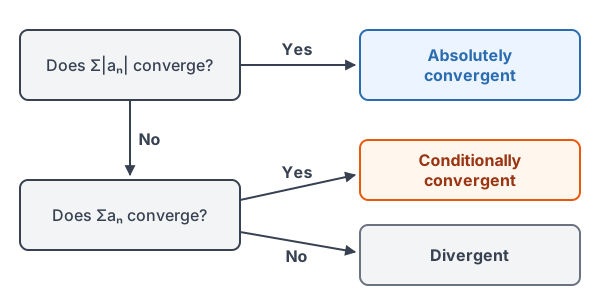
Absolute and conditional convergence examples
Example 1: Absolutely convergent
Classify \sum_{n=1}^{\infty} \dfrac{(-1)^{n+1}}{n^2}.
\left|\dfrac{(-1)^{n+1}}{n^2}\right| = \dfrac{1}{n^2}Take the absolute value; the sign factor has size 1.
\sum \dfrac{1}{n^2} \text{ converges}It is a p-series with p = 2.
Answer: the series converges absolutely.
Example 2: Conditionally convergent
Classify \sum_{n=1}^{\infty} \dfrac{(-1)^{n+1}}{n}.
\sum \left|\dfrac{(-1)^{n+1}}{n}\right| = \sum \dfrac{1}{n} \text{ diverges}The absolute values form the harmonic series.
b_n = \dfrac{1}{n} \to 0 \text{ and } b_n \text{ decreases}Now test the original series with the alternating series test.
\sum \dfrac{(-1)^{n+1}}{n} \text{ converges}Both conditions hold.
Answer: the series converges conditionally.
Example 3: Signs that do not alternate
Does \sum_{n=1}^{\infty} \dfrac{\sin n}{n^2} converge?
\left|\dfrac{\sin n}{n^2}\right| = \dfrac{|\sin n|}{n^2}Take the absolute value. The signs of sin n follow no simple pattern, so the alternating series test cannot be used.
\dfrac{|\sin n|}{n^2} \le \dfrac{1}{n^2}|sin n| is at most 1.
\sum \dfrac{|\sin n|}{n^2} \text{ converges}Direct comparison with the p-series 1/n².
\sum \dfrac{\sin n}{n^2} \text{ converges}Absolute convergence implies convergence.
Answer: the series converges absolutely, so it converges.
Example 4: Divergent
Classify \sum_{n=1}^{\infty} \dfrac{(-1)^n 2n}{n + 3}.
\left|\dfrac{(-1)^n 2n}{n + 3}\right| = \dfrac{2n}{n + 3}Take the absolute value.
\lim_{n \to \infty} \dfrac{2n}{n + 3} = \lim_{n \to \infty} \dfrac{2}{1 + \frac{3}{n}} = 2Divide the top and bottom by n.
\lim_{n \to \infty} a_n \text{ does not exist}The terms swing between values near 2 and −2, so they do not approach 0.
Answer: the series diverges by the divergence test. It is neither absolutely nor conditionally convergent.
Example 5: A bouncing spring (word problem)
A weight on a spring moves up 10 cm, then down 8 cm, then up 6.4 cm, and so on: each move is 0.8 times the one before, in the opposite direction. (a) Where does the weight end up, compared with its start? (b) What total distance does it travel?
10 - 8 + 6.4 - 5.12 + \cdots
(a) The net position is a geometric series with a = 10 and r = −0.8.
\dfrac{10}{1 - (-0.8)} = \dfrac{10}{1.8}|r| is less than 1, so use a/(1 − r) (see infinite geometric series).
\dfrac{10}{1.8} = \dfrac{50}{9} \approx 5.56Simplify.
10 + 8 + 6.4 + 5.12 + \cdots
(b) The distance adds the sizes of the moves: the absolute values.
\dfrac{10}{1 - 0.8} = \dfrac{10}{0.2} = 50Geometric with a = 10 and r = 0.8.
Answer: (a) the weight ends up about 5.56 cm above its start. (b) It travels 50 cm in total. Both series converge, so the motion series converges absolutely: even the total distance is finite.
Common mistakes
| Mistake | Example of the error | Fix |
|---|---|---|
| Thinking conditional convergence means divergence | “\sum |a_n| diverges, so \sum a_n diverges” | Divergence of the absolute values proves nothing about the original series. Test it next. |
| Calling a series absolutely convergent after the alternating series test | “\sum (-1)^n/n passes the alternating series test, so it converges absolutely” | The alternating series test shows only convergence. Check \sum |a_n| separately. |
| Using the alternating series test when signs are irregular | Applying it to \sum \sin n/n^2 | The signs do not strictly alternate. Test \sum |a_n| instead. |
| Forgetting the absolute value inside | Writing |(-1)^n n/(n^2 + 1)| = (-1)^n n/(n^2 + 1) | The absolute value removes the sign factor: n/(n^2 + 1). |
| Rearranging a conditionally convergent series | Regrouping the positive and negative terms of \sum (-1)^{n+1}/n freely | Rearranging can change the sum of a conditionally convergent series. Absolutely convergent series can be rearranged safely. |
| Skipping the divergence check | Calling \sum (-1)^n \frac{2n}{n+3} conditionally convergent | Its terms do not approach 0, so it diverges. |
Related methods
Rearranging terms
If a series converges absolutely, you can add its terms in any order and get the same sum. A conditionally convergent series is fragile: Riemann’s rearrangement theorem says its terms can be reordered to add up to any number you choose, or to diverge.
Ratio and root tests
The ratio test and the root test, coming next in this unit, look at the sizes |a_n|. When they show convergence, they show absolute convergence.
Practice problems
- Classify \sum_{n=1}^{\infty} \dfrac{(-1)^n}{n^3}.
- Classify \sum_{n=1}^{\infty} \dfrac{(-1)^{n+1}}{\sqrt{n}}.
- Classify \sum_{n=1}^{\infty} \dfrac{(-1)^n n}{n^2 + 1}.
- Classify \sum_{n=1}^{\infty} \dfrac{\cos n}{n^{3/2}}.
- Classify \sum_{n=1}^{\infty} \dfrac{(-1)^n (n + 2)}{n + 5}.
- Classify \sum_{n=1}^{\infty} \dfrac{(-1)^{n+1}}{2n + 1}.
- Classify \sum_{n=1}^{\infty} \left(-\tfrac{2}{3}\right)^n.
- Classify \sum_{n=2}^{\infty} \dfrac{(-1)^n}{\ln n}.
- Classify \sum_{n=1}^{\infty} \dfrac{(-1)^n n}{2^n}. (Hint: n \le 1.5^n for n ≥ 1.)
- A stock price changes by +$4, −$2, +$1, −$0.50, and so on, each change half the size of the one before with the opposite sign. Find the net change in price and the total amount of movement.
Show answers
1.
\sum \left|\dfrac{(-1)^n}{n^3}\right| = \sum \dfrac{1}{n^3}Take absolute values.
\sum \dfrac{1}{n^3} \text{ converges}p-series with p = 3.
Answer: converges absolutely
2.
\sum \dfrac{1}{\sqrt{n}} \text{ diverges}The absolute values form a p-series with p = 1/2.
\dfrac{1}{\sqrt{n}} \text{ decreases to } 0The alternating series test applies to the original series.
Answer: converges conditionally
3.
\lim_{n \to \infty} \dfrac{n/(n^2 + 1)}{1/n} = \lim_{n \to \infty} \dfrac{n^2}{n^2 + 1} = 1Limit comparison of the absolute values with the harmonic series (see limit comparison test).
\sum \dfrac{n}{n^2 + 1} \text{ diverges}Because the harmonic series diverges.
\dfrac{n}{n^2 + 1} \text{ decreases to } 0Its derivative check gives (1 − x²)/(x² + 1)² ≤ 0 for x ≥ 1, so the alternating series test applies.
Answer: converges conditionally
4.
\dfrac{|\cos n|}{n^{3/2}} \le \dfrac{1}{n^{3/2}}|cos n| is at most 1.
\sum \dfrac{1}{n^{3/2}} \text{ converges}p-series with p = 3/2.
Answer: converges absolutely
5.
\lim_{n \to \infty} \dfrac{n + 2}{n + 5} = 1The sizes approach 1, not 0.
Answer: diverges by the divergence test
6.
\lim_{n \to \infty} \dfrac{1/(2n + 1)}{1/n} = \lim_{n \to \infty} \dfrac{n}{2n + 1} = \dfrac{1}{2}Limit comparison of the absolute values with 1/n.
\sum \dfrac{1}{2n + 1} \text{ diverges}The harmonic series diverges.
\dfrac{1}{2n + 1} \text{ decreases to } 0The alternating series test applies.
Answer: converges conditionally
7.
\sum \left|\left(-\tfrac{2}{3}\right)^n\right| = \sum \left(\tfrac{2}{3}\right)^nTake absolute values.
\sum \left(\tfrac{2}{3}\right)^n \text{ converges}Geometric with r = 2/3.
Answer: converges absolutely
8.
\dfrac{1}{\ln n} \gt \dfrac{1}{n}ln n < n, so the absolute values are bigger than the harmonic terms.
\sum \dfrac{1}{\ln n} \text{ diverges}Direct comparison with the harmonic series.
\dfrac{1}{\ln n} \text{ decreases to } 0The alternating series test applies.
Answer: converges conditionally
9.
\dfrac{n}{2^n} \le \dfrac{1.5^n}{2^n} = \left(\tfrac{3}{4}\right)^nUse the hint, then simplify the base: 1.5/2 = 3/4.
\sum \left(\tfrac{3}{4}\right)^n \text{ converges}Geometric with r = 3/4.
Answer: converges absolutely
10.
4 - 2 + 1 - 0.5 + \cdots = \dfrac{4}{1 - (-0.5)}Net change: geometric with a = 4 and r = −0.5.
\dfrac{4}{1.5} = \dfrac{8}{3} \approx 2.67Simplify.
4 + 2 + 1 + 0.5 + \cdots = \dfrac{4}{1 - 0.5} = 8Total movement: the absolute values, geometric with r = 0.5.
Answer: the price rises by about $2.67 in total, after $8 of total movement (absolutely convergent)
Absolute and conditional convergence FAQ
What is the difference between absolute and conditional convergence?
A series converges absolutely if it still converges after you make every term positive. It converges conditionally if it converges as written but diverges once every term is made positive.
Does absolute convergence imply convergence?
Yes. If \sum |a_n| converges, then \sum a_n converges too. The reverse is false: \sum (-1)^n/n converges, but \sum 1/n does not.
How do you test for conditional convergence?
First show that \sum |a_n| diverges. Then show that \sum a_n converges, usually with the alternating series test. Both steps are needed.
Is every alternating series that converges conditionally convergent?
No. Some converge absolutely, like \sum (-1)^n/n^2. You must check the absolute values to tell which kind it is.
Summary
- Absolutely convergent: \sum |a_n| converges.
- Conditionally convergent: \sum a_n converges, but \sum |a_n| diverges.
- Absolute convergence implies convergence, so tests for positive series can settle series with any signs.
- Classify by testing \sum |a_n| first, then \sum a_n.
- Only absolutely convergent series can be rearranged without changing the sum.
Previous lesson: Alternating Series Test
Next lesson: Ratio Test
Back to the Calculus 2 Index