
Divergence Test
The divergence test, also called the nth term test, says that if the terms of a series do not approach 0, the series diverges. In symbols, if \lim_{n \to \infty} a_n \neq 0 or the limit does not exist, then \sum a_n diverges. If the limit is 0, the test tells you nothing.
Before this lesson: Infinite Series and Partial Sums, Convergence of Sequences and Limits at Infinity
Why terms that don’t shrink make a series diverge
Suppose the terms of a series settle near 2. Then every new term adds about 2 to the running total. After 100 more terms the total has grown by about 200, and it never stops growing. The partial sums cannot level off.
The same thing happens if the terms keep jumping between two values, such as 1 and −1. Each new term moves the running total by a full unit, so the partial sums keep jumping too.
For the partial sums to level off, the steps between them must shrink to nothing. Those steps are exactly the terms a_n. So a convergent series must have terms that go to 0.
The divergence test
\text{If } \lim_{n \to \infty} a_n \neq 0 \text{ or the limit does not exist, then } \sum_{n=1}^{\infty} a_n \text{ diverges.}Why it works. If \sum a_n converges to S, then S_n \to S and S_{n-1} \to S. Since a_n = S_n - S_{n-1}, the terms go to S - S = 0. So a convergent series always has a_n \to 0. The divergence test is this fact turned around (its contrapositive; see conditional statements).
The one-way warning. If \lim a_n = 0, the series might converge or might diverge. The test is inconclusive, and you need a different test.
How to use the divergence test
- Find \lim_{n \to \infty} a_n, using algebra, limits at infinity or L’Hôpital’s rule.
- If the limit is a nonzero number, or infinite, or does not exist, the series diverges. You are done.
- If the limit is 0, the test is inconclusive. Try another test.
Divergence test examples
Example 1: A rational term with a nonzero limit
Use the divergence test on \sum_{n=1}^{\infty} \dfrac{3n^2 + 1}{5n^2 - 2n}.
\lim_{n \to \infty} \dfrac{3n^2 + 1}{5n^2 - 2n} = \lim_{n \to \infty} \dfrac{3 + \frac{1}{n^2}}{5 - \frac{2}{n}}Divide the top and bottom by n², the highest power.
\lim_{n \to \infty} \dfrac{3 + \frac{1}{n^2}}{5 - \frac{2}{n}} = \dfrac{3 + 0}{5 - 0}1/n² and 2/n go to 0.
\lim_{n \to \infty} a_n = \dfrac{3}{5}Simplify.
\dfrac{3}{5} \neq 0Compare the limit with 0.
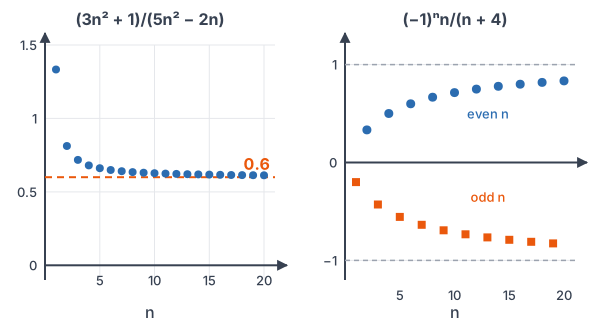
Answer: the terms approach 3/5, not 0, so the series diverges. Adding numbers close to 0.6 forever makes the total grow without bound.
Example 2: Alternating signs
Use the divergence test on \sum_{n=1}^{\infty} \dfrac{(-1)^n n}{n + 4}.
|a_n| = \dfrac{n}{n + 4}Look at the size of each term; (−1)ⁿ only changes the sign.
\lim_{n \to \infty} \dfrac{n}{n + 4} = \lim_{n \to \infty} \dfrac{1}{1 + \frac{4}{n}}Divide the top and bottom by n.
\lim_{n \to \infty} \dfrac{1}{1 + \frac{4}{n}} = 14/n goes to 0.
a_{2k} \to 1 \text{ and } a_{2k+1} \to -1Even-numbered terms are positive and odd-numbered terms are negative.
\lim_{n \to \infty} a_n \text{ does not exist}The terms do not approach one number.
Answer: the limit of the terms does not exist, so it is not 0, and the series diverges. The partial sums keep swinging by almost 1 each step.
Example 3: When the test is inconclusive
Use the divergence test on (a) \sum_{n=1}^{\infty} \dfrac{1}{n} and (b) \sum_{n=1}^{\infty} \dfrac{1}{n^2}.
\lim_{n \to \infty} \dfrac{1}{n} = 0(a) The denominator grows without bound.
\lim_{n \to \infty} \dfrac{1}{n^2} = 0(b) The denominator grows even faster.
\text{Both limits are } 0So the divergence test says nothing about either series.
Answer: the test is inconclusive for both. In fact, (a) diverges and (b) converges. Later lessons in this unit prove both facts with the integral test and p-series. This example is why a limit of 0 never proves convergence.
Example 4: A limit that needs L’Hôpital’s rule
Use the divergence test on \sum_{n=1}^{\infty} n\sin\left(\dfrac{1}{n}\right).
n\sin\left(\dfrac{1}{n}\right) = \dfrac{\sin\left(\frac{1}{n}\right)}{\frac{1}{n}}Rewrite the product as a quotient.
t = \dfrac{1}{n},\ t \to 0^+ \text{ as } n \to \inftySubstitute t = 1/n; as n grows, t shrinks toward 0.
\lim_{t \to 0^+} \dfrac{\sin t}{t} \text{ has the form } \dfrac{0}{0}Both sin t and t go to 0 (see indeterminate forms).
\lim_{t \to 0^+} \dfrac{\sin t}{t} = \lim_{t \to 0^+} \dfrac{\cos t}{1}Apply L’Hôpital’s rule: the derivative of sin t is cos t (see derivatives of trig functions).
\lim_{t \to 0^+} \dfrac{\cos t}{1} = \cos 0 = 1Substitute t = 0.
\lim_{n \to \infty} n\sin\left(\dfrac{1}{n}\right) = 1 \neq 0Return to n.
Answer: the terms approach 1, so the series diverges. For example, the 10th term is 10 sin(0.1) ≈ 0.998.
Example 5: Weekly donations (word problem)
A bakery donates bread to a food bank every week. In week n it donates \dfrac{200n}{n + 10} loaves. Will the total number of loaves donated stay below some fixed number, no matter how many weeks go by?
\sum_{n=1}^{\infty} \dfrac{200n}{n + 10}The total donated over all weeks is this series.
\lim_{n \to \infty} \dfrac{200n}{n + 10} = \lim_{n \to \infty} \dfrac{200}{1 + \frac{10}{n}}Divide the top and bottom by n.
\lim_{n \to \infty} \dfrac{200}{1 + \frac{10}{n}} = 20010/n goes to 0.
200 \neq 0
The weekly donation approaches 200 loaves, not 0.
\sum_{n=1}^{\infty} \dfrac{200n}{n + 10} \text{ diverges}Apply the divergence test.
Answer: no. The weekly donation climbs toward 200 loaves (about 18 in week 1, 100 in week 10 and 190 in week 190), so the total keeps growing without bound.
Common mistakes
| Mistake | Example of the error | Fix |
|---|---|---|
| Using the test to prove convergence | “1/n \to 0, so \sum 1/n converges” | A limit of 0 means the test is inconclusive. The harmonic series \sum 1/n actually diverges. |
| Taking the limit of the partial sums instead of the terms | Finding \lim S_n and calling it the divergence test | The divergence test looks only at \lim a_n, the limit of the terms. |
| Ignoring the sign factor | Saying (-1)^n n/(n + 4) \to 1 | With (−1)ⁿ the terms jump between values near 1 and −1, so the limit does not exist. The series still diverges. |
| Using the size trick with a nonzero limit backward | “|a_n| \to 0 fails, so the test is inconclusive” | If |a_n| approaches a nonzero number, a_n cannot approach 0, so the series diverges. |
| Stopping at a 0/0 form | “n \sin(1/n) has the form ∞ · 0, so it goes to 0” | Rewrite the indeterminate form and evaluate it. Here the limit is 1. |
| Saying a series converges to the limit of its terms | “\sum \frac{3n^2 + 1}{5n^2 - 2n} = \frac{3}{5}” | 3/5 is the limit of the terms. The series itself diverges. |
Related methods
Why the harmonic series diverges
The harmonic series 1 + \tfrac{1}{2} + \tfrac{1}{3} + \tfrac{1}{4} + \cdots passes the 0 limit but still diverges. Group its terms: \tfrac{1}{3} + \tfrac{1}{4} \gt \tfrac{1}{4} + \tfrac{1}{4} = \tfrac{1}{2}, and \tfrac{1}{5} + \cdots + \tfrac{1}{8} \gt 4 \cdot \tfrac{1}{8} = \tfrac{1}{2}. Each new group adds more than 1/2, so the partial sums grow without bound, just very slowly.
What to try when the limit is 0
When the terms go to 0, use a test that measures how fast they shrink. Telescoping series, the integral test, p-series and the comparison tests come next in this unit.
Practice problems
- Use the divergence test on \sum_{n=1}^{\infty} \dfrac{4n - 1}{7n + 2}.
- Use the divergence test on \sum_{n=1}^{\infty} \dfrac{n^2}{n^3 + 1}.
- Use the divergence test on \sum_{n=1}^{\infty} (-1)^n.
- Use the divergence test on \sum_{n=1}^{\infty} \dfrac{2^n}{3 \cdot 2^n + 5}.
- Use the divergence test on \sum_{n=1}^{\infty} \dfrac{\ln n}{n}.
- Use the divergence test on \sum_{n=1}^{\infty} \cos\left(\dfrac{1}{n}\right).
- Use the divergence test on \sum_{n=1}^{\infty} \left(1 + \dfrac{2}{n}\right)^n.
- Use the divergence test on \sum_{n=1}^{\infty} \dfrac{n}{\sqrt{n^2 + 9}}.
- Use the divergence test on \sum_{n=1}^{\infty} \arctan n.
- A leaking tank loses 3 + \dfrac{1}{n} liters of water in minute n. The tank starts with 1000 liters. Explain why the tank must eventually run dry.
Show answers
1.
\lim_{n \to \infty} \dfrac{4n - 1}{7n + 2} = \lim_{n \to \infty} \dfrac{4 - \frac{1}{n}}{7 + \frac{2}{n}}Divide the top and bottom by n.
\lim_{n \to \infty} \dfrac{4 - \frac{1}{n}}{7 + \frac{2}{n}} = \dfrac{4}{7}1/n and 2/n go to 0.
\dfrac{4}{7} \neq 0Compare with 0.
Answer: the series diverges
2.
\lim_{n \to \infty} \dfrac{n^2}{n^3 + 1} = \lim_{n \to \infty} \dfrac{\frac{1}{n}}{1 + \frac{1}{n^3}}Divide the top and bottom by n³.
\lim_{n \to \infty} \dfrac{\frac{1}{n}}{1 + \frac{1}{n^3}} = \dfrac{0}{1} = 01/n and 1/n³ go to 0.
Answer: the limit is 0, so the test is inconclusive (this series actually diverges, as a later comparison test shows)
3.
a_n = 1 \text{ for even } n,\ a_n = -1 \text{ for odd } nThe terms alternate between 1 and −1.
\lim_{n \to \infty} (-1)^n \text{ does not exist}The terms never settle on one number.
Answer: the series diverges
4.
\dfrac{2^n}{3 \cdot 2^n + 5} = \dfrac{1}{3 + \frac{5}{2^n}}Divide the top and bottom by 2ⁿ.
\lim_{n \to \infty} \dfrac{5}{2^n} = 02ⁿ grows without bound.
\lim_{n \to \infty} a_n = \dfrac{1}{3 + 0} = \dfrac{1}{3}Substitute the limit.
Answer: the limit is 1/3, not 0, so the series diverges
5.
\lim_{x \to \infty} \dfrac{\ln x}{x} \text{ has the form } \dfrac{\infty}{\infty}Replace n with x to use L’Hôpital’s rule.
\lim_{x \to \infty} \dfrac{\ln x}{x} = \lim_{x \to \infty} \dfrac{1/x}{1}Apply L’Hôpital’s rule: the derivative of ln x is 1/x (see derivatives of logarithmic functions).
\lim_{x \to \infty} \dfrac{1}{x} = 01/x shrinks toward 0.
Answer: the limit is 0, so the test is inconclusive (this series actually diverges)
6.
\lim_{n \to \infty} \dfrac{1}{n} = 0Find the limit of the inside.
\lim_{n \to \infty} \cos\left(\dfrac{1}{n}\right) = \cos 0Cosine is continuous, so take the limit inside (see continuity).
\cos 0 = 1
Evaluate.
Answer: the limit is 1, not 0, so the series diverges
7.
\ln a_n = n\ln\left(1 + \dfrac{2}{n}\right) = \dfrac{\ln\left(1 + \frac{2}{n}\right)}{\frac{1}{n}}Take the natural log and rewrite as a quotient, which has the form 0/0 (see properties of logarithms).
\lim_{x \to \infty} \dfrac{\ln\left(1 + \frac{2}{x}\right)}{\frac{1}{x}} = \lim_{x \to \infty} \dfrac{\dfrac{-2/x^2}{1 + 2/x}}{-1/x^2}Apply L’Hôpital’s rule, with the chain rule on top.
\lim_{x \to \infty} \dfrac{\dfrac{-2/x^2}{1 + 2/x}}{-1/x^2} = \lim_{x \to \infty} \dfrac{2}{1 + \frac{2}{x}} = 2Simplify, then let 2/x go to 0.
\lim_{n \to \infty} a_n = e^2ln aₙ goes to 2, so aₙ goes to e².
Answer: the limit is e² ≈ 7.39, not 0, so the series diverges
8.
\dfrac{n}{\sqrt{n^2 + 9}} = \dfrac{1}{\sqrt{1 + \frac{9}{n^2}}}Divide the top and bottom by n; inside the root, divide by n².
\lim_{n \to \infty} \dfrac{1}{\sqrt{1 + \frac{9}{n^2}}} = \dfrac{1}{\sqrt{1}} = 19/n² goes to 0.
Answer: the limit is 1, not 0, so the series diverges
9.
\lim_{n \to \infty} \arctan n = \dfrac{\pi}{2}The graph of arctan x levels off at π/2 (see inverse trig functions).
\dfrac{\pi}{2} \neq 0Compare with 0.
Answer: the series diverges
10.
\sum_{n=1}^{\infty} \left(3 + \dfrac{1}{n}\right)The total water lost over all minutes is this series.
\lim_{n \to \infty} \left(3 + \dfrac{1}{n}\right) = 31/n goes to 0.
3 \neq 0
The loss per minute approaches 3 liters, not 0.
\sum_{n=1}^{\infty} \left(3 + \dfrac{1}{n}\right) \text{ diverges}By the divergence test, the total loss grows without bound.
3 + \dfrac{1}{n} \gt 3 \text{, so } S_n \gt 3nEach minute loses more than 3 liters.
3n \ge 1000 \text{ when } n \ge 334Divide 1000 by 3 and round up.
Answer: the total loss grows without bound, so the tank runs dry; since more than 3 liters leak every minute, it is empty within 334 minutes
Divergence test FAQ
What does the divergence test say?
If the terms of a series do not approach 0, the series diverges. If the terms do approach 0, the test gives no answer.
Is the divergence test the same as the nth term test?
Yes. Both names refer to the same test, because it looks at the limit of the nth term, a_n. Some books call it the test for divergence.
Can the divergence test prove that a series converges?
No. It can only prove divergence. The harmonic series \sum 1/n has terms that go to 0, yet it diverges.
What should I do if the limit of the terms is 0?
Use another test, such as the integral test, a comparison test, the ratio test or a p-series check. A limit of 0 is required for convergence, but it is not enough.
Summary
- If \lim a_n \neq 0 or the limit does not exist, then \sum a_n diverges.
- If \lim a_n = 0, the divergence test is inconclusive.
- It works because a convergent series has a_n = S_n - S_{n-1} \to S - S = 0.
- Use limits at infinity or L’Hôpital’s rule to find the limit of the terms.
- The harmonic series shows that terms going to 0 do not guarantee convergence.
Previous lesson: Infinite Series and Partial Sums
Next lesson: Telescoping Series
Back to the Calculus 2 Index